Stratégie de cassure de prix basée sur le score standard

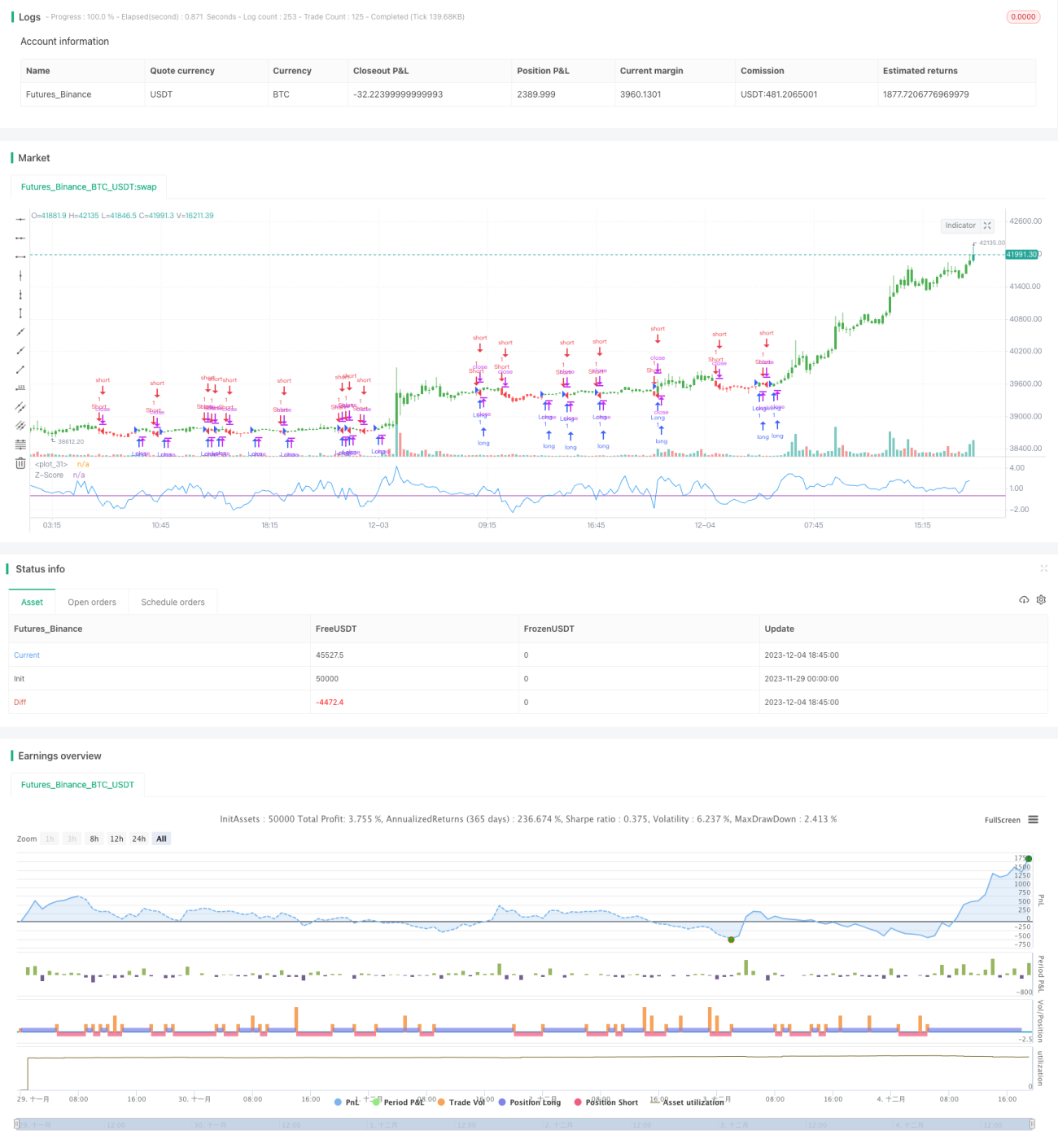
Aperçu
La stratégie de breakout avec le score Z (Z-Score Price Breakout Strategy) utilise le score Z du prix pour déterminer si le prix actuel est dans un état anormal, générant ainsi des signaux de trading. Lorsque le score Z du prix dépasse un seuil positif ou négatif, cela indique que le prix est entré dans un état anormal, ce qui peut déclencher une opération d'achat (long) ou de vente (short).
Principe de la stratégie
L'indicateur central de cette stratégie est le score Z (Z-Score) du prix, calculé comme suit :
Z_score = (C - SMA(n)) / StdDev(C,n)
Où C est le prix de clôture, SMA(n) la moyenne mobile simple sur n périodes, et StdDev(C,n) l'écart type du prix de clôture sur n périodes.
Le score Z reflète l'écart entre le prix actuel et le prix moyen. Lorsque le score Z est supérieur à un certain seuil positif (par exemple +2), le prix actuel est supérieur à la moyenne de 2 écarts types, ce qui correspond à un niveau élevé. Lorsqu'il est inférieur à un seuil négatif (par exemple -2), le prix actuel est inférieur à la moyenne de 2 écarts types, ce qui correspond à un niveau bas.
La stratégie calcule d'abord le score Z du prix, puis définit un seuil positif et un seuil négatif (par exemple 0 et 0). Lorsque le score Z dépasse le seuil positif, un signal d'achat est généré ; lorsqu'il est inférieur au seuil négatif, un signal de vente est généré.
Avantages
- Utiliser le score Z du prix pour identifier les anomalies de prix est une méthode quantitative courante et efficace.
- Permet de réaliser facilement des opérations bidirectionnelles (long et short).
- Paramétrage flexible : période, seuils, etc. peuvent être ajustés.
- Peut être combiné avec d'autres indicateurs pour former un système de trading.
Risques
- La stratégie basée sur le score Z est relativement grossière et peut générer de faux signaux.
- Nécessite un réglage approprié des paramètres tels que la période et les seuils.
- Il est impératif de considérer une stratégie de stop-loss pour contrôler les risques.
Pistes d'optimisation
- Optimiser le paramètre de période pour trouver la période optimale.
- Optimiser les seuils positif et négatif pour réduire les faux signaux.
- Ajouter des filtres supplémentaires, par exemple en combinant avec d'autres indicateurs.
- Intégrer une stratégie de stop-loss.
Résumé
La stratégie de breakout avec le score Z détermine si le prix actuel est dans un état anormal et effectue des transactions en fonction du signe du score Z. Cette stratégie est simple à mettre en œuvre, permet des opérations bidirectionnelles, mais comporte certains risques. Grâce à l'optimisation des paramètres et à l'ajout de stops, elle peut être renforcée et combinée avec d'autres indicateurs pour former un système de trading quantitatif complet.
/*backtest
start: 2023-11-29 00:00:00
end: 2023-12-04 19:00:00
period: 15m
basePeriod: 5m
exchanges: [{"eid":"Futures_Binance","currency":"BTC_USDT"}]
*/

//@version=2
////////////////////////////////////////////////////////////
//  Copyright by HPotter v1.0 18/01/2017
// The author of this indicator is Veronique Valcu. The z-score (z) for a data - 1