Stratégie d'indicateur de momentum RSI/MFI basée sur la théorie de Dow


Date de création: 2023-12-12 17:54:58 Dernière modification: 2023-12-12 17:54:58
Copier: 0 Nombre de clics: 774
1
Suivre
1621
Abonnés

Stratégie d’indicateur de momentum RSI/MFI basée sur la théorie de Dow

Aperçu

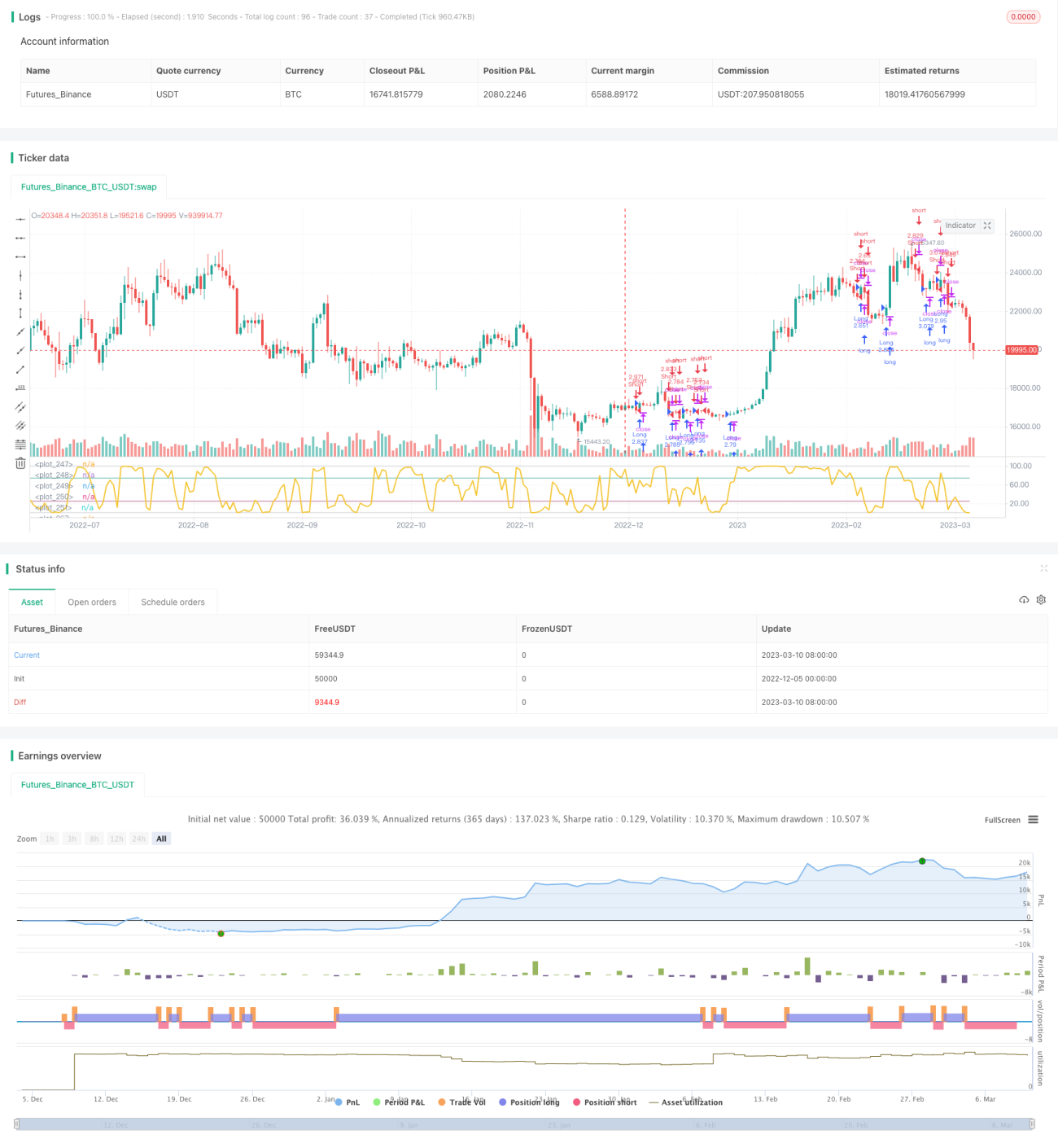
Cette stratégie utilise l’indicateur de force relative (RSI) ou l’indicateur de flux de trésorerie (MFI) pour déterminer si le marché est haussier ou baissier et, combiné au coefficient de hausse et de baisse de la théorie Dow, pour calculer la distribution de probabilité ajustée. Selon les différents types de marché, différentes logiques d’entrée et de sortie sont utilisées.

Principe de stratégie

  1. Calculer le RSI ou MFI pour déterminer l’état actuel du marché (bull ou bear)
  2. Coefficient de Dow pour calculer le coefficient de Bull et de Bear, qui reflète la corrélation entre les prix actuels et le volume des transactions
  3. Ajuster la distribution de probabilité RSI/MFI pour déterminer une distribution plus large avec précision
  4. Déterminer si une session est acceptée en fonction de l’identifiant de session et de la probabilité
  5. Stop loss lorsque les bénéfices sont retirés ou que le marché se calme

Analyse des avantages

  1. La théorie de la dynamique, combinée à la théorie de la dynamique, permet d’évaluer plus précisément le type de marché.
  2. Éviter l’admission à l’aveugle en tenant compte des facteurs d’ajustement
  3. Haute marge bénéficiaire, bas retrait

Analyse des risques

  1. Les paramètres ne sont pas à la bonne heure, cela peut entraîner de nombreuses erreurs de jugement
  2. Il faut un soutien historique suffisant.
  3. La logique d’arrêt des pertes est simple et ne peut pas être optimisée pour des situations spécifiques.

Direction d’optimisation

  1. Il est possible de considérer d’autres indicateurs pour juger de la session de marché.
  2. Ajout de logiques de stop-loss plus rigoureuses basées sur la volatilité et les données historiques
  3. Vous pouvez essayer d’identifier de meilleurs paramètres avec l’apprentissage automatique.

Résumer

Cette stratégie est généralement bien testée et a une certaine valeur de combat. Cependant, des tests et des ajustements supplémentaires sont nécessaires, en particulier la logique d’arrêt des pertes. L’utilisation d’indicateurs d’aide au jugement est plus efficace et ne peut pas être suivie à l’aveugle.

Code source de la stratégie
/*backtest
start: 2022-12-05 00:00:00
end: 2023-03-11 00:00:00
period: 1d
basePeriod: 1h
exchanges: [{"eid":"Futures_Binance","currency":"BTC_USDT"}]
*/

//@version=4

//MIT License

//Copyright (c) 2019 user-Noldo

//Permission is hereby granted, free of charge, to any person obtaining a copy
//of this software and associated documentation files (the "Software"), to deal
//in the Software without restriction, including without limitation the rights
//to use, copy, modify, merge, publish, distribute, sublicense, and/or sell
//copies of the Software, and to permit persons to whom the Software is
//furnished to do so, subject to the following conditions:

//The above copyright notice and this permission notice shall be included in all
//copies or substantial portions of the Software.

//THE SOFTWARE IS PROVIDED "AS IS", WITHOUT WARRANTY OF ANY KIND, EXPRESS OR
//IMPLIED, INCLUDING BUT NOT LIMITED TO THE WARRANTIES OF MERCHANTABILITY,
//FITNESS FOR A PARTICULAR PURPOSE AND NONINFRINGEMENT. IN NO EVENT SHALL THE
//AUTHORS OR COPYRIGHT HOLDERS BE LIABLE FOR ANY CLAIM, DAMAGES OR OTHER
//LIABILITY, WHETHER IN AN ACTION OF CONTRACT, TORT OR OTHERWISE, ARISING FROM,
//OUT OF OR IN CONNECTION WITH THE SOFTWARE OR THE USE OR OTHER DEALINGS IN THE
//SOFTWARE.


strategy("Dow Factor RSI/MFI and Dependent Variable Odd Generator Strategy",shorttitle = "Dow_Factor RSI/MFI & DVOG Strategy", overlay = false, default_qty_type=strategy.percent_of_equity,commission_type=strategy.commission.percent, commission_value=0.125, default_qty_value=100 )
src = close 
lights          = input(title="Barcolor I / 0 ? ", options=["ON", "OFF"], defval="OFF")
method          = input(title="METHOD", options=["MFI", "RSI"], defval="RSI")

length = input(5, minval=2,maxval = 14, title = "Strategy Period")

// Essential Functions 

// Function Sum 

f_sum(_src , _length) => 

    _output  = 0.00 
    
    _length_adjusted = _length < 1 ? 1 : _length
    
    for i = 0 to _length_adjusted-1
        _output := _output + _src[i]


f_sma(_src, _length)=>
    _length_adjusted = _length < 1 ? 1 : _length
    float _sum = 0
    for _i = 0 to (_length_adjusted - 1)
        _sum := _sum + _src[_i]
    _return = _sum / _length_adjusted
   

// Unlocked Exponential Moving Average Function

f_ema(_src, _length)=>
    _length_adjusted = _length < 1 ? 1 : _length
    _multiplier = 2 / (_length_adjusted + 1)
    _return  = 0.00
    _return := na(_return[1]) ? _src : ((_src - _return[1]) * _multiplier) + _return[1]


// Function Standard Deviation

f_stdev(_src,_length) =>

    float _output = na 
    _length_adjusted = _length < 2 ? 2 : _length
    _avg  = f_ema(_src , _length_adjusted)
    evar  = (_src - _avg) * (_src - _avg)
    evar2 = ((f_sum(evar,_length_adjusted))/_length_adjusted)
    
    _output := sqrt(evar2)


// Linear Regression Channels : 

f_pearson_corr(_src1, _src2, _length) =>

    _length_adjusted = _length < 2 ? 2 : _length
    _ema1 = f_ema(_src1, _length_adjusted)
    _ema2 = f_ema(_src2, _length_adjusted)
    isum = 0.0
    for i = 0 to _length_adjusted - 1
        isum := isum + (_src1[i] - _ema1) * (_src2[i] - _ema2)
    isumsq1 = 0.0
    for i = 0 to _length_adjusted - 1
        isumsq1 := isumsq1 + pow(_src1[i] - _ema1, 2)
    isumsq2 = 0.0
    for i = 0 to _length_adjusted - 1
        isumsq2 := isumsq2 + pow(_src2[i] - _ema2, 2)
    pcc = isum/(sqrt(isumsq1*isumsq2))
    pcc


// Dow Theory Cycles 


dow_coeff = f_pearson_corr(src,volume,length)

dow_bull_factor = (1 + dow_coeff)
dow_bear_factor = (1 - dow_coeff)


// MONEY FLOW INDEX =====> FOR BULL OR BEAR MARKET (CLOSE)


upper_s = f_sum(volume * (change(src) <= 0 ? 0 : src), length)
lower_s = f_sum(volume * (change(src) >= 0 ? 0 : src), length)

_market_index = rsi(upper_s, lower_s)


// RSI (Close)

// Function RMA 

f_rma(_src, _length) =>
    _length_adjusted = _length < 1 ? 1 : _length
    alpha = _length_adjusted
    sum = 0.0
    sum := (_src + (alpha - 1) * nz(sum[1])) / alpha


// Function Relative Strength Index (RSI)

f_rsi(_src, _length) => 

    _output = 0.00 
    _length_adjusted = _length < 0 ? 0 : _length

    u = _length_adjusted < 1 ? max(_src - _src[_length_adjusted], 0) : max(_src - _src[1] , 0) // upward change
    d = _length_adjusted < 1 ? max(_src[_length_adjusted] - _src, 0) : max(_src[1] - _src , 0) // downward change
    rs = f_rma(u, _length) / f_rma(d, _length)
    res = 100 - 100 / (1 + rs)
    res


_rsi = f_rsi(src, length)


// Switchable Method Codes 

_method = 0.00 


if (method=="MFI")

    _method:= _market_index 
    
if (method=="RSI")

    _method:= _rsi   


// Conditions  

_bull_gross  = (_method )
_bear_gross  = (100 - _method )

_price_stagnant = ((_bull_gross * _bear_gross ) / 100)
_price_bull     =  (_bull_gross - _price_stagnant) 
_price_bear     =  (_bear_gross - _price_stagnant) 


_coeff_price = (_price_stagnant + _price_bull + _price_bear) / 100 

_bull     = _price_bull / _coeff_price 
_bear     = _price_bear / _coeff_price 
_stagnant = _price_stagnant / _coeff_price


// Market Types with Dow Factor

_temp_bull_gross     =  _bull     * dow_bull_factor       

_temp_bear_gross     =  _bear     * dow_bear_factor 


// Addition : Odds with Stagnant Market 


_coeff_normal = (_temp_bull_gross + _temp_bear_gross) / 100


// ********* OUR RSI / MFI VALUE ***********

_value        = _temp_bull_gross / _coeff_normal


// Temporary Pure Odds 

_temp_stagnant = ((_temp_bull_gross * _temp_bear_gross) / 100)
_temp_bull     = _temp_bull_gross - _temp_stagnant 
_temp_bear     = _temp_bear_gross - _temp_stagnant 


// Now we ll do venn scheme (Probability Cluster)
// Pure Bull + Pure Bear + Pure Stagnant = 100 
// Markets will get their share in the Probability Cluster 

 
_coeff = (_temp_stagnant + _temp_bull + _temp_bear) / 100

_odd_bull     = _temp_bull / _coeff
_odd_bear     = _temp_bear / _coeff
_odd_stagnant = _temp_stagnant / _coeff


_positive_condition     = crossover (_value,50)
_negative_condition     = crossunder(_value,50)
_stationary_condition   = ((_odd_stagnant > _odd_bull ) and (_odd_stagnant > _odd_bear))


// Strategy 

closePosition = _stationary_condition


if (_positive_condition)
    strategy.entry("Long", strategy.long, comment="Long")
    
strategy.close(id = "Long", when = closePosition )

if (_negative_condition)
    strategy.entry("Short", strategy.short, comment="Short")
    
strategy.close(id = "Short", when = closePosition )    


// Plot Data

// Plotage 

oversold   = input(25 , type = input.integer , title = "Oversold")   
overbought = input(75 , type = input.integer , title = "Overbought") 

zero    = 0 
hundred = 100
limit   = 50

// Plot Data 

stagline       = hline(limit      , color=color.new(color.white,0)   , linewidth=1, editable=false)
zeroline       = hline(zero       , color=color.new(color.silver,100), linewidth=0, editable=false)
hundredline    = hline(hundred    , color=color.new(color.silver,100), linewidth=0, editable=false)
oversoldline   = hline(oversold   , color=color.new(color.silver,100), linewidth=0, editable=false)
overboughtline = hline(overbought , color=color.new(color.silver,100), linewidth=0, editable=false)

// Filling Borders

fill(zeroline       , oversoldline   , color=color.maroon  , transp=88 , title = "Oversold Area")
fill(oversoldline   , stagline       , color=color.red     , transp=80 , title = "Bear Market")
fill(stagline       , overboughtline , color=color.green   , transp=80 , title = "Bull Market")
fill(overboughtline , hundredline    , color=color.teal    , transp=88 , title = "Overbought Market")


// Plot DOW Factor Methods

plot(_value, color = #F4C430 , linewidth = 2 , title = "DOW F-RSI" , transp = 0)

// Plot border lines

plot(oversold  ,style = plot.style_line,color = color.new(color.maroon,30),linewidth = 1)
plot(overbought,style = plot.style_line,color = color.new(color.teal,30)  ,linewidth = 1)


plot(zero     ,style = plot.style_line , color = color.new(color.silver,30) , linewidth = 1 ,editable = false)
plot(hundred  ,style = plot.style_line , color = color.new(color.silver,30) , linewidth = 1 ,editable = false)


// Switchable Barcolor ( On / Off)

_lights = 0.00 


if (lights=="ON")

    _lights:= 1.00
    
if (lights=="OFF")

    _lights:= -1.00   


bcolor_on  = _lights ==  1.00
bcolor_off = _lights == -1.00


barcolor((_positive_condition and bcolor_on)    ? color.green : (_negative_condition and bcolor_on) ? color.red : 
          (_stationary_condition and bcolor_on) ? color.yellow : na)


// Alerts 

alertcondition(_positive_condition , title='Strong Buy !', message='Strong Buy Signal ')
alertcondition(crossover(_value,overbought) , title='Gradual Buy', message='Gradual Buy Signal')
alertcondition(crossover(_value,oversold)   , title='Gradual Buy', message='Gradual Buy Signal')

alertcondition(crossunder(_value,overbought) , title='Gradual Sell', message='Gradual Sell Signal')
alertcondition(crossunder(_value,oversold)   , title='Gradual Sell', message='Gradual Sell Signal')

alertcondition(_negative_condition , title='Strong Sell !', message='Strong Sell Signal ')