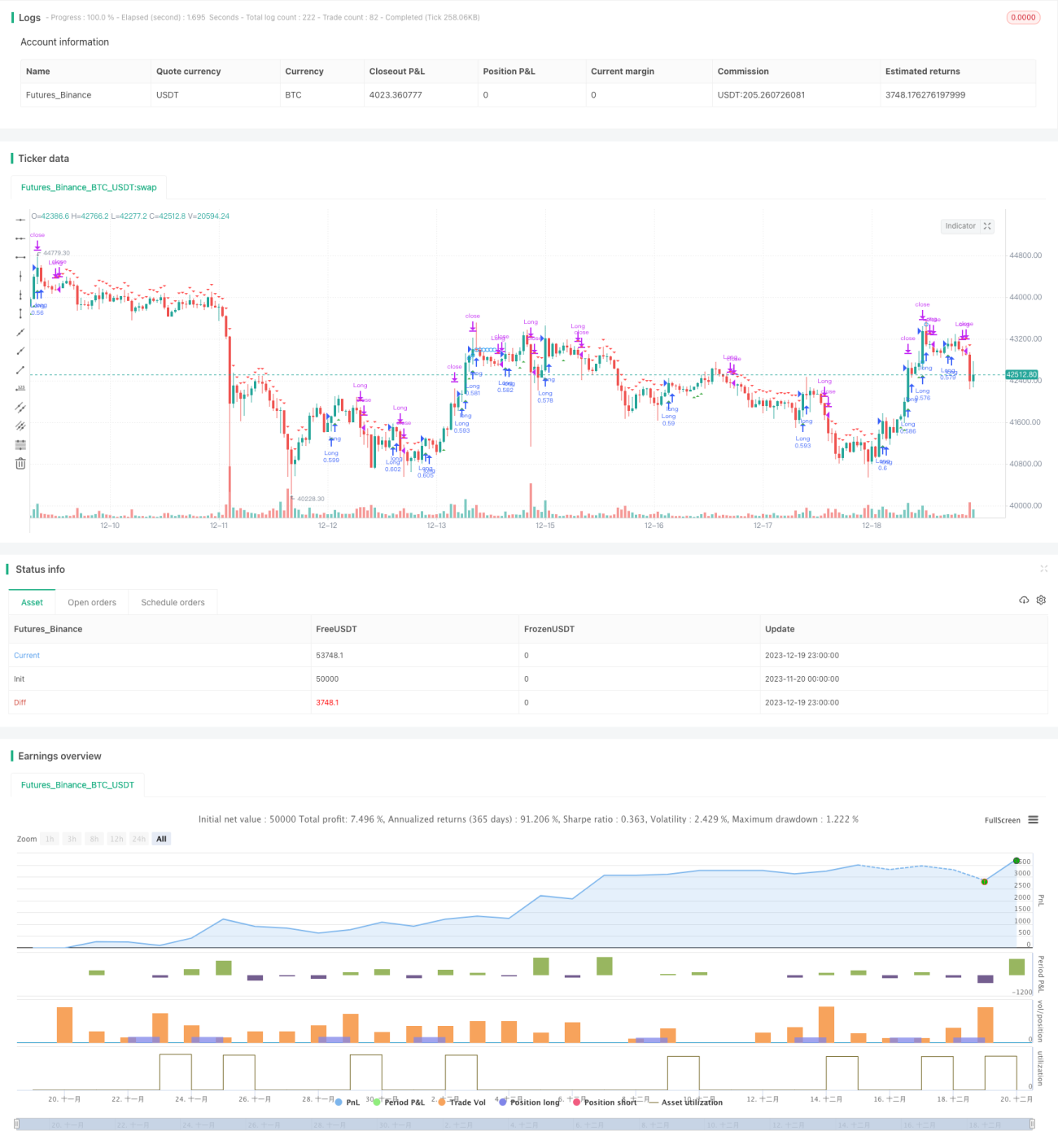
Cette stratégie est une stratégie de trading quantitatif de MACD à double orbite inverse. Elle s’appuie sur les indicateurs techniques décrits par William Blau dans son livre Momentum, Direction et Divergence, et s’étend sur cette base.
La clé de la stratégie est le signal de transaction inverse, c’est-à-dire la relation entre xmacd et xMA_MACD, par opposition à l’indicateur MACD classique, d’où le nom de l’aiguille MACD inverse.
En outre, la stratégie introduit un filtre de tendance. Lorsque plusieurs signaux sont émis, un filtre de tendance bullish est configuré pour détecter si le prix est en hausse; de même, un signal de courbe détecte une tendance à la baisse. Les indicateurs RSI et MFI peuvent également être utilisés pour filtrer la configuration du signal.
Le plus grand avantage de cette stratégie réside dans la fonctionnalité de rétro-mesure. Vous pouvez choisir différentes variétés de transactions, définir un intervalle de temps de rétro-mesure et optimiser la stratégie pour les données de variétés spécifiques. Comparé à la simple stratégie MACD, il ajoute des jugements de tendance, de survente et de survente, et peut filtrer certains signaux de contrepartie.
Le risque de cette stratégie est principalement lié à l’idée d’un trading à l’envers. Les signaux à l’envers, bien que permettant d’obtenir des opportunités, signifient également de renoncer à certains points de vente ou de vente traditionnels du MACD, ce qui doit être évalué avec prudence. De plus, le MACD lui-même est sujet à de multiples faux signaux.
Pour réduire le risque, il est possible d’ajuster les paramètres de manière appropriée, en optimisant la longueur des moyennes mobiles; en combinant les filtres de tendance et d’indicateur, en évitant de générer des signaux sur des marchés en crise; en augmentant de manière appropriée la distance d’arrêt pour assurer le contrôle des pertes de chaque transaction.
Cette stratégie peut être optimisée dans les domaines suivants:
La stratégie de quantification MACD inverse bi-orbitale s’inspire de l’idée de l’indicateur MACD classique, sur laquelle elle a été étendue et améliorée. La stratégie présente des avantages tels que la configuration flexible des paramètres, le choix d’un riche mécanisme de filtrage et une puissante fonction de rétroaction. Cela lui permet d’optimiser la personnalisation pour différentes variétés de transactions et constitue une stratégie de trading quantifié potentielle qui mérite d’être explorée.
/*backtest
start: 2023-11-20 00:00:00
end: 2023-12-20 00:00:00
period: 1h
basePeriod: 15m
exchanges: [{"eid":"Futures_Binance","currency":"BTC_USDT"}]
*/
//@version = 3
////////////////////////////////////////////////////////////
// Copyright by HPotter v1.0 09/12/2016
// This is one of the techniques described by William Blau in his book
// "Momentum, Direction and Divergence" (1995). If you like to learn more,
// we advise you to read this book. His book focuses on three key aspects
// of trading: momentum, direction and divergence. Blau, who was an electrical
// engineer before becoming a trader, thoroughly examines the relationship
// between price and momentum in step-by-step examples. From this grounding,
// he then looks at the deficiencies in other oscillators and introduces some
// innovative techniques, including a fresh twist on Stochastics. On directional
// issues, he analyzes the intricacies of ADX and offers a unique approach to help
// define trending and non-trending periods.
// Blau`s indicator is like usual MACD, but it plots opposite of meaningof
// stndard MACD indicator.
//
// You can change long to short in the Input Settings
// Please, use it only for learning or paper trading. Do not for real trading.
//
//
// 2018-09 forked by Khalid Salomão
// - Backtesting
// - Added filters: RSI, MFI, Price trend
// - Trailing Stop Loss
// - Other minor adjustments
//
////////////////////////////////////////////////////////////
strategy(title="Ergotic MACD Backtester [forked from HPotter]", shorttitle="Ergotic MACD Backtester", overlay=true, pyramiding=0, default_qty_type=strategy.cash, default_qty_value=25000, initial_capital=50000, commission_type=strategy.commission.percent, commission_value=0.15, slippage=3)
// === BACKTESTING: INPUT BACKTEST RANGE ===
source = input(close)
strategyType = input(defval="Long Only", options=["Long & Short", "Long Only", "Short Only"])
FromMonth = input(defval = 7, title = "From Month", minval = 1, maxval = 12)
FromDay = input(defval = 1, title = "From Day", minval = 1, maxval = 31)
FromYear = input(defval = 2018, title = "From Year", minval = 2017)
ToMonth = input(defval = 12, title = "To Month", minval = 1, maxval = 12)
ToDay = input(defval = 1, title = "To Day", minval = 1, maxval = 31)
ToYear = input(defval = 2030, title = "To Year", minval = 2017)
start = timestamp(FromYear, FromMonth, FromDay, 00, 00)
finish = timestamp(ToYear, ToMonth, ToDay, 23, 59)
window() => true // window of time verification
// === STRATEGY ===
r = input(144, minval=1, title="R (32,55,89,100,144,200)") // default 32
slowMALen = input(6, minval=1) // default 32
signalLength = input(6, minval=1)
reverse = input(false, title="Trade reverse (long/short switch)")
//hline(0, color=blue, linestyle=line)
fastMA = ema(source, r)
slowMA = ema(source, slowMALen)
xmacd = fastMA - slowMA
xMA_MACD = ema(xmacd, signalLength)
pos = 0
pos := iff(xmacd < xMA_MACD, 1,
iff(xmacd > xMA_MACD, -1, nz(pos[1], 0)))
possig = 0
possig := iff(reverse and pos == 1, -1,
iff(reverse and pos == -1, 1, pos))
// === FILTER: price trend ====
trending_price_long = input(true, title="Long only if price has increased" )
trending_price_short = input(false, title="Short only if price has decreased" )
trending_price_length = input( 2, minval=1 )
trending_price_with_ema = input( false )
trending_price_ema = input( 3, minval=1 )
price_trend = trending_price_with_ema ? ema(source, trending_price_ema) : source
priceLongTrend() => (trending_price_long ? rising(price_trend, trending_price_length) : true)
priceShortTrend() => (trending_price_short ? falling(price_trend, trending_price_length) : true)
// === FILTER: RSI ===
rsi_length = input( 14, minval=1 )
rsi_overSold = input( 14, minval=0, title="RSI Sell Cutoff (Sell only if >= #)" )
rsi_overBought = input( 82, minval=0, title="RSI Buy Cutoff (Buy only if <= #)" )
vrsi = rsi(source, rsi_length)
rsiOverbought() => vrsi > rsi_overBought
rsiOversold() => vrsi < rsi_overSold
trending_rsi_long = input(false, title="Long only if RSI has increased" )
trending_rsi_length = input( 2 )
rsiLongTrend() => trending_rsi_long ? rising(vrsi, trending_rsi_length) : true
// === FILTER: MFI ===
mfi_length = input(14, minval=1)
mfi_lower = input(14, minval=0, maxval=50)
mfi_upper = input(82, minval=50, maxval=100)
upper_s = sum(volume * (change(source) <= 0 ? 0 : source), mfi_length)
lower_s = sum(volume * (change(source) >= 0 ? 0 : source), mfi_length)
mf = rsi(upper_s, lower_s)
mfiOverbought() => (mf > mfi_upper)
mfiOversold() => (mf < mfi_lower)
trending_mfi_long = input(false, title="Long only if MFI has increased" )
trending_mfi_length = input( 2 )
mfiLongTrend() => trending_mfi_long ? rising(mf, trending_mfi_length) : true
// === SIGNAL CALCULATION ===
long = window() and possig == 1 and rsiLongTrend() and mfiLongTrend() and not rsiOverbought() and not mfiOverbought() and priceLongTrend()
short = window() and possig == -1 and not rsiOversold() and not mfiOversold() and priceShortTrend()
// === trailing stop
tslSource=input(hlc3,title="TSL source")
//suseCurrentRes = input(true, title="Use current chart resolution for stop trigger?")
tslResolution = input(title="Use different timeframe for stop trigger? Uncheck box above.", defval="5")
tslTrigger = input(3.0) / 100
tslStop = input(0.6) / 100
currentPrice = request.security(syminfo.tickerid, tslResolution, tslSource, barmerge.gaps_off, barmerge.lookahead_off)
isLongOpen = false
isLongOpen := nz(isLongOpen[1], false)
entryPrice=0.0
entryPrice:= nz(entryPrice[1], 0.0)
trailPrice=0.0
trailPrice:=nz(trailPrice[1], 0.0)
// update TSL high mark
if (isLongOpen )
if (not trailPrice and currentPrice >= entryPrice * (1 + tslTrigger))
trailPrice := currentPrice
else
if (trailPrice and currentPrice > trailPrice)
trailPrice := currentPrice
if (trailPrice and currentPrice <= trailPrice * (1 - tslStop))
// FIRE TSL SIGNAL
short:=true // <===
long := false
// if short clean up
if (short)
isLongOpen := false
entryPrice := 0.0
trailPrice := 0.0
if (long)
isLongOpen := true
if (not entryPrice)
entryPrice := currentPrice
// === BACKTESTING: ENTRIES ===
if long
if (strategyType == "Short Only")
strategy.close("Short")
else
strategy.entry("Long", strategy.long, comment="Long")
if short
if (strategyType == "Long Only")
strategy.close("Long")
else
strategy.entry("Short", strategy.short, comment="Short")
//barcolor(possig == -1 ? red: possig == 1 ? green : blue )
//plot(xmacd, color=green, title="Ergotic MACD")
//plot(xMA_MACD, color=red, title="SigLin")
plotshape(trailPrice ? trailPrice : na, style=shape.circle, location=location.absolute, color=blue, size=size.tiny)
plotshape(long, style=shape.triangleup, location=location.belowbar, color=green, size=size.tiny)
plotshape(short, style=shape.triangledown, location=location.abovebar, color=red, size=size.tiny)
// === Strategy Alert ===
alertcondition(long, title='BUY - Ergotic MACD Long Entry', message='Go Long!')
alertcondition(short, title='SELL - Ergotic MACD Long Entry', message='Go Short!')
// === BACKTESTING: EXIT strategy ===
sl_inp = input(7, title='Stop Loss %', type=float)/100
tp_inp = input(1.8, title='Take Profit %', type=float)/100
stop_level = strategy.position_avg_price * (1 - sl_inp)
take_level = strategy.position_avg_price * (1 + tp_inp)
strategy.exit("Stop Loss/Profit", "Long", stop=stop_level, limit=take_level)