Stratégie de suivi de tendance par croisement de deux moyennes mobiles (MA)

Aperçu
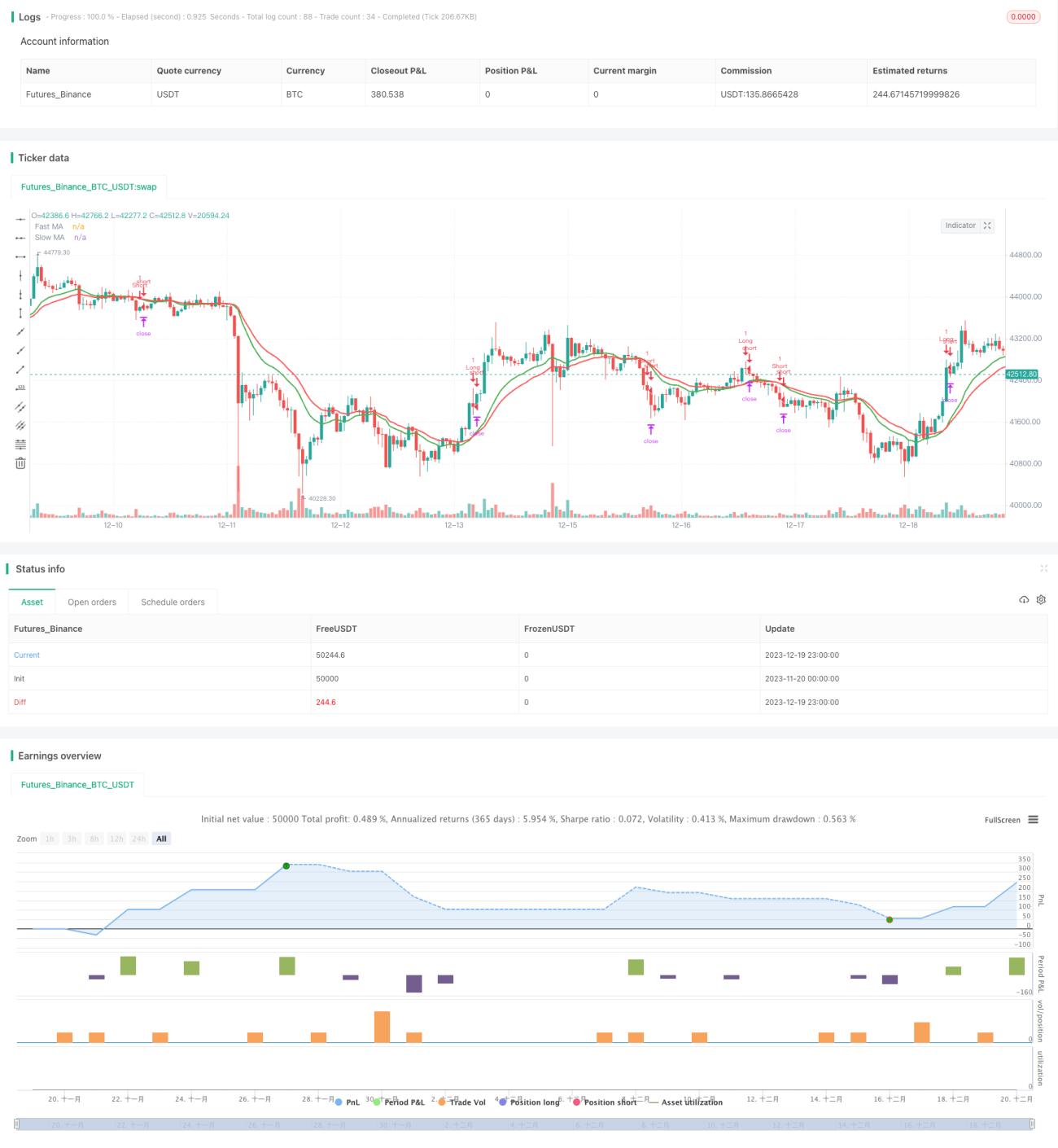
Cette stratégie adopte la méthode classique de suivi de tendance par croisement de moyennes mobiles doubles, tout en intégrant des mécanismes de gestion des risques tels que le stop loss, le take profit et le trailing stop, dans le but de capturer les profits importants générés par les tendances.
Principe de la stratégie
- Calculer la moyenne mobile exponentielle (EMA) sur une période rapide de n jours, comme moyenne mobile à court terme.
- Calculer l'EMA sur une période lente de m jours, comme moyenne mobile à long terme.
- Lorsque la moyenne mobile à court terme franchit la moyenne mobile à long terme par le bas, on prend une position longue ; lorsqu'elle la franchit par le haut, on prend une position courte.
- Condition de sortie : franchissement inverse (par exemple, en position longue, un franchissement inverse déclenche la clôture).
- Utiliser le stop loss, le take profit et le trailing stop pour gérer le risque.
Analyse des avantages
- L'utilisation de deux EMA permet de mieux identifier les points de retournement de tendance des prix et de capturer les mouvements de tendance.
- L'intégration du stop loss, du take profit et du trailing stop permet de contrôler efficacement les pertes unitaires, de verrouiller les profits et de réduire le drawdown.
- De nombreux paramètres sont personnalisables, ce qui permet des ajustements et des optimisations en fonction des différents instruments et conditions de marché.
- La logique de la stratégie est simple et claire, facile à comprendre et à modifier.
- La stratégie prend en charge les positions longues et courtes, ce qui lui permet de s'adapter à différents types de marchés.
Analyse des risques
- La stratégie à double moyenne mobile est très sensible aux faux signaux de cassure, ce qui peut piéger le trader.
- Un mauvais réglage des paramètres peut entraîner des transactions fréquentes, augmentant les coûts de transaction et les pertes liées au slippage.
- La stratégie elle-même ne peut pas déterminer les points de retournement de tendance ; il est préférable de la combiner avec d'autres indicateurs.
- Dans les marchés sans tendance (range), elle peut générer des signaux de trading mais avec une faible rentabilité réelle.
- Les paramètres doivent être optimisés pour s'adapter aux différents instruments et environnements de marché.
Les risques peuvent être réduits des manières suivantes :
- Combiner avec d'autres indicateurs pour filtrer les faux signaux de cassure.
- Optimiser les réglages des paramètres pour réduire la fréquence des transactions.
- Ajouter des indicateurs de tendance pour éviter de trader dans les marchés sans tendance.
- Ajuster la gestion de la taille des positions pour réduire le risque unitaire.
Directions d'optimisation
Cette stratégie peut être optimisée sous les aspects suivants :
- Optimiser les périodes des moyennes mobiles rapides et lentes pour s'adapter à différents instruments et environnements de marché.
- Ajouter d'autres indicateurs pour juger de la tendance et filtrer les faux signaux de cassure. Typiquement, on peut ajouter le MACD, le KDJ, etc.
- Envisager de remplacer l'EMA par une SMA (moyenne mobile simple) ou une WMA (moyenne mobile pondérée).
- Ajuster dynamiquement la distance du stop loss en fonction de l'ATR.
- En fonction de la méthode de gestion de la taille des positions, ajuster la taille unitaire de manière flexible.
- Effectuer une optimisation adaptative des paramètres en combinant des indicateurs de corrélation et de volatilité.
Résumé
Dans l'ensemble, cette stratégie est une stratégie classique de suivi de tendance basée sur le croisement de deux EMA. Elle présente l'avantage de capturer les tendances, tout en intégrant des moyens de gestion des risques tels que le stop loss, le take profit et le trailing stop. Cependant, elle souffre également de problèmes typiques, comme une sensibilité élevée au bruit et aux marchés sans tendance, ce qui peut piéger le trader. En introduisant d'autres indicateurs auxiliaires, en optimisant les paramètres, en effectuant des ajustements dynamiques et en les combinant, on peut améliorer encore l'efficacité de cette stratégie. Globalement, si les paramètres sont bien réglés et s'alignent sur le marché de l'instrument, cette stratégie peut obtenir de bons résultats.
- 1