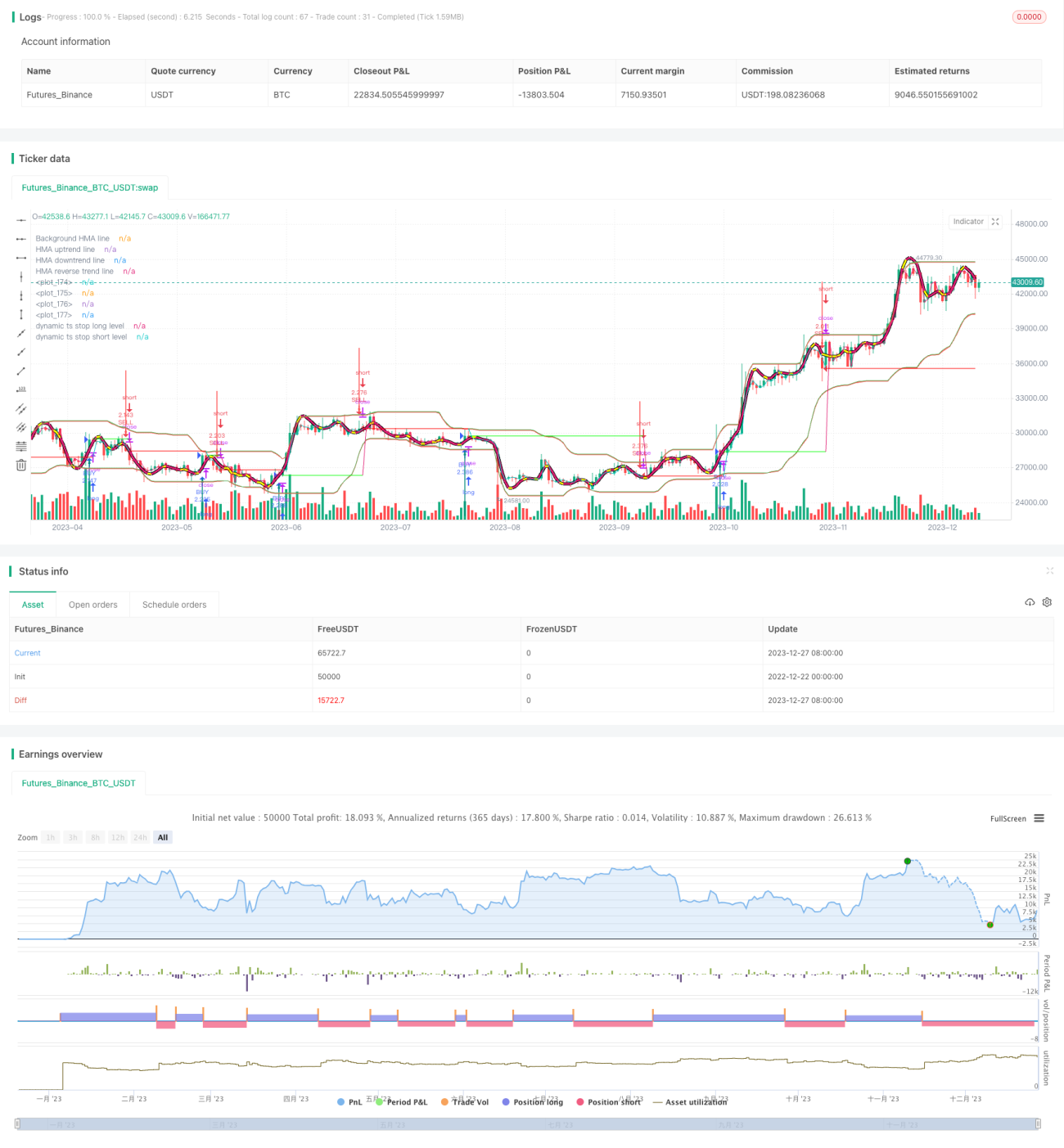
Stratégie d'optimisation du stop loss en mouvement dynamique basée sur la stratégie du filet de pêche


Date de création: 2023-12-29 14:40:47 Dernière modification: 2023-12-29 14:40:47
Copier: 0 Nombre de clics: 747
1
Suivre
1621
Abonnés

Stratégie d’optimisation du stop loss en mouvement dynamique basée sur la stratégie du filet de pêche

Aperçu

L’idée centrale de cette stratégie est de combiner la stratégie de filet de pêche et le mécanisme d’arrêt mobile dynamique pour obtenir une sortie de stop plus efficace. La stratégie de filet de pêche détermine la tendance et la position du marché à l’aide de l’indicateur de ligne K, pour déterminer dynamiquement le moment d’acheter et de vendre.

Le principe

La stratégie est basée sur les modules suivants:

  1. Module de mesure des filets

Les indices de filet de pêche sont calculés à l’aide de l’indicateur de Fisher-Stress et de l’indicateur de Stoch pour déterminer les tendances du marché et les points d’achat et de vente.

  1. Module d’arrêt dynamique

Le stop loss est calculé en fonction de l’indicateur ATR et du RSI.

  1. Module de suivi des pertes mobiles

Il s’agit de définir des points de décalage de stop-loss fixes et de se retirer de la position lorsque le prix atteint le point de stop-loss.

Analyse des avantages

Le plus grand avantage de cette stratégie réside dans son excellente capacité à contrôler les risques. Le mécanisme de stop-loss dynamique peut définir une marge de stop-loss appropriée en fonction de la volatilité du marché, éviter efficacement les pertes causées par des glissements excessifs et suivre la tendance mieux que le stop-loss fixe. De plus, l’indicateur de filet de pêche est fiable pour déterminer le moment de l’achat et de la vente et peut filtrer une partie du bruit des transactions.

Analyse des risques

Les principaux risques de cette stratégie sont que des paramètres de stop-loss mal réglés peuvent entraîner des retraits trop radicaux. De plus, si des paramètres trop radicaux sont utilisés, cela peut également entraîner des transactions de whipsaw trop fréquentes. Pour réduire ces risques, les paramètres doivent être choisis de manière raisonnable et éviter de régler une amplitude de déplacement excessive.

Direction d’optimisation

L’espace d’optimisation de cette stratégie se concentre principalement sur les aspects suivants:

  1. Optimiser les paramètres de l’indicateur du filet de pêche pour trouver des tendances à un meilleur ensemble de paramètres;

  2. Optimisation des paramètres de stop-loss dynamiques pour trouver une amplitude de stop-loss plus équilibrée;

  3. Ajout d’un module de gestion de position basé sur la volatilité, permettant d’ajuster les positions en fonction de la volatilité du marché.

La recherche de paramètres et l’optimisation des règles permettent à la stratégie d’obtenir un rendement ajusté au risque plus élevé.

Résumer

Cette stratégie utilise des indicateurs de filet de pêche et des techniques d’arrêt dynamique pour déterminer avec plus de précision les tendances du marché, favoriser la prise de décision en temps opportun, et ajuster dynamiquement l’ampleur de l’arrêt pour contrôler efficacement les risques. Grâce à l’extension continue des modules et à l’optimisation des paramètres, cette stratégie peut devenir un cadre de stratégie efficace pouvant être appliqué à long terme.

Code source de la stratégie
/*backtest
start: 2022-12-22 00:00:00
end: 2023-12-28 00:00:00
period: 1d
basePeriod: 1h
exchanges: [{"eid":"Futures_Binance","currency":"BTC_USDT"}]
*/

//@version=4
strategy("IFTS+TS Strategy Overlay ", overlay=true, pyramiding = 0, calc_on_order_fills = false, commission_type =  strategy.commission.percent, commission_value = 0.0454, default_qty_type = strategy.percent_of_equity, default_qty_value = 100)

//INPUTS
stochlength=input(19, "Stoch & ATR Length")
wmalength=input(4, title="Smooth")
ul = input(82.05,step=0.01, title="UP line")
dl = input(19,step=0.01, title="DOWN line")
uts = input(true, title="Use trailing stop")
rts = input(false, title="Re-enter after trailing stop")
tsi = input(title="trailing stop actiation pips",defval=245)                                                                       
tso = input(title="trailing stop offset pips",defval=20)
udts = input(true, title="Use dynamic trailing stop start")
mpl2 = input(68.3,step=0.05, title="Multiplier for Dynamic TS start X*ATR")
udto = input(true, title="Use dynamic trailing stop offset")
mpl = input(1,step=0.01, title="Multiplier for Dynamic TS offset X*ATR")
occ = input(1, title="Occurancy for dynamic TS")
useCurrentRes = input(true, title="Use Current Chart Resolution?")  
resCustom = input(title="Timeframe",defval="30")
hma = input(title="Plot Hull MA", defval=true)
pl = input(title="Plot all", defval=true)

//CALCULATIONS
v1=0.1*(stoch(close, high, low, stochlength)-50)
v2=wma(v1, wmalength)
k1=(exp(2*v2)-1)/(exp(2*v2)+1)*50+50
res = useCurrentRes ? timeframe.period : resCustom
k=security(syminfo.tickerid, res, k1, barmerge.lookahead_off)

//CALCULATIONS HULL MA
n=stochlength/2
n2ma=2*wma(close,round(n/2))
nma=wma(close,n)
diff=n2ma-nma
sqn=round(sqrt(n))
n2ma1=2*wma(close[1],round(n/2))
nma1=wma(close[1],n)
diff1=n2ma1-nma1
sqn1=round(sqrt(n))
n1=wma(diff,sqn)    
n2=wma(diff1,sqn)
n3=n1-(n1*-1)
n4=n1+(n1)

//CALCULATIONS FOR BUY/SELL LEVELS
//stc=(stoch(close, high, low, stochlength))

//v3=0.1*(stoch(low, low, low, stochlength)-50)
//v4=wma(v3, wmalength)
//k3=(exp(2*v4)-1)/(exp(2*v4)+1)*50+50
//k2=security(syminfo.tickerid, res, k3, barmerge.lookahead_off)
//stl=(stoch(low, low, low, stochlength))

//v5=0.1*(stoch(high, high, high, stochlength)-50)
//v6=wma(v5, wmalength)
//k5=(exp(2*v6)-1)/(exp(2*v6)+1)*50+50
//k4=security(syminfo.tickerid, res, k5, barmerge.lookahead_off)
//sth=(stoch(high, high, high, stochlength))

//difc=k-stc
//difl=k2-stl+difc
//difh=k4-sth+difc

hg1=wma(highest(stochlength),wmalength)//-highest(stochlength)*(difh/10000)
hg=security(syminfo.tickerid, res, hg1, barmerge.lookahead_off)
hgob=hg-hg*((100-ul)/10000)
lw1=wma(lowest(stochlength),wmalength)//-lowest(stochlength)*(difl/10000)
lw=security(syminfo.tickerid, res, lw1, barmerge.lookahead_off)
lwos=lw+lw*(dl/10000)

////CONDITIONS CROSS
sell = crossunder(k,ul)? 1 : 0
buy = crossover(k,dl)? 1 : 0

////COUNT BARCOLORS
var countred = 0
if sell == 1
    countred := 1
if buy == 1
    countred := 0

var countgreen = 0
if buy == 1
    countgreen := 1
if sell == 1
    countgreen := 0

////CONDITIONS COUNT BARCOLORS
long=countgreen[1]==0 and countgreen==1 ? 1 : 0
short=countred[1]==0 and countred==1 ? 1 : 0
    
////COLORS
//STOCH
col = k>=k[1] ? color.aqua : color.red
col1 = countred[2]==1 ? na : #00FF00
col2 = countgreen[2]==1 ? na : #FF0000
col3 = countred[2]==1 ? na : color.yellow
col4 = countgreen[2]==1 ? na : color.yellow
//HMA
dif = n1[1]-n3
dif1 = dif>dif[1] and dif[1]>dif[2] ? na: #00FF00 //uptrend - green
dif3 = n4-n1[1]
dif2 = dif3>dif3[1] and dif3[1]>dif3[2] ? na: #FF0000  //downtrend - red
dif4 = (dif>dif[1] and dif[1]>dif[2]) == (dif3>dif3[1] and dif3[1]>dif3[2]) ? #FFFF00: na //trend change - yellow

////PLOTS CALCULATIONS DYNAMIC TS
dtso1 = sma(atr(stochlength),2)*100
dtso=security(syminfo.tickerid, "1", dtso1,barmerge.lookahead_on)*mpl
dtsi = rsi(atr(stochlength),stochlength)/mpl2*tsi
dtsiv = valuewhen(long or short, dtsi, occ)
dtsov = valuewhen(long or short, dtso, occ)
//DYNAMIC TS START
dtsil1 = countred[2]==1 and pl and uts and udts? open+(dtsiv/100) : na
dtsis1 = countgreen[2]==1 and pl and uts and udts? open-(dtsiv/100) : na
dtsil = countred[2]==1 and pl and uts and udts? open+(dtsiv/100) : fixnan(dtsil1[1])
dtsis = countgreen[2]==1 and pl and uts and udts? open-(dtsiv/100) : fixnan(dtsis1[1])
//DYNAMIC TS OFFSET+START
dtsol1 = countred[2]==1 and pl and uts and udto? dtsil-(dtsov/100) : na
dtsos1 = countgreen[2]==1 and pl and uts and udto? dtsis+(dtsov/100) : na
dtsol = countred[2]==1 and pl and uts and udto? dtsil-(dtsov/100) : fixnan(dtsol1[1])
dtsos = countgreen[2]==1 and pl and uts and udto? dtsis+(dtsov/100) : fixnan(dtsos1[1])
//CONST TS START
tsil1 = countred[2]==1 and pl and uts and not udts? open+(tsi/100) : na
tsis1 = countgreen[2]==1 and pl and uts and not udts? open-(tsi/100) : na
tsil = countred[2]==1 and pl and uts and not udts? open+(tsi/100) : fixnan(tsil1[1])
tsis = countgreen[2]==1 and pl and uts and not udts? open-(tsi/100) : fixnan(tsis1[1])
//CONST TS START + DYNAMIC TS OFFSET
tsol21 = countred[2]==1 and pl and uts and not udts and udto? open+(tsi/100)-(dtsov/100) : na
tsos21 = countgreen[2]==1 and pl and uts and not udts and udto? open-(tsi/100)+(dtsov/100) : na
tsol2 = countred[2]==1 and pl and uts and not udts and udto? open+(tsi/100)-(dtsov/100) : fixnan(tsol21[1])
tsos2 = countgreen[2]==1 and pl and uts and not udts and udto? open-(tsi/100)+(dtsov/100) : fixnan(tsos21[1])
//CONST TS OFFSET
tsol1 = countred[2]==1 and pl and uts and not udto? tsil-(tso/100) : na
tsos1 = countgreen[2]==1 and pl and uts and not udto? tsis+(tso/100) : na
tsol = countred[2]==1 and pl and uts and not udto? tsil-(tso/100) : fixnan(tsol1[1])
tsos = countgreen[2]==1 and pl and uts and not udto? tsis+(tso/100) : fixnan(tsos1[1])

//////PLOTS
////LABELS
//TS LABELS
// ltsos = (short==1) and udto and pl? label.new(bar_index, high[1]+close*0.006,  text="os "+tostring(round(dtsov)), color=color.white, size=size.small) : na
// ltsol = (long==1) and udto and pl? label.new(bar_index, low[1]-close*0.006,  text="os "+tostring(round(dtsov)), color=color.white, size=size.small, style=label.style_labelup) : na
// ltsis = (short==1) and udts and pl? label.new(bar_index, high[1]+close*0.008, text="st "+tostring(round(dtsiv)), color=color.white, size=size.small) : na
// ltsil = (long==1) and udts and pl? label.new(bar_index, low[1]-close*0.008,  text="st "+tostring(round(dtsiv)), color=color.white, size=size.small, style=label.style_labelup) : na
//STOCH LABEL
//lk = k>ul and pl? label.new(bar_index, high, text=tostring(round(k)), color=col, size=size.small) :na
//lk2 = k<dl and pl? label.new(bar_index, high, text=tostring(round(k)), color=col, size=size.small) :na
//lk3 = k>dl and k<ul and pl? label.new(bar_index, high, text=tostring(round(k)), color=color.white, size=size.small) :na
//label.delete(lk[1])
//label.delete(lk2[1])
//label.delete(lk3[1])

//ltson = udto==true and pl? label.new(bar_index, 75, text="os "+tostring(round(dtso)), color=color.yellow, size=size.small) :na
//label.delete(ltson[1])
//ltsin = udts==true and pl? label.new(bar_index, 0, text="st "+tostring(round(dtsi)), color=color.yellow, size=size.small) :na
//label.delete(ltsin[1])

//DYNAMIC TS LINES
plot(dtsil, color=col1, transp = 0, title = "dynamic ts stop long level")
plot(dtsis, color=col2, transp = 0, title = "dynamic ts stop short level")
plot(dtsol, color=col3, transp = 30, title = "dynamic ts offset long level")
plot(dtsos, color=col4, transp = 30, title = "dynamic ts offset short level")
plot(tsol2, color=col3, transp = 30, title = "const start + dynamic ts offset long level")
plot(tsos2, color=col4, transp = 30, title = "const start + dynamic ts offset short level")
//TS LINES
plot(tsil, color=col1, transp = 0, title = "const ts stop long level")
plot(tsis, color=col2, transp = 0, title = "const ts stop short level")
plot(tsol, color=col3, transp = 30, title = "const ts stop offset long level")
plot(tsos, color=col4, transp = 30, title = "const ts stop offset short level")
//ARROWS
plotarrow(pl==true? long : na, colorup = color.teal, transp=0, title = "buy arrow")
plotarrow(pl==true? -short : na, colordown = color.red, transp=0, title = "sell arrow")
//HIGH/LOW
p1 = plot(pl==true?hg : na, color=color.green, transp=100, editable=false)
p2 = plot(pl==true?lw : na, color=color.red, transp=100, editable=false)
p3 = plot(pl==true?lwos : na, color=color.green, linewidth=1, transp=100, editable=false)
p4 = plot(pl==true?hgob : na, color=color.red, linewidth=1, transp=100, editable=false)
fill(p1,p4, color=color.green, transp=75, title = "highest price levels")
fill(p2,p3, color=color.red, transp=75, title = "lowest price levels")
//HMA
mab=plot(hma and pl ? n1 : na,color=#000000, linewidth=5, transp=0, title = "Background HMA line") //black
ma=plot(hma and pl ? n1 : na,color=dif1, linewidth=3, transp=10, title = "HMA uptrend line") //green
ma2=plot(hma and pl ? n1 : na,color=dif2, linewidth=3, transp=20, title = "HMA downtrend line")//red
ma3=plot(hma and pl ? n1 : na,color=dif4, linewidth=3, transp=10, title = "HMA reverse trend line") //yellow
//LINES
// ldl = long[1]==1 and uts and udts? line.new(bar_index, high, bar_index, dtsil, color=#00FF00, width = 1) : na
// lds = short[1]==1 and uts and udts? line.new(bar_index, high, bar_index, dtsis, color=#FF0000, width = 1) : na
// ll = long[1]==1 and uts and not udts? line.new(bar_index, high, bar_index, tsil, color=#00FF00, width = 1) : na
// ls = short[1]==1 and uts and not udts? line.new(bar_index, high, bar_index, tsis, color=#FF0000, width = 1) : na

////STRATEGY
strategy.entry("BUY", strategy.long, when = buy)
strategy.entry("SELL", strategy.short, when = sell)

if (rts)
    strategy.entry("BUY", strategy.long, when = countgreen==1 and dif1==#00FF00)
    strategy.entry("SELL", strategy.short, when = countred==1 and dif2==#FF0000)

if  (uts)
    strategy.exit("Close BUY with TS","BUY", trail_points = tsi, trail_offset = tso)
    strategy.exit("Close SELL with TS","SELL", trail_points = tsi, trail_offset = tso)

    if  (udto)
        strategy.exit("Close BUY with TS","BUY", trail_points = tsi, trail_offset = dtsov)
        strategy.exit("Close SELL with TS","SELL", trail_points = tsi, trail_offset = dtsov)
        
    if  (udts)
        strategy.exit("Close BUY with TS","BUY", trail_points = dtsiv, trail_offset = tso)
        strategy.exit("Close SELL with TS","SELL", trail_points = dtsiv, trail_offset = tso)
        
    if  (udto and udts)
        strategy.exit("Close BUY with TS","BUY", trail_points = dtsiv, trail_offset = dtsov)
        strategy.exit("Close SELL with TS","SELL", trail_points = dtsiv, trail_offset = dtsov)