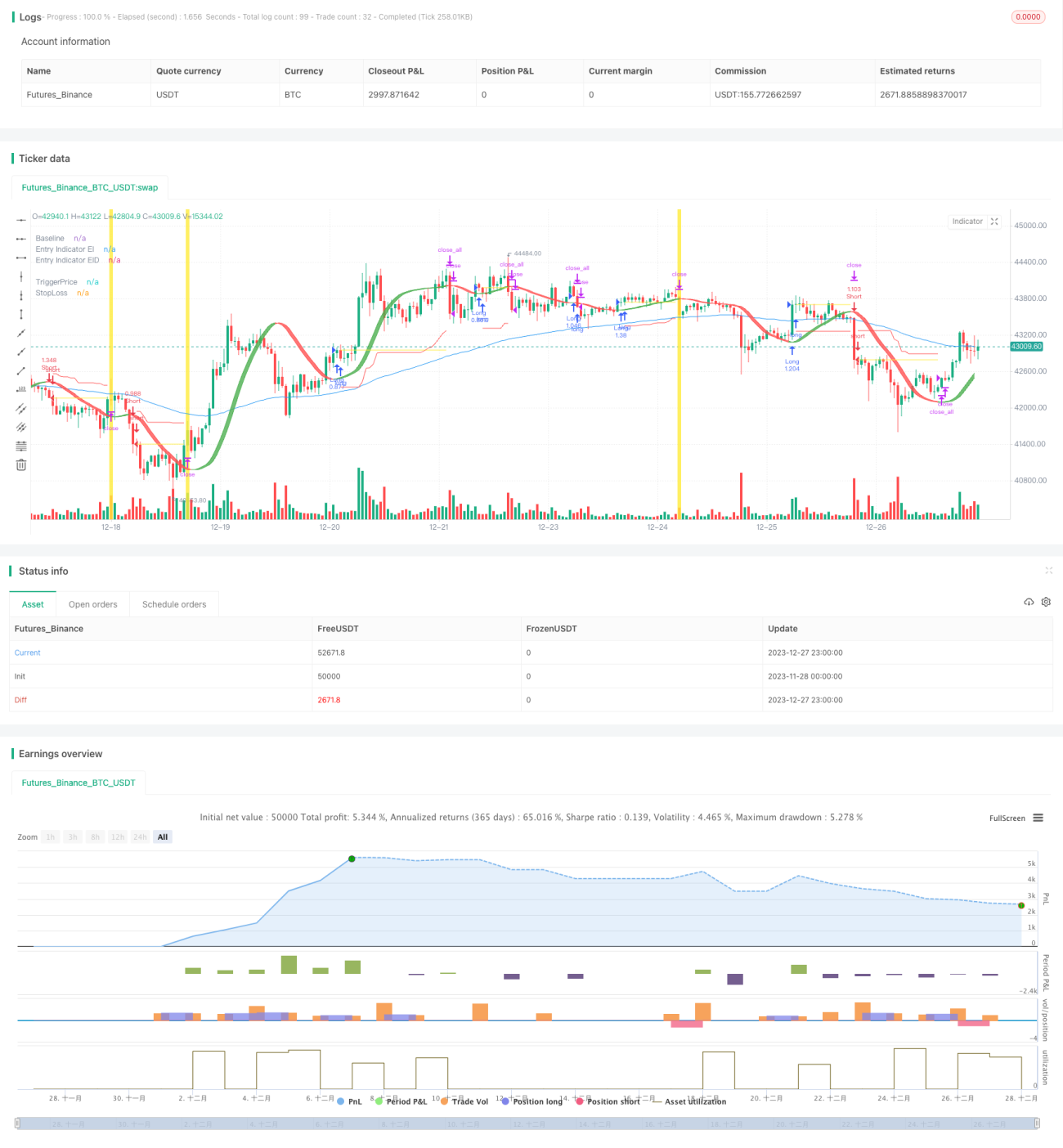
La stratégie de suivi de la parité utilise la moyenne mobile de Hull comme indicateur principal d’entrée sur le marché pour déterminer la direction de la tendance des prix. En même temps, la stratégie est combinée avec de nombreux autres indicateurs, tels que la ligne de référence, les indicateurs de confirmation, etc., pour vérifier la tendance des prix et filtrer les faux signaux. Après l’entrée sur le marché, la stratégie utilise l’amplitude moyenne réelle pour calculer les arrêts dynamiques pour suivre la tendance et tirer profit.
Le cœur de la stratégie de suivi de la moyenne est la moyenne mobile de Hull. La moyenne mobile de Hull est plus sensible aux changements de prix et permet de déterminer efficacement la direction de la tendance.
En outre, la stratégie a introduit un indicateur de référence pour déterminer les tendances à court terme et un indicateur de confirmation pour filtrer les fausses ruptures. Un signal de négociation n’est émis que lorsque la ligne de référence et l’indicateur de confirmation confirment la direction de la tendance.
Après la mise en bourse, la stratégie utilise l’amplitude réelle moyenne calculée par l’ATR et l’EMA de Hull pour définir la position de stop-loss. Au fur et à mesure que la tendance se poursuit, la ligne de stop-loss continue de se déplacer à la hausse / à la baisse pour bloquer la tendance à la hausse.
La stratégie de suivi de la parité, combinant le jugement de la tendance et la maîtrise du risque, permet d’obtenir de meilleurs rendements dans une situation de tendance. Par rapport à la stratégie de stop-loss fixe, elle permet de suivre la tendance en effectuant des stop-loss mobiles et d’éviter d’être stoppée par les fluctuations normales du marché.
L’utilisation combinée de nombreux indicateurs rend également la stratégie plus sensible aux changements du marché et permet de filtrer efficacement les faux signaux. De plus, la stratégie fournit également plusieurs paramètres à ajuster, que l’utilisateur peut optimiser en fonction de son propre jugement sur le marché.
La stratégie repose principalement sur les indicateurs de tendance, ce qui peut entraîner des signaux erronés et des pertes de stockage. De plus, des combinaisons d’indicateurs multiples peuvent entraîner des conflits d’indicateurs. Des paramètres mal configurés peuvent également entraîner une mauvaise performance de la stratégie.
On peut envisager d’ajouter des modules de jugement supplémentaires à la stratégie, suspendant les transactions en cas de divergence d’indicateurs; ou d’utiliser un mécanisme de vote, intégrant les résultats de plusieurs indicateurs. En ce qui concerne la configuration des paramètres, les meilleurs paramètres peuvent être trouvés grâce à une méthode d’optimisation de la rétroaction.
Les stratégies de suivi de la parité peuvent être optimisées dans les directions suivantes:
La stratégie de suivi de la parité est une excellente stratégie de suivi de la tendance dans l’ensemble. Elle combine avec succès le jugement de la tendance et le stop-loss dynamique, ce qui permet de suivre efficacement la tendance.
/*backtest
start: 2023-11-28 00:00:00
end: 2023-12-28 00:00:00
period: 1h
basePeriod: 15m
exchanges: [{"eid":"Futures_Binance","currency":"BTC_USDT"}]
*/
// © Milleman
//@version=4
strategy("MilleMachine", overlay=true, default_qty_type = strategy.percent_of_equity, default_qty_value = 100, initial_capital=10000, commission_type=strategy.commission.percent, commission_value=0.06)
// Additional settings
Mode = input(title="Mode", defval="LongShort", options=["LongShort", "OnlyLong", "OnlyShort","Indicator Mode"])
UseTP = false //input(false, title="Use Take Profit?")
QuickSwitch = true //input(true, title="Quickswitch")
UseTC = true //input(true, title="Use Trendchange?")
// Risk management settings
//Spacer2 = input(false, title="======= Risk management settings =======")
Risk = input(1.0, title="% Risk",minval=0)/100
RRR = 2 //input(2,title="Risk Reward Ratio",step=0.1,minval=0,maxval=20)
SL_Mode = false // input(true, title="ON = Fixed SL / OFF = Dynamic SL (ATR)")
SL_Fix = 3 //input(3,title="StopLoss %",step=0.25, minval=0)/100
ATR = atr(14) //input(14,title="Periode ATR"))
Mul = input(2,title="ATR Multiplier",step=0.1)
xATR = ATR * Mul
SL = SL_Mode ? SL_Fix : (1 - close/(close+xATR))
// INDICATORS //////////////////////////////////////////////////////////////////////////////////////////////////////////////////////////////////////////////////////////////////////
Ind(type, src, len) =>
float result = 0
if type=="McGinley"
result := na(result[1]) ? ema(src, len) : result[1] + (src - result[1]) / (len * pow(src/result[1], 4))
if type=="HMA"
result := wma(2*wma(src, len/2)-wma(src, len), round(sqrt(len)))
if type=="EHMA"
result := ema(2*ema(src, len/2)-ema(src, len), round(sqrt(len)))
if type=="THMA"
lend = len/2
result := wma(wma(src, lend/3)*3-wma(src, lend/2)-wma(src,lend), lend)
if type=="SMA" // Simple
result := sma(src, len)
if type=="EMA" // Exponential
result := ema(src, len)
if type=="DEMA" // Double Exponential
e = ema(src, len)
result := 2 * e - ema(e, len)
if type=="TEMA" // Triple Exponential
e = ema(src, len)
result := 3 * (e - ema(e, len)) + ema(ema(e, len), len)
if type=="WMA" // Weighted
result := wma(src, len)
if type=="VWMA" // Volume Weighted
result := vwma(src, len)
if type=="SMMA" // Smoothed
w = wma(src, len)
result := (w[1] * (len - 1) + src) / len
if type == "RMA"
result := rma(src, len)
if type=="LSMA" // Least Squares
result := linreg(src, len, 0)
if type=="ALMA" // Arnaud Legoux
result := alma(src, len, 0.85, 6)
if type=="Kijun" //Kijun-sen
kijun = avg(lowest(len), highest(len))
result :=kijun
if type=="WWSA" // Welles Wilder Smoothed Moving Average
result := nz(result[1]) + (close -nz(result[1]))/len
result
// Baseline : Switch from Long to Short and vice versa
BL_Act = input(true, title="====== Activate Baseline - Switch L/S ======")
BL_type = input(title="Baseline Type", defval="McGinley", options=["McGinley","HMA","EHMA","THMA","SMA","EMA","DEMA","TEMA","WMA","VWMA","SMMA","RMA","LSMA","ALMA","Kijun","WWSA"])
BL_src = input(close, title="BL source")
BL_len = input(50, title="BL length", minval=1)
BL = Ind(BL_type,BL_src, BL_len)
// Confirmation indicator
C1_Act = input(false, title="===== Activate Confirmation indicator =====")
C1_type = input(title="C1 Entry indicator", defval="SMA", options=["McGinley","HMA","EHMA","THMA","SMA","EMA","DEMA","TEMA","WMA","VWMA","SMMA","RMA","LSMA","ALMA","Kijun","WWSA"])
C1_src = input(close, title="Source")
C1_len = input(5,title="Length", minval=1)
C1 = Ind(C1_type,C1_src,C1_len)
// Entry indicator : Hull Moving Average
Spacer5 = input(true, title="====== ENTRY indicator =======")
EI_type = input(title="EI Entry indicator", defval="HMA", options=["McGinley","HMA","EHMA","THMA","SMA","EMA","DEMA","TEMA","WMA","VWMA","SMMA","RMA","LSMA","ALMA","Kijun","WWSA"])
EI_src = input(close, title="Source")
EI_Len = input(46,title="Length", minval=1)
EI = Ind(EI_type,EI_src,EI_Len)
// Trail stop settings
TrailActivation = input(true, title="===== Activate Trailing Stop =====")
TS_type = input(title="TS Traling Stop Type", defval="EMA", options=["McGinley","HMA","EHMA","THMA","SMA","EMA","DEMA","TEMA","WMA","VWMA","SMMA","RMA","LSMA","ALMA","Kijun","WWSA"])
TrailSLScaling = 1 //input(100, title="SL Scaling", minval=0, step=5)/100
TrailingSourceLong = Ind(TS_type,low,input(5,"Smoothing Trail Long EMA", minval=1))
TrailingSourceShort = Ind(TS_type,high,input(2,"Smoothing Trail Short EMA", minval=1))
//VARIABLES MANAGEMENT
TriggerPrice = 0.0, TriggerPrice := TriggerPrice[1]
TriggerSL = 0.0, TriggerSL := TriggerSL[1]
SLPrice = 0.0, SLPrice := SLPrice[1], TPPrice = 0.0, TPPrice := TPPrice[1]
isLong = false, isLong := isLong[1], isShort = false, isShort := isShort[1]
//LOGIC
GoLong = crossover(EI,EI[1]) and (strategy.position_size == 0.0 and QuickSwitch) and (not BL_Act or BL/BL[1] > 1) and (not C1_Act or C1>C1[1]) and (Mode == "LongShort" or Mode == "OnlyLong")
GoShort = crossunder(EI,EI[1]) and (strategy.position_size == 0.0 and QuickSwitch) and (not BL_Act or BL/BL[1] < 1) and (not C1_Act or C1<C1[1]) and (Mode == "LongShort" or Mode == "OnlyShort")
ExitLong = isLong and crossunder(EI,EI[1]) and UseTC
ExitShort = isShort and crossover(EI,EI[1]) and UseTC
//FRAMEWORK
//Reset Long-Short memory
if isLong and strategy.position_size == 0.0
isLong := false
if isShort and strategy.position_size == 0.0
isShort := false
//Long
if GoLong
isLong := true, TriggerPrice := close, TriggerSL := SL
TPPrice := UseTP? TriggerPrice * (1 + (TriggerSL * RRR)) : na
SLPrice := TriggerPrice * (1-TriggerSL)
Entry_Contracts = strategy.equity * Risk / ((TriggerPrice-SLPrice)/TriggerPrice) / TriggerPrice
strategy.entry("Long", strategy.long, comment=tostring(round((TriggerSL/TriggerPrice)*1000)), qty=Entry_Contracts)
strategy.exit("TPSL","Long", limit=TPPrice, stop=SLPrice)
if isLong
NewValSL = TrailingSourceLong * (1 - (SL*TrailSLScaling))
if TrailActivation and NewValSL > SLPrice
SLPrice := NewValSL
strategy.exit("TPSL","Long", limit=TPPrice, stop=SLPrice)
if ExitLong
strategy.close_all(comment="TrendChange")
isLong := false
//Short
if GoShort
isShort := true, TriggerPrice := close, TriggerSL := SL
TPPrice := UseTP? TriggerPrice * (1 - (TriggerSL * RRR)) : na
SLPrice := TriggerPrice * (1 + TriggerSL)
Entry_Contracts = strategy.equity * Risk / ((SLPrice-TriggerPrice)/TriggerPrice) / TriggerPrice
strategy.entry("Short", strategy.short, comment=tostring(round((TriggerSL/TriggerPrice)*1000)), qty=Entry_Contracts)
strategy.exit("TPSL","Short", limit=TPPrice, stop=SLPrice)
if isShort
NewValSL = TrailingSourceShort * (1 + (SL*TrailSLScaling))
if TrailActivation and NewValSL < SLPrice
SLPrice := NewValSL
strategy.exit("TPSL","Short", limit=TPPrice, stop=SLPrice)
if ExitShort
strategy.close_all(comment="TrendChange")
isShort := false
//VISUALISATION
plot(BL_Act?BL:na, color=color.blue,title="Baseline")
plot(C1_Act?C1:na, color=color.yellow,title="confirmation Indicator")
EIColor = EI>EI[1] ? color.green : color.red
Fill_EI = plot(EI, color=EIColor, linewidth=1, transp=40, title="Entry Indicator EI")
Fill_EID = plot(EI[1], color=EIColor, linewidth=1, transp=40, title="Entry Indicator EID")
fill(Fill_EI,Fill_EID, title="EI_Fill", color=EIColor,transp=50)
plot(strategy.position_size != 0.0 and (isLong or isShort) ? TriggerPrice : na, title="TriggerPrice", color=color.yellow, style=plot.style_linebr)
plot(strategy.position_size != 0.0 and (isLong or isShort) ? TPPrice : na, title="TakeProfit", color=color.green, style=plot.style_linebr)
plot(strategy.position_size != 0.0 and (isLong or isShort) ? SLPrice : na, title="StopLoss", color=color.red, style=plot.style_linebr)
bgcolor(isLong[1] and cross(low,SLPrice) and low[1] > SLPrice and TriggerPrice>SLPrice ? color.yellow : na, transp=75, title="SL Long")
bgcolor(isShort[1] and cross(high,SLPrice) and high[1] < SLPrice and TriggerPrice<SLPrice ? color.yellow : na, transp=75, title="SL Short")