Stratégie de combinaison de moyenne mobile avec momentum et retournement

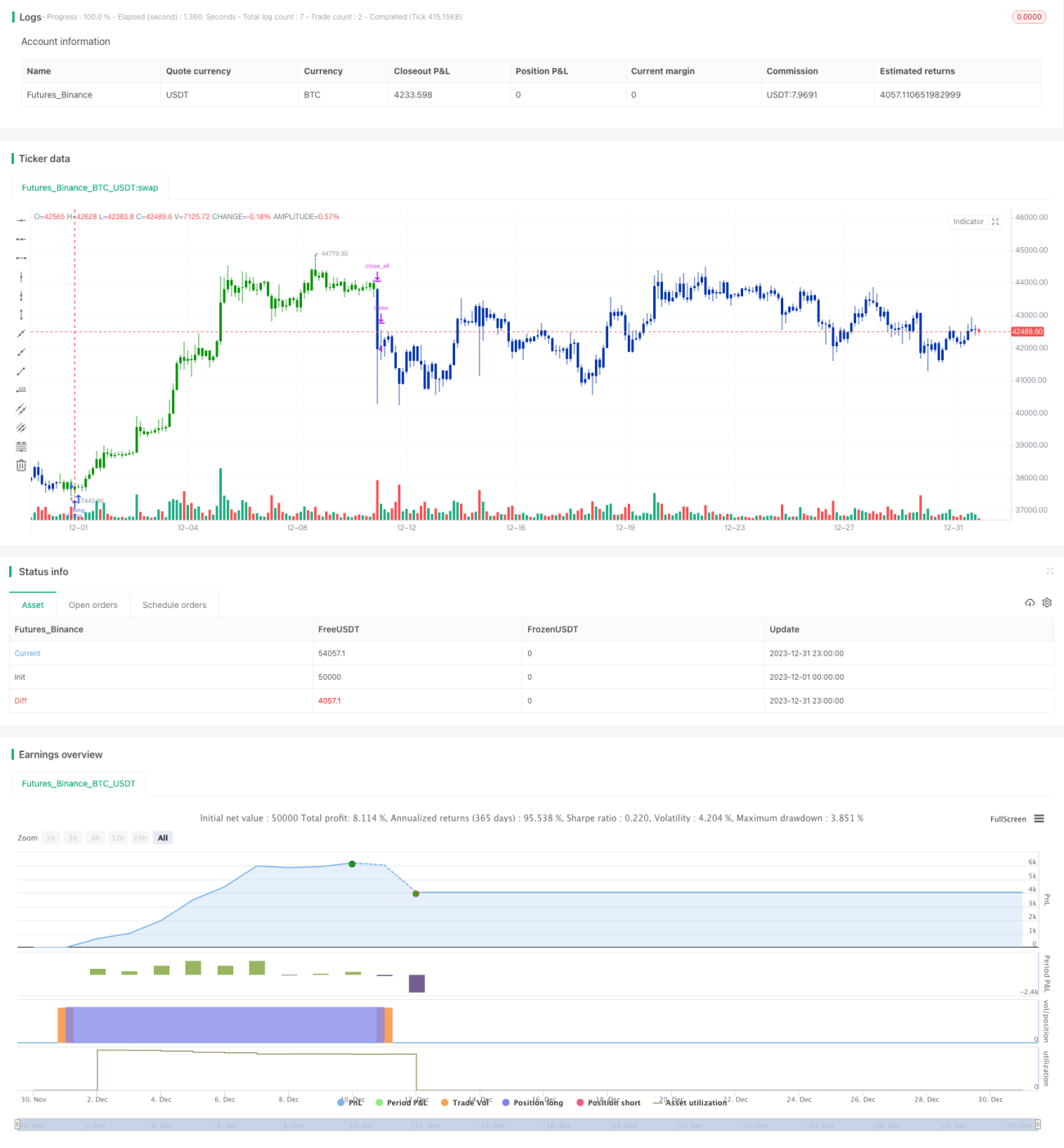
Aperçu
Cette stratégie combine la stratégie de retournement 123 et la stratégie de moyenne mobile CMO pour former un signal d'achat/vente composite. La stratégie de retournement 123 génère des signaux de trading en détectant de nouveaux plus hauts ou plus bas sur deux jours consécutifs de clôture, combinés à l'indice stochastique pour évaluer la force acheteuse/vendeuse. La stratégie de moyenne mobile CMO utilise l'indicateur CMO pour juger de la dynamique des prix et produire des signaux de trading. La combinaison des signaux des deux stratégies permet d'obtenir un signal composite plus fiable.
Principe de la stratégie
La stratégie de retournement 123 génère des signaux de trading selon les principes suivants :
- Lorsque le prix de clôture augmente deux jours consécutifs et que l'indice stochastique sur 9 jours est inférieur à 50, achetez (long).
- Lorsque le prix de clôture baisse deux jours consécutifs et que l'indice stochastique sur 9 jours est supérieur à 50, vendez (short).
Cette stratégie juge si le prix forme de nouveaux plus hauts ou plus bas à court terme, combinée à l'indicateur haussier/baissier stochastique, pour générer des signaux.
La stratégie de moyenne mobile CMO génère des signaux selon les principes suivants :
- Calculer les valeurs CMO sur 5, 10 et 20 jours.
- Calculer leur moyenne.
- Lorsque la moyenne CMO est supérieure à 70, achetez (long).
- Lorsque la moyenne CMO est inférieure à -70, vendez (short).
Cette stratégie effectue une opération d'ensemble sur les valeurs CMO de différentes périodes pour juger de la direction de la dynamique des prix et générer des signaux.
La stratégie composite effectue une opération ET sur les signaux des deux stratégies : le signal d'achat/vente réel n'est émis que lorsque les deux stratégies donnent simultanément un signal long ou un signal short.
Avantages de la stratégie
Cette stratégie présente les avantages suivants :
- Le signal composite est plus fiable, réduisant les faux signaux.
- La stratégie de retournement 123 est adaptée pour capturer les tendances après des corrections à court terme.
- La stratégie de moyenne mobile CMO juge la dynamique des prix à une échelle plus large.
- Elle peut s'adapter à différents environnements de marché.
Analyse des risques
Cette stratégie comporte également les risques suivants :
- La stratégie de retournement 123 dépend fortement de la formation des prix, ce qui peut entraîner des défaillances.
- L'indicateur CMO est sensible aux oscillations du marché et peut générer des signaux erronés.
- Le signal composite peut être trop conservateur, entraînant des occasions de trading manquées.
- Les paramètres doivent être ajustés pour s'adapter à différentes périodes et environnements de marché.
Les contre-mesures comprennent :
- Optimiser les règles de détection des formations de retournement.
- Ajouter d'autres indicateurs auxiliaires à la stratégie de moyenne mobile CMO.
- Évaluer l'efficacité de la stratégie sur une période récente et ajuster dynamiquement les paramètres.
Axes d'optimisation
Cette stratégie peut être optimisée dans les domaines suivants :
- Utiliser des algorithmes d'apprentissage automatique pour optimiser automatiquement les pondérations de combinaison.
- Ajouter un module d'auto-adaptation des paramètres pour optimiser dynamiquement les paramètres de la stratégie.
- Ajouter un module de stop-loss pour contrôler efficacement les risques.
- Évaluer la robustesse de la stratégie et améliorer l'algorithme de reconnaissance des formations.
- Intégrer des facteurs de sélection sectorielle, fondamentaux, etc.
Résumé
Cette stratégie combine deux stratégies complémentaires, le retournement 123 et la moyenne mobile CMO, pour former une stratégie de trading composite efficace. Sous réserve d'un contrôle des risques, elle peut générer des rendements excédentaires stables. Avec l'optimisation continue des algorithmes et des modèles, on s'attend à ce que le rendement et la stabilité de cette stratégie s'améliorent encore.
/*backtest
start: 2023-12-01 00:00:00
end: 2023-12-31 23:59:59
period: 3h
basePeriod: 15m
exchanges: [{"eid":"Futures_Binance","currency":"BTC_USDT"}]
*/

//@version=4
////////////////////////////////////////////////////////////
//  Copyright by HPotter v1.0 19/09/2019
// This is combo strategies for get a cumulative signal. - 1