Stratégie de suivi de super tendance multi-timeframe

Aperçu
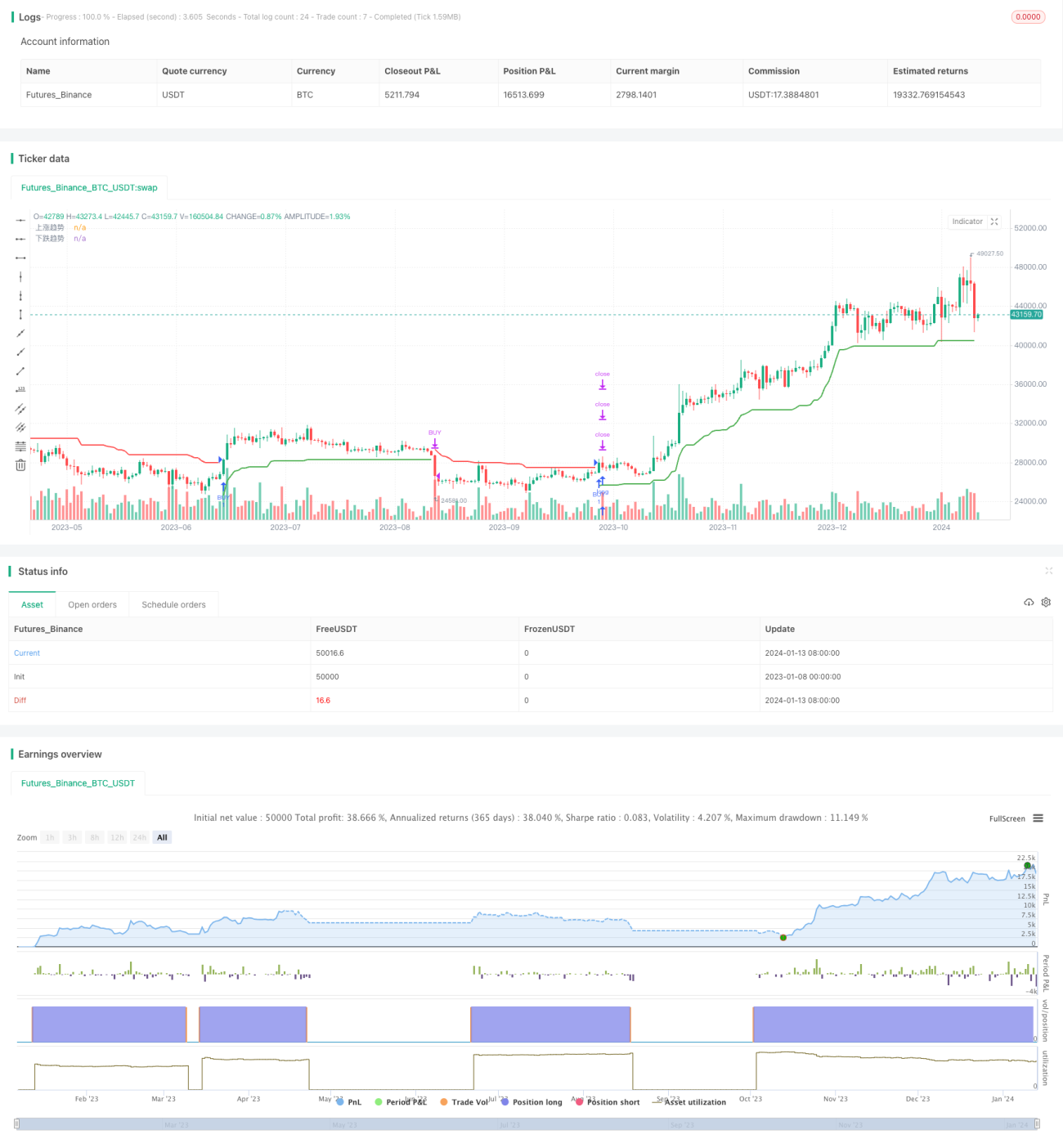
Cette stratégie utilise l'indicateur ATR pour construire un canal de tendance dynamique sur plusieurs périodes, permettant de suivre la tendance. La stratégie génère des signaux lorsqu'un prix franchit le canal, en ajustant continuellement ce dernier pour capturer des tendances plus amples.
Principe de la stratégie
La stratégie construit un canal de tendance haussière et un canal de tendance baissière à l'aide de l'ATR. Concrètement, la ligne du canal haussier correspond au prix de clôture moins N fois l'ATR ; la ligne du canal baissier correspond au prix de clôture plus N fois l'ATR. La valeur de N peut être ajustée via les paramètres.
Lorsque le prix franchit le canal haussier, un signal d'achat est généré ; lorsqu'il franchit le canal baissier, un signal de vente est émis. Le canal s'ajuste dynamiquement en fonction du dernier prix, permettant ainsi le suivi de tendance.
Par ailleurs, la stratégie définit une variable trend pour déterminer si le marché est en tendance haussière ou baissière, utilisée conjointement avec les lignes du canal pour éviter les signaux erronés.
Avantages de la stratégie
- Utilisation d'un canal dynamique pour suivre la tendance et agir dans le sens du marché.
- Évite d'acheter au sommet ou de vendre au creux, réduisant le risque de retournement de tendance.
- Paramètres ajustables du canal, grande adaptabilité.
- Configuration multi-périodes plus flexible.
Risques de la stratégie
- Un suivi trop agressif peut augmenter le risque de pertes.
- Un réglage inapproprié des paramètres du canal entraîne peu de signaux ou des signaux erronés.
- Nécessite des compétences solides en programmation pour ajuster les paramètres.
Méthodes d'optimisation :
- Réduire le multiple de l'ATR pour diminuer l'amplitude du suivi.
- Optimiser les paramètres pour trouver la meilleure combinaison.
- Ajouter une stratégie de stop-loss pour limiter les pertes individuelles.
Axes d'amélioration
- Ajouter d'autres indicateurs comme filtres pour garantir des signaux plus fiables.
- Introduire une stratégie de stop-loss pour réduire les risques.
- Effectuer une optimisation des paramètres afin de trouver les meilleurs réglages.
- Optimiser les points d'entrée et de sortie pour améliorer le taux de profit.
Conclusion
Globalement, cette stratégie constitue un bon outil de suivi de tendance. Elle s'adapte dynamiquement, suit le sens du marché et évite les achats ou ventes à contre‑tendance. Grâce à l'optimisation des paramètres et à des améliorations appropriées, il est possible de renforcer ses avantages, de réduire les risques et d'obtenir de meilleurs résultats.
- 1