Stratégie de trading d'options périodiques basée sur l'indicateur Stochastic

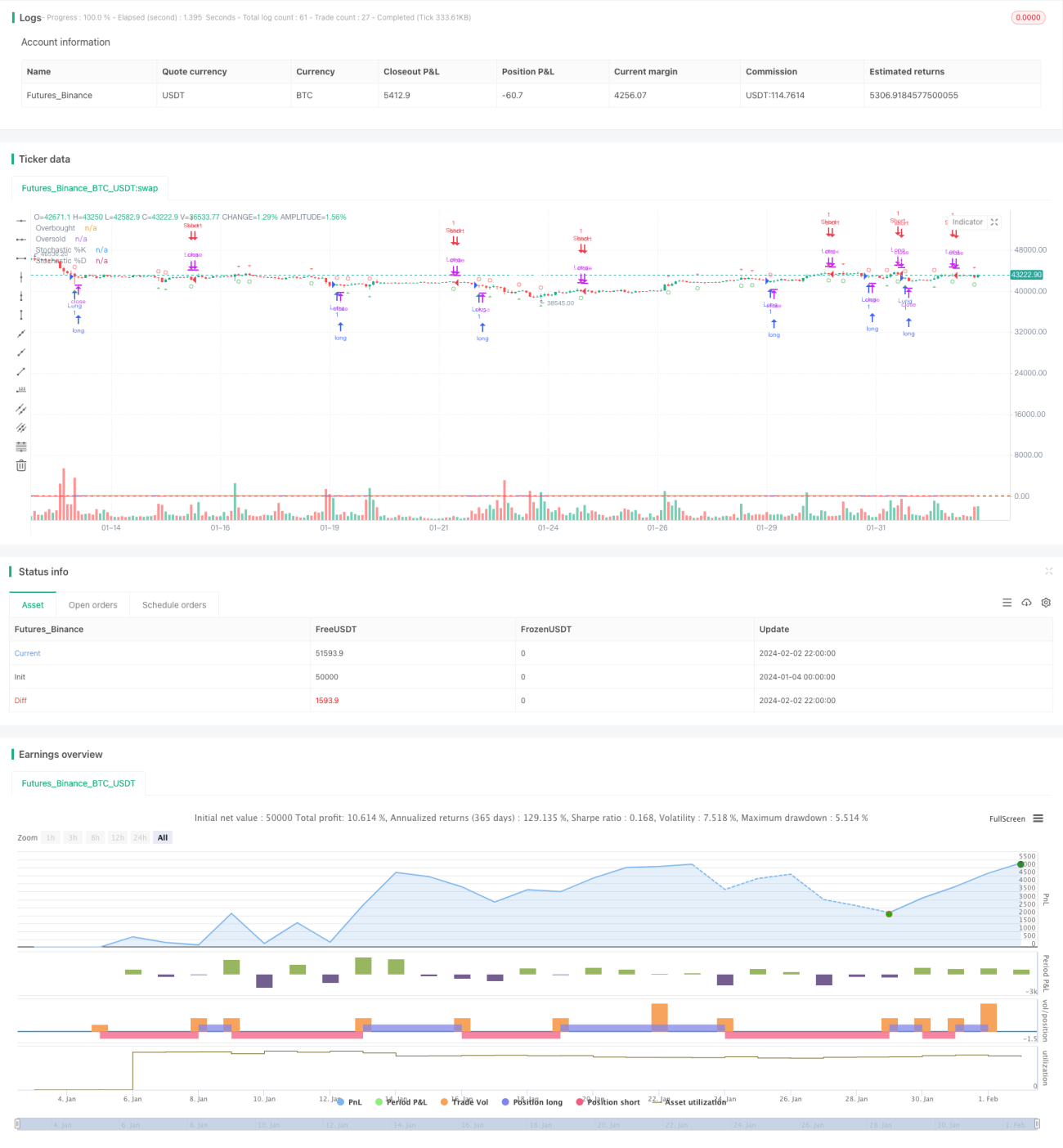
Aperçu
Cette stratégie, nommée "Stratégie de trading d'options périodiques basée sur l'indicateur Stochastic", utilise l'oscillateur stochastique pour identifier les points d'entrée et de sortie potentiels pour le trading d'options. Elle est spécifiquement conçue pour le trading d'options et permet d'identifier les opportunités de trading à la fois haussières et baissières.
Principe de la stratégie
Cette stratégie utilise la ligne %K stochastique sur 14 périodes et la ligne %D stochastique calculée comme une moyenne mobile simple sur 3 périodes de la ligne %K. Lorsque la ligne %K franchit la ligne %D par le bas, cela est considéré comme un signal haussier ; lorsque la ligne %K franchit la ligne %D par le haut, c'est un signal baissier. Les conditions d'entrée et de sortie spécifiques sont les suivantes :
Entrée longue : lorsque la ligne %K franchit la ligne %D par le bas à partir d'un niveau inférieur à 20, prendre une position longue.
Sortie longue : lorsque la ligne %K franchit la ligne %D par le haut à partir d'un niveau supérieur à 80, fermer la position longue.
Entrée courte : lorsque la ligne %K franchit la ligne %D par le haut à partir d'un niveau supérieur à 80, prendre une position courte.
Sortie courte : lorsque la ligne %K franchit la ligne %D par le bas à partir d'un niveau inférieur à 20, fermer la position courte.
Avantages de la stratégie
- Utilise l'indicateur stochastique pour identifier les zones de surachat et de survente, évitant d'acheter au sommet ou de vendre au creux.
- L'optimisation des paramètres de l'indicateur peut améliorer la qualité des signaux de trading.
- Les conditions d'entrée et de sortie personnalisables permettent d'optimiser la gestion des positions.
- Peut être utilisé pour le trading d'options, améliorant l'efficacité de l'utilisation des fonds.
Analyse des risques
- L'indicateur stochastique peut générer des faux signaux ; il est nécessaire de le combiner avec d'autres indicateurs pour filtrer.
- Les paramètres fixes peuvent manquer certaines opportunités de trading.
- Les drawdowns peuvent s'élargir ; il est nécessaire de contrôler la taille de chaque position.
- Il faut prêter attention aux fondamentaux de l'action et aux changements de l'environnement macroéconomique.
Directions d'optimisation de la stratégie
- Combiner avec des indicateurs tels que les moyennes mobiles pour filtrer les faux signaux.
- Tester différentes combinaisons de paramètres pour optimiser les réglages.
- Augmenter les paramètres de franchissement pour réduire les faux signaux.
- Optimiser les conditions de stop-loss et de take-profit pour contrôler les pertes individuelles.
Conclusion
Cette stratégie exploite le principe de surachat/survente de l'indicateur stochastique pour identifier les opportunités d'entrée potentielles. Par rapport aux stratégies de suivi de tendance traditionnelles, elle permet de capturer des mouvements importants aux points de retournement du marché. L'optimisation des paramètres et le filtrage des signaux peuvent encore améliorer la stabilité de la stratégie. Cette stratégie peut être utilisée pour le trading d'options, visant à obtenir des rendements élevés tout en contrôlant les risques.
- 1