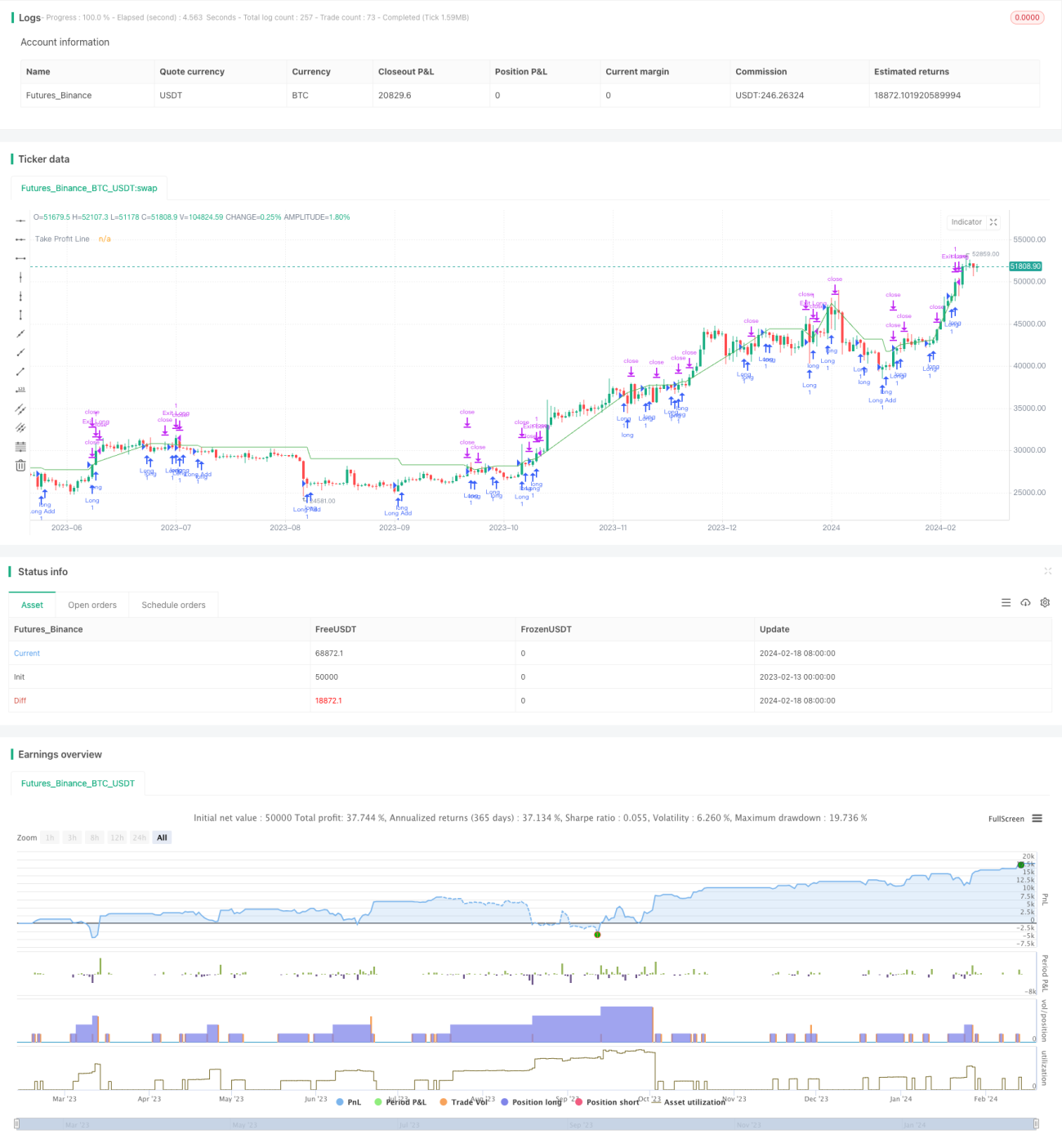
La stratégie utilise de multiples indicateurs techniques tels que le RSI, le MACD, l’OBV, le CCI, le CMF, le MFI et le VWMACD pour détecter l’écart entre le prix et le volume de transaction afin d’identifier les opportunités d’entrée potentielles. La stratégie est également combinée avec l’indicateur de détection de la baisse de l’utilisateur pour émettre des signaux de négociation lorsque des conditions de volatilité et de profondeur élevées ou de VFI sont remplies. La stratégie fait plus, en utilisant le suivi des arrêts de perte pour établir des positions de placement.
Calculer les indicateurs RSI, MACD, OBV, CCI, CMF, MFI et VWMACD et détecter le décalage entre chaque indicateur et le prix historique par une méthode de régression linéaire adaptative. Un signal d’achat est émis lorsque l’indicateur est bas et que le prix ne suit pas le bas.
Les seuils de fréquence d’oscillation et les seuils de pourcentage de profondeur sont basés sur les entrées de l’utilisateur, combinés à des filtres d’indicateurs VFI, émettant un signal sur la ligne K qui répond aux tests de haute oscillation et de profondeur.
Après avoir effectué une première prise de position, il peut être configuré pour effectuer une nouvelle prise de position si le prix tombe en dessous d’un certain pourcentage de la dernière prise de position.
Le stop loss est utilisé pour tracer le plafond de la position lorsque le stop ratio de la configuration est atteint.
La combinaison de plusieurs facteurs, l’utilisation intégrée des prix et des indicateurs de volume d’achat, améliore la fiabilité du signal.
La méthode de régression linéaire auto-adaptative détecte les déviations et évite la subjectivité des jugements humains.
La combinaison de la fréquence d’oscillation avec les indicateurs de détection de la profondeur / VFI peut aider à identifier les opportunités de reprise.
La mise en place de plusieurs lots permet de profiter pleinement de la régression des prix et de suivre les gains de blocage.
Les combinaisons de facteurs sont plus complexes, et l’optimisation des paramètres et le décalage de l’effet de reconnaissance peuvent affecter la performance réelle.
Les positions unilatérales sont plus risquées et peuvent entraîner des pertes plus importantes en cas d’erreur de jugement.
Les pertes augmentent également avec le mode de prise de position répétée, il est nécessaire de contrôler soigneusement la position.
Les commissions sur les transactions doivent être prises en compte pour les bénéfices réels.
Tester l’efficacité de différentes combinaisons de paramètres et indicateurs, en choisissant la configuration souhaitée.
Ajout d’une stratégie de stop-loss pour contrôler les encaissements et les pertes maximales.
Envisagez des opportunités de négociation bilatérale afin de diversifier les risques.
Paramètres d’optimisation automatique combinés à une méthode d’apprentissage automatique.
Cette stratégie intègre plusieurs indicateurs techniques pour identifier le moment d’entrée, tout en utilisant les conditions définies par l’utilisateur et les indicateurs VFI pour filtrer les signaux faux. La stratégie utilise la reprise des prix pour poursuivre la reprise des positions, ce qui est utile pour saisir les opportunités de la tendance. Mais il est également confronté au risque d’erreur de jugement et de position unilatérale.
/*backtest
start: 2023-02-13 00:00:00
end: 2024-02-19 00:00:00
period: 1d
basePeriod: 1h
exchanges: [{"eid":"Futures_Binance","currency":"BTC_USDT"}]
*/
// This Pine Script™ code is subject to the terms of the Mozilla Public License 2.0 at https://mozilla.org/MPL/2.0/
// © mkose81
//@version=5
strategy("RSI ve MACD Uyumsuzluğu Stratejisi (Sadece Long)", overlay=true, max_bars_back=4000,use_bar_magnifier= true,pyramiding=40)
// RSI Hesaplama
rsi = ta.rsi(close, 14)
float botRSI = na
botRSI := ta.pivotlow(5, 5)
botcRSI = 0
botcRSI := botRSI ? 5 : nz(botcRSI[1]) + 1
newbotRSI = ta.pivotlow(5, 0)
emptylRSI = true
if not na(newbotRSI) and newbotRSI < low[botcRSI]
diffRSI = (newbotRSI - low[botcRSI]) / botcRSI
llineRSI = newbotRSI - diffRSI
for x = 1 to botcRSI - 1 by 1
if close[x] < llineRSI
emptylRSI := false
break
llineRSI -= diffRSI
emptylRSI
// Pozitif Uyumsuzluk Alım Sinyali - RSI
alRSI = 0
if emptylRSI and not na(newbotRSI)
if rsi[botcRSI] < rsi
alRSI := 1
// MACD Hesaplama
[macd, signal, _] = ta.macd(close, 21, 55, 8)
float botMACD = na
botMACD := ta.pivotlow(5, 5)
botcMACD = 0
botcMACD := botMACD ? 5 : nz(botcMACD[1]) + 1
newbotMACD = ta.pivotlow(5, 0)
emptylMACD = true
if not na(newbotMACD) and newbotMACD < low[botcMACD]
diffMACD = (newbotMACD - low[botcMACD]) / botcMACD
llineMACD = newbotMACD - diffMACD
for x = 1 to botcMACD - 1 by 1
if close[x] < llineMACD
emptylMACD := false
break
llineMACD -= diffMACD
emptylMACD
// Pozitif Uyumsuzluk Alım Sinyali - MACD
alMACD = 0
if emptylMACD and not na(newbotMACD)
if macd[botcMACD] < macd
alMACD := 1
// OBV Hesaplama ve Uyumsuzluk Tespiti
obv = ta.cum(ta.change(close) > 0 ? volume : ta.change(close) < 0 ? -volume : 0)
float botOBV = na
botOBV := ta.pivotlow(5, 5)
botcOBV = 0
botcOBV := botOBV ? 5 : nz(botcOBV[1]) + 1
newbotOBV = ta.pivotlow(5, 0)
emptylOBV = true
if not na(newbotOBV) and newbotOBV < obv[botcOBV]
diffOBV = (newbotOBV - obv[botcOBV]) / botcOBV
llineOBV = newbotOBV - diffOBV
for x = 1 to botcOBV - 1 by 1
if obv[x] < llineOBV
emptylOBV := false
break
llineOBV -= diffOBV
emptylOBV
// Pozitif Uyumsuzluk Alım Sinyali - OBV
alOBV = 0
if emptylOBV and not na(newbotOBV)
if obv[botcOBV] < obv
alOBV := 1
// CCI Hesaplama ve Uyumsuzluk Tespiti
cci = ta.cci(close, 20)
float botCCI = na
botCCI := ta.pivotlow(5, 5)
botcCCI = 0
botcCCI := botCCI ? 5 : nz(botcCCI[1]) + 1
newbotCCI = ta.pivotlow(5, 0)
emptylCCI = true
if not na(newbotCCI) and newbotCCI < cci[botcCCI]
diffCCI = (newbotCCI - cci[botcCCI]) / botcCCI
llineCCI = newbotCCI - diffCCI
for x = 1 to botcCCI - 1 by 1
if cci[x] < llineCCI
emptylCCI := false
break
llineCCI -= diffCCI
emptylCCI
// Pozitif Uyumsuzluk Alım Sinyali - CCI
alCCI = 0
if emptylCCI and not na(newbotCCI)
if cci[botcCCI] < cci
alCCI := 1
// CMF Hesaplama
length = 20
mfm = ((close - low) - (high - close)) / (high - low)
mfv = mfm * volume
cmf = ta.sma(mfv, length) / ta.sma(volume, length)
float botCMF = na
botCMF := ta.pivotlow(5, 5)
botcCMF = 0
botcCMF := botCMF ? 5 : nz(botcCMF[1]) + 1
newbotCMF = ta.pivotlow(5, 0)
emptylCMF = true
if not na(newbotCMF) and newbotCMF < cmf[botcCMF]
diffCMF = (newbotCMF - cmf[botcCMF]) / botcCMF
llineCMF = newbotCMF - diffCMF
for x = 1 to botcCMF - 1 by 1
if cmf[x] < llineCMF
emptylCMF := false
break
llineCMF -= diffCMF
emptylCMF
// Pozitif Uyumsuzluk Alım Sinyali - CMF
alCMF = 0
if emptylCMF and not na(newbotCMF)
if cmf[botcCMF] < cmf
alCMF := 1
// MFI Hesaplama
lengthMFI = 14
mfi = ta.mfi(close, lengthMFI)
float botMFI = na
botMFI := ta.pivotlow(mfi, 5, 5)
botcMFI = 0
botcMFI := botMFI ? 5 : nz(botcMFI[1]) + 1
newbotMFI = ta.pivotlow(mfi, 5, 0)
emptylMFI = true
if not na(newbotMFI) and newbotMFI < mfi[botcMFI]
diffMFI = (newbotMFI - mfi[botcMFI]) / botcMFI
llineMFI = newbotMFI - diffMFI
for x = 1 to botcMFI - 1 by 1
if mfi[x] < llineMFI
emptylMFI := false
break
llineMFI -= diffMFI
emptylMFI
// Pozitif Uyumsuzluk Alım Sinyali - MFI
alMFI = 0
if emptylMFI and not na(newbotMFI)
if mfi[botcMFI] < mfi
alMFI := 1
// VWMACD Hesaplama
fastLength = 12
slowLength = 26
signalSmoothing = 9
vwmacd = ta.ema(close, fastLength) - ta.ema(close, slowLength)
signalLine = ta.ema(vwmacd, signalSmoothing)
histogram = vwmacd - signalLine
// VWMACD Uyumsuzluk Tespiti
float botVWMACD = na
botVWMACD := ta.pivotlow(histogram, 5, 5)
botcVWMACD = 0
botcVWMACD := botVWMACD ? 5 : nz(botcVWMACD[1]) + 1
newbotVWMACD = ta.pivotlow(histogram, 5, 0)
emptylVWMACD = true
if not na(newbotVWMACD) and newbotVWMACD < histogram[botcVWMACD]
diffVWMACD = (newbotVWMACD - histogram[botcVWMACD]) / botcVWMACD
llineVWMACD = newbotVWMACD - diffVWMACD
for x = 1 to botcVWMACD - 1 by 1
if histogram[x] < llineVWMACD
emptylVWMACD := false
break
llineVWMACD -= diffVWMACD
emptylVWMACD
// Pozitif Uyumsuzluk Alım Sinyali - VWMACD
alVWMACD = 0
if emptylVWMACD and not na(newbotVWMACD)
if histogram[botcVWMACD] < histogram
alVWMACD := 1
//Dipci indikator
lengthd= 130
coef = 0.2
vcoef = 2.5
signalLength = 5
smoothVFI = false
ma(x, y) =>
smoothVFI ? ta.sma(x, y) : x
typical = hlc3
inter = math.log(typical) - math.log(typical[1])
vinter = ta.stdev(inter, 30)
cutoff = coef * vinter * close
vave = ta.sma(volume, lengthd)[1]
vmax = vave * vcoef
vc = volume < vmax ? volume : vmax //min( volume, vmax )
mf = typical - typical[1]
iff_4 = mf < -cutoff ? -vc : 0
vcp = mf > cutoff ? vc : iff_4
vfi = ma(math.sum(vcp, lengthd) / vave, 3)
vfima = ta.ema(vfi, signalLength)
d = vfi - vfima
// Kullanıcı girdileri
volatilityThreshold = input.float(1.005, title="Volume Percentage Threshold")
pinThreshold = input.float(1.005, title="Deep Percentage Threshold")
// Hesaplamalar
volatilityPercentage = (high - low) / open
pinPercentage = close > open ? (high - close) / open : (close - low) / open
// Volatilite koşulu ve VFI ile filtreleme
voldip = volatilityPercentage >= volatilityThreshold or pinPercentage >= pinThreshold
volCondition = voldip and vfi< 0 // VFI değeri 0'dan küçükse volCondition aktif olacak
threeCommasEntryComment = input.string(title="3Commas Entry Comment", defval="")
threeCommasExitComment = input.string(title="3Commas Exit Comment", defval="")
takeProfitPerc = input.float(1, title="Take Profit Percentage (%)") / 100
fallPerc = input.float(5, title="Percentage for Additional Buy (%)") / 100
// Değişkenlerin tanımlanması
var float lastBuyPrice = na
var float tpPrice = na
var int lastTpBar = na
// Alım koşulları
longCondition = alRSI or alMACD or alOBV or alCCI or alCMF or alMFI or alVWMACD or volCondition
// Son alım fiyatını saklamak için değişken
// İlk alım stratejisi
if (longCondition and strategy.position_size == 0)
strategy.entry("Long", strategy.long,comment=threeCommasEntryComment)
lastBuyPrice := open
// İkinci ve sonraki alım koşulları (son alım fiyatının belirlenen yüzde altında)
if (open < lastBuyPrice * (1 - fallPerc) and strategy.position_size > 0)
strategy.entry("Long Add", strategy.long,comment=threeCommasEntryComment)
lastBuyPrice := open
// Kar alma fiyatını hesaplama ve strateji çıkışı
tp_price = strategy.position_avg_price * (1 + takeProfitPerc)
if strategy.position_size > 0
strategy.exit("Exit Long", "Long", limit=tp_price,comment=threeCommasExitComment)
strategy.exit("Exit Long Add", "Long Add", limit=tp_price,comment=threeCommasExitComment)
tpPrice := na // Pozisyon kapandığında TP çizgisini sıfırla
// Kar alma seviyesi çizgisi çizme
plot(strategy.position_size > 0 ? tp_price : na, color=color.green, title="Take Profit Line")