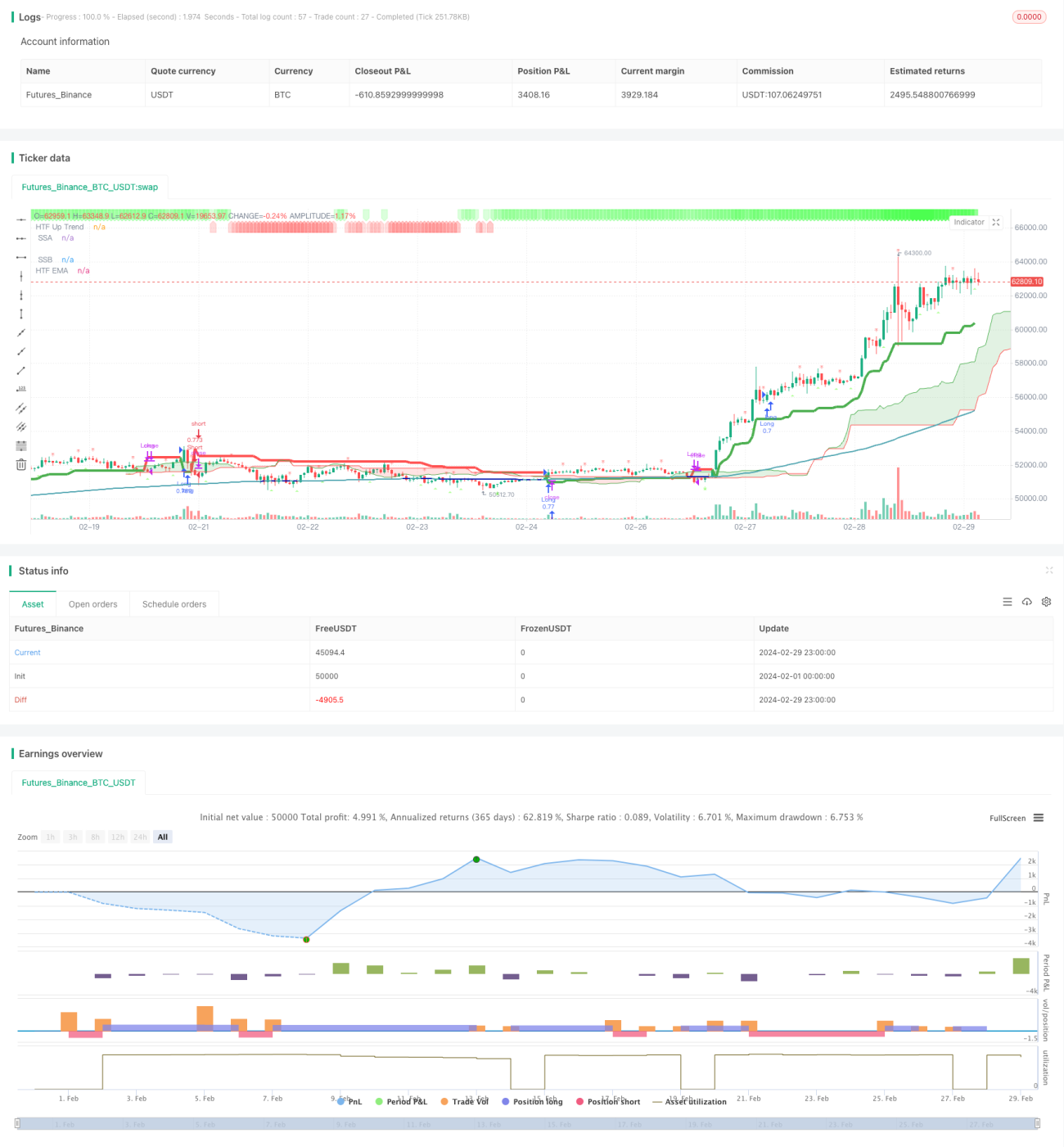
TrendHunter w/MF est une stratégie de suivi des tendances basée sur plusieurs indicateurs techniques et une analyse de plusieurs périodes. La stratégie prend en compte des facteurs tels que le nuage de marché, la moyenne, les supertrends, les tendances des vagues et les flux de capitaux, afin de déterminer les points d’entrée et de capturer les principales tendances du marché.
Le principe central de cette stratégie est basé sur l’analyse globale de plusieurs indicateurs techniques sur plusieurs périodes de temps.
Une courbe de marché ((Ichimoku): analyse la position relative du prix par rapport au graphique de la courbe de la courbe, ainsi que la position relative de la ligne moyenne par rapport au graphique de la courbe de la courbe, pour juger de la tendance actuelle du marché. Lorsque le prix est au-dessus du graphique de la courbe de la courbe et que la ligne moyenne est également au-dessus du graphique de la courbe de la courbe, il est considéré comme une tendance à la hausse; au contraire, il est considéré comme une tendance à la baisse.
SuperTrend (SuperTrend): Confirmation de la tendance actuelle du marché par l’analyse de la position relative du prix par rapport à la supertendance. Quand le prix est au-dessus de la supertendance, il est considéré comme une tendance à la hausse; le contraire est considéré comme une tendance à la baisse.
WaveTrend: analyse de la direction et de la position de l’indicateur de tendance des vagues pour juger de la tendance actuelle du marché. Quand la tendance des vagues est à la hausse et n’atteint pas la zone de survente, elle est considérée comme une tendance à la hausse; quand la tendance des vagues est à la baisse et n’atteint pas la zone de survente, elle est considérée comme une tendance à la baisse.
Le flux de trésorerie (MoneyFlow): analyse de l’état de l’indicateur de flux de trésorerie pour confirmer la tendance actuelle du marché. Quand le flux de trésorerie est positif, il est considéré comme une tendance à la hausse; le contraire est considéré comme une tendance à la baisse.
La stratégie de long terme exige que le prix soit au-dessus du graphique du nuage, à la même ligne au-dessus du graphique du nuage, que la tendance des supers soit à la hausse, que la tendance des vagues soit à la hausse et qu’elle n’ait pas atteint la zone de survente, et que le flux de fonds soit positif. Le courtage est le contraire. Ce filtrage strict de plusieurs indicateurs et de plusieurs périodes permet d’éviter efficacement la fréquence des transactions dans les marchés instables, ce qui améliore la stabilité et la fiabilité de la stratégie.
Une analyse complète de plusieurs indicateurs, une fiabilité élevée: la stratégie complète prend en compte plusieurs indicateurs techniques qui se complètent dans différentes conditions de marché, reflètent globalement les tendances du marché et évitent les erreurs possibles d’un seul indicateur.
Conditions d’entrée strictes pour éviter les transactions fréquentes: la stratégie définit des conditions d’entrée strictes, plusieurs indicateurs doivent être remplis simultanément pour être admis, ce qui évite efficacement les transactions fréquentes dans les marchés en crise et réduit les pertes de la stratégie.
Analyse de plusieurs périodes pour saisir les grandes tendances: la stratégie analyse les principales tendances du marché sur plusieurs périodes, ce qui permet à la stratégie de les saisir dans une perspective plus large et d’éviter d’être perturbée par le bruit à court terme.
La stratégie de stop loss est claire et le risque est contrôlable: la stratégie utilise la super-tendance comme condition de stop loss, une fois que la tendance du marché a changé, la stratégie peut arrêter les pertes en temps opportun et contrôler les pertes dans une plage acceptable.
Manque d’ajustement dynamique, capacité limitée à faire face aux changements du marché: le paramètre de la stratégie est fixe, manque de capacité à s’ajuster dynamiquement en fonction de l’état du marché. La stratégie peut être invalidée en cas de changement majeur de l’état du marché.
Les conditions d’entrée sont trop strictes et risquent de manquer des opportunités: les conditions d’entrée des stratégies sont très strictes, ce qui permet d’éviter des transactions fréquentes, mais peut également entraîner la perte de bonnes opportunités d’entrée.
Adaptabilité à des situations extrêmes inconnue: la stratégie fonctionne bien dans des conditions de marché normales, mais l’adaptabilité de la stratégie à des situations extrêmes, telles que des variations rapides et importantes du cours, reste à tester.
Les stratégies de stop loss sont relativement simples et ont de la place pour l’optimisation: les stratégies actuelles n’utilisent que les supertrends comme conditions de stop loss, ce qui est simple et évident, mais les stratégies de stop loss ont encore de la place pour une optimisation supplémentaire afin de mieux contrôler les risques.
L’introduction de certains indicateurs de jugement de l’état du marché, tels que l’indicateur de volatilité, peut être envisagée pour ajuster dynamiquement les paramètres de la stratégie en fonction des changements de l’état du marché, afin de s’adapter à différents environnements de marché.
Optimiser les conditions d’entrée, améliorer la sensibilité: il est possible d’envisager d’optimiser les conditions d’entrée, comme l’introduction de plus d’indicateurs de confirmation, afin d’améliorer la sensibilité de la stratégie tout en garantissant la fiabilité et de capturer plus d’opportunités de négociation.
Augmentation des mesures de réponse aux situations extrêmes: pour certaines situations extrêmes, telles que des pertes importantes et rapides, il est possible d’envisager l’introduction de mesures de réponse spéciales, telles que l’augmentation de l’intensité de l’arrêt des pertes ou la suspension des transactions, etc., afin de réduire les risques liés aux situations extrêmes.
Optimiser les stratégies de stop-loss et améliorer la capacité de contrôle des risques: il est possible d’envisager d’introduire davantage de conditions de stop-loss, telles que le stop-loss dans le temps, le stop-loss dans la bannière, etc. Il est également possible d’envisager d’introduire des stratégies de stop-loss dynamiques, telles que le stop-loss suivi, etc., pour mieux contrôler les risques.
La stratégie de suivi des tendances à plusieurs périodes est une stratégie de suivi des tendances basée sur plusieurs indicateurs et analyses à plusieurs périodes. En prenant en compte des facteurs tels que les courbes de marché, les moyennes, les super-tendances, les tendances ondulées et les flux de capitaux, les conditions d’entrée rigoureuses et l’analyse à plusieurs périodes, la stratégie capture de manière plus fiable les principales tendances du marché, évitant les transactions fréquentes dans les marchés instables et ayant une meilleure stabilité et fiabilité.
Cependant, la stratégie présente des limites et des risques, tels que le manque de capacité d’adaptation dynamique, les conditions d’entrée qui peuvent être trop strictes, l’adaptation à des situations extrêmes inconnue, et la stratégie d’arrêt des pertes relativement simple. Ce sont des directions que la stratégie peut optimiser et améliorer à l’avenir.
Dans l’ensemble, la stratégie de suivi de tendance à plusieurs périodes de temps de TrendHunter w/MF est une stratégie de suivi de tendance à fort potentiel. Lors de son utilisation, le trader doit bien comprendre ses principes, ses avantages et ses risques, et effectuer les ajustements et optimisations nécessaires en fonction de ses propres préférences en matière de risque et de style de négociation.
/*backtest
start: 2024-02-01 00:00:00
end: 2024-02-29 23:59:59
period: 1h
basePeriod: 15m
exchanges: [{"eid":"Futures_Binance","currency":"BTC_USDT"}]
*/
// This Pine Script™ code is subject to the terms of the Mozilla Public License 2.0 at https://mozilla.org/MPL/2.0/
// © godzcopilot / blockybears
// Thanks to anthonyf50 for his MTF Ichimoku https://www.tradingview.com/script/Pw9cBFma/
// Thanks to KivancOzbilgic for his SuperTrend https://www.tradingview.com/script/r6dAP7yi/
// Thanks to ZenAndTheArtOfTrading / PineScriptMastery for their Higher Timeframe EMA https://www.tradingview.com/script/Vh3XG9sD-Higher-Timeframe-EMA/
// Thanks to LazyBear for WaveTrend Oscillator https://www.tradingview.com/script/2KE8wTuF-Indicator-WaveTrend-Oscillator-WT/
// Thanks to andreholanda73 for MFI+RSI Area https://www.tradingview.com/script/UlGZzUAr/
//@version=5
strategy("TrendHunter w/MF [Blocky]", overlay=true, default_qty_type=strategy.percent_of_equity, default_qty_value=80, initial_capital=1000, pyramiding=0)
// ================
// Strategy Inputs
// ================
// Defines user inputs for configuring the strategy.
// Inputs for EMA
len = input.int(title="EMA Length", defval=200, group ='== EMA ==')
col = input.bool(title="Colour EMA", defval=true, group ='== EMA ==')
// SuperTrend
Periods = input(title='ATR: Period', defval=10, group = '== Supertrend ==', inline = 'atr')
Multiplier = input.float(title='Mult', step=0.1, defval=3.0, group = '== Supertrend ==', inline = 'atr')
Src = input.source(title='Src', defval=hl2, group = '== Supertrend ==', inline = 'atr')
// Ichimoku
conversionPeriods = input.int(9, minval=1, title='Conversion', group = '== Ichimoku ==', inline = 'ich1')
basePeriods = input.int(26, minval=1, title='Base', group = '== Ichimoku ==', inline = 'ich1')
laggingSpan2Periods = input.int(52, minval=1, title='Lagging', group = '== Ichimoku ==', inline = 'ich2')
displacement = input.int(26, minval=1, title='Displacement', group = '== Ichimoku ==', inline = 'ich2')
// Ichimoku Display Options
isActiveConversion = input(false, 'Conversion', group = '== Ichimoku ==', inline = 'lines1')
isActiveBase = input(false, 'Base', group = '== Ichimoku ==', inline = 'lines1')
isActiveLagging = input(false, 'Lagging', group = '== Ichimoku ==', inline = 'lines1')
isActiveCloud = input(true, 'Cloud', group = '== Ichimoku ==', inline = 'lines1')
// Input for WaveTrend
n1 = input(9, 'Channel Length', group = '== WaveTrend ==', inline = 'wt1')
n2 = input(12, 'Average Length', group = '== WaveTrend ==', inline = 'wt1')
obLevel = input(60, 'Over Bought', group = '== WaveTrend ==', inline = 'wt2')
osLevel = input(-60, 'Over Sold', group = '== WaveTrend ==', inline = 'wt2')
// Input for Money Flow
rsiMFIperiod = input(60, 'Money Flow Length', group = '== Money Flow ==', inline = 'mf')
rsiMFIMultiplier = input(190, 'RSI+MFI Area multiplier', group = '== Money Flow ==', inline = 'mf')
MFRSIMA = input.string(defval='SMA', title='Money Flow MA Type', options=['RMA', 'SMA', 'EMA', 'WMA', 'VWMA'], group = '== Money Flow ==', inline = 'mf')
// ================
// Strategy Options
// ================
bTable = input.bool(false, title='Trade Table', group='== Strategy Options ==', tooltip = "Show table that shows current selected options and trade trade entry parameters")
bLong = input.bool(true, title='Enter Longs', group='== Strategy Options ==', inline = 'LongShort')
bShort = input.bool(true, title='Enter Shorts', group='== Strategy Options ==', inline = 'LongShort', tooltip = "Filter long / short trade signals")
bPriceCloud = input.bool(true, title='Price outside cloud', group='== Strategy Options ==', inline='PriceCloud')
priceActionOption = input.string(title="", defval="Close", options=["Close", "Candle Body", "Full Candle"], group = "== Strategy Options ==", inline='PriceCloud')
bPriceEMA = input.bool(false, title='Price above/below EMA', group='== Strategy Options ==', inline='PriceEMA')
priceEMAOption = input.string(title="", defval="Close", options=["Close", "Candle Body", "Full Candle"], group = "== Strategy Options ==", inline='PriceEMA')
bSuper = input.bool(true, title='Supertrend transistions', group='== Strategy Options ==', tooltip = "Trade in direction of the supertrend transitions")
bEMACloud1 = input.bool(true, title='EMA Outside Cloud', group='== Strategy Options ==', tooltip = "EMA must be outside the ichimoku cloud")
bEMACloud2 = input.bool(false, title='EMA above/below Cloud', group='== Strategy Options ==', tooltip = "Longs when EMA above the cloud.\nShort when EMA below the cloud")
bMFI = input.bool(false, title='Money Flow', group='== Strategy Options ==', tooltip = "Money Flow Green for Long\nMoney Flow Red for Short")
bWT = input.bool(false, title='Wavetrend', group='== Strategy Options ==', inline = 'WT')
bWTOB = input.bool(false, title='Overbought/sold', group='== Strategy Options ==', tooltip = "Longs when WT Rising\nShort when WT Falling\n\nRestrict entries if in overbough or oversold levels",inline = 'WT')
bExitHTFTrail = input.bool(true, title='Super Trend Exits', group='== Strategy Options ==', inline = 'Exits')
// ===========================
// EMA Functions and Plotting
// ===========================
// Calculate EMA
ema = ta.ema(close, len)
emaSmooth = request.security(syminfo.tickerid, "", ema[barstate.isrealtime ? 1 : 0], gaps=barmerge.gaps_on)[barstate.isrealtime ? 0 : 1]
// Draw EMA
plot(emaSmooth, color=col ? (close > emaSmooth ? color.rgb(76, 163, 175) : color.rgb(6, 23, 173)) : color.black, linewidth=2, title="HTF EMA")
// ==================================
// Supertrend Functions and Plotting
// ==================================
// Function to calculate SuperTrend
calcSuperTrend(src, atrPeriods, multiplier) =>
atr = ta.atr(atrPeriods)
up = src - multiplier * atr
up1 = nz(up[1], up)
up := close[1] > up1 ? math.max(up, up1) : up
dn = src + multiplier * atr
dn1 = nz(dn[1], dn)
dn := close[1] < dn1 ? math.min(dn, dn1) : dn
trend = 1
trend := nz(trend[1], trend)
trend := trend == -1 and close > dn1 ? 1 : trend == 1 and close < up1 ? -1 : trend
[up, dn, trend]
// Fetching the higher time frame data
[HTF_up, HTF_dn, HTF_trend] = request.security(syminfo.tickerid, "", calcSuperTrend(hl2, Periods, Multiplier), lookahead=barmerge.lookahead_on)
// Plotting for the higher time frame
plot(HTF_trend == 1 ? HTF_up : HTF_dn, title='HTF Up Trend', color= HTF_trend == 1 ? color.green : color.red, linewidth=4)
// ===============================
// Ichimoku Functions and Plotting
// ===============================
// Function to convert timeframe to hours
f_convertTimeframeToHours(tf) =>
val = 0.0
if tf == "1S" or tf == "S"
val := 1.0 / 3600.0
else if str.contains(tf, "S")
val := str.tonumber(str.replace(tf, "S", "")) / 3600.0
else if tf == "1D" or tf == "D"
val := 24.0
else if str.contains(tf, "D")
val := str.tonumber(str.replace(tf, "D", "")) * 24.0
else if tf == "1W" or tf == "W"
val := 24.0 * 7.0
else if str.contains(tf, "W")
val := str.tonumber(str.replace(tf, "W", "")) * 24.0 * 7.0
else if tf == "1M" or tf == "M"
val := 24.0 * 30.0 // Approximation for a month
else if str.contains(tf, "M")
val := str.tonumber(str.replace(tf, "M", "")) * 24.0 * 30.0 // Approximation for months
else
// Default to minutes
val := str.tonumber(tf) / 60.0
val
// Time
timeOffset = time - time[1]
// Returns the displacement based on the chart / HTF resolution
f_getDisplacement(_res) =>
_res == '' ? displacement : math.round(f_convertTimeframeToHours(_res) / f_convertTimeframeToHours(timeframe.period) * displacement)
//f_avgDilationOf(_res) * displacement
// Returns average value between lowest and highest
f_avgLH(_len) =>
math.avg(ta.lowest(_len), ta.highest(_len))
// Returns f_donchian data
f_donchian(_tf, _src) =>
request.security(syminfo.tickerid, _tf, _src, barmerge.gaps_off, barmerge.lookahead_on)
// Returns ichimoku data
f_ichimokuData(_tf) =>
_isShow = _tf == '' or f_convertTimeframeToHours(_tf) >= f_convertTimeframeToHours(timeframe.period)
_displacement = _isShow ? f_getDisplacement(_tf) : na
_Conversion = _isShow ? f_donchian(_tf, f_avgLH(conversionPeriods)) : na
_Base = _isShow ? f_donchian(_tf, f_avgLH(basePeriods)) : na
_Lagging = _isShow ? f_donchian(_tf, close) : na
_SSA = _isShow ? math.avg(_Conversion, _Base) : na
_SSB = _isShow ? f_donchian(_tf, f_avgLH(laggingSpan2Periods)) : na
_middleCloud = _isShow ? _SSA[0] > _SSB[0] ? _SSA[0] - math.abs(_SSA[0] - _SSB[0]) / 2 : _SSA[0] + math.abs(_SSA[0] - _SSB[0]) / 2 : na
[_displacement, _Conversion, _Base, _Lagging, _SSA, _SSB, _middleCloud]
// Plotting ichimoku data
[Displacement, Conversion, Base, Lagging, SSA, SSB, fisrtMiddleCloud] = f_ichimokuData("")
// ————— Conversion
plot(isActiveConversion ? Conversion : na, color=color.new(color.blue, 0), title=' Conversion', linewidth=1)
// ————— Base
plot(isActiveBase ? Base : na, color=color.new(color.fuchsia, 0), title=' Base', linewidth=2)
// ————— Lagging
plot(isActiveLagging ? Lagging : na, offset=-Displacement, color=color.new(color.green, 0), title=' Lagging')
// ————— SSA + SSB
ssa = plot(isActiveCloud ? SSA : na, offset=Displacement, color=color.new(color.green, 0), title=' SSA', linewidth=1)
ssb = plot(isActiveCloud ? SSB : na, offset=Displacement, color=color.new(color.red, 0), title=' SSB', linewidth=1)
fill(ssa, ssb, color=color.new(SSA > SSB ? color.green : color.red , 80), title=' Cloud')
// ===============================
// Makret Cypher Additions
// ===============================
// WaveTrend calculations
ap = hlc3
esa = ta.ema(ap, n1)
d = ta.ema(math.abs(ap - esa), n1)
ci = (ap - esa) / (0.015 * d)
tci = ta.ema(ci, n2)
wt1 = tci
wt2 = ta.sma(wt1, 3)
// WaveTrend plotting
//plot(0, color=color.rgb(120, 123, 134), title='Zero Line')
//plot(emaSmooth + wt1, color=color.rgb(191, 228, 255), style=plot.style_linebr, title='WaveTrend 1')
//plot(emaSmooth + wt2, color=color.rgb(56, 56, 56, 40), style=plot.style_linebr, title='WaveTrend 2')
// WaveTrend shapes
plotshape(ta.crossover(wt1, wt2) and wt2[2] < osLevel ? close : na, title='Pos Crossover', location=location.belowbar, style=shape.cross, size=size.small, color=color.rgb(63, 255, 0, 60))
plotshape(ta.crossover(wt2, wt1) and wt1[2] > osLevel ? close : na, title='Neg Crossover', location=location.abovebar, style=shape.cross, size=size.small, color=color.rgb(255, 82, 82, 60))
plotshape(ta.crossover(wt1, wt2) and osLevel ? close : na, title='Positive Crossover', location=location.belowbar, style=shape.triangleup, size=size.tiny, color=color.rgb(63, 255, 0, 60))
plotshape(ta.crossover(wt2, wt1) and obLevel ? close : na, title='Negative Crossover', location=location.abovebar, style=shape.triangledown, size=size.tiny, color=color.rgb(255, 82, 82, 60))
// Function to determine WaveTrend direction and steepness
isWaveTrendUp() =>
wt1Slope = wt1 - wt1[1]
wt2Slope = wt2 - wt2[1]
if wt1 > wt2 // wt1Slope > 0 and wt2Slope > 0
1 // Both are going up
else if wt1 < wt2 // wt1Slope < 0 and wt2Slope < 0
2 // Both are going down
else
na // Trends are not in the same direction
ma(matype, src, length) =>
if matype == 'RMA'
ta.rma(src, length)
else
if matype == 'SMA'
ta.sma(src, length)
else
if matype == 'EMA'
ta.ema(src, length)
else
if matype == 'WMA'
ta.wma(src, length)
else
if matype == 'VWMA'
ta.vwma(src, length)
else
src
// Money Flow calculations
candleValue = (close - open) / (high - low)
MVC = ma(MFRSIMA, candleValue, rsiMFIperiod)
MVC := MVC * rsiMFIMultiplier
mfi_transp = math.abs(MVC) > 35 ? 0 : math.abs(MVC) > 30 ? 20 : math.abs(MVC) > 25 ? 30 : math.abs(MVC) > 20 ? 40 : math.abs(MVC) > 15 ? 50 : math.abs(MVC) > 10 ? 60 : math.abs(MVC) > 5 ? 65 : math.abs(MVC) > 2 ? 70 : 80
color_area = MVC > 0 ? color.rgb(76, 255, 80, mfi_transp) : color.rgb(255, 82, 82, mfi_transp)
// Money Flow plotting
// RSIMFIplot = plot(MVC * rsiMFIMultiplier, title='Money Flow', color=color_area, style=plot.style_area)
// fill(RSIMFIplot, plot(0), color_area)
plotshape(MVC > 0 ? true : na, title='MFI', location=location.top, style=shape.labeldown, size= size.tiny, color=color_area)
plotshape(MVC < 0 ? true : na, title='MFI', location=location.top, style= shape.labelup, size= size.tiny, color=color_area)
// ===============================
// Strategy Entries
// ===============================
// Checks whether price is inside the Ichimoku cloud
f_PriceCloud(dir) =>
_enter = false
if bPriceCloud
if bLong and dir == 1
_enter := switch priceActionOption
"Close" => close > math.max(SSA[Displacement], SSB[Displacement])
"Candle Body" => open > math.max(SSA[Displacement], SSB[Displacement]) and close > math.max(SSA[Displacement], SSB[Displacement])
"Full Candle" => low > math.max(SSA[Displacement], SSB[Displacement]) and high > math.max(SSA[Displacement], SSB[Displacement])
if bShort and dir == 2
_enter := switch priceActionOption
"Close" => close < math.min(SSA[Displacement], SSB[Displacement])
"Candle Body" => open < math.min(SSA[Displacement], SSB[Displacement]) and close < math.min(SSA[Displacement], SSB[Displacement])
"Full Candle" => low < math.min(SSA[Displacement], SSB[Displacement]) and high < math.min(SSA[Displacement], SSB[Displacement])
else
_enter := na
_enter
// Checks whether price is above / below the ema
f_PriceEMA(dir) =>
_enter = false
if bPriceEMA
if bLong and dir == 1
_enter := switch priceEMAOption
"Close" => close > math.max(SSA[Displacement], SSB[Displacement])
"Candle Body" => open > math.max(SSA[Displacement], SSB[Displacement]) and close > math.max(SSA[Displacement], SSB[Displacement])
"Full Candle" => low > math.max(SSA[Displacement], SSB[Displacement]) and high > math.max(SSA[Displacement], SSB[Displacement])
if bShort and dir == 2
_enter := switch priceEMAOption
"Close" => close < math.min(SSA[Displacement], SSB[Displacement])
"Candle Body" => open < math.min(SSA[Displacement], SSB[Displacement]) and close < math.min(SSA[Displacement], SSB[Displacement])
"Full Candle" => low < math.min(SSA[Displacement], SSB[Displacement]) and high < math.min(SSA[Displacement], SSB[Displacement])
else
_enter := na
_enter
// Checks HTF supertrend direction
f_Super(dir) =>
_enter = false
if bSuper
if bLong and dir == 1
_enter := HTF_trend == 1
if bShort and dir == 2
_enter := HTF_trend == -1
else
_enter := na
_enter
// Checks whether ema is inside the Ichimoku cloud
f_EMACloud1(dir) =>
_enter = false
if bEMACloud1
if bLong and dir == 1
_enter := (emaSmooth > math.max(SSA[Displacement], SSB[Displacement])) or (emaSmooth < math.min(SSA[Displacement], SSB[Displacement]))
if bShort and dir == 2
_enter := (emaSmooth > math.max(SSA[Displacement], SSB[Displacement])) or (emaSmooth < math.min(SSA[Displacement], SSB[Displacement]))
else
_enter := na
_enter
// Checks whether ema is above/below Ichimoku cloud
f_EMACloud2(dir) =>
_enter = false
if bEMACloud2
if bLong and dir == 1
_enter := emaSmooth > math.max(SSA[Displacement], SSB[Displacement])
if bShort and dir == 2
_enter := emaSmooth < math.min(SSA[Displacement], SSB[Displacement])
else
_enter := na
_enter
// Checks whether moneyflow is positive
f_MFI(dir) =>
_enter = false
if bMFI
if bLong and dir == 1
_enter := MVC > 0
if bShort and dir == 2
_enter := MVC < 0
else
_enter := na
_enter
// Checks whether wavetrend is rising or falling
f_WT(dir) =>
_enter = false
if bWT
if bLong and dir == 1
_enter := isWaveTrendUp() == dir
if bShort and dir == 2
_enter := isWaveTrendUp() == dir
else
_enter := na
_enter
f_WTOB(dir) =>
_enter = false
if bWT and bWTOB
if bLong and dir == 1
_enter := wt1 < obLevel
if bShort and dir == 2
_enter := wt1 > osLevel
else
_enter := na
_enter
// Check if a value is 'na' or true.
f_NATrue(val) =>
_enter = false
if na(val)
_enter := true
if val
_enter := true
_enter
// Consolidates entry conditions.
f_checkCondition(dir) =>
_enter = false
if na(f_PriceCloud(dir)) and na(f_PriceEMA(dir)) and na(f_Super(dir)) and na(f_EMACloud1(dir)) and na(f_EMACloud2(dir)) and na(f_MFI(dir)) and na(f_WT(dir)) and na(f_WTOB(dir))
_enter := false
else if f_NATrue(f_PriceCloud(dir)) and f_NATrue(f_PriceEMA(dir)) and f_NATrue(f_Super(dir)) and f_NATrue(f_EMACloud1(dir)) and f_NATrue(f_EMACloud2(dir)) and f_NATrue(f_MFI(dir)) and f_NATrue(f_WT(dir)) and f_NATrue(f_WTOB(dir))
_enter := true
_enter
// Execute long trade entries
longCondition = bLong and f_checkCondition(1)
if (longCondition)
strategy.entry("Long", strategy.long)
// Execute short trade entries
shortCondition = bShort and f_checkCondition(2)
if (shortCondition)
strategy.entry("Short", strategy.short)
// Excute trade exits
exitLong = (bExitHTFTrail and (close < HTF_up or HTF_trend == -1))
exitShort = (bExitHTFTrail and (close > HTF_dn or HTF_trend == 1))
if exitLong
strategy.close("Long")
if exitShort
strategy.close("Short")
// Creates a table shoing all the user options and their current status for entering a trade
if bTable
// Create a table
tbl = table.new(position = position.bottom_right, columns = 4, rows = 11, bgcolor=color.new(color.black,100), border_width = 0, frame_width = 0)
table.cell(tbl, 1, 0, "Selected", text_halign = text.align_center, text_size = size.small, text_color = color.rgb(207, 207, 207))
table.cell(tbl, 2, 0, "Long", bgcolor=na(bLong) ? color.new(color.black,100) : bShort ? color.rgb(4, 112, 8) : color.rgb(100, 7, 7), text_halign = text.align_center, text_size = size.small, text_color = color.rgb(207, 207, 207))
table.cell(tbl, 3, 0, "Short", bgcolor=na(bShort) ? color.new(color.black,100) : bShort ? color.rgb(4, 112, 8) : color.rgb(100, 7, 7), text_halign = text.align_center, text_size = size.small, text_color = color.rgb(207, 207, 207))
table.cell(tbl, 0, 1, "Entry", text_halign = text.align_left, text_size = size.small, text_color = color.rgb(207, 207, 207))
table.cell(tbl, 2, 1, longCondition ? "✓" : "✗", bgcolor=longCondition ? color.green : color.red, text_halign = text.align_center, text_size = size.small, text_color = color.rgb(207, 207, 207))
table.cell(tbl, 3, 1, shortCondition ? "✓" : "✗", bgcolor=shortCondition ? color.green : color.red, text_halign = text.align_center, text_size = size.small, text_color = color.rgb(207, 207, 207))
table.cell(tbl, 0, 3, "Price Cloud", text_halign = text.align_left, text_size = size.small, text_color = color.rgb(207, 207, 207))
table.cell(tbl, 1, 3, bPriceCloud ? "✓" : "✗", bgcolor=na(bPriceCloud) ? color.new(color.black,100) : bPriceCloud ? color.green : color.red, text_halign = text.align_center, text_size = size.small, text_color = color.rgb(207, 207, 207))
table.cell(tbl, 2, 3, f_PriceCloud(1) ? "✓" : "✗", bgcolor=na(f_PriceCloud(1)) ? color.new(color.black,100) : f_PriceCloud(1) ? color.green : color.red, text_halign = text.align_center, text_size = size.small, text_color = color.rgb(207, 207, 207))
table.cell(tbl, 3, 3, f_PriceCloud(2) ? "✓" : "✗", bgcolor=na(f_PriceCloud(2)) ? color.new(color.black,100) : f_PriceCloud(2) ? color.green : color.red, text_halign = text.align_center, text_size = size.small, text_color = color.rgb(207, 207, 207))
table.cell(tbl, 0, 4, "Price EMA", text_halign = text.align_left, text_size = size.small, text_color = color.rgb(207, 207, 207))
table.cell(tbl, 1, 4, bPriceEMA ? "✓" : "✗", bgcolor=na(bPriceEMA) ? color.new(color.black,100) : bPriceEMA ? color.green : color.red, text_halign = text.align_center, text_size = size.small, text_color = color.rgb(207, 207, 207))
table.cell(tbl, 2, 4, f_PriceEMA(1) ? "✓" : "✗", bgcolor=na(f_PriceEMA(1)) ? color.new(color.black,100) : f_PriceEMA(1) ? color.green : color.red, text_halign = text.align_center, text_size = size.small, text_color = color.rgb(207, 207, 207))
table.cell(tbl, 3, 4, f_PriceEMA(2) ? "✓" : "✗", bgcolor=na(f_PriceEMA(2)) ? color.new(color.black,100) : f_PriceEMA(2) ? color.green : color.red, text_halign = text.align_center, text_size = size.small, text_color = color.rgb(207, 207, 207))
table.cell(tbl, 0, 5, "SuperTrend", text_halign = text.align_left, text_size = size.small, text_color = color.rgb(207, 207, 207))
table.cell(tbl, 1, 5, bSuper ? "✓" : "✗", bgcolor=na(bSuper) ? color.new(color.black,100) : bSuper ? color.green : color.red, text_halign = text.align_center, text_size = size.small, text_color = color.rgb(207, 207, 207))
table.cell(tbl, 2, 5, f_Super(1) ? "✓" : "✗", bgcolor=na(f_Super(1)) ? color.new(color.black,100) : f_Super(1) ? color.green : color.red, text_halign = text.align_center, text_size = size.small, text_color = color.rgb(207, 207, 207))
table.cell(tbl, 3, 5, f_Super(2) ? "✓" : "✗", bgcolor=na(f_Super(2)) ? color.new(color.black,100) : f_Super(2) ? color.green : color.red, text_halign = text.align_center, text_size = size.small, text_color = color.rgb(207, 207, 207))
table.cell(tbl, 0, 6, "EMA Outside Cloud", text_halign = text.align_left, text_size = size.small, text_color = color.rgb(207, 207, 207))
table.cell(tbl, 1, 6, bEMACloud1 ? "✓" : "✗", bgcolor=na(bEMACloud1) ? color.new(color.black,100) : bEMACloud1 ? color.green : color.red, text_halign = text.align_center, text_size = size.small, text_color = color.rgb(207, 207, 207))
table.cell(tbl, 2, 6, f_EMACloud1(1) ? "✓" : "✗", bgcolor=na(f_EMACloud1(1)) ? color.new(color.black,100) : f_EMACloud1(1) ? color.green : color.red, text_halign = text.align_center, text_size = size.small, text_color = color.rgb(207, 207, 207))
table.cell(tbl, 3, 6, f_EMACloud1(2) ? "✓" : "✗", bgcolor=na(f_EMACloud1(2)) ? color.new(color.black,100) : f_EMACloud1(2) ? color.green : color.red, text_halign = text.align_center, text_size = size.small, text_color = color.rgb(207, 207, 207))
table.cell(tbl, 0, 7, "EMA Above/Below Cloud", text_halign = text.align_left, text_size = size.small, text_color = color.rgb(207, 207, 207))
table.cell(tbl, 1, 7, bEMACloud2 ? "✓" : "✗", bgcolor=na(bEMACloud2) ? color.new(color.black,100) : bEMACloud2 ? color.green : color.red, text_halign = text.align_center, text_size = size.small, text_color = color.rgb(207, 207, 207))
table.cell(tbl, 2, 7, f_EMACloud2(1) ? "✓" : "✗", bgcolor=na(f_EMACloud2(1)) ? color.new(color.black,100) : f_EMACloud2(1) ? color.green : color.red, text_halign = text.align_center, text_size = size.small, text_color = color.rgb(207, 207, 207))
table.cell(tbl, 3, 7, f_EMACloud2(2) ? "✓" : "✗", bgcolor=na(f_EMACloud2(2)) ? color.new(color.black,100) : f_EMACloud2(2) ? color.green : color.red, text_halign = text.align_center, text_size = size.small, text_color = color.rgb(207, 207, 207))
table.cell(tbl, 0, 8, "Moneyflow", text_halign = text.align_left, text_size = size.small, text_color = color.rgb(207, 207, 207))
table.cell(tbl, 1, 8, bMFI ? "✓" : "✗", bgcolor=na(bMFI) ? color.new(color.black,100) : bMFI ? color.green : color.red, text_halign = text.align_center, text_size = size.small, text_color = color.rgb(207, 207, 207))
table.cell(tbl, 2, 8, f_MFI(1) ? "✓" : "✗", bgcolor=na(f_MFI(1)) ? color.new(color.black,100) : f_MFI(1) ? color.green : color.red, text_halign = text.align_center, text_size = size.small, text_color = color.rgb(207, 207, 207))
table.cell(tbl, 3, 8, f_MFI(2) ? "✓" : "✗", bgcolor=na(f_MFI(2)) ? color.new(color.black,100) : f_MFI(2) ? color.green : color.red, text_halign = text.align_center, text_size = size.small, text_color = color.rgb(207, 207, 207))
table.cell(tbl, 0, 9, "WaveTrend", text_halign = text.align_left, text_size = size.small, text_color = color.rgb(207, 207, 207))
table.cell(tbl, 1, 9, bWT ? "✓" : "✗", bgcolor=na(bWT) ? color.new(color.black,100) : bWT ? color.green : color.red, text_halign = text.align_center, text_size = size.small, text_color = color.rgb(207, 207, 207))
table.cell(tbl, 2, 9, f_WT(1) ? "✓" : "✗", bgcolor=na(f_WT(1)) ? color.new(color.black,100) : f_WT(1) ? color.green : color.red, text_halign = text.align_center, text_size = size.small, text_color = color.rgb(207, 207, 207))
table.cell(tbl, 3, 9, f_WT(2) ? "✓" : "✗", bgcolor=na(f_WT(2)) ? color.new(color.black,100) : f_WT(2) ? color.green : color.red, text_halign = text.align_center, text_size = size.small, text_color = color.rgb(207, 207, 207))
table.cell(tbl, 0, 10, "Overbought/Sold " + str.tostring(wt1, '#.#'), text_halign = text.align_left, text_size = size.small, text_color = color.rgb(207, 207, 207))
table.cell(tbl, 1, 10, bWTOB ? "✓" : "✗", bgcolor=na(bWTOB) ? color.new(color.black,100) : bWTOB ? color.green : color.red, text_halign = text.align_center, text_size = size.small, text_color = color.rgb(207, 207, 207))
table.cell(tbl, 2, 10, f_WTOB(1) ? "✓" : "✗", bgcolor=na(f_WTOB(1)) ? color.new(color.black,100) : f_WTOB(1) ? color.green : color.red, text_halign = text.align_center, text_size = size.small, text_color = color.rgb(207, 207, 207))
table.cell(tbl, 3, 10, f_WTOB(2) ? "✓" : "✗", bgcolor=na(f_WTOB(2)) ? color.new(color.black,100) : f_WTOB(2) ? color.green : color.red, text_halign = text.align_center, text_size = size.small, text_color = color.rgb(207, 207, 207))