Stratégie d'inversion de tendance de Fibonacci

ATR TSOT RMA
Date de création: 2024-04-28 14:05:45 Dernière modification: 2024-04-28 14:05:45
Copier: 0 Nombre de clics: 652
1
Suivre
1617
Abonnés

Stratégie d’inversion de tendance de Fibonacci

Aperçu

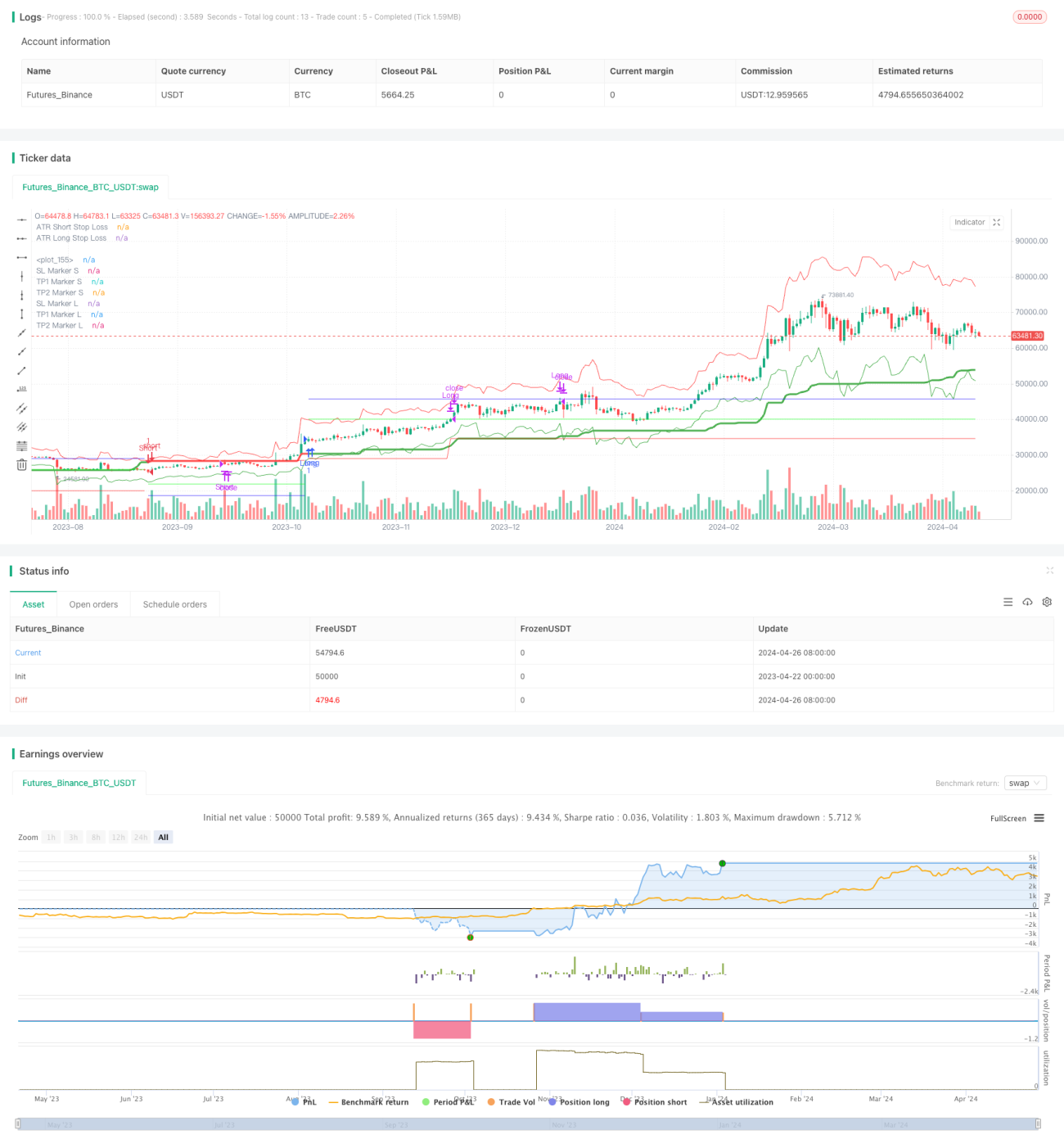
La “stratégie de retournement de tendance de Fibonacci” est une stratégie de négociation qui utilise le niveau de retrait de Fibonacci et l’indicateur de force de tendance (TSOT) pour capturer les points de retournement de tendance du marché. La stratégie permet de gérer les risques et de maximiser les bénéfices grâce à des arrêts ATR dynamiques et des arrêts partiels.

Principe de stratégie

La stratégie utilise les niveaux de rétraction de Fibonacci ((0.236, 0.5 et 0.786) pour identifier les points de retournement de tendance potentiels. En même temps, l’indicateur TSOT est utilisé pour mesurer la force de la tendance par le classement en pourcentage du prix.

Avantages stratégiques

  1. La combinaison des retraits de Fibonacci et de l’indicateur de force de tendance permet de capturer plus précisément les points de retournement de tendance.
  2. Le stop-loss ATR dynamique est ajusté en fonction de la volatilité du marché actuel, permettant une gestion efficace des risques.
  3. Les paramètres de blocage partiel permettent d’obtenir des bénéfices en temps opportun lorsque l’objectif de profit est atteint, tout en laissant les bénéfices continuer à courir.
  4. La flexibilité et l’adaptabilité de la stratégie ont été améliorées en permettant le renversement des positions en fonction des nouveaux signaux.

Risque stratégique

  1. Les signaux de retournement fréquents peuvent entraîner une survente et des pertes en cas de turbulences ou de tendances incertaines.
  2. Bien que l’arrêt dynamique et l’arrêt partiel aident à contrôler les risques, des retraits plus importants peuvent survenir dans des situations extrêmes.
  3. Le choix des paramètres de la stratégie (par exemple, les niveaux de Fibonacci, le calcul TSOT, etc.) doit être optimisé en fonction des différents marchés et des différentes périodes de temps. Des paramètres inappropriés peuvent affecter la performance de la stratégie.

Orientation de l’optimisation de la stratégie

  1. L’introduction de plus de signaux de confirmation (tels que le volume des transactions, les indicateurs de dynamique, etc.) pour filtrer les signaux faux et améliorer la précision d’ouverture des positions.
  2. Optimisation de la logique de stop loss, comme l’ajustement dynamique de l’objectif de stop loss combiné à l’intensité de la tendance, ou l’introduction de stops de suivi, etc.
  3. Pour les cas de retournements fréquents, il est possible de définir des limites de retournement ou d’ajouter des conditions de filtrage de retournement pour réduire les transactions excessives.
  4. Optimisation et test minutieux des paramètres stratégiques pour différentes caractéristiques du marché et variétés de transactions.

Résumer

La stratégie Fibonacci de renversement de tendance permet de capturer efficacement les points de renversement de tendance grâce à la combinaison du niveau de rétractation Fibonacci et de l’indicateur TSOT, et d’atteindre les objectifs de contrôle des risques et de profit grâce à des arrêts de perte dynamiques et partiels. La stratégie fonctionne bien dans les marchés où la tendance est claire, mais nécessite une réponse prudente dans les marchés en turbulence.

Code source de la stratégie
/*backtest
start: 2023-04-22 00:00:00
end: 2024-04-27 00:00:00
period: 1d
basePeriod: 1h
exchanges: [{"eid":"Futures_Binance","currency":"BTC_USDT"}]
*/

// This Pine Script™ code is subject to the terms of the Mozilla Public License 2.0 at https://mozilla.org/MPL/2.0/
// © nioboi

//@version=5
strategy("Fibonacci Trend Reversals", overlay=true, process_orders_on_close = true, commission_value = 0.055, initial_capital = 1000)

// =========================================
// Input Groups
// =========================================
string rsi_group = "RSI"
string main_group = "Fib Sensitivity"
string atr_sl_finder_group = "ATR SL Finder"
string trade_execution_group = "Strategy Execution"

// =========================================
// Fibonacci Retracement Trend Reversal
// =========================================
sensitivity_input = input.float(title = 'Sensitive', step = 0.1, defval = 18, group = main_group)
var bool is_long_trend_started = false
var bool is_short_trend_started = false
var bool is_trend_change = na
var bool is_long_trend = false
var bool is_short_trend = false
var bool can_long = false
var bool can_short = false

sensitivity = sensitivity_input
sensitivity *= 10

high_line = ta.highest(high, int(sensitivity))
low_line = ta.lowest(low, int(sensitivity))
channel_range = high_line - low_line
fib_236 = high_line - channel_range * (0.236)
fib_5 = high_line - channel_range * 0.5
fib_786 = high_line - channel_range * (0.786)
imba_trend_line = fib_5

// =========================================
// TSOT | Trend Strength Over Time
// =========================================

// Calculate 75th percentile of price for each length
percentile_13H = ta.percentile_nearest_rank(high, 13, 75) 
percentile_21H = ta.percentile_nearest_rank(high, 21, 75) 
percentile_34H = ta.percentile_nearest_rank(high, 34, 75) 
percentile_55H = ta.percentile_nearest_rank(high, 55, 75) 
percentile_89H = ta.percentile_nearest_rank(high, 89, 75)

// Calculate 25th percentile of  price for each length
percentile_13L =  ta.percentile_nearest_rank(low, 13, 25) 
percentile_21L =  ta.percentile_nearest_rank(low, 21, 25) 
percentile_34L =  ta.percentile_nearest_rank(low, 34, 25) 
percentile_55L = ta.percentile_nearest_rank(low, 55, 25) 
percentile_89L = ta.percentile_nearest_rank(low, 89, 25)

// Calculate 75th and 25th for length 144 (longest length)
highest_high = ta.percentile_nearest_rank(high, 144, 75) 
lowest_low = ta.percentile_nearest_rank(low, 144, 25) 

// Calculate trend strength conditions
trendBull1 = percentile_13H > highest_high
trendBull2 = percentile_21H > highest_high
trendBull3 = percentile_34H > highest_high
trendBull4 = percentile_55H > highest_high
trendBull5 = percentile_89H > highest_high
trendBull6 = percentile_13L > highest_high
trendBull7 = percentile_21L > highest_high
trendBull8 = percentile_34L > highest_high
trendBull9 = percentile_55L > highest_high
trendBull10 = percentile_89L > highest_high

trendBear1 = percentile_13H < lowest_low
trendBear2 = percentile_21H < lowest_low
trendBear3 = percentile_34H < lowest_low
trendBear4 = percentile_55H < lowest_low
trendBear5 = percentile_89H < lowest_low
trendBear6 = percentile_13L < lowest_low
trendBear7 = percentile_21L < lowest_low
trendBear8 = percentile_34L < lowest_low
trendBear9 = percentile_55L < lowest_low
trendBear10 = percentile_89L < lowest_low

countBull =
     (trendBull1 ? 1 : 0) +
     (trendBull2 ? 1 : 0) +
     (trendBull3 ? 1 : 0) +
     (trendBull4 ? 1 : 0) +
     (trendBull5 ? 1 : 0) +
     (trendBull6 ? 1 : 0) +
     (trendBull7 ? 1 : 0) +
     (trendBull8 ? 1 : 0) +
     (trendBull9 ? 1 : 0) +
     (trendBull10 ? 1 : 0)

countBear =
     (trendBear1 ? 1 : 0) +
     (trendBear2 ? 1 : 0) +
     (trendBear3 ? 1 : 0) +
     (trendBear4 ? 1 : 0) +
     (trendBear5 ? 1 : 0) +
     (trendBear6 ? 1 : 0) +
     (trendBear7 ? 1 : 0) +
     (trendBear8 ? 1 : 0) +
     (trendBear9 ? 1 : 0) +
     (trendBear10 ? 1 : 0)

// Calculate weak bull count
weakBullCount = 
     (percentile_13L < highest_high and percentile_13L > lowest_low ? 1 : 0) +
     (percentile_21L < highest_high and percentile_21L > lowest_low ? 1 : 0) +
     (percentile_34L < highest_high and percentile_34L > lowest_low ? 1 : 0) +
     (percentile_55L < highest_high and percentile_55L > lowest_low ? 1 : 0) +
     (percentile_89L < highest_high and percentile_89L > lowest_low ? 1 : 0)

// Calculate weak bear count
weakBearCount = 
     (percentile_13H > lowest_low and percentile_13H < highest_high ? 1 : 0) +
     (percentile_21H > lowest_low and percentile_21H < highest_high ? 1 : 0) +
     (percentile_34H > lowest_low and percentile_34H < highest_high ? 1 : 0) +
     (percentile_55H > lowest_low and percentile_55H < highest_high ? 1 : 0) +
     (percentile_89H > lowest_low and percentile_89H < highest_high ? 1 : 0)

// Calculate bull strength and bear strength
bullStrength = 10 * (countBull + 0.5*weakBullCount - 0.5*weakBearCount - countBear)
bearStrength = 10 * (countBear + 0.5*weakBearCount - 0.5*weakBullCount - countBull)

// Calculate the current trend
currentTrendValue = bullStrength - bearStrength

tsot_bullish = currentTrendValue > 0
tsot_bearish = currentTrendValue < 0

// CAN LONG/SHORT
can_long := close >= imba_trend_line and close >= fib_236 and not is_long_trend and tsot_bullish
can_short := close <= imba_trend_line and close <= fib_786 and not is_short_trend and tsot_bearish

if can_long
    is_long_trend := true
    is_short_trend := false
    is_long_trend_started := is_long_trend_started ? false : true
else if can_short
    is_short_trend := true
    is_long_trend := false
    is_short_trend_started := is_short_trend_started ? false : true
else
    is_trend_change := false
    can_long := false
    can_short := false
    is_short_trend_started := false
    is_long_trend_started := false

is_trend_change := is_short_trend_started or is_long_trend_started
plotshape(is_long_trend and is_long_trend_started ? imba_trend_line : na, title="Long", style=shape.triangleup, location=location.belowbar, color=color.green, size=size.small)
plotshape(is_short_trend and is_short_trend_started ? imba_trend_line : na, title="Short", style=shape.triangledown, location=location.abovebar, color=color.red, size=size.small)
plot(imba_trend_line, color = is_long_trend[1] ? color.green : color.red, linewidth = 3)

// =========================================
// ATR SL Finder
// =========================================
atrlength = input.int(title='Length', defval=14, minval=1, group = atr_sl_finder_group)
smoothing = input.string(title='Smoothing', defval='RMA', options=['RMA', 'SMA', 'EMA', 'WMA'], group = atr_sl_finder_group)
m = input(3.5, 'Multiplier', group = atr_sl_finder_group)
src1 = high
src2 = low
ma_function(source, length) =>
    if smoothing == 'RMA'
        ta.rma(source, length)
    else
        if smoothing == 'SMA'
            ta.sma(source, length)
        else
            if smoothing == 'EMA'
                ta.ema(source, length)
            else
                ta.wma(source, length)

x = ma_function(ta.tr(true), atrlength) * m + src1 // SHORT SL
x2 = src2 - ma_function(ta.tr(true), atrlength) * m // LONG SL

p1 = plot(x, title="ATR Short Stop Loss", color=color.red)
p2 = plot(x2, title="ATR Long Stop Loss", color=color.green)

// =========================================
// Strategy Execution
// =========================================

tradeDirection = input.string("Both", "Trade Direction", ["Long Only", "Short Only", "Both"], group = trade_execution_group, tooltip = "Select if you want this strategy to run only Long or Only Short positions, or Both")

risk_reward_ratio = input.float(2, "Risk Reward Ratio", group = trade_execution_group)
partialTp = input.bool(true, "Use Partial Take Profit", tooltip = "Enable this if you want to exit 50% of your position when half point of your Risk Reward is reached.", group = trade_execution_group)
allowReversePosition = input.bool(true, "Allow Reversing of Position", tooltip = "Enable this if you want to reverse position when new opposite signal occurs", group = trade_execution_group)

// Long or Short Conditions
enterLong = can_long and (tradeDirection == "Long Only" or tradeDirection == "Both")
enterShort = can_short and (tradeDirection == "Short Only" or tradeDirection == "Both")

// Long Entry Variables
var bool plotMarkers_long = false
var bool firstTPHit_long = false
var float sl_long = na
var float breakEven_long = na
var float tp1_long = na
var float tp2_long = na
var float entryPrice_long = na
var bool inLongPosition = false

// Short Entry Variables
var bool plotMarkers_short = false
var bool firstTPHit_short = false
var float sl_short = na
var float breakEven_short = na
var float tp1_short = na
var float tp2_short = na
var float entryPrice_short = na
var bool inShortPosition = false


// Reversal Logic
if inLongPosition and can_short and allowReversePosition // in a long position and signal to enter short and havent yet hit first tp
    strategy.close("Long", "Reversing Long to Short") // close Long in preparation to enter short in the next few lines
    inLongPosition := false
else if inShortPosition and can_long and allowReversePosition // in a short position and signal to enter long and havent yet hit first tp
    strategy.close("Short", "Reversing Short to Long") // close Short in preparation to enter long in the next few lines 
    inShortPosition := false

// Long Entries
if enterLong
    entryPrice_long := close 
    sl_long := x2
    risk = entryPrice_long - sl_long
    tp1_long := entryPrice_long + ((risk_reward_ratio * risk) / 2)
    tp2_long := entryPrice_long + (risk_reward_ratio * risk)
    breakEven_long := entryPrice_long + (entryPrice_long * 0.002)
    strategy.entry("Long", strategy.long)
    if not partialTp
        strategy.exit("Exit Long", "Long", limit = tp2_long, stop = sl_long)
    firstTPHit_long := false
    inLongPosition := true

// Short Entries
if enterShort
    entryPrice_short := close
    sl_short := x
    risk = sl_short - entryPrice_short
    tp1_short := entryPrice_short - ((risk_reward_ratio * risk)/2)
    tp2_short := entryPrice_short - (risk_reward_ratio * risk)
    breakEven_short := entryPrice_short - (entryPrice_short * 0.002)
    strategy.entry("Short", strategy.short)
    if not partialTp
        strategy.exit("Exit Short", "Short", limit = tp2_short, stop = sl_short)
    firstTPHit_short := false
    inShortPosition := true

// Dynamic TP and exit strategy for Longs
if inLongPosition and partialTp // in long position and partial TP for exit strategy is enabled
    if high >= tp1_long and not firstTPHit_long // high of candle hit first TP of long, and not yet hit first TP before
        strategy.close("Long", "TP-1 Long", qty_percent = 50) // close 50% of our long position
        sl_long := breakEven_long
        firstTPHit_long := true // set the first TP checker flag to true
    else if high >= tp2_long and firstTPHit_long // already hit the first TP and we hit our 2nd tp
        strategy.close("Long", "TP-2 long") // close the remaining of the long position
        inLongPosition := false // not in long position anymore
    else if low <= sl_long and not firstTPHit_long // not yet hit first TP but hit our SL
        strategy.close("Long", "SL long") // close the entire long position
        inLongPosition := false // not in long position anymore
    else if low <= breakEven_long and firstTPHit_long // already hit first TP and retraced back to breakEven
        strategy.close("Long", "BE Long")
        inLongPosition := false // not in long position anymore

// Dynamic TP and exit strategy for Shorts
if inShortPosition and partialTp // in short position and partial TP for exit strategy is enabled
    if low <= tp1_short and not firstTPHit_short // low of candle hit first TP of short, and not yet hit first TP before
        strategy.close("Short", "TP-1 Short", qty_percent = 50) // close 50% of our short position
        firstTPHit_short := true // set the first TP checker flag to true
        sl_short := breakEven_short
    else if low <= tp2_short and firstTPHit_short // already hit the first TP and we hit our 2nd tp
        strategy.close("Short", "TP-2 Short") // close the remaining of the short position
        inShortPosition := false // not in short position anymore
    else if high >= sl_short and not firstTPHit_short // not yet hit first TP but hit our SL
        strategy.close("Short", "SL Short") // close the entire long position
        inShortPosition := false // not in long position anymore
    else if high >= breakEven_short and firstTPHit_short // already hit first TP and retraced back to breakEven
        strategy.close("Short", "BE Short")
        inShortPosition := false // not in long position anymore

// =========================================
// Entry Visuals
// =========================================

// Entry Visual Flags
if inLongPosition
    plotMarkers_long := true
    plotMarkers_short := false
else if inShortPosition
    plotMarkers_long := false
    plotMarkers_short := true
    
showEntryVisuals = input.bool(true, "Show Entry Visuals", group = trade_execution_group)
plot(plotMarkers_long and showEntryVisuals?sl_long:na, "SL Marker L", color = #ff0000a4, linewidth = 1, style = plot.style_linebr)
plot(plotMarkers_long and showEntryVisuals?tp1_long:na, "TP1 Marker L", color = #00ff08a8, linewidth = 1, style = plot.style_linebr)
plot(plotMarkers_long and showEntryVisuals?tp2_long:na, "TP2 Marker L", color = #1100ffa9, linewidth = 1, style = plot.style_linebr)
plot(plotMarkers_short and showEntryVisuals?sl_short:na, "SL Marker S", color = #ff0000a4, linewidth = 1, style = plot.style_linebr)
plot(plotMarkers_short and showEntryVisuals?tp1_short:na, "TP1 Marker S", color = #00ff08a8, linewidth = 1, style = plot.style_linebr)
plot(plotMarkers_short and showEntryVisuals?tp2_short:na, "TP2 Marker S", color = #1100ffa9, linewidth = 1, style = plot.style_linebr)