Stratégie de capture de tendance avec l'Alligator de Williams (moyennes mobiles)

Aperçu
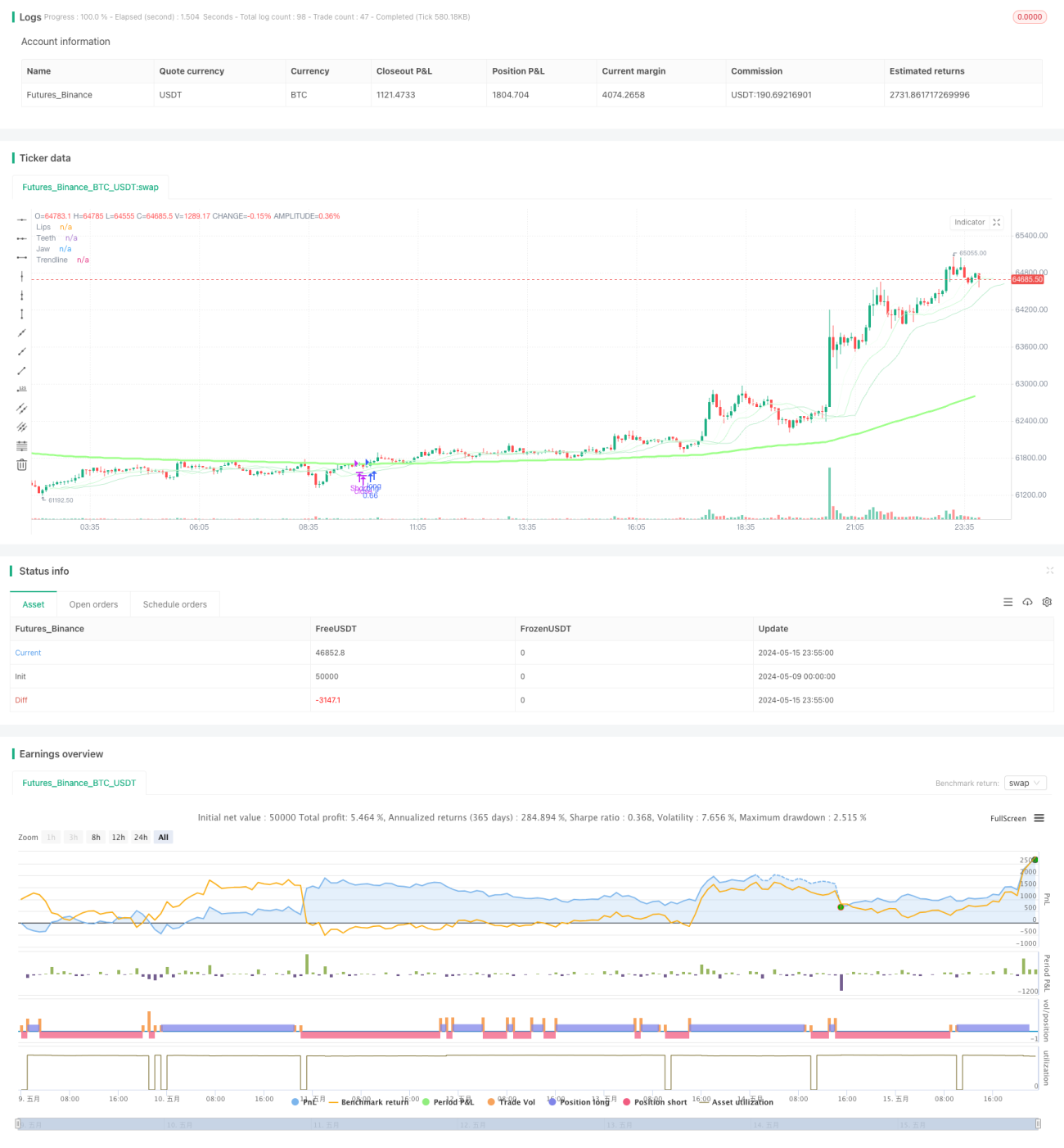
La stratégie de capture de tendance basée sur l'indicateur Alligator de Williams et les moyennes mobiles est une stratégie de suivi de tendance qui combine l'indicateur Alligator de Williams et les moyennes mobiles. Cette stratégie utilise la position relative des trois lignes de l'indicateur Alligator (mâchoire, dents et lèvres) pour déterminer la direction de la tendance, tout en utilisant la moyenne mobile comme confirmation secondaire de la tendance. Lorsque le prix franchit la moyenne mobile et que les trois lignes de l'indicateur Alligator sont alignées en configuration haussière, la stratégie ouvre une position longue ; lorsque le prix casse la moyenne mobile à la baisse et que les trois lignes de l'indicateur Alligator sont alignées en configuration baissière, la stratégie ouvre une position courte. Cette stratégie est adaptée aux marchés présentant des tendances prononcées, comme les actifs à forte volatilité tels que le Bitcoin et l'Ethereum.
Principe de la stratégie
Le cœur de la stratégie de capture de tendance avec l'indicateur Alligator de Williams et la moyenne mobile réside dans l'identification et la confirmation de la tendance à l'aide de l'indicateur Alligator et de la moyenne mobile. L'indicateur Alligator de Williams est composé de trois lignes : la mâchoire (Jaw), les dents (Teeth) et les lèvres (Lips), qui sont des moyennes mobiles lissées (SMMA) de différentes périodes. Lorsque le marché est en tendance haussière, les lèvres sont au-dessus des dents, et les dents au-dessus de la mâchoire ; lorsque le marché est en tendance baissière, les lèvres sont en dessous des dents, et les dents en dessous de la mâchoire. La stratégie introduit la moyenne mobile comme confirmation secondaire de la tendance : lorsque le prix franchit la moyenne mobile, en combinaison avec l'alignement haussier ou baissier de l'indicateur Alligator, la stratégie ouvre une position longue ou courte. Ce mécanisme de double confirmation permet de filtrer efficacement le bruit et d'améliorer la précision de l'identification des tendances.
Avantages de la stratégie
- Suivi de tendance : En combinant l'indicateur Alligator de Williams et la moyenne mobile, cette stratégie permet d'identifier et de suivre efficacement les tendances du marché, ce qui la rend adaptée aux marchés à forte tendance.
- Double confirmation : La stratégie utilise un mécanisme de double confirmation avec l'indicateur Alligator et la moyenne mobile, ce qui permet de filtrer efficacement le bruit, d'améliorer la précision de l'identification des tendances et de réduire les faux signaux.
- Paramètres flexibles : Les réglages des paramètres de la stratégie sont assez flexibles ; les utilisateurs peuvent ajuster les périodes de l'indicateur Alligator et de la moyenne mobile en fonction des différentes caractéristiques du marché et de leur style de trading pour optimiser les performances.
- Large applicabilité : Cette stratégie peut être appliquée à divers marchés présentant des tendances prononcées, tels que les crypto-monnaies, le forex, les matières premières et les contrats à terme, offrant ainsi une référence pour différents types de traders.
Risques de la stratégie
- Marchés en range : Dans les marchés en range, l'indicateur Alligator de Williams et la moyenne mobile peuvent générer de nombreux faux signaux, entraînant des ouvertures et fermetures de positions fréquentes, ce qui nuit aux rendements.
- Retournement de tendance : Cette stratégie peut réagir lentement lors des retournements de tendance, ce qui peut conduire à rater le meilleur moment d'entrée ou à retarder la sortie, entraînant des pertes.
- Optimisation des paramètres : Les performances de la stratégie dépendent du choix des paramètres ; différents réglages peuvent entraîner des écarts importants dans les résultats, nécessitant des backtests et une optimisation approfondis.
- Gestion des risques : Cette stratégie ne comporte pas de mesures explicites de gestion des risques, telles que des stop-loss ou une gestion de la taille des positions, ce qui peut entraîner des drawdowns importants en cas de fluctuations brutales du marché.
Axes d'optimisation de la stratégie
- Ajout d'un filtre sur la force de la tendance : Intégrer dans les conditions d'ouverture une évaluation de la force de la tendance, par exemple avec l'indicateur ADX ou la pente de la moyenne mobile, afin de filtrer les signaux de tendance faible et d'améliorer la qualité des entrées.
- Optimisation du mécanisme de sortie : En cas de retournement de tendance, envisager d'utiliser un mécanisme de sortie plus réactif, comme un stop-loss basé sur l'ATR ou une ligne de tendance, pour verrouiller les profits rapidement et réduire le drawdown.
- Optimisation dynamique des paramètres : En fonction de l'évolution de l'état du marché, ajuster dynamiquement les paramètres de l'indicateur Alligator et de la moyenne mobile pour s'adapter aux différents rythmes et caractéristiques de volatilité.
- Ajout de la gestion des risques : Mettre en place des mesures strictes de gestion des risques, comme la définition de niveaux de stop-loss raisonnables et des règles de gestion de la taille des positions, afin de contrôler l'exposition au risque de chaque transaction et le drawdown maximal du compte global.
Résumé
La stratégie de capture de tendance avec l'indicateur Alligator de Williams et la moyenne mobile constitue une stratégie de suivi de tendance simple et efficace. Elle est adaptée aux marchés présentant des tendances prononcées et améliore la précision de l'identification des tendances grâce à un mécanisme de double confirmation. Cependant, ses performances peuvent être médiocres dans les marchés en range et elle manque de mesures explicites de gestion des risques. À l'avenir, il est possible d'optimiser la stratégie en ajoutant un filtre sur la force de la tendance, en améliorant le mécanisme de sortie, en ajustant dynamiquement les paramètres et en intégrant une gestion des risques, afin d'en accroître la robustesse et la rentabilité.
- 1