Stratégie de suivi de tendance avec multiples moyennes mobiles et momentum

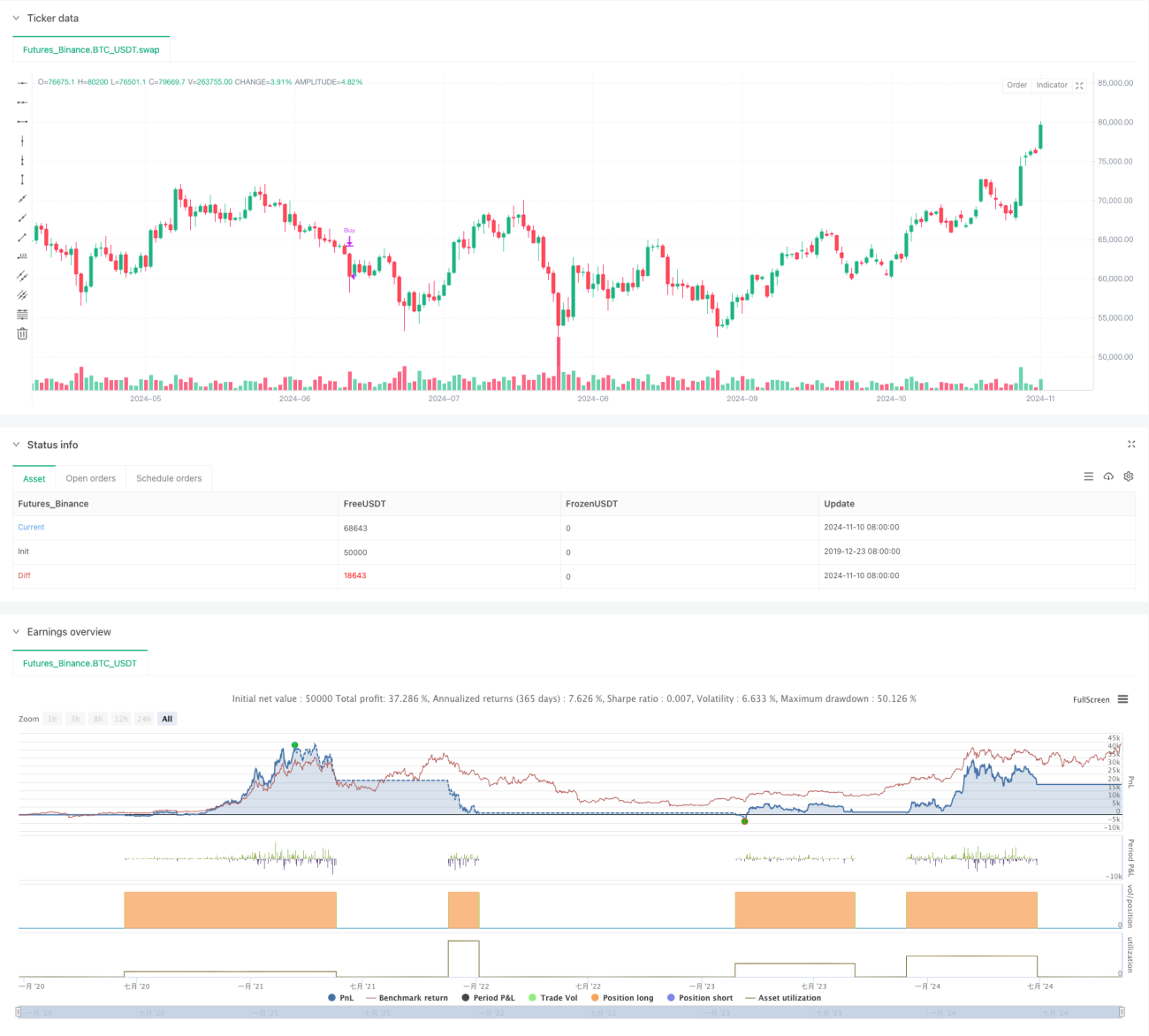
Aperçu
Cette stratégie est un système de trading de suivi de tendance basé sur des moyennes mobiles multiples et des indicateurs de momentum. Elle utilise principalement la relation dynamique entre les moyennes mobiles simples (SMA) à 20, 50, 150 et 200 jours, combinée aux indicateurs de volume et RSI, pour capturer les tendances haussières fortes sur le graphique journalier et clôturer les positions dès que la tendance s’affaiblit. En associant plusieurs indicateurs techniques, cette stratégie filtre efficacement les faux signaux et améliore la précision des transactions.
Principe de la stratégie
La logique centrale de la stratégie comprend les éléments clés suivants :
- Système de moyennes mobiles : Utilisation des SMA à 20, 50, 150 et 200 jours pour construire un système de jugement de tendance, exigeant que les multiples moyennes mobiles soient alignées en hausse.
- Confirmation du momentum : Utilisation du RSI et de sa moyenne mobile pour évaluer le momentum du prix, exigeant que le RSI soit supérieur à 55 ou que la SMA du RSI soit supérieure à 50 et que le RSI soit orienté à la hausse.
- Validation par le volume : Comparaison du volume récent avec la moyenne mobile du volume sur 20 jours pour confirmer la validité des signaux d’achat et de vente.
- Vérification de la persistance de la tendance : La SMA à 50 jours doit rester en hausse pendant au moins 25 des 40 derniers jours de trading.
- Confirmation de la position : Le prix doit se maintenir au-dessus de la SMA à 150 jours pendant au moins 20 jours de trading.
Conditions d’achat : les conditions suivantes doivent être remplies :
- Sur les 10 derniers jours, plus de 4 bougies sont haussières et au moins 1 d’entre elles présente un volume accru.
- Le RSI satisfait les conditions de momentum.
- Le système de moyennes mobiles est aligné en hausse et continue de monter.
- Le prix évolue de manière stable au-dessus de la SMA à 150 jours.
Conditions de vente :
- Le prix passe en dessous de la SMA à 150 jours.
- Apparition d’une série de baisses avec volumes croissants.
- La SMA à 50 jours passe en dessous de la SMA à 150 jours.
- Les bougies récentes sont principalement baissières avec un volume en augmentation.
Avantages de la stratégie
- Croisement de plusieurs indicateurs techniques, réduisant efficacement le taux de fausses interprétations.
- Exigences strictes de persistance de la tendance, permettant de filtrer les fluctuations à court terme.
- Analyse du volume intégrée, renforçant la fiabilité des signaux.
- Conditions claires de stop-loss et de take-profit, contrôlant efficacement les risques.
- Adaptée pour capturer les tendances à moyen et long terme, réduisant la fréquence des transactions.
- Logique de stratégie claire, facile à comprendre et à exécuter.
Risques de la stratégie
- Les systèmes de moyennes mobiles présentent un retard, pouvant faire manquer la phase initiale de la tendance.
- Des conditions d’entrée strictes peuvent entraîner la perte de certaines opportunités de trading.
- Sur des marchés oscillants, des faux signaux fréquents peuvent se produire.
- Il existe un certain retard dans l’identification des retournements de tendance.
- Un capital important est nécessaire pour supporter les drawdowns.
Recommandations de contrôle des risques :
- Mettre en place des niveaux de stop-loss raisonnables.
- Adopter une gestion de capital modérément conservatrice.
- Envisager d’ajouter des indicateurs de confirmation de tendance.
- Ajuster les paramètres en fonction des conditions de marché.
Axes d’optimisation de la stratégie
- Ajout de paramètres adaptatifs
- Ajuster dynamiquement les périodes des moyennes mobiles en fonction de la volatilité du marché.
- Optimiser les seuils du RSI.
- Amélioration du mécanisme de stop-loss
- Ajouter un stop-loss suiveur.
- Mettre en place un stop-loss temporel.
- Introduction de l’analyse de l’environnement de marché
- Ajouter un indicateur de force de tendance.
- Tenir compte d’indicateurs de volatilité.
- Optimisation de la taille des transactions
- Concevoir une gestion de position dynamique.
- Ajuster en fonction de la force des signaux.
Résumé
Il s’agit d’une stratégie de suivi de tendance rigoureusement conçue, qui, grâce à la combinaison de multiples indicateurs techniques, parvient à capturer efficacement les opportunités de tendance fortes. Son principal atout réside dans son mécanisme complet de confirmation des signaux et son système strict de contrôle des risques. Bien qu’elle présente un certain retard, avec une optimisation appropriée des paramètres et une gestion des risques adaptée, cette stratégie peut maintenir des performances stables sur le long terme. Il est recommandé aux investisseurs, lors de son application en conditions réelles, de prêter attention à son adéquation avec l’environnement de marché, de contrôler raisonnablement les positions et de procéder à des optimisations ciblées en fonction de la situation réelle.
- 1