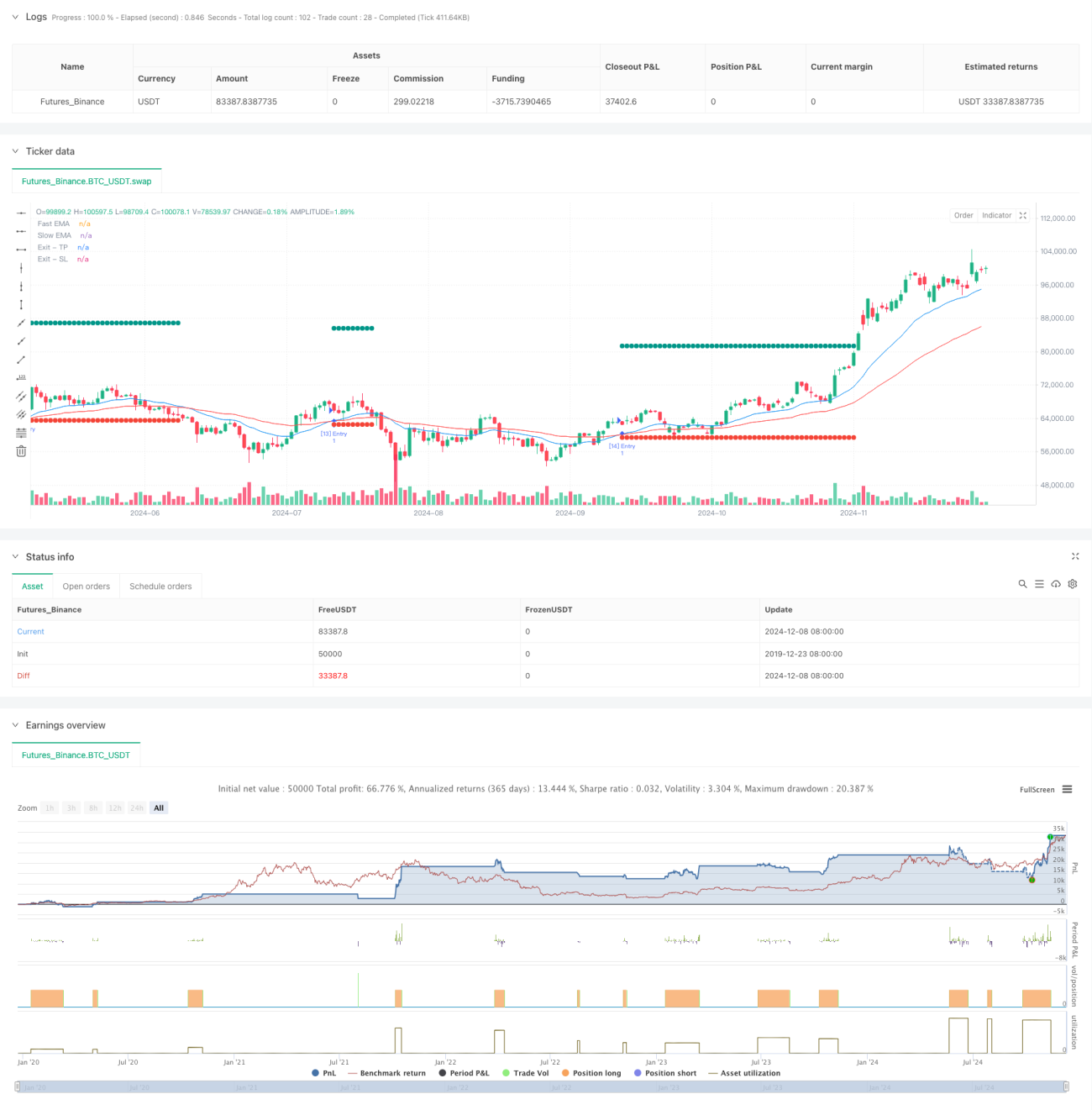
Il s’agit d’une stratégie de trading quantitative basée sur des signaux de croisement bi-homogènes, qui permet de juger de la tendance du marché par la croisée des moyennes mobiles des indices rapides (EMA) et des moyennes mobiles des indices lents (EMA), tout en gérant le risque en combinaison avec un contrôle de stop-loss dynamique. La stratégie utilise une gestion de position en pourcentage, en utilisant par défaut 10% de fonds pour la négociation, pour protéger les bénéfices et contrôler le risque en définissant des prix d’arrêt et de stop-loss dynamiques.
La logique centrale de la stratégie est d’identifier les changements de tendance en surveillant les croisements des moyennes mobiles indicielles (EMA) de 20 cycles et de 50 cycles. Lorsque les EMAs rapides traversent les EMAs lents vers le haut, le système génère plusieurs signaux. Après chaque ouverture de position, le système définit automatiquement le prix d’arrêt (c’est-à-dire 1,3 fois le prix d’entrée) et le prix d’arrêt (c’est-à-dire 0,95 fois le prix d’entrée).
Il s’agit d’une stratégie de suivi de tendance conçue de manière rationnelle et logique, qui capture les tendances par des croisements bi-homogènes et utilise des stop-loss dynamiques pour gérer le risque. L’avantage de la stratégie réside dans la clarté des règles d’exploitation et la maîtrise du risque, adaptée au cadre de base du système de négociation à moyen et long terme.
/*backtest
start: 2019-12-23 08:00:00
end: 2024-12-09 08:00:00
period: 1d
basePeriod: 1d
exchanges: [{"eid":"Futures_Binance","currency":"BTC_USDT"}]
*/
// This source code is subject to the terms of the Mozilla Public License 2.0 at https://mozilla.org/MPL/2.0/
// © Pineify
//======================================================================//
// ____ _ _ __ //
// | _ \(_)_ __ ___(_)/ _|_ _ //
// | |_) | | '_ \ / _ \ | |_| | | | //
// | __/| | | | | __/ | _| |_| | //
// |_| |_|_| |_|\___|_|_| \__, | //
// |___/ //
//======================================================================//
//@version=5
strategy(title="TQQQ EMA Strategy", overlay=true)
//#region —————————————————————————————————————————————————— Common Dependence
p_comm_time_range_to_unix_time(string time_range, int date_time = time, string timezone = syminfo.timezone) =>
int start_unix_time = na
int end_unix_time = na
int start_time_hour = na
int start_time_minute = na
int end_time_hour = na
int end_time_minute = na
if str.length(time_range) == 11
// Format: hh:mm-hh:mm
start_time_hour := math.floor(str.tonumber(str.substring(time_range, 0, 2)))
start_time_minute := math.floor(str.tonumber(str.substring(time_range, 3, 5)))
end_time_hour := math.floor(str.tonumber(str.substring(time_range, 6, 8)))
end_time_minute := math.floor(str.tonumber(str.substring(time_range, 9, 11)))
else if str.length(time_range) == 9
// Format: hhmm-hhmm
start_time_hour := math.floor(str.tonumber(str.substring(time_range, 0, 2)))
start_time_minute := math.floor(str.tonumber(str.substring(time_range, 2, 4)))
end_time_hour := math.floor(str.tonumber(str.substring(time_range, 5, 7)))
end_time_minute := math.floor(str.tonumber(str.substring(time_range, 7, 9)))
start_unix_time := timestamp(timezone, year(date_time, timezone), month(date_time, timezone), dayofmonth(date_time, timezone), start_time_hour, start_time_minute, 0)
end_unix_time := timestamp(timezone, year(date_time, timezone), month(date_time, timezone), dayofmonth(date_time, timezone), end_time_hour, end_time_minute, 0)
[start_unix_time, end_unix_time]
p_comm_time_range_to_start_unix_time(string time_range, int date_time = time, string timezone = syminfo.timezone) =>
int start_time_hour = na
int start_time_minute = na
if str.length(time_range) == 11
// Format: hh:mm-hh:mm
start_time_hour := math.floor(str.tonumber(str.substring(time_range, 0, 2)))
start_time_minute := math.floor(str.tonumber(str.substring(time_range, 3, 5)))
else if str.length(time_range) == 9
// Format: hhmm-hhmm
start_time_hour := math.floor(str.tonumber(str.substring(time_range, 0, 2)))
start_time_minute := math.floor(str.tonumber(str.substring(time_range, 2, 4)))
timestamp(timezone, year(date_time, timezone), month(date_time, timezone), dayofmonth(date_time, timezone), start_time_hour, start_time_minute, 0)
p_comm_time_range_to_end_unix_time(string time_range, int date_time = time, string timezone = syminfo.timezone) =>
int end_time_hour = na
int end_time_minute = na
if str.length(time_range) == 11
end_time_hour := math.floor(str.tonumber(str.substring(time_range, 6, 8)))
end_time_minute := math.floor(str.tonumber(str.substring(time_range, 9, 11)))
else if str.length(time_range) == 9
end_time_hour := math.floor(str.tonumber(str.substring(time_range, 5, 7)))
end_time_minute := math.floor(str.tonumber(str.substring(time_range, 7, 9)))
timestamp(timezone, year(date_time, timezone), month(date_time, timezone), dayofmonth(date_time, timezone), end_time_hour, end_time_minute, 0)
p_comm_timeframe_to_seconds(simple string tf) =>
float seconds = 0
tf_lower = str.lower(tf)
value = str.tonumber(str.substring(tf_lower, 0, str.length(tf_lower) - 1))
if str.endswith(tf_lower, 's')
seconds := value
else if str.endswith(tf_lower, 'd')
seconds := value * 86400
else if str.endswith(tf_lower, 'w')
seconds := value * 604800
else if str.endswith(tf_lower, 'm')
seconds := value * 2592000
else
seconds := str.tonumber(tf_lower) * 60
seconds
p_custom_sources() =>
[open, high, low, close, volume]
//#endregion —————————————————————————————————————————————————————————————————
//#region —————————————————————————————————————————————————— Ta Dependence
//#endregion —————————————————————————————————————————————————————————————
//#region —————————————————————————————————————————————————— Constants
// Input Groups
string P_GP_1 = ""
//#endregion —————————————————————————————————————————————————————————
//#region —————————————————————————————————————————————————— Inputs
// Default
int p_inp_1 = input.int(defval=20, title="Fast EMA Length", group=P_GP_1)
int p_inp_2 = input.int(defval=50, title="Slow EMA Length", group=P_GP_1)
float p_inp_3 = input.float(defval=1.3, title="Take Profit Price Multiplier", group=P_GP_1, step=0.01)
float p_inp_4 = input.float(defval=0.95, title="Stop Loss Price Multiplier", group=P_GP_1, step=0.01)
//#endregion ———————————————————————————————————————————————————————
//#region —————————————————————————————————————————————————— Price Data
//#endregion ———————————————————————————————————————————————————————————
//#region —————————————————————————————————————————————————— Indicators
p_ind_1 = ta.ema(close, p_inp_1) // Fast EMA
p_ind_2 = ta.ema(close, p_inp_2) // Slow EMA
//#endregion ———————————————————————————————————————————————————————————
//#region —————————————————————————————————————————————————— Conditions
p_cond_1 = (ta.crossover(p_ind_1, p_ind_2))
//#endregion ———————————————————————————————————————————————————————————
//#region —————————————————————————————————————————————————— Strategy
// Strategy Order Variables
string p_st_name_1 = "Entry"
string p_st_name_2 = "Exit"
var float p_st_name_2_tp = na
var bool p_st_name_2_tp_can_drawing = true
var float p_st_name_2_sl = na
var bool p_st_name_2_sl_can_drawing = true
// Strategy Global
open_trades_number = strategy.opentrades
pre_bar_open_trades_number = na(open_trades_number[1]) ? 0 : open_trades_number[1]
var p_entry_order_id = 1
p_can_place_entry_order() =>
strategy.equity > 0
get_entry_id_name(int current_order_id, string name) =>
"[" + str.tostring(current_order_id) + "] " + name
is_entry_order(string order_id, string name) =>
str.startswith(order_id, "[") and str.endswith(order_id, "] " + name)
get_open_trades_entry_ids() =>
int p_open_trades_count = strategy.opentrades
string[] p_entry_ids = array.new_string(0, "")
if p_open_trades_count > 0
for i = 0 to p_open_trades_count - 1
array.push(p_entry_ids, strategy.opentrades.entry_id(i))
p_entry_ids
// Entry (Entry)
if p_cond_1 and p_can_place_entry_order()
p_st_name_1_id = get_entry_id_name(p_entry_order_id, p_st_name_1)
p_entry_order_id := p_entry_order_id + 1
string entry_message = ""
strategy.entry(id=p_st_name_1_id, direction=strategy.long, alert_message=entry_message, comment=p_st_name_1_id)
// TP/SL Exit (Exit)
float p_st_name_2_limit = close * p_inp_3
if p_st_name_2_tp_can_drawing
p_st_name_2_tp_can_drawing := false
p_st_name_2_tp := p_st_name_2_limit
float p_st_name_2_stop = close * p_inp_4
if p_st_name_2_sl_can_drawing
p_st_name_2_sl_can_drawing := false
p_st_name_2_sl := p_st_name_2_stop
string p_st_name_2_alert_message = ""
strategy.exit(id=p_st_name_1_id + "_0", from_entry=p_st_name_1_id, qty_percent=100, limit=p_st_name_2_limit, stop=p_st_name_2_stop, comment_profit=p_st_name_2 + " - TP", comment_loss=p_st_name_2 + " - SL", alert_message=p_st_name_2_alert_message)
if high >= p_st_name_2_tp or (pre_bar_open_trades_number > 0 and open_trades_number == 0)
p_st_name_2_tp_can_drawing := true
p_st_name_2_sl_can_drawing := true
p_st_name_2_tp := na
p_st_name_2_sl := na
plot(p_st_name_2_tp, title="Exit - TP", color=color.rgb(0, 150, 136, 0), linewidth=1, style = plot.style_circles)
if low <= p_st_name_2_sl or (pre_bar_open_trades_number > 0 and open_trades_number == 0)
p_st_name_2_sl_can_drawing := true
p_st_name_2_tp_can_drawing := true
p_st_name_2_sl := na
p_st_name_2_tp := na
plot(p_st_name_2_sl, title="Exit - SL", color=color.rgb(244, 67, 54, 0), linewidth=1, style = plot.style_circles)
//#endregion —————————————————————————————————————————————————————————
//#region —————————————————————————————————————————————————— Indicator Plots
// Fast EMA
plot(p_ind_1, "Fast EMA", color.rgb(33, 150, 243, 0), 1)
// Slow EMA
plot(p_ind_2, "Slow EMA", color.rgb(255, 82, 82, 0), 1)
//#endregion ————————————————————————————————————————————————————————————————
//#region —————————————————————————————————————————————————— Custom Plots
//#endregion —————————————————————————————————————————————————————————————
//#region —————————————————————————————————————————————————— Alert
//#endregion ——————————————————————————————————————————————————————