
Aperçu
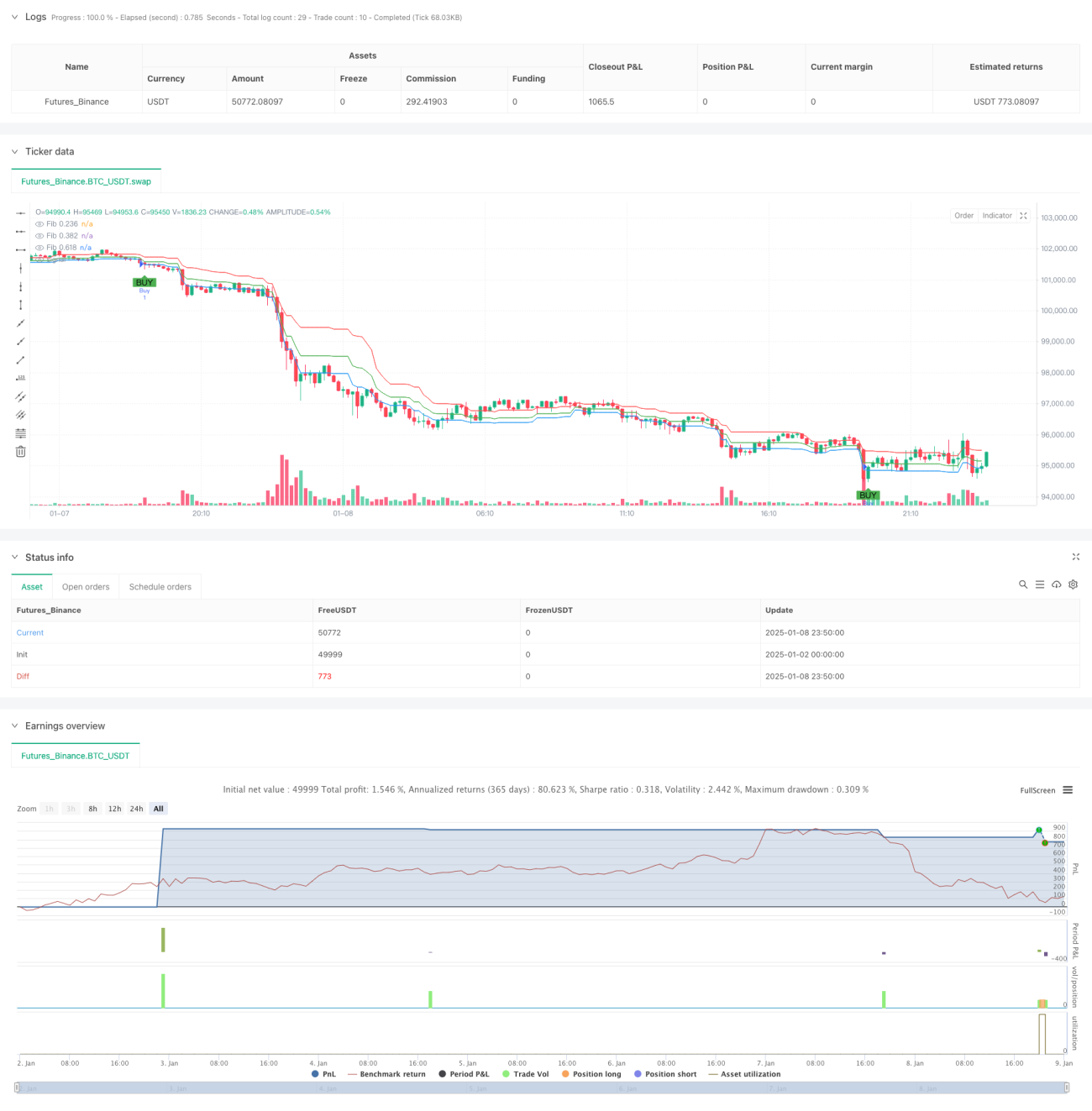
Cette stratégie est un système de trading intraday combinant les bandes de Bollinger et les niveaux de retracement de Fibonacci. Elle utilise l'indicateur des bandes de Bollinger pour identifier les conditions de surachat et de survente, tout en exploitant les niveaux de retracement de Fibonacci pour confirmer les supports et résistances potentiels, capturant ainsi des opportunités de trading dans la volatilité du marché. La stratégie génère des signaux sur la base de bandes de Bollinger à 20 périodes et de trois niveaux clés de Fibonacci : 0,236, 0,382 et 0,618.
Principe de la stratégie
La logique centrale de la stratégie repose sur les éléments clés suivants :
- Utiliser les bandes supérieure et inférieure de Bollinger (écart-type de 2) pour identifier les zones de surachat et de survente des prix.
- Calculer les niveaux de retracement de Fibonacci sur la base du plus haut et du plus bas des 20 dernières périodes.
- Générer un signal d'achat lorsque le prix franchit la bande inférieure de Bollinger et se situe au-dessus du support de Fibonacci à 0,236 ou 0,382.
- Générer un signal de vente lorsque le prix franchit la bande supérieure de Bollinger et se situe en dessous de la résistance de Fibonacci à 0,618.
- Utiliser un stop-loss et un take-profit fixes (en points) pour contrôler les risques et verrouiller les profits.
Avantages de la stratégie
- Combinaison d'une double confirmation entre tendance et support/résistance, améliorant la fiabilité des signaux de trading.
- Les bandes de Bollinger s'adaptent dynamiquement aux changements de volatilité du marché, offrant une bonne adaptabilité.
- Les niveaux de Fibonacci fournissent un cadre de référence clair pour les points d'entrée et de sortie.
- Les stop-loss et take-profit fixes permettent un contrôle strict des risques.
- Les paramètres de la stratégie peuvent être ajustés de manière flexible en fonction des conditions de marché.
Risques de la stratégie
- En marché rangeant, des signaux de faux breakout fréquents peuvent se produire.
- Les stop-loss et take-profit fixes peuvent ne pas convenir à toutes les conditions de marché.
- L'efficacité des niveaux de Fibonacci est fortement influencée par la structure du marché.
- En marché fortement tendanciel, certaines opportunités peuvent être manquées.
- Un suivi et un ajustement constants des paramètres sont nécessaires pour s'adapter aux évolutions du marché.
Pistes d'optimisation
- Introduire un indicateur de volume pour confirmer la validité des breakouts.
- Ajuster dynamiquement les niveaux de stop-loss et take-profit en fonction de la volatilité du marché.
- Ajouter un filtre de tendance pour éviter de trader dans un marché latéral.
- Optimiser la période de calcul des niveaux de Fibonacci.
- Envisager d'ajouter un filtre horaire pour éviter de trader pendant les périodes de faible liquidité.
Résumé
Il s'agit d'un système de trading complet combinant des outils classiques d'analyse technique. Grâce à la synergie entre les bandes de Bollinger et les retracements de Fibonacci, il offre aux traders un cadre de trading systématique. Bien qu'il présente certaines limites, avec une optimisation appropriée des paramètres et une gestion des risques, cette stratégie peut donner de bons résultats en trading intraday. La clé est d'effectuer les ajustements et optimisations nécessaires en fonction de l'instrument spécifique et des conditions de marché.
- 1