
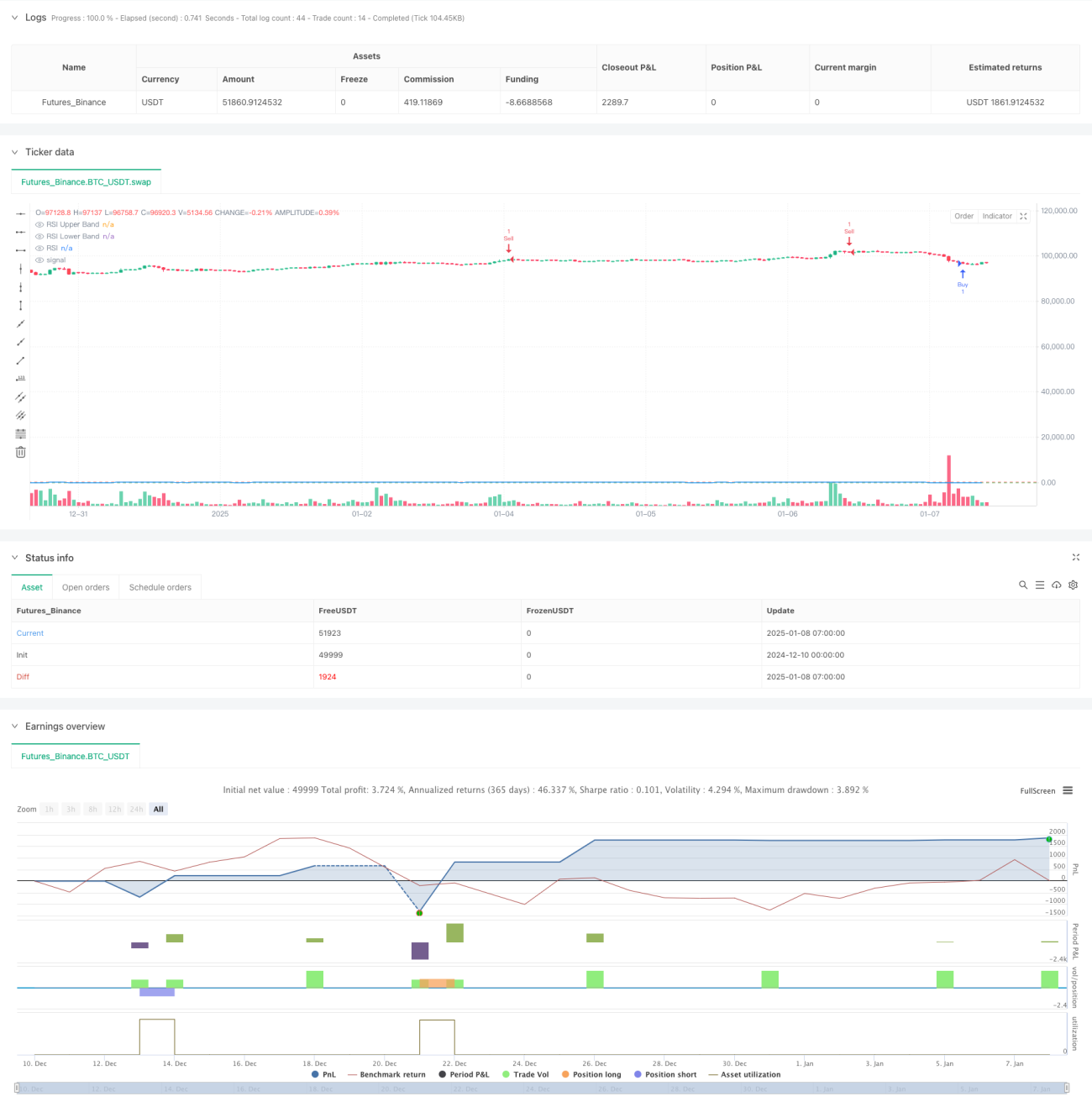
Aperçu
Cette stratégie est un système de trading multi-niveaux basé sur l'indice de force relative (RSI). Elle opère dans une fenêtre de temps spécifique, identifie les opportunités de trading via les signaux de surachat et de survente du RSI, et intègre un mécanisme d'ajustement dynamique des positions en utilisant une approche de construction par lots lors des mouvements contraires du marché. La gestion des prises de bénéfices repose sur un objectif de profit basé sur le prix d'entrée moyen.
Principe de la stratégie
La stratégie fonctionne principalement à partir des composants clés suivants :
- Le calcul du RSI utilise une période standard de 14, avec le prix de clôture comme donnée source.
- La fenêtre de trading est contrôlée entre 2 et 4 heures, adaptable selon les caractéristiques du marché.
- Les signaux d'entrée sont basés sur des niveaux de survente inférieurs à 30 et de surachat supérieurs à 70 pour le RSI.
- Le mécanisme de construction de position comprend deux niveaux : la position initiale et l'ajustement dynamique.
- Un déclenchement d'augmentation de position se produit lorsque le prix évolue défavorablement de plus d'un point.
- La prise de bénéfices est fixée à 1,5 points au-dessus du prix d'entrée moyen.
Avantages de la stratégie
- Filtrage multi-niveaux des signaux : combinaison du filtre technique RSI et de la fenêtre temporelle pour réduire efficacement les faux signaux.
- Gestion dynamique des positions : réduction du coût moyen grâce au mécanisme de construction par lots lors des mouvements contraires du marché.
- Ratio risque/rendement raisonnable : le point de prise de bénéfices est basé sur le prix d'entrée moyen, garantissant le rendement attendu de l'ensemble des transactions.
- Logique claire : chaque module a des responsabilités bien définies, facilitant l'optimisation et les ajustements ultérieurs.
- Adaptabilité : les paramètres clés peuvent être optimisés en fonction des caractéristiques du marché.
Risques de la stratégie
- Risque de marché en tendance : dans un marché fortement orienté, l'augmentation fréquente des positions peut entraîner une utilisation excessive des capitaux.
- Contrainte de la fenêtre temporelle : une fenêtre spécifique peut faire manquer de bonnes opportunités à d'autres moments.
- Sensibilité des paramètres : les réglages comme la période RSI ou l'intervalle de construction de position ont un impact important sur la performance.
- Risque de gestion des capitaux : il est nécessaire de contrôler raisonnablement la proportion de chaque ouverture de position pour éviter une concentration excessive des fonds.
Directions d'optimisation de la stratégie
- Ajout d'un filtre de tendance : recommandation d'ajouter des indicateurs de tendance comme les moyennes mobiles pour optimiser le timing d'entrée.
- Optimisation dynamique des paramètres : possibilité d'ajuster dynamiquement les seuils RSI et l'intervalle de construction de position en fonction de la volatilité du marché.
- Amélioration du mécanisme de stop-loss : suggestion d'ajouter un stop suiveur pour mieux protéger les profits existants.
- Optimisation de la fenêtre temporelle : analyse par backtest pour trouver les meilleurs créneaux de trading.
- Ajout d'indicateurs de volume : combinaison avec l'analyse des volumes pour améliorer la fiabilité des signaux.
Résumé
Cette stratégie forme un système de trading complet en combinant l'indicateur RSI avec un mécanisme de construction de position par lots. Son principal avantage réside dans le filtrage multi-niveaux des signaux et la gestion flexible des positions, mais il faut également prêter attention aux risques de marché en tendance et à l'optimisation des paramètres. En ajoutant un filtre de tendance ou en améliorant le mécanisme de stop-loss, la performance globale de la stratégie peut encore être améliorée.
- 1