
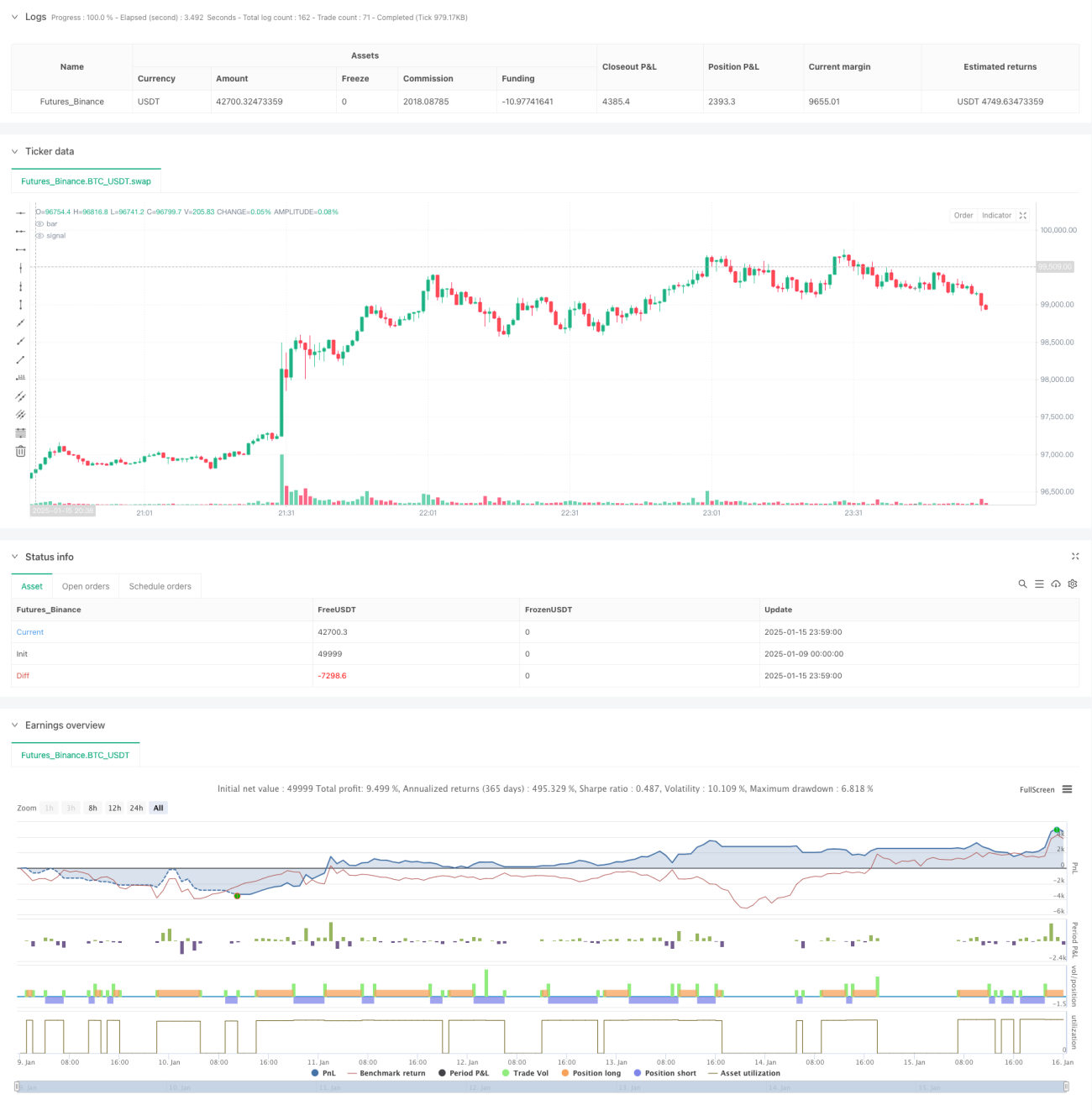
Aperçu
Cette stratégie est un système de trading avancé combinant des motifs harmoniques et l'indicateur Williams %R (WPR). Elle identifie les motifs harmoniques du marché (tels que Gartley, Bat, Crab et Butterfly) et utilise les niveaux de surachat/survente de l'indicateur Williams %R pour déterminer les points d'entrée et de sortie des transactions. La stratégie adopte un mécanisme de confirmation multiple, améliorant la précision et la fiabilité des transactions grâce à la synergie des indicateurs techniques.
Principe de la stratégie
La logique centrale de la stratégie comprend les éléments clés suivants:
- Identification des motifs harmoniques : Utilise les points de retournement des prix pour identifier les motifs harmoniques potentiels, en analysant les relations entre les hauts et les bas pour déterminer la structure du marché.
- Calcul de l'indicateur Williams %R : Utilise une période personnalisée pour calculer l'indicateur Williams %R, en analysant les relations entre le plus haut, le plus bas et le cours de clôture pour évaluer l'état du marché.
- Conditions d'entrée :
- Entrée longue : Lors de l'apparition d'un motif harmonique haussier et que l'indicateur Williams %R se trouve en zone de survente.
- Entrée courte : Lors de l'apparition d'un motif harmonique baissier et que l'indicateur Williams %R se trouve en zone de surachat.
- Gestion des risques : Utilise un stop-loss dynamique basé sur les plus bas/plus hauts récents, et définit des objectifs de profit en fonction du ratio risque/récompense.
Avantages de la stratégie
- Analyse multidimensionnelle : Combine l'analyse des motifs et les indicateurs de momentum, offrant des signaux de trading plus fiables.
- Contrôle des risques robuste : Adopte un stop-loss dynamique et des objectifs de profit basés sur le ratio risque/récompense, contrôlant efficacement le risque de chaque transaction.
- Adaptabilité : Grâce à l'optimisation des paramètres, peut s'adapter à différents environnements de marché et instruments de trading.
- Mécanisme de confirmation des signaux : La double confirmation par les motifs harmoniques et l'indicateur Williams %R réduit l'impact des faux signaux.
Risques de la stratégie
- Risque de reconnaissance des motifs : L'identification simplifiée des motifs harmoniques peut entraîner une mauvaise interprétation de certains motifs.
- Sensibilité aux paramètres : Le réglage de plusieurs paramètres nécessite une optimisation minutieuse ; des paramètres inappropriés peuvent affecter les performances de la stratégie.
- Dépendance aux conditions du marché : Peut sous-performer dans des marchés très volatils ou latéraux.
- Retard des signaux : Les signaux basés sur des indicateurs techniques peuvent présenter un certain décalage.
Axes d'optimisation de la stratégie
- Amélioration de la reconnaissance des motifs :
- Ajouter une validation plus stricte des ratios harmoniques.
- Introduire une analyse de la structure des prix pour améliorer la précision de l'identification des motifs.
- Filtrage des signaux :
- Ajouter un filtre de tendance.
- Envisager d'intégrer des indicateurs de volatilité pour s'adapter à différents environnements de marché.
- Optimisation de la gestion des risques :
- Mettre en œuvre un ajustement dynamique du ratio risque/récompense.
- Ajouter une gestion de la position basée sur la volatilité du marché.
Résumé
Cette stratégie construit un système de trading relativement complet en combinant les motifs harmoniques et l'indicateur Williams %R. Ses avantages résident dans l'approche d'analyse multidimensionnelle et le mécanisme de contrôle des risques robuste, mais il faut néanmoins prêter attention aux problèmes d'optimisation des paramètres et d'adaptabilité aux conditions du marché. Grâce aux axes d'optimisation suggérés, la stabilité et la fiabilité de la stratégie pourraient être encore améliorées.
- 1