Stratégie de momentum de tendance - Système de timing dynamique de bandes zigzag multi-périodes

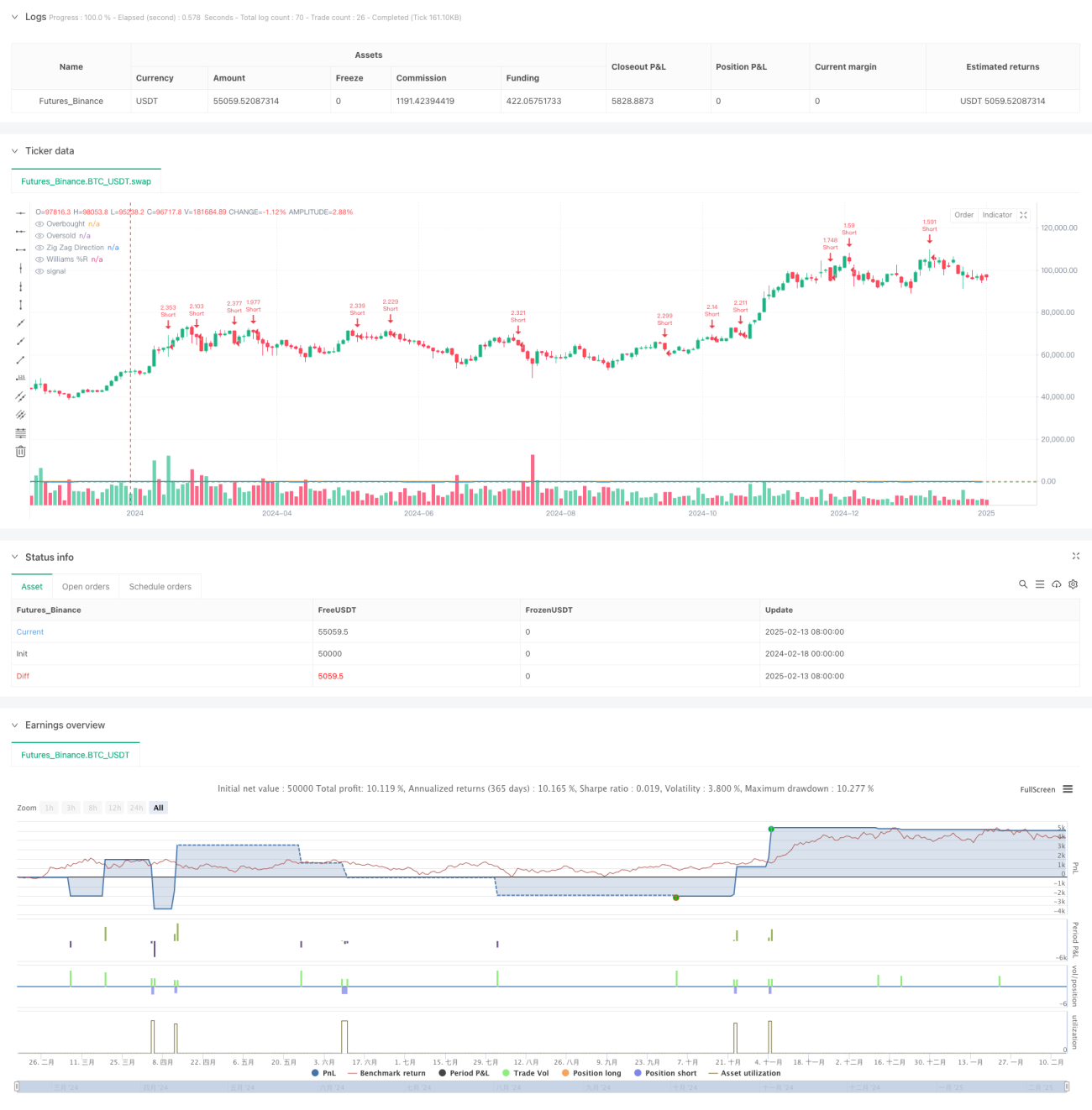
Aperçu
Cette stratégie est un système de trading multidimensionnel combinant l'indicateur ZigZag et l'indicateur Williams %R. L'indicateur ZigZag identifie les points hauts et bas significatifs des vagues, tandis que l'indicateur Williams %R confirme les points d'entrée lorsque le marché atteint des conditions de surachat ou de survente. Cette combinaison permet non seulement de capturer les principaux points de retournement de tendance, mais aussi d'améliorer la précision des transactions grâce à la confirmation de momentum.
Principe de la stratégie
La logique centrale de la stratégie repose sur deux composantes principales :
- L'indicateur ZigZag identifie les points hauts et bas significatifs des vagues via des paramètres de profondeur et de déviation, filtrant le bruit du marché pour déterminer la direction de la tendance. Un nouveau point bas indique le début d'une tendance haussière, tandis qu'un nouveau point haut signale le début d'une tendance baissière.
- L'indicateur Williams %R calcule l'état de momentum du marché en comparant le prix actuel au plus haut sur une période donnée. Lorsque la valeur de l'indicateur franchit -80, cela indique une survente (opportunité d'achat potentielle) ; lorsqu'elle franchit -20, cela indique un surachat (opportunité de vente potentielle).
Les règles de trading de la stratégie sont les suivantes :
- Condition d'achat : l'indicateur ZigZag identifie un nouveau point bas et l'indicateur Williams %R franchit à la hausse la zone de survente.
- Condition de vente : l'indicateur ZigZag identifie un nouveau point haut et l'indicateur Williams %R franchit à la baisse la zone de surachat.
- Le stop-loss est fixé à 1 % et le take-profit à 2 %.
Avantages de la stratégie
- Confirmation multidimensionnelle : Grâce à une double confirmation de tendance et de momentum, la fiabilité des signaux de trading est améliorée.
- Forte adaptabilité : Le paramètre de déviation de l'indicateur ZigZag peut être ajusté dynamiquement en fonction de la volatilité du marché.
- Gestion des risques solide : Utilisation d'une stratégie de stop-loss et take-profit à pourcentage fixe pour contrôler le risque de chaque transaction.
- Bonne visualisation : Affichage clair des signaux de trading via des étiquettes et des graphiques, facilitant l'analyse et l'optimisation.
Risques de la stratégie
- Risque lié aux marchés non directionnels : Dans un marché latéral, des signaux de faux cassages fréquents peuvent se produire.
- Risque de slippage : En situation de forte volatilité, un slippage important peut survenir.
- Sensibilité aux paramètres : Le choix des paramètres de l'indicateur a un impact significatif sur la performance de la stratégie.
- Retard du signal : En raison de la nécessité de confirmer la formation d'un nouveau point de vague, certaines situations de marché rapide peuvent être manquées.
Pistes d'optimisation de la stratégie
- Ajout d'un filtre de condition de marché : Intégrer un indicateur de volatilité pour identifier l'état du marché et utiliser différents réglages de paramètres selon les environnements.
- Optimisation du stop-loss dynamique : Ajuster dynamiquement le niveau de stop-loss en fonction de l'ATR ou de la volatilité.
- Intégration de la confirmation de volume : Ajouter une vérification du volume lors de la génération des signaux.
- Filtre temporel : Ajouter un filtre sur les plages horaires de trading pour éviter les périodes de forte volatilité.
Résumé
Il s'agit d'un système de trading complet alliant suivi de tendance et trading de momentum. Grâce à la synergie de multiples indicateurs techniques, il permet de maintenir un taux de réussite élevé tout en contrôlant efficacement les risques. Bien qu'il présente un certain décalage, une optimisation appropriée des paramètres et une gestion des risques permettent d'obtenir des performances de trading stables. Cette stratégie convient particulièrement aux tendances de moyen à long terme et donne de meilleurs résultats lorsque le marché présente des opportunités directionnelles claires.
/*backtest
start: 2024-02-18 00:00:00
end: 2025-02-15 08:00:00
period: 2d
basePeriod: 2d
exchanges: [{"eid":"Futures_Binance","currency":"BTC_USDT"}]
*/

//@version=6
strategy("Zig Zag + Williams %R Strategy", overlay=true, default_qty_type=strategy.percent_of_equity, default_qty_value=300)

// ====================- 1