
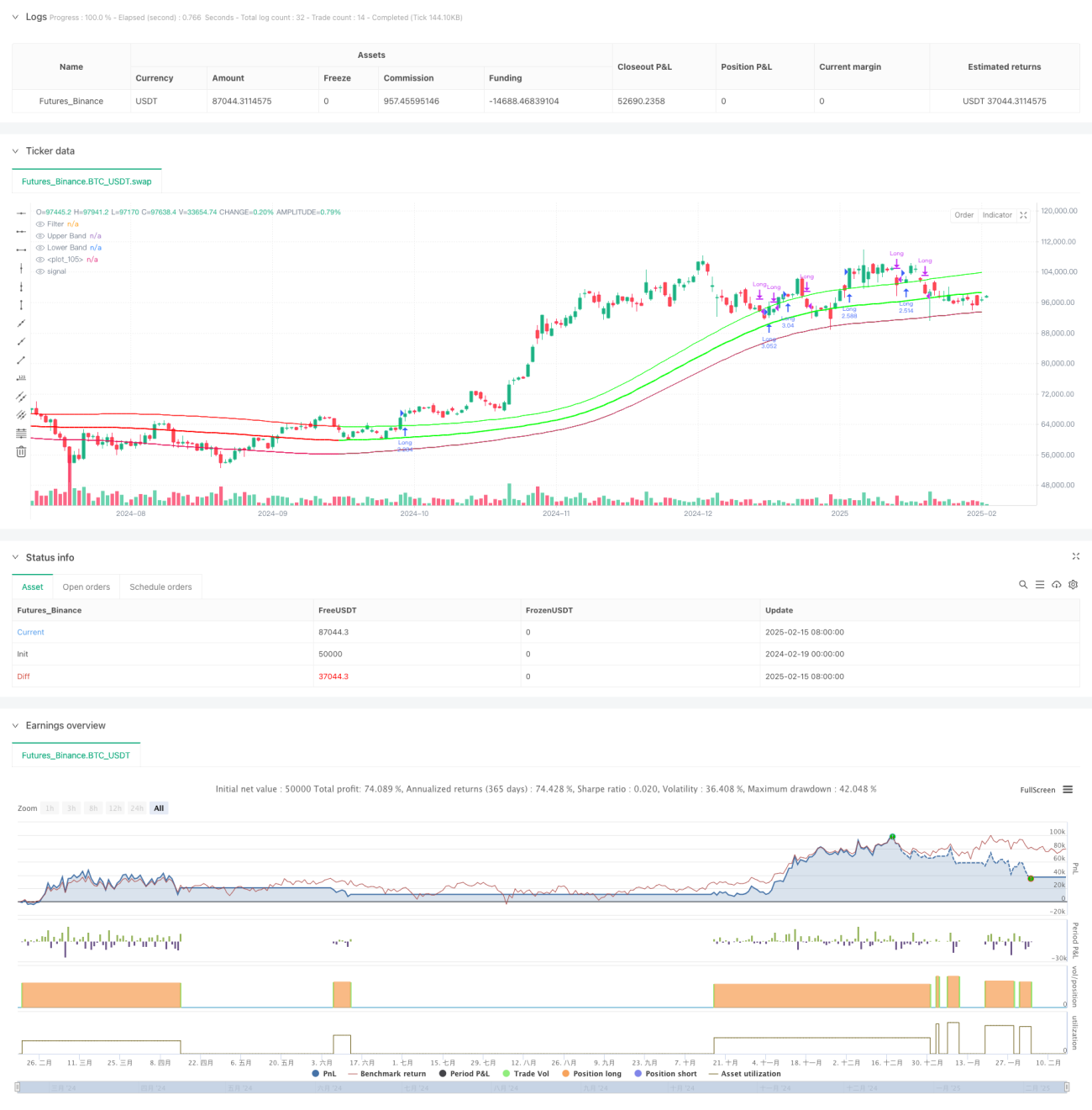
Aperçu
Cette stratégie est un système de trading de suivi de tendance basé sur le filtre gaussien et l'indicateur StochRSI. La stratégie identifie la tendance du marché via un canal gaussien et optimise les points d'entrée en combinant les zones de surachat et survente du StochRSI. Le système construit un canal gaussien par ajustement polynomial, permettant un suivi précis des mouvements de prix grâce à l'ajustement dynamique des bandes supérieure et inférieure.
Principe de la stratégie
Le cœur de la stratégie repose sur un canal de prix construit à partir d'un algorithme de filtrage gaussien. Les étapes clés sont les suivantes :
- Utilisation de la fonction polynomiale
f_filt9xpour réaliser un filtrage gaussien d'ordre 9, optimisé par pôles pour améliorer l'efficacité. - Calcul de la ligne de filtre principale et du canal de volatilité basé sur le prix HLC3.
- Introduction du mode
reducedLagpour réduire le décalage du filtre, et du modefastResponsepour accélérer la réactivité. - Utilisation des zones de surachat/survente (80/20) du StochRSI pour déterminer les signaux de trading.
- Génération d'un signal long lorsque le canal gaussien est orienté à la hausse et que le prix dépasse la bande supérieure, en conjonction avec le StochRSI.
- Clôture de la position lorsque le prix repasse en dessous de la bande supérieure.
Avantages de la stratégie
- Le filtre gaussien possède une excellente capacité de réduction du bruit, filtrant efficacement le bruit du marché.
- L'ajustement polynomial permet un suivi lissé de la tendance, réduisant les faux signaux.
- Prise en charge des modes d'optimisation du décalage et de réponse rapide, adaptable aux caractéristiques du marché.
- Optimisation des points d'entrée en combinant le StochRSI, améliorant le taux de réussite des transactions.
- Largeur de canal dynamique, s'adaptant automatiquement aux variations de volatilité du marché.
Risques de la stratégie
- Le filtre gaussien présente un certain décalage, pouvant entraîner des entrées ou sorties retardées.
- Dans un marché en range, des signaux de trading fréquents peuvent augmenter les coûts de transaction.
- Le StochRSI peut générer des signaux retardés dans certaines conditions de marché.
- L'optimisation des paramètres est complexe, nécessitant un réajustement selon les environnements de marché.
- Le système exige des ressources de calcul élevées, avec un certain délai pour le calcul en temps réel.
Directions d'optimisation de la stratégie
- Introduction d'un mécanisme d'optimisation adaptative des paramètres, ajustés dynamiquement en fonction de l'état du marché.
- Ajout d'un module de reconnaissance de l'environnement de marché, utilisant différentes combinaisons de paramètres selon les conditions.
- Optimisation de l'algorithme de filtrage gaussien pour réduire davantage le délai de calcul.
- Introduction d'indicateurs techniques supplémentaires pour une validation croisée, améliorant la fiabilité des signaux.
- Développement d'un mécanisme de stop-loss intelligent pour renforcer le contrôle des risques.
Résumé
Cette stratégie combine le filtre gaussien et le StochRSI pour suivre efficacement la tendance du marché. Le système offre une bonne capacité de réduction du bruit et d'identification des tendances, mais présente également un certain décalage et une complexité d'optimisation des paramètres. Grâce à une amélioration continue, cette stratégie pourrait générer des rendements stables dans le trading réel.
/*backtest
start: 2024-02-19 00:00:00
end: 2025-02-16 08:00:00
period: 1d
basePeriod: 1d
exchanges: [{"eid":"Futures_Binance","currency":"BTC_USDT"}]
*/

//@version=5
strategy(title="Demo GPT - Gaussian Channel Strategy v3.0", overlay=true, commission_type=strategy.commission.percent, commission_value=0.1, slippage=0, default_qty_type=strategy.percent_of_equity, default_qty_value=250)

// ============================================- 1