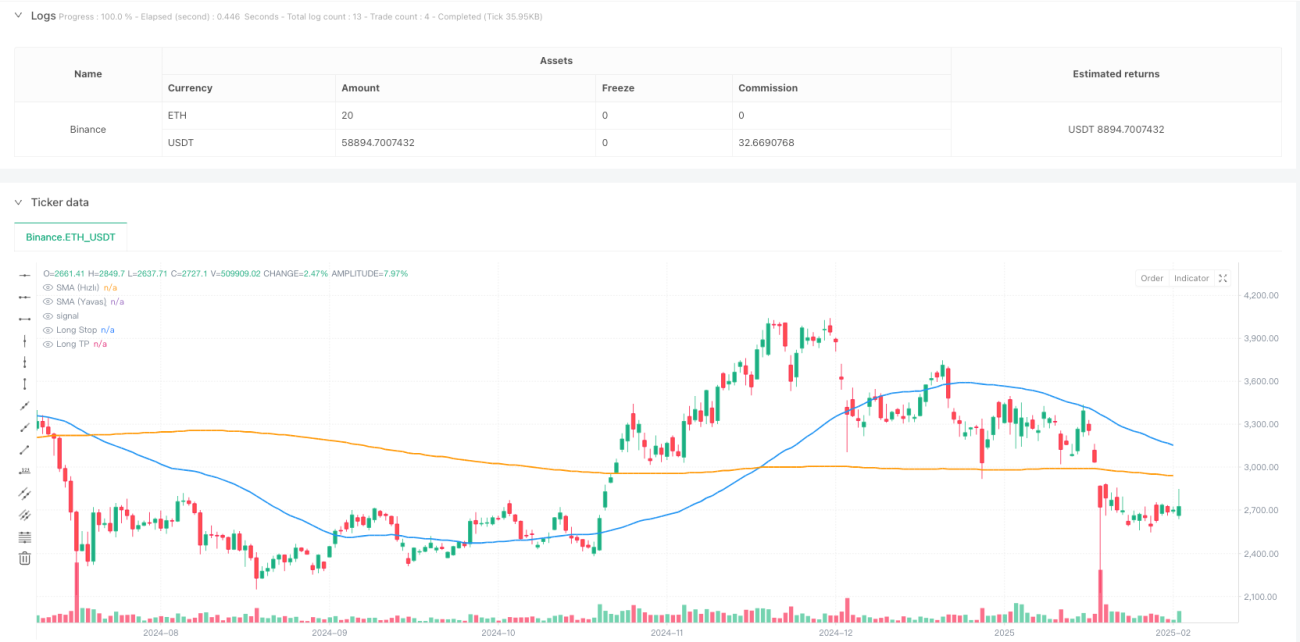
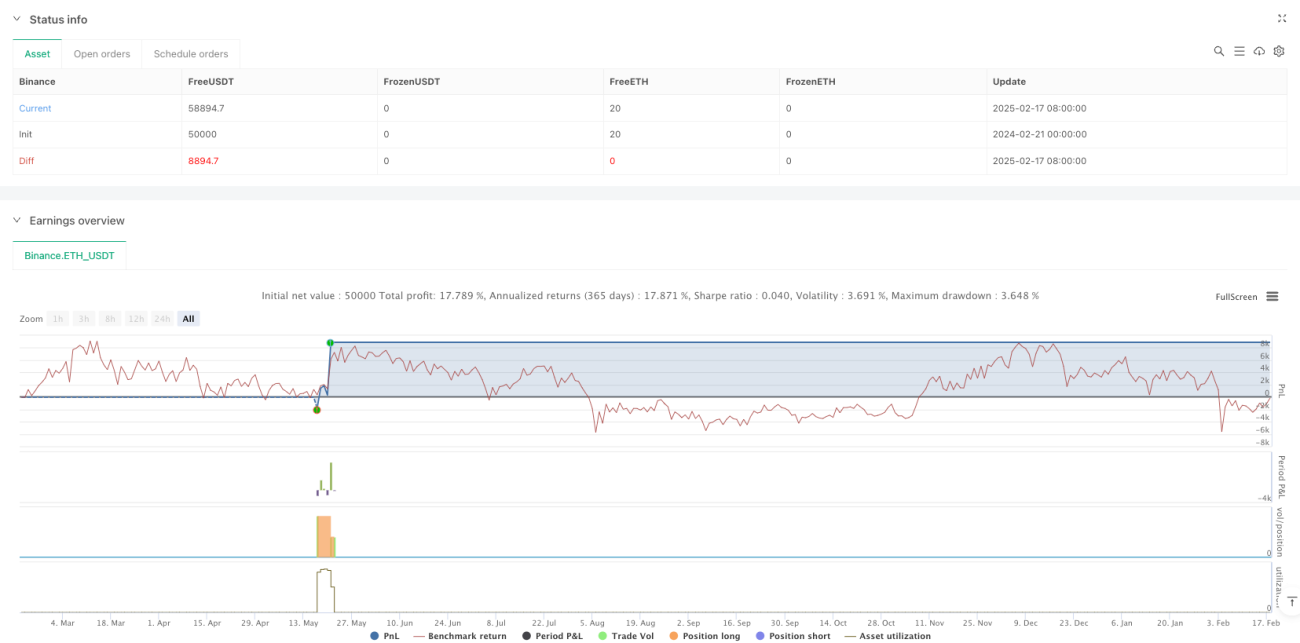
La stratégie est un système de suivi de tendance combinant plusieurs indicateurs techniques. Elle est principalement basée sur les signaux croisés du RSI, du MACD et du SMA pour déterminer la direction des transactions, tout en utilisant les indicateurs ATR pour ajuster dynamiquement les niveaux de stop-loss et de gain. La stratégie intègre également un filtre de volume de transactions pour assurer la négociation avec une liquidité suffisante sur le marché et utilise une partie du mécanisme de stop-loss pour optimiser la gestion des fonds.
La stratégie utilise un mécanisme de triple vérification pour confirmer les signaux de transaction:
Le but de la multi-vérification est de réduire les faux signaux et d’améliorer l’exactitude des transactions. La stratégie consiste à faire plusieurs conditions (trend à la hausse + RSI à travers 40 + MACD à la hausse + confirmation du volume de transaction) pour ouvrir une position et utiliser 2 fois l’ATR comme arrêt-perte et 4 fois comme arrêt.
Il s’agit d’une stratégie globale de suivi des tendances, qui établit un système de négociation robuste grâce à l’utilisation combinée de multiples indicateurs techniques. La principale caractéristique de la stratégie est de s’adapter aux changements du marché grâce à des mécanismes de stop-loss et de profit dynamiques tout en garantissant la sécurité. Bien qu’il existe des endroits qui nécessitent une optimisation, le cadre global est raisonnable et convient à un perfectionnement ultérieur et à des tests en direct.
/*backtest
start: 2024-02-21 00:00:00
end: 2025-02-18 08:00:00
period: 1d
basePeriod: 1d
exchanges: [{"eid":"Binance","currency":"ETH_USDT"}]
*/
//@version=5
strategy( title="AI Trade Strategy v2 (Extended) - Fixed", shorttitle="AI_Trade_v2", overlay=true, format=format.price, initial_capital=100000, default_qty_type=strategy.percent_of_equity, default_qty_value=100, pyramiding=0)
//============================================================================
//=== 1) Basic Indicators (SMA, RSI, MACD) ==================================
//============================================================================
// Time Filter (optional, you can update)
inDateRange = (time >= timestamp("2018-01-01T00:00:00")) and (time <= timestamp("2069-01-01T00:00:00"))
// RSI Parameters
rsiLength = input.int(14, "RSI Period")
rsiOB = input.int(60, "RSI Overbought Level")
rsiOS = input.int(40, "RSI Oversold Level")
rsiSignal = ta.rsi(close, rsiLength)
// SMA Parameters
smaFastLen = input.int(50, "SMA Fast Period")
smaSlowLen = input.int(200, "SMA Slow Period")
smaFast = ta.sma(close, smaFastLen)
smaSlow = ta.sma(close, smaSlowLen)
// MACD Parameters
fastLength = input.int(12, "MACD Fast Period")
slowLength = input.int(26, "MACD Slow Period")
signalLength = input.int(9, "MACD Signal Period")
[macdLine, signalLine, histLine] = ta.macd(close, fastLength, slowLength, signalLength)
//============================================================================
//=== 2) Additional Filter (Volume) ========================================
//============================================================================
useVolumeFilter = input.bool(true, "Use Volume Filter?")
volumeMaPeriod = input.int(20, "Volume MA Period")
volumeMa = ta.sma(volume, volumeMaPeriod)
// If volume filter is enabled, current bar volume should be greater than x times the average volume
volMultiplier = input.float(1.0, "Volume Multiplier (Volume > x * MA)")
volumeFilter = not useVolumeFilter or (volume > volumeMa * volMultiplier)
//============================================================================
//=== 3) Trend Conditions (SMA) ============================================
//============================================================================
isBullTrend = smaFast > smaSlow
isBearTrend = smaFast < smaSlow
//============================================================================
//=== 4) Entry Conditions (RSI + MACD + Trend + Volume) ====================
//============================================================================
// RSI crossing above 30 + Bullish Trend + Positive MACD + Volume Filter
longCondition = isBullTrend and ta.crossover(rsiSignal, rsiOS) and (macdLine > signalLine) and volumeFilter
shortCondition = isBearTrend and ta.crossunder(rsiSignal, rsiOB) and (macdLine < signalLine) and volumeFilter
//============================================================================
//=== 5) ATR-based Stop + Trailing Stop ===================================
//============================================================================
atrPeriod = input.int(14, "ATR Period")
atrMultiplierSL = input.float(2.0, "Stop Loss ATR Multiplier")
atrMultiplierTP = input.float(4.0, "Take Profit ATR Multiplier")
atrValue = ta.atr(atrPeriod)
//============================================================================
//=== 6) Trade (Position) Management ======================================
//============================================================================
if inDateRange
//--- Long Entry ---
if longCondition
strategy.entry(id="Long", direction=strategy.long, comment="Long Entry")
//--- Short Entry ---
if shortCondition
strategy.entry(id="Short", direction=strategy.short, comment="Short Entry")
//--- Stop & TP for Long Position ---
if strategy.position_size > 0
// ATR-based fixed Stop & TP calculation
longStopPrice = strategy.position_avg_price - atrValue * atrMultiplierSL
longTakeProfit = strategy.position_avg_price + atrValue * atrMultiplierTP
// PARTIAL EXIT: (Example) take 50% of the position at early TP
partialTP = strategy.position_avg_price + (atrValue * 2.5)
strategy.exit( id = "Partial TP Long", stop = na, limit = partialTP, qty_percent= 50, from_entry = "Long" )
// Trailing Stop + Final ATR Stop
// WARNING: trail_offset=... is the offset in price units.
// For example, in BTCUSDT, a value like 300 means a 300 USDT trailing distance.
float trailingDist = atrValue * 1.5
strategy.exit( id = "Long Exit (Trail)", stop = longStopPrice, limit = longTakeProfit, from_entry = "Long", trail_offset= trailingDist )
//--- Stop & TP for Short Position ---
if strategy.position_size < 0
// ATR-based fixed Stop & TP calculation for Short
shortStopPrice = strategy.position_avg_price + atrValue * atrMultiplierSL
shortTakeProfit = strategy.position_avg_price - atrValue * atrMultiplierTP
// PARTIAL EXIT: (Example) take 50% of the position at early TP
partialTPShort = strategy.position_avg_price - (atrValue * 2.5)
strategy.exit( id = "Partial TP Short", stop = na, limit = partialTPShort, qty_percent= 50, from_entry = "Short" )
// Trailing Stop + Final ATR Stop for Short
float trailingDistShort = atrValue * 1.5
strategy.exit( id = "Short Exit (Trail)", stop = shortStopPrice, limit = shortTakeProfit, from_entry = "Short", trail_offset= trailingDistShort )
//============================================================================
//=== 7) Plot on Chart (SMA, etc.) =========================================
//============================================================================
plot(smaFast, color=color.blue, linewidth=2, title="SMA (Fast)")
plot(smaSlow, color=color.orange, linewidth=2, title="SMA (Slow)")
// (Optional) Plot Stop & TP levels dynamically:
longStopForPlot = strategy.position_size > 0 ? strategy.position_avg_price - atrValue * atrMultiplierSL : na
longTPForPlot = strategy.position_size > 0 ? strategy.position_avg_price + atrValue * atrMultiplierTP : na
shortStopForPlot = strategy.position_size < 0 ? strategy.position_avg_price + atrValue * atrMultiplierSL : na
shortTPForPlot = strategy.position_size < 0 ? strategy.position_avg_price - atrValue * atrMultiplierTP : na
plot(longStopForPlot, color=color.red, style=plot.style_linebr, title="Long Stop")
plot(longTPForPlot, color=color.green, style=plot.style_linebr, title="Long TP")
plot(shortStopForPlot, color=color.red, style=plot.style_linebr, title="Short Stop")
plot(shortTPForPlot, color=color.green, style=plot.style_linebr, title="Short TP")