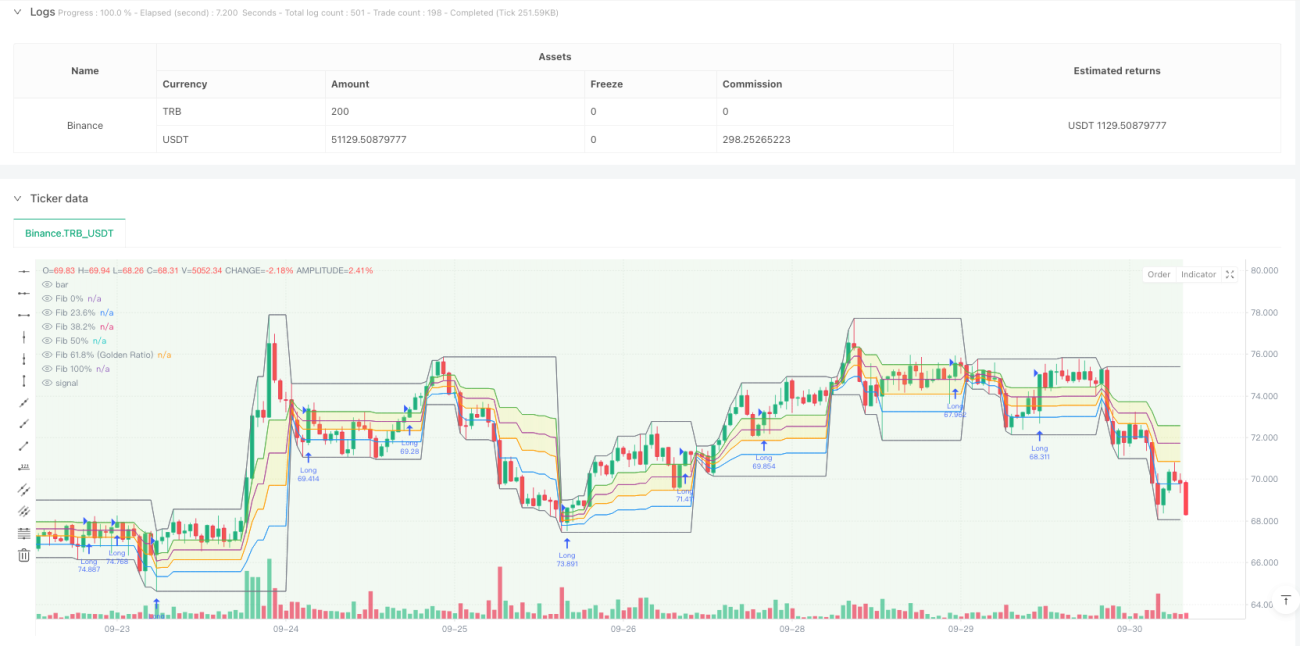
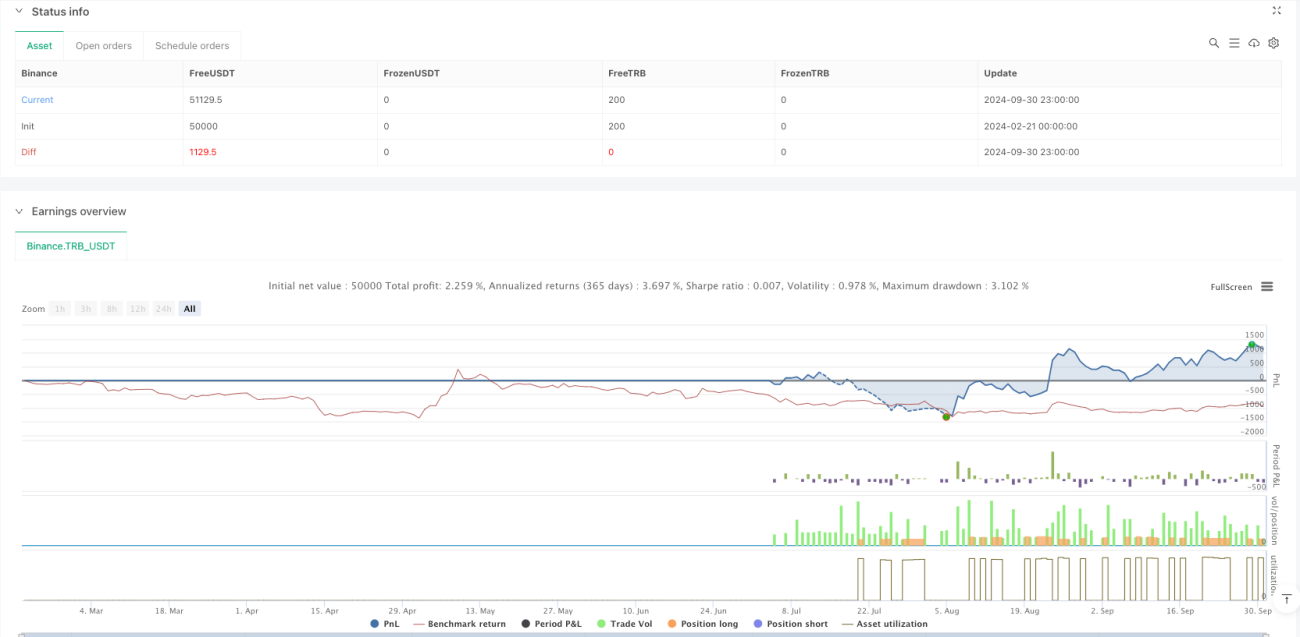
Il s’agit d’une stratégie de négociation innovante à cycles multiples combinant l’exposant Hurst et le niveau de rétraction Fibonacci. La stratégie évalue les caractéristiques de la tendance du marché en calculant l’exposant Hurst pour différentes périodes de temps et identifie les opportunités de négociation potentielles en combinaison avec les niveaux de prix critiques Fibonacci. La stratégie utilise un cadre de gestion du risque strict, comprenant des ratios de risque fixes, des marges de gain et de perte cibles et des limites de fréquence de négociation quotidienne et globale.
La logique centrale de la stratégie repose sur deux composantes principales:
Il s’agit d’une stratégie innovante qui combine les outils classiques de l’analyse technique avec des méthodes modernes de quantification. Par l’analyse de plusieurs cycles de temps et la gestion rigoureuse des risques, la stratégie maintient la base théorique tout en mettant l’accent sur la faisabilité pratique. Bien qu’il existe une certaine marge d’optimisation, le cadre global présente une bonne extensibilité et une valeur pratique.
/*backtest
start: 2024-02-21 00:00:00
end: 2024-10-01 00:00:00
period: 1h
basePeriod: 1h
exchanges: [{"eid":"Binance","currency":"TRB_USDT"}]
*/
//@version=5
// Advanced Multi-Timeframe Trading System (Risk Managed)
//
// Description:
// This strategy combines an approximate measure of market trending via a Hurst exponent
// calculation with Fibonacci retracement levels derived from a higher timeframe (default: Daily)
// to identify potential reversal zones and trade opportunities. The Hurst exponent is calculated
// as a rough indicator of market persistence, while the Fibonacci retracement levels provide potential
// support and resistance areas.
//
// Signal Logic:
// - A long entry is signaled when the price crosses above the 61.8% Fibonacci level (Golden Ratio)
// and the daily Hurst exponent is above 0.5 (suggesting a trending market).
// - A short entry is signaled when the price crosses below the 38.2% Fibonacci level and the daily Hurst
// exponent is below 0.5.
//
// Risk Management:
// Each trade is risk-managed with a stop-loss set at 2% below (or above for shorts) the entry price,
// and a take profit order is set to achieve a 1:2 risk-reward ratio. Position sizing is fixed at 10% of
// equity per trade. Additionally, the strategy limits trading to a maximum of 5 trades per day and 510 trades
// overall (for backtesting since 2019) to ensure a realistic number of orders.
//
// Backtesting Parameters:
// - Initial Capital: $10,000
// - Commission: 0.1% per trade
// - Slippage: 1 tick per bar
// - Position Sizing: 10% of equity per trade
//
// Disclaimer:
// Past performance is not indicative of future results. This strategy is experimental and is provided solely
// for educational purposes. Use caution and perform your own testing before any live deployment.
//
// Author: [Your Name]
// Date: [Date]
strategy("Advanced Multi-Timeframe Trading System (Risk Managed)",
overlay=true,
max_bars_back=500,
initial_capital=10000,
default_qty_type=strategy.percent_of_equity,
default_qty_value=10, // 10% of equity per trade
commission_type=strategy.commission.percent,
commission_value=0.1, // 0.1% commission per trade
slippage=1, // 1 tick per bar
calc_on_order_fills=true,
calc_on_every_tick=true)
// ─── INPUTS ─────────────────────────────────────────────────────────────
hurstLen = input.int(50, title="Hurst Lookback Period", minval=10)
fibTF = input.timeframe("D", title="Fibonacci Retracement Timeframe")
maxTradesPerDay = input.int(5, title="Max Trades Per Day", minval=1)
maxTotalTrades = input.int(510, title="Max Total Trades since 2019", minval=1)
riskPerc = input.float(2.0, title="Risk Percent per Trade (%)", step=0.1) * 0.01 // 2% risk per trade
rrRatio = input.float(2.0, title="Risk-Reward Ratio", step=0.1) // Target profit = 2x risk
// ─── FUNCTION: Approximate Hurst Exponent Calculation ──────────────────────
// This function uses a simple rescaled range method to approximate the Hurst exponent.
// Note: This is an experimental calculation and should be interpreted as a rough gauge of market trending.
calcHurst(src, len) =>
mean = ta.sma(src, len)
dev = src - mean
cumDev = 0.0
for i = 0 to len - 1
cumDev := cumDev + dev[i]
R = ta.highest(cumDev, len) - ta.lowest(cumDev, len)
S = ta.stdev(src, len)
hurst = na(S) or S == 0 ? na : math.log(R / S) / math.log(len)
hurst
// Calculate the Hurst exponent on the current timeframe and from a higher timeframe (daily)
currHurst = calcHurst(close, hurstLen)
dailyHurst = request.security(syminfo.tickerid, "D", calcHurst(close, hurstLen))
// ─── FIBONACCI RETRACEMENT LEVELS (WITH GOLDEN RATIO) ──────────────────────────
// Retrieve the daily high/low from the selected timeframe (default: Daily)
dHigh = request.security(syminfo.tickerid, fibTF, high)
dLow = request.security(syminfo.tickerid, fibTF, low)
// Define Fibonacci levels between the daily low and high.
fib_0 = dLow
fib_100 = dHigh
fib_236 = dLow + 0.236 * (dHigh - dLow)
fib_382 = dLow + 0.382 * (dHigh - dLow)
fib_500 = dLow + 0.5 * (dHigh - dLow)
fib_618 = dLow + 0.618 * (dHigh - dLow) // Golden ratio level
// Plot the Fibonacci levels for reference.
pFib0 = plot(fib_0, color=color.gray, title="Fib 0%")
pFib236 = plot(fib_236, color=color.blue, title="Fib 23.6%")
pFib382 = plot(fib_382, color=color.orange, title="Fib 38.2%")
pFib500 = plot(fib_500, color=color.purple, title="Fib 50%")
pFib618 = plot(fib_618, color=color.green, title="Fib 61.8% (Golden Ratio)")
pFib100 = plot(fib_100, color=color.gray, title="Fib 100%")
// Fill the area between the 61.8% and 38.2% levels to highlight the key retracement zone.
fill(pFib618, pFib382, color=color.new(color.yellow, 80), title="Fibonacci Retracement Zone")
// ─── TRADE COUNT MANAGEMENT ─────────────────────────────────────────────────
// To simulate realistic trading frequency, the strategy limits trades to a maximum of 5 per day and 510 overall.
var int tradesToday = 0
var int globalTradeCount = 0
// Reset the daily trade counter at the start of a new day.
newDay = ta.change(time("D"))
if newDay
tradesToday := 0
// Allow new trades only if within the daily and overall trade limits.
canTrade = (tradesToday < maxTradesPerDay) and (globalTradeCount < maxTotalTrades)
// ─── TRADING SIGNALS ─────────────────────────────────────────────────────────
// Entry conditions based on Fibonacci levels and daily Hurst conditions:
// • Long: Price crosses above the 61.8% (Golden Ratio) level and daily Hurst > 0.5.
// • Short: Price crosses below the 38.2% level and daily Hurst < 0.5.
longCond = ta.crossover(close, fib_618) and (dailyHurst > 0.5)
shortCond = ta.crossunder(close, fib_382) and (dailyHurst < 0.5)
if longCond and canTrade
strategy.entry("Long", strategy.long)
tradesToday := tradesToday + 1
globalTradeCount := globalTradeCount + 1
if shortCond and canTrade
strategy.entry("Short", strategy.short)
tradesToday := tradesToday + 1
globalTradeCount := globalTradeCount + 1
// ─── RISK MANAGEMENT: STOP-LOSS & TAKE-PROFIT ──────────────────────────────
// For active positions, define stop-loss and take profit levels based on the entry price.
// This ensures that each trade risks approximately 2% of the entry price with a target
// of 2x the risk (1:2 risk-reward ratio).
if strategy.position_size > 0
longStop = strategy.position_avg_price * (1 - riskPerc)
longTarget = strategy.position_avg_price * (1 + rrRatio * riskPerc)
strategy.exit("Long Exit", from_entry="Long", stop=longStop, limit=longTarget)
if strategy.position_size < 0
shortStop = strategy.position_avg_price * (1 + riskPerc)
shortTarget = strategy.position_avg_price * (1 - rrRatio * riskPerc)
strategy.exit("Short Exit", from_entry="Short", stop=shortStop, limit=shortTarget)
// ─── CHART OVERLAYS & VISUAL AIDS ────────────────────────────────────────────
// Background color indicates the daily market trend:
// Green for trending conditions (dailyHurst > 0.5) and red for less trending conditions.
bgcolor(dailyHurst > 0.5 ? color.new(color.green, 90) : color.new(color.red, 90), title="Daily Trend Background")
// Display an information table in the top-right corner to help interpret key values.
var table infoTable = table.new(position.top_right, 2, 4, border_width=1, frame_color=color.gray)
if barstate.islast
table.cell(infoTable, 0, 0, "Current Hurst", text_color=color.white, bgcolor=color.black)
table.cell(infoTable, 1, 0, str.tostring(currHurst, "#.###"), text_color=color.white, bgcolor=color.black)
table.cell(infoTable, 0, 1, "Daily Hurst", text_color=color.white, bgcolor=color.black)
table.cell(infoTable, 1, 1, str.tostring(dailyHurst, "#.###"), text_color=color.white, bgcolor=color.black)
table.cell(infoTable, 0, 2, "Trades Today", text_color=color.white, bgcolor=color.black)
table.cell(infoTable, 1, 2, str.tostring(tradesToday), text_color=color.white, bgcolor=color.black)
table.cell(infoTable, 0, 3, "Global Trades", text_color=color.white, bgcolor=color.black)
table.cell(infoTable, 1, 3, str.tostring(globalTradeCount), text_color=color.white, bgcolor=color.black)
// Optional: Add labels on the final bar to mark the key Fibonacci levels.
if barstate.islast
label.new(bar_index, fib_618, "61.8% (Golden Ratio)", style=label.style_label_left, color=color.green, textcolor=color.white, size=size.tiny)
label.new(bar_index, fib_382, "38.2%", style=label.style_label_left, color=color.orange, textcolor=color.white, size=size.tiny)