
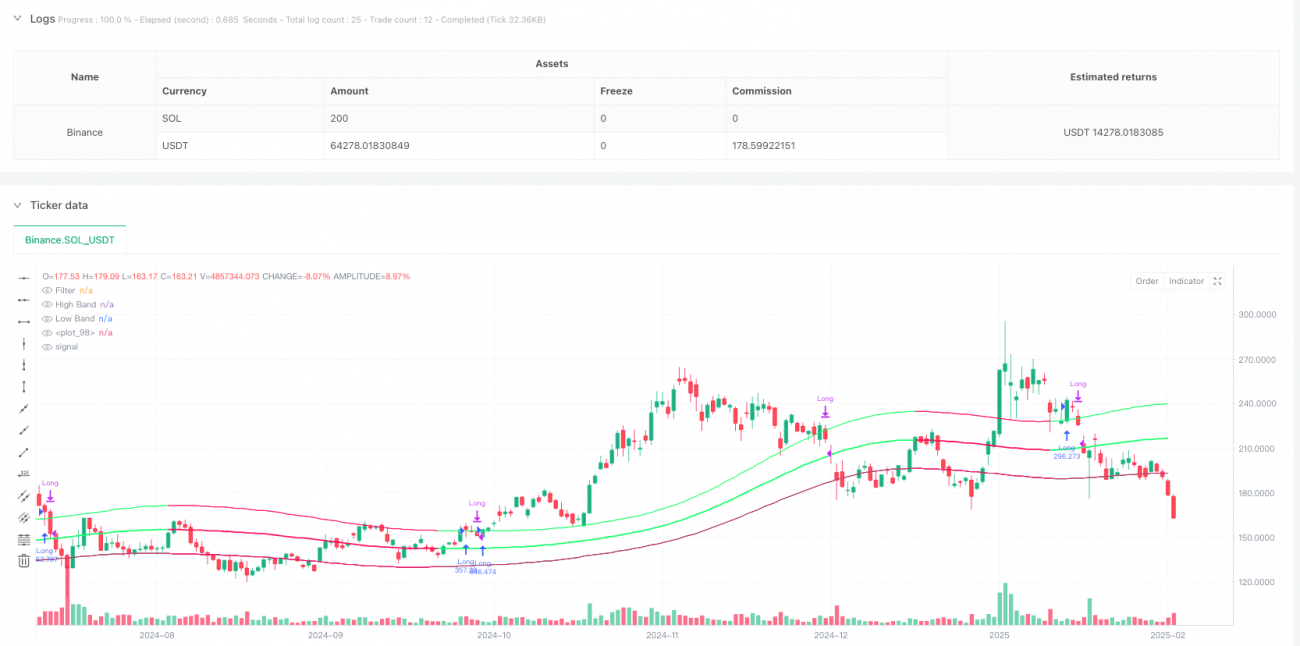
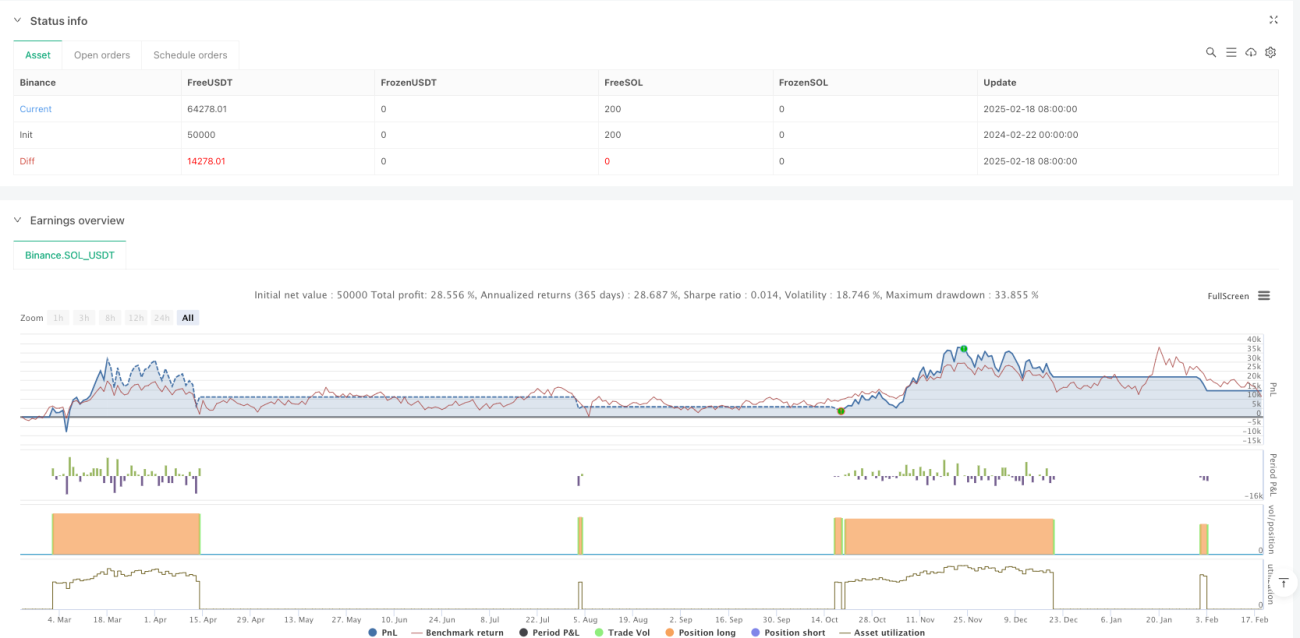
Aperçu
Cette stratégie est un système de trading complet combinant un filtre à canal gaussien et l'indicateur RSI stochastique. Elle détermine les opportunités de trading en se basant sur les changements directionnels du canal gaussien et la position du prix, associés aux signaux de surachat/survente du RSI stochastique. La stratégie utilise un modèle mathématique complexe pour construire un canal adaptatif, capable de filtrer efficacement le bruit du marché et de capturer les mouvements de prix importants.
Principe de la stratégie
La logique centrale de la stratégie repose sur les éléments clés suivants :
- Calcul du canal gaussien : utilisation d'un filtre gaussien multi-pôles sur les données de prix HLC3 pour créer un canal adaptatif. Les paramètres bêta et alpha optimisent l'effet de filtrage, avec une option pour réduire le décalage.
- Ajustement de la largeur du canal : la largeur est ajustée dynamiquement en fonction de la vraie amplitude (TR), avec un multiplicateur par défaut de 1,414.
- Signal RSI stochastique : combinaison d'un RSI sur 14 périodes et d'un indicateur stochastique pour générer des signaux au-dessus de 80 ou en dessous de 20.
- Conditions d'entrée : nécessité de remplir simultanément trois conditions : canal gaussien orienté à la hausse, prix dépassant la bande supérieure, et signal du RSI stochastique déclenché.
- Logique de sortie : clôture de la position lorsque le prix repasse sous la bande supérieure du canal gaussien.
Avantages de la stratégie
- Fiabilité des signaux : le mécanisme de confirmation multi-indicateurs améliore considérablement la fiabilité des signaux de trading.
- Forte adaptabilité : le canal gaussien ajuste automatiquement sa largeur en fonction de la volatilité du marché.
- Filtrage du bruit : le filtre gaussien réduit efficacement l'impact du bruit du marché.
- Haute flexibilité : plusieurs paramètres ajustables sont proposés, notamment la période du canal, le nombre de pôles et les paramètres du RSI.
- Visualisation intuitive : les changements de couleur indiquent visuellement la direction de la tendance et les signaux de trading.
Risques de la stratégie
- Sensibilité aux paramètres : le nombre de pôles du canal gaussien et le réglage de la période d'échantillonnage ont un impact important sur les performances de la stratégie.
- Risque de décalage : bien qu'une option de réduction du décalage soit proposée, l'indicateur lui-même présente toujours un certain retard.
- Risque de faux dépassements : des signaux de dépassement fréquents peuvent se produire dans un marché en range.
- Gestion du capital insuffisante : la version actuelle manque d'un mécanisme détaillé de gestion des positions.
Directions d'optimisation de la stratégie
- Identification de l'environnement de marché : ajouter un indicateur de force de tendance pour ajuster les paramètres de la stratégie en fonction des différentes conditions de marché.
- Optimisation dynamique des paramètres : ajuster automatiquement les paramètres du canal gaussien en fonction de la volatilité du marché.
- Amélioration de la gestion des positions : introduire un système de gestion dynamique des positions basé sur la volatilité.
- Renforcement du mécanisme de sortie : ajouter un stop suiveur et un mécanisme de prise de bénéfices partielle.
- Optimisation des horizons temporels : valider les signaux sur plusieurs timeframe pour améliorer la stabilité du trading.
Résumé
Cette stratégie construit un système de trading très adaptatif en combinant le filtre à canal gaussien et l'indicateur RSI stochastique. La base mathématique du canal gaussien garantit la fluidité et la fiabilité des signaux, tandis que l'association avec le RSI stochastique améliore encore la précision du timing d'entrée. Le principal avantage de la stratégie réside dans son filtrage efficace du bruit du marché et sa bonne capture des tendances, mais il convient également de prêter attention aux problèmes d'optimisation des paramètres et de gestion des risques. Grâce aux directions d'optimisation suggérées, les performances globales de la stratégie peuvent encore être améliorées.
/*backtest
start: 2024-02-22 00:00:00
end: 2025-02-19 08:00:00
period: 1d
basePeriod: 1d
exchanges: [{"eid":"Binance","currency":"SOL_USDT"}]
*/

//@version=5
strategy(title="Gaussian Channel Strategy v3.0", overlay=true, calc_on_every_tick=false, initial_capital=1000, default_qty_type=strategy.percent_of_equity, default_qty_value=100, commission_type=strategy.commission.percent, commission_value=0.1, slippage=0, fill_orders_on_standard_ohlc=true)

//------------------------------------------------------------------------------------------------------------------------------------------------------------------ 1