
Aperçu
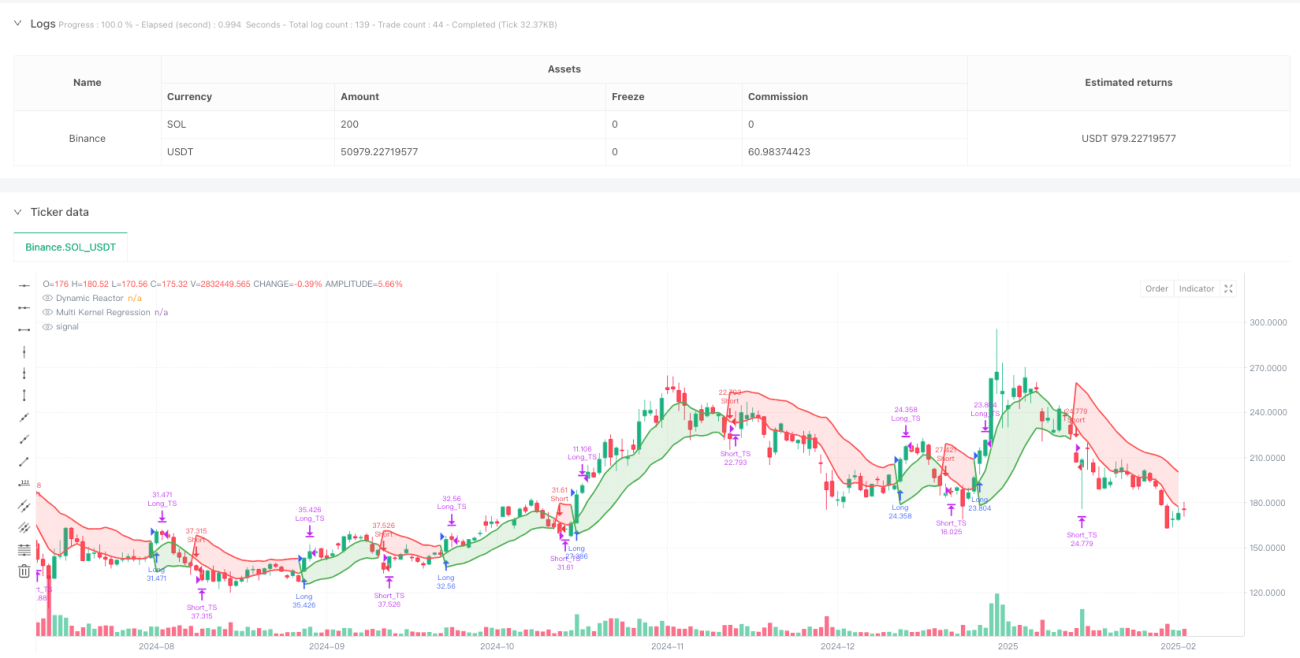
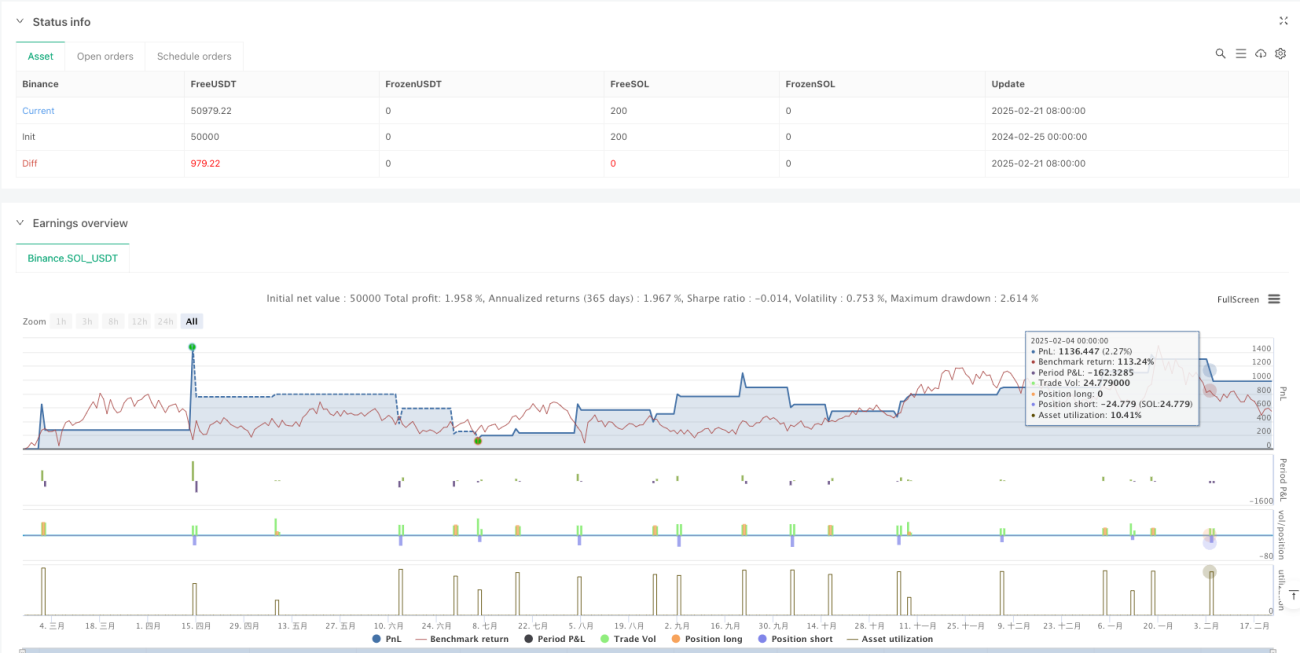
Cette stratégie est un système de suivi de tendance combinant un réacteur dynamique (Dynamic Reactor) et une régression multi-noyaux (Multi-Kernel Regression). Elle capture les tendances du marché en fusionnant un canal ATR, une moyenne mobile SMA, ainsi qu'une régression par noyau gaussien et une régression par noyau Epanechnikov, tout en utilisant l'indicateur RSI pour filtrer les signaux. La stratégie intègre également un système complet de gestion de position, incluant un stop-loss dynamique, des objectifs de profit multiples et un trailing stop.
Principe de la stratégie
Le cœur de la stratégie se compose de deux parties principales. La première partie est le réacteur dynamique (DR), qui construit un canal de prix adaptatif basé sur l'ATR et la SMA. La largeur du canal est déterminée par un multiplicateur de l'ATR, tandis que sa position s'ajuste en fonction de l'évolution de la SMA. Lorsque le prix franchit le canal, le système met à jour la direction de la tendance. La deuxième partie est la régression multi-noyaux (MKR), qui combine une régression par noyau gaussien et une régression par noyau Epanechnikov. En paramétrant différentes largeurs de bande et pondérations, le système parvient à mieux ajuster l'évolution des prix. Le signal de transaction est généré par le croisement entre les lignes MKR et DR, puis filtré par le RSI afin d'éviter les zones de surachat ou de survente.
Avantages de la stratégie
- Forte adaptabilité : Grâce à la combinaison du réacteur dynamique et de la régression multi-noyaux, la stratégie s'adapte automatiquement à différents environnements de marché et conditions de volatilité.
- Gestion des risques complète : Elle intègre de multiples mécanismes de contrôle des risques : stop-loss dynamique, prise de profits échelonnée et trailing stop.
- Haute qualité des signaux : Le filtrage par RSI et la confirmation du croisement des deux lignes réduisent efficacement les faux signaux.
- Efficacité de calcul : Bien qu'elle utilise un algorithme de régression par noyau complexe, l'optimisation des méthodes de calcul garantit des performances en temps réel.
Risques de la stratégie
- Sensibilité aux paramètres : L'efficacité dépend fortement du réglage des paramètres tels que le multiplicateur ATR et la largeur de bande des noyaux. Un paramétrage inapproprié peut entraîner un excès de transactions ou des opportunités manquées.
- Retard : En raison de l'utilisation de moyennes mobiles et de régressions, un certain retard peut survenir lors de mouvements rapides du marché.
- Adaptabilité au marché : La stratégie fonctionne bien en tendance, mais peut générer de faux signaux fréquents dans un marché en range.
- Complexité de calcul : La partie régression multi-noyaux est relativement complexe ; des optimisations de performance sont nécessaires pour un trading à haute fréquence.
Pistes d'optimisation
- Paramètres adaptatifs : Introduire un mécanisme d'adaptation pour ajuster dynamiquement le multiplicateur ATR et la largeur de bande des noyaux en fonction de la volatilité du marché.
- Amélioration des signaux : Envisager d'ajouter des indicateurs auxiliaires tels que le volume ou les figures de prix pour renforcer la fiabilité des signaux.
- Contrôle des risques : Adapter dynamiquement les ratios de stop-loss et d'objectifs de profit en fonction de la volatilité du marché.
- Filtrage du marché : Ajouter un module d'identification de l'environnement de marché pour utiliser différentes stratégies selon les conditions.
Conclusion
Cette stratégie constitue un système de trading complet alliant des méthodes statistiques modernes et l'analyse technique traditionnelle. Grâce à la combinaison innovante du réacteur dynamique et de la régression multi-noyaux, ainsi qu'à un mécanisme de gestion des risques solide, elle démontre une bonne adaptabilité et stabilité. Malgré quelques points à optimiser, des améliorations continues et un réglage des paramètres devraient lui permettre de maintenir des performances stables dans différents environnements de marché.
/*backtest
start: 2024-07-20 00:00:00
end: 2025-07-19 08:00:00
period: 1d
basePeriod: 1d
exchanges: [{"eid":"Binance","currency":"ETH_USDT","balance":2000000}]
*/

//@version=5
strategy("DR+MKR Signals – Band SL, Multiple TP & Trailing Stop", overlay=true, default_qty_value=10)

// =====================================================================- 1