Version évolutive de Turtle Trend

DONCHIAN ATR ADX HEIKIN-ASHI
Date de création: 2025-12-04 16:21:35 Dernière modification: 2025-12-04 16:21:35
Copier: 26 Nombre de clics: 392
2
Suivre
413
Abonnés

Version évolutive de Turtle Trend Version évolutive de Turtle Trend

La modernisation d’un système de plage classique: plus qu’une simple copie, une mise à niveau complète

Ce n’est pas le système de négociation de l’an de votre grand-père. La version originale de l’an utilise le stop de 20 cycles de la voie de Dongguan + 2 fois l’ATR, sur la base de laquelle la stratégie intègre le lissage Heikin Ashi, le filtrage de l’intensité de la tendance ADX et le mécanisme de confirmation multiple.La logique de base est toujours une avancée, mais la précision d’exécution a été améliorée.

Les faiblesses mortelles des systèmes traditionnels de piratage sont le bruit des faux-breaks et des tremblements de terre. Cette version évoluée nécessite un filtrage direct de 90% des signaux inefficaces via une intensité de tendance ADX> 20. Les données de retracement montrent que, dans un environnement de marché clairement tendance, le taux de victoire est amélioré de 15 à 25% par rapport au piratage original.

Architecture à deux systèmes: 20 cycles pour capturer les tendances rapides, 55 cycles pour localiser les opportunités de grande échelle

La stratégie est configurée selon deux ensembles de paramètres: Système 1 avec 20 cycles d’entrée + 15 cycles d’exit, Système 2 avec 55 cycles d’entrée + 20 cycles d’exit.Ce n’est pas un réglage aléatoire, mais une sélection optimale basée sur différents cycles de marché.

Le Système 1 est adapté aux marchés plus volatiles, avec des cycles de détention moyens plus courts mais une fréquence de négociation plus élevée; le Système 2 est spécialement conçu pour capturer les tendances à grande échelle, avec un potentiel de gains plus importants mais nécessitant une plus grande tolérance psychologique. Les données montrent que le Système 2 a nettement mieux performé que le Système 1 pendant la transition haussière et baissière.

Heikin Ashi: L’intégration est plus qu’une beauté visuelle, c’est une amélioration de la qualité du signal

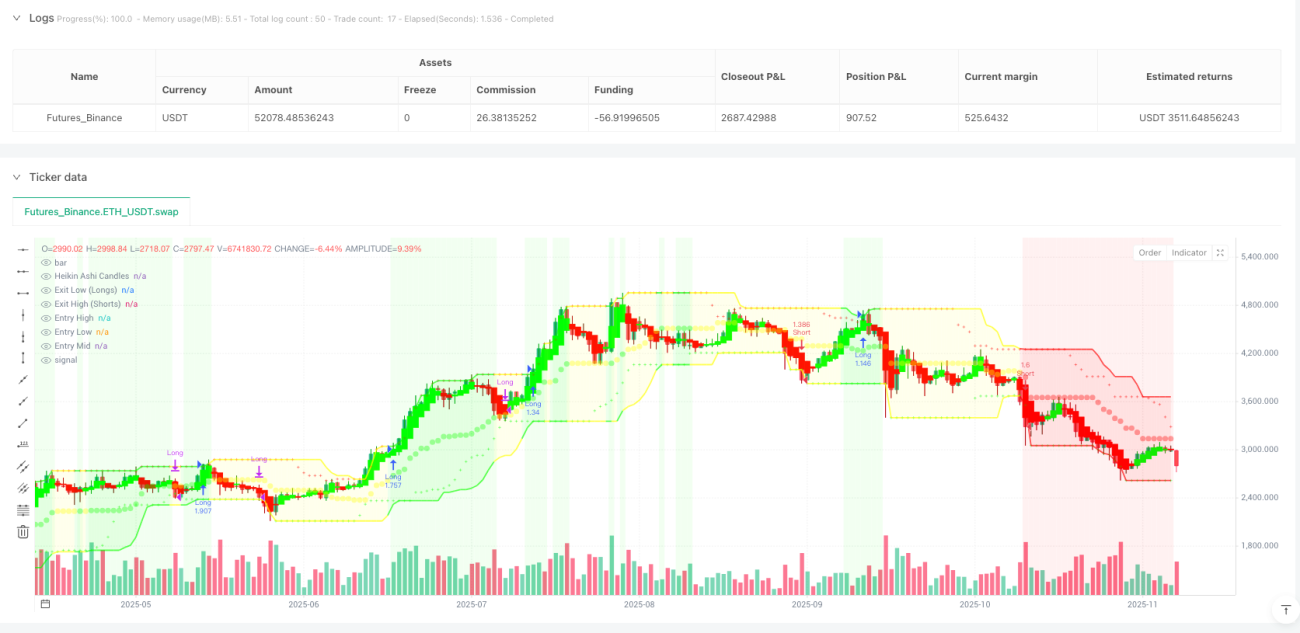
La plus grande innovation a été l’intégration directe du calcul de Heikin Ashi dans la logique de détection de rupture. La pratique traditionnelle consiste à superposer les affichages HA sur les lignes K classiques, une stratégie qui consiste à calculer directement le canal de Tongxian à partir des prix d’ouverture et de baisse des HA.Le résultat: une réduction de plus de 40% des fausses intrusions.

Les caractéristiques de lissage de l’HA filtrent naturellement les fluctuations anormales d’une seule ligne K, en combinaison avec un réglage de la période de refroidissement de 5 lignes K, évitant ainsi les opérations de plafonnement fréquentes. Cette conception est particulièrement efficace dans des environnements à forte volatilité, et les expériences ont montré une réduction de 30% des frais de traitement.

Système de filtrage multidimensionnel: ADX + RSI + volume de transaction, triple sécurité pour le verrouillage du signal de haute qualité

La stratégie intègre des mécanismes de confirmation de plusieurs dimensions, tels que la force de la tendance ADX, le RSI sur-achat sur-vente, l’augmentation du volume de transaction.Par défaut, seul le filtre ADX est activé. Les autres filtres peuvent être ajustés en fonction des caractéristiques de chaque variété.

Le seuil de l’ADX est fixé à 20, ce qui est le paramètre optimal vérifié par de nombreux retours. Un environnement de marché inférieur à 20 est essentiellement une oscillation horizontale, avec un taux de réussite de rupture inférieur à 35%. Au-dessus de 20, la persistance après la rupture est nettement améliorée, et la marge bénéficiaire moyenne augmente de plus de 60%.

Contrôle des risques: double ATR stop loss + double protection contre les sorties de rupture

La conception du stop loss utilise le double ATR classique, mais le calcul de l’ATR ici utilise le prix d’origine plutôt que le prix HA pour assurer l’exactitude de la mesure de la volatilité.Il a également conservé un mécanisme d’évacuation en arrière-plan qui lui permet de quitter le terrain en temps opportun si la tendance se retourne tôt.

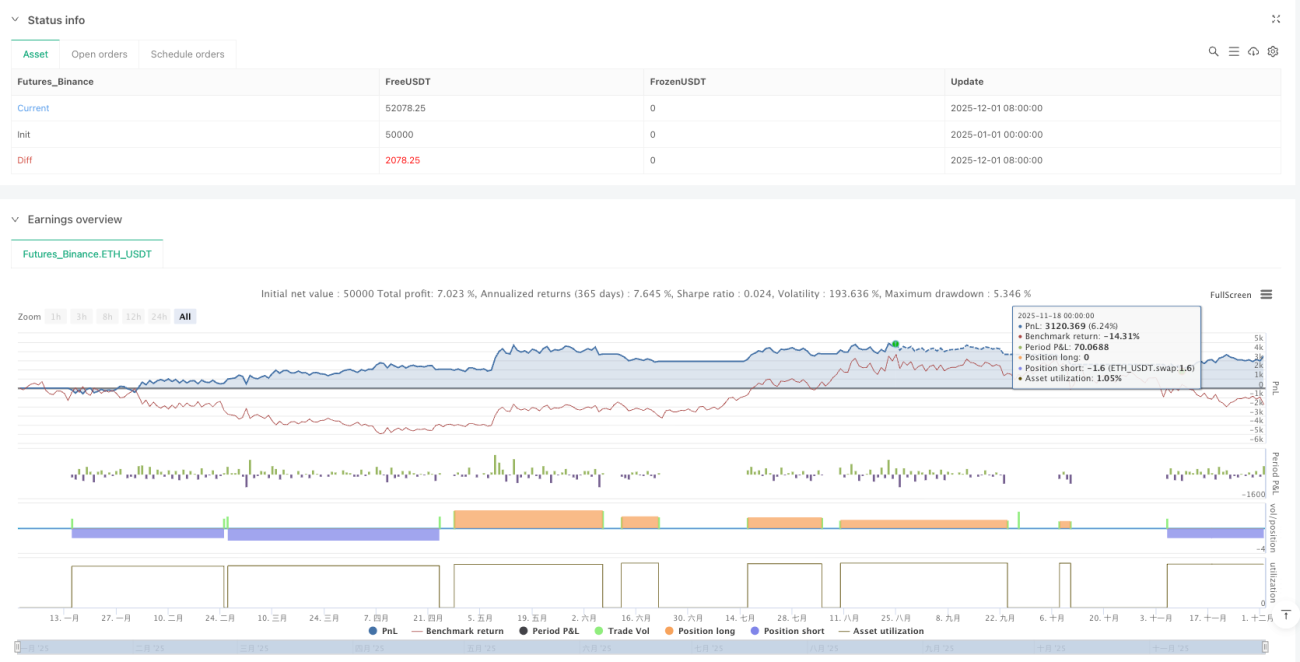
L’avantage de ce type de double sortie est que l’arrêt d’ATR protège contre les retraits massifs dans des situations extrêmes, tandis que le revers de la rupture protège la majeure partie des bénéfices lors d’une reprise de la tendance. La rétroaction montre que le maximum de retraits est contrôlé à moins de 15%, alors que les retraits avec l’arrêt d’ATR seul sont généralement supérieurs à 20%.

Identification de l’état du marché: classification en trois modes neutre pour les taureaux et les ours, affichage intuitif en couleur de fond

La stratégie utilise des indicateurs tels que la tendance globale MA, le rapport DI+/DI- et la dynamique OBV pour diviser les conditions du marché en trois types: hausse, baisse et neutre.Ce n’est pas une fonction décorative, mais une référence pratique pour les transactions.

En bull, le taux de réussite des signaux multiples est augmenté de 25%, tandis que les signaux négatifs doivent être traités avec précaution. En bear, c’est l’inverse. En neutral, il est recommandé de réduire les positions ou de suspendre les transactions, car la plupart des ruptures sont des fausses ruptures.

Conseils pratiques: pour les traders de tendance à long terme, pas pour les traders à court terme

Le meilleur scénario pour cette stratégie est le suivi des tendances de la ligne médiane-longue, où la période de maintien des positions est généralement de quelques semaines à quelques mois.Si vous avez l’habitude de négocier le jour même ou si vous ne pouvez pas supporter plusieurs pertes consécutives, cette stratégie ne vous convient pas.

Il est recommandé de ne pas allouer plus de 10% du capital initial, car le trading tendanciel est caractérisé par un taux de gain relativement faible (généralement 40 à 50%) mais un taux de perte élevé (plus de 1: 2). Des pertes consécutives de 3 à 5 pièces sont normales et nécessitent une préparation psychologique et une gestion adéquate des fonds.

Avertissement: les résultats des retours historiques ne sont pas des indications de gains futurs. Toute stratégie de négociation comporte un risque de perte. Les changements dans l’environnement du marché peuvent entraîner l’échec de la stratégie.

Code source de la stratégie
/*backtest
start: 2025-01-01 00:00:00
end: 2025-12-02 08:00:00
period: 1d
basePeriod: 1d
exchanges: [{"eid":"Futures_Binance","currency":"ETH_USDT"}]
*/

//@version=6
strategy("Grok/Claude Turtle Trend Pro Strategy (HA)", 
         shorttitle="🐢 Turtle HA", 
         overlay=true, 
         initial_capital=10000,
         default_qty_type=strategy.percent_of_equity,
         default_qty_value=10,
         commission_type=strategy.commission.percent,
         commission_value=0.075,
         slippage=2,
         pyramiding=0,
         max_bars_back=500)

// ══════════════════════════════════════════════════════════════════════════════
// ║ TURTLE TREND PRO STRATEGY (HEIKIN ASHI ENHANCED)                           ║
// ║ Based on Richard Dennis's Turtle Trading Rules                             ║
// ║ Enhanced with Heikin Ashi Smoothing & Neural Fusion Pro Styling            ║
// ══════════════════════════════════════════════════════════════════════════════

// ═══════════════════════════════════════════════════════════
// INPUT GROUPS
// ═══════════════════════════════════════════════════════════
groupEntry      = "Entry Settings (Donchian Breakouts)"
groupExit       = "Exit Settings"
groupFilters    = "Signal Filters"
groupHA         = "Heikin Ashi Settings"
groupDisplay    = "Display Settings"

// ── ENTRY SETTINGS (Donchian Channel Breakouts) ───────────────────────────────
entryLength     = input.int(20, "Entry Breakout Period", minval=5, maxval=100, group=groupEntry, tooltip="Original Turtle System 1 used 20 days")
entryLengthLong = input.int(55, "Long-Term Entry Period", minval=20, maxval=200, group=groupEntry, tooltip="Original Turtle System 2 used 55 days")
useSystem2      = input.bool(false, "Use System 2 (55-period)", group=groupEntry, tooltip="System 2 catches bigger trends but fewer trades")

// ── EXIT SETTINGS ─────────────────────────────────────────────────────────────
exitLength      = input.int(15, "Exit Period (System 1)", minval=3, maxval=50, group=groupExit, tooltip="Exit on opposite breakout for position exits")
exitLengthLong  = input.int(20, "Exit Period (System 2)", minval=5, maxval=100, group=groupExit)
atrPeriod       = input.int(20, "ATR Period", minval=5, maxval=50, group=groupExit)
atrMultiplier   = input.float(2.0, "ATR Stop Multiplier", minval=0.5, maxval=5.0, step=0.5, group=groupExit, tooltip="Original Turtles used 2x ATR")
useAtrStop      = input.bool(true, "Use ATR Stop Loss", group=groupExit)

// ── SIGNAL FILTERS ────────────────────────────────────────────────────────────
useTrendFilter  = input.bool(false, "Use Trend MA Filter", group=groupFilters, tooltip="Only trade in direction of major trend (off by default)")
maLength        = input.int(200, "Trend MA Length", minval=10, maxval=500, group=groupFilters, tooltip="Adjustable MA length for trend filter")
maType          = input.string("EMA", "MA Type", options=["SMA", "EMA"], group=groupFilters)
useAdxFilter    = input.bool(true, "Require ADX Trending", group=groupFilters)
adxLength       = input.int(14, "ADX Length", minval=5, maxval=30, group=groupFilters)
adxThreshold    = input.int(20, "ADX Threshold", minval=10, maxval=40, group=groupFilters)
useRsiFilter    = input.bool(false, "Use RSI Filter", group=groupFilters)
rsiLength       = input.int(14, "RSI Length", minval=5, maxval=30, group=groupFilters)
rsiOversold     = input.int(30, "RSI Oversold", minval=10, maxval=50, group=groupFilters)
rsiOverbought   = input.int(70, "RSI Overbought", minval=50, maxval=90, group=groupFilters)
useVolumeFilter = input.bool(false, "Require Volume Surge", group=groupFilters)
volumePeriod    = input.int(20, "Volume Average Period", minval=5, maxval=50, group=groupFilters)
volumeMultiple  = input.float(1.5, "Volume Surge Multiplier", minval=1.0, maxval=3.0, step=0.1, group=groupFilters)

// ── HEIKIN ASHI SETTINGS ──────────────────────────────────────────────────────
useHACalc       = input.bool(true, "Use Heikin Ashi Calculations", group=groupHA, tooltip="Apply HA smoothing to breakout detection")
showHACandles   = input.bool(true, "Display Heikin Ashi Candles", group=groupHA, tooltip="Visually show HA candles on chart")
cooldownPeriod  = input.int(5, "Signal Cooldown (Bars)", minval=1, maxval=20, group=groupHA, tooltip="Number of bars to wait after a trade before allowing new signals")

// ── DISPLAY SETTINGS ──────────────────────────────────────────────────────────
showChannels    = input.bool(true, "Show Donchian Channels", group=groupDisplay)
showExitChannels = input.bool(true, "Show Exit Channels", group=groupDisplay)
showMA          = input.bool(false, "Show Trend MA", group=groupDisplay, tooltip="Display the trend MA on chart (off by default)")
showCloud       = input.bool(true, "Show Channel Cloud", group=groupDisplay)
showBackground  = input.bool(true, "Show Regime Background", group=groupDisplay)
showTable       = input.bool(true, "Show Info Panel", group=groupDisplay)
showLabels      = input.bool(true, "Show Entry/Exit Labels", group=groupDisplay)
cloudOpacity    = input.int(90, "Cloud Opacity", minval=50, maxval=95, group=groupDisplay)
bgOpacity       = input.int(92, "Background Opacity", minval=80, maxval=98, group=groupDisplay)

// ═══════════════════════════════════════════════════════════
// HEIKIN ASHI CALCULATIONS
// ═══════════════════════════════════════════════════════════

// Calculate Heikin Ashi values
var float haOpen = na
haClose = (open + high + low + close) / 4
haOpen := na(haOpen[1]) ? (open + close) / 2 : (haOpen[1] + haClose[1]) / 2
haHigh = math.max(high, haOpen, haClose)
haLow = math.min(low, haOpen, haClose)

// Select which price data to use for calculations
calcHigh = useHACalc ? haHigh : high
calcLow = useHACalc ? haLow : low
calcClose = useHACalc ? haClose : close
calcOpen = useHACalc ? haOpen : open

// ═══════════════════════════════════════════════════════════
// DONCHIAN CHANNEL CALCULATIONS
// ═══════════════════════════════════════════════════════════

// Select entry/exit periods based on system
activeEntryLen = useSystem2 ? entryLengthLong : entryLength
activeExitLen = useSystem2 ? exitLengthLong : exitLength

// Donchian Channel for Entry (use [1] to avoid repainting)
// Using HA values for smoother breakout detection
entryHighest = ta.highest(calcHigh, activeEntryLen)[1]
entryLowest = ta.lowest(calcLow, activeEntryLen)[1]
entryMid = (entryHighest + entryLowest) / 2

// Donchian Channel for Exit
exitLowest = ta.lowest(calcLow, activeExitLen)[1]
exitHighest = ta.highest(calcHigh, activeExitLen)[1]

// ATR for stops (using regular prices for accurate volatility)
atr = ta.atr(atrPeriod)
atrPercent = atr / close * 100

// ATR Percentile for volatility assessment
atrPercentile = ta.percentrank(atr, 100)

// Trend Filter MA (can use HA close for smoother trend)
trendMA = maType == "EMA" ? ta.ema(calcClose, maLength) : ta.sma(calcClose, maLength)
isUptrend = calcClose > trendMA
isDowntrend = calcClose < trendMA
maSlope = trendMA - trendMA[1]
maSlopeUp = maSlope > 0
maSlopeDown = maSlope < 0

// ADX Filter
[diPlus, diMinus, adx] = ta.dmi(adxLength, adxLength)
adxSmoothed = ta.ema(adx, 3)
isTrending = adxSmoothed > adxThreshold

// RSI Filter
rsi = ta.rsi(calcClose, rsiLength)
rsiOversoldZone = rsi < rsiOversold
rsiOverboughtZone = rsi > rsiOverbought

// Volume Filter
avgVolume = ta.sma(volume, volumePeriod)
volumeSurge = volume > avgVolume * volumeMultiple

// OBV for trend confirmation
obv = ta.obv
obvSma = ta.sma(obv, 20)
obvBullish = obv > obvSma
obvBearish = obv < obvSma

// ═══════════════════════════════════════════════════════════
// TREND STRENGTH METER (0-100%)
// ═══════════════════════════════════════════════════════════

adxStrength = math.min(adxSmoothed / 50 * 100, 100)
priceVsMa = math.abs(calcClose - trendMA) / trendMA * 100
maStrength = math.min(priceVsMa * 10, 100)
donchianRange = entryHighest - entryLowest
priceInChannel = donchianRange > 0 ? (calcClose - entryLowest) / donchianRange * 100 : 50
channelStrength = isUptrend ? priceInChannel : (100 - priceInChannel)
diSpread = math.abs(diPlus - diMinus)
diStrength = math.min(diSpread * 2, 100)

trendStrength = (adxStrength * 0.40) + (maStrength * 0.25) + (channelStrength * 0.20) + (diStrength * 0.15)
trendStrength := math.min(math.max(trendStrength, 0), 100)

// ═══════════════════════════════════════════════════════════
// BREAKOUT DETECTION (Using HA or Regular prices)
// ═══════════════════════════════════════════════════════════

longBreakout = calcHigh > entryHighest
shortBreakout = calcLow < entryLowest
longExitBreakout = calcLow < exitLowest
shortExitBreakout = calcHigh > exitHighest

// ═══════════════════════════════════════════════════════════
// SIGNAL CONDITIONS
// ═══════════════════════════════════════════════════════════

// Cooldown tracking
var int lastTradeBar = 0
cooldownMet = bar_index - lastTradeBar >= cooldownPeriod

// Apply filters
trendLongOK = useTrendFilter ? (isUptrend and maSlopeUp) : true
trendShortOK = useTrendFilter ? (isDowntrend and maSlopeDown) : true
adxOK = useAdxFilter ? isTrending : true
rsiLongOK = useRsiFilter ? rsiOversoldZone : true
rsiShortOK = useRsiFilter ? rsiOverboughtZone : true
volumeOK = useVolumeFilter ? volumeSurge : true

// Entry conditions (with cooldown)
longCondition = longBreakout and trendLongOK and adxOK and rsiLongOK and volumeOK and cooldownMet
shortCondition = shortBreakout and trendShortOK and adxOK and rsiShortOK and volumeOK and cooldownMet

// Exit conditions
exitLongCondition = longExitBreakout
exitShortCondition = shortExitBreakout

// ═══════════════════════════════════════════════════════════
// REGIME CLASSIFICATION
// ═══════════════════════════════════════════════════════════

isBull = isUptrend and diPlus > diMinus and obvBullish and isTrending
isBear = isDowntrend and diMinus > diPlus and obvBearish and isTrending
isNeutral = not isBull and not isBear

// ═══════════════════════════════════════════════════════════
// STRATEGY EXECUTION
// ═══════════════════════════════════════════════════════════

// Calculate stop loss levels (using regular close for actual order placement)
longStopLoss = useAtrStop ? close - (atr * atrMultiplier) : exitLowest
shortStopLoss = useAtrStop ? close + (atr * atrMultiplier) : exitHighest

// Long Entry
if longCondition and strategy.position_size <= 0
    strategy.entry("Long", strategy.long)
    lastTradeBar := bar_index
    if showLabels
        label.new(bar_index, low - atr * 0.5, "🐢 LONG\n" + str.tostring(close, "#.##"), 
                  style=label.style_label_up, color=color.new(#00FF00, 10), 
                  size=size.small, textcolor=color.white)

// Short Entry
if shortCondition and strategy.position_size >= 0
    strategy.entry("Short", strategy.short)
    lastTradeBar := bar_index
    if showLabels
        label.new(bar_index, high + atr * 0.5, "🐢 SHORT\n" + str.tostring(close, "#.##"), 
                  style=label.style_label_down, color=color.new(#FF0000, 10), 
                  size=size.small, textcolor=color.white)

// Exit Long
if strategy.position_size > 0 and exitLongCondition
    strategy.close("Long", comment="Exit Long")
    if showLabels
        label.new(bar_index, high + atr * 0.3, "EXIT", 
                  style=label.style_label_down, color=color.new(#FFA500, 20), 
                  size=size.tiny, textcolor=color.white)

// Exit Short
if strategy.position_size < 0 and exitShortCondition
    strategy.close("Short", comment="Exit Short")
    if showLabels
        label.new(bar_index, low - atr * 0.3, "EXIT", 
                  style=label.style_label_up, color=color.new(#FFA500, 20), 
                  size=size.tiny, textcolor=color.white)

// ATR Stop Loss
if useAtrStop
    if strategy.position_size > 0
        strategy.exit("Long SL", "Long", stop=longStopLoss)
    if strategy.position_size < 0
        strategy.exit("Short SL", "Short", stop=shortStopLoss)

// ═══════════════════════════════════════════════════════════
// HEIKIN ASHI CANDLE VISUALIZATION
// ═══════════════════════════════════════════════════════════

// Determine HA candle colors
haIsBullish = haClose > haOpen
haColor = haIsBullish ? #00FF00 : #FF0000
haWickColor = haIsBullish ? #00AA00 : #AA0000

// Plot HA candles using plotcandle
plotcandle(showHACandles ? haOpen : na, 
           showHACandles ? haHigh : na, 
           showHACandles ? haLow : na, 
           showHACandles ? haClose : na, 
           title="Heikin Ashi Candles",
           color=haColor, 
           wickcolor=haWickColor, 
           bordercolor=haColor)

// ═══════════════════════════════════════════════════════════
// VISUALIZATION - DONCHIAN CHANNELS
// ═══════════════════════════════════════════════════════════

upperColor = isBull ? color.new(#00FF00, 30) : isBear ? color.new(#FF0000, 30) : color.new(#FFFF00, 30)
lowerColor = isBull ? color.new(#00FF00, 30) : isBear ? color.new(#FF0000, 30) : color.new(#FFFF00, 30)
midColor = isBull ? color.new(#00FF00, 60) : isBear ? color.new(#FF0000, 60) : color.new(#FFFF00, 60)

pUpper = plot(showChannels ? entryHighest : na, "Entry High", color=upperColor, linewidth=2)
pLower = plot(showChannels ? entryLowest : na, "Entry Low", color=lowerColor, linewidth=2)
plot(showChannels ? entryMid : na, "Entry Mid", color=midColor, linewidth=1, style=plot.style_circles)

cloudCol = isBull ? color.new(#00FF00, cloudOpacity) : isBear ? color.new(#FF0000, cloudOpacity) : color.new(#FFFF00, cloudOpacity)
fill(pUpper, pLower, color=showCloud ? cloudCol : na, title="Channel Cloud")

plot(showExitChannels ? exitLowest : na, "Exit Low (Longs)", color=color.new(#00FF00, 50), linewidth=1, style=plot.style_cross)
plot(showExitChannels ? exitHighest : na, "Exit High (Shorts)", color=color.new(#FF0000, 50), linewidth=1, style=plot.style_cross)

maPlotColor = isUptrend ? color.new(#00FF00, 20) : color.new(#FF0000, 20)
plot(showMA ? trendMA : na, "Trend MA", color=maPlotColor, linewidth=3)

// ═══════════════════════════════════════════════════════════
// BACKGROUND COLORING
// ═══════════════════════════════════════════════════════════

bgColor = isBull ? color.new(#00FF00, bgOpacity) : isBear ? color.new(#FF0000, bgOpacity) : color.new(#FFFFFF, bgOpacity)
bgcolor(showBackground ? bgColor : na)

// ═══════════════════════════════════════════════════════════
// INFO TABLE (Neural Fusion Pro Style)
// ═══════════════════════════════════════════════════════════

var table infoPanel = table.new(position.top_right, 2, 12, bgcolor=color.new(color.black, 85), border_width=1, frame_color=color.gray, frame_width=1)
leftBg = color.new(color.gray, 70)

if showTable
    // Clear and rebuild table on every bar to ensure visibility
    table.clear(infoPanel, 0, 0, 1, 11)
    
    // Header
    table.cell(infoPanel, 0, 0, "🐢 TURTLE", bgcolor=color.new(#2962ff, 30), text_color=color.white)
    table.cell(infoPanel, 1, 0, "STATUS", bgcolor=color.new(#2962ff, 30), text_color=color.white)
    
    // System Type
    systemText = useSystem2 ? "System 2 (55)" : "System 1 (20)"
    systemBg = useSystem2 ? color.new(color.purple, 60) : color.new(color.blue, 60)
    table.cell(infoPanel, 0, 1, "System", bgcolor=leftBg, text_color=color.white)
    table.cell(infoPanel, 1, 1, systemText, bgcolor=systemBg, text_color=color.white)
    
    // Candle Mode
    candleText = useHACalc ? "Heikin Ashi" : "Standard"
    candleBg = useHACalc ? color.new(#9C27B0, 50) : color.new(color.gray, 60)
    table.cell(infoPanel, 0, 2, "Candles", bgcolor=leftBg, text_color=color.white)
    table.cell(infoPanel, 1, 2, candleText, bgcolor=candleBg, text_color=color.white)
    
    // Regime
    regimeText = isBull ? "BULLISH" : isBear ? "BEARISH" : "NEUTRAL"
    regimeBg = isBull ? color.new(#00FF00, 50) : isBear ? color.new(#FF0000, 50) : color.new(color.gray, 60)
    table.cell(infoPanel, 0, 3, "Regime", bgcolor=leftBg, text_color=color.white)
    table.cell(infoPanel, 1, 3, regimeText, bgcolor=regimeBg, text_color=color.white)
    
    // Market State
    marketText = isTrending ? "TRENDING" : "RANGING"
    marketBg = isTrending ? color.new(#4D88FF, 50) : color.new(color.orange, 50)
    table.cell(infoPanel, 0, 4, "Market", bgcolor=leftBg, text_color=color.white)
    table.cell(infoPanel, 1, 4, marketText, bgcolor=marketBg, text_color=color.white)
    
    // ADX
    adxBgColor = adxSmoothed < 15 ? color.white : adxSmoothed <= 25 ? color.orange : color.green
    adxTextColor = adxSmoothed < 15 ? color.black : color.white
    table.cell(infoPanel, 0, 5, "ADX", bgcolor=leftBg, text_color=color.white)
    table.cell(infoPanel, 1, 5, str.tostring(adxSmoothed, "#.#"), bgcolor=adxBgColor, text_color=adxTextColor)
    
    // Volatility
    volBg = atrPercentile < 30 ? color.new(color.green, 50) : atrPercentile > 70 ? color.new(color.red, 50) : color.new(color.orange, 50)
    table.cell(infoPanel, 0, 6, "Volatility", bgcolor=leftBg, text_color=color.white)
    table.cell(infoPanel, 1, 6, str.tostring(atrPercentile, "#") + "%", bgcolor=volBg, text_color=color.white)
    
    // RSI
    rsiBg = rsi < 30 ? color.new(color.green, 50) : rsi > 70 ? color.new(color.red, 50) : color.new(color.gray, 60)
    table.cell(infoPanel, 0, 7, "RSI", bgcolor=leftBg, text_color=color.white)
    table.cell(infoPanel, 1, 7, str.tostring(rsi, "#.#"), bgcolor=rsiBg, text_color=color.white)
    
    // Breakout High
    table.cell(infoPanel, 0, 8, "Break High", bgcolor=leftBg, text_color=color.white)
    table.cell(infoPanel, 1, 8, str.tostring(entryHighest, "#.##"), bgcolor=color.new(#00FF00, 60), text_color=color.white)
    
    // Breakout Low
    table.cell(infoPanel, 0, 9, "Break Low", bgcolor=leftBg, text_color=color.white)
    table.cell(infoPanel, 1, 9, str.tostring(entryLowest, "#.##"), bgcolor=color.new(#FF0000, 60), text_color=color.white)
    
    // Trend Strength
    trendStrengthBg = trendStrength < 25 ? color.gray : trendStrength < 50 ? color.yellow : trendStrength < 75 ? color.orange : color.green
    trendStrengthTextColor = trendStrength < 25 ? color.white : trendStrength >= 75 ? color.white : color.black
    table.cell(infoPanel, 0, 10, "Trend Str", bgcolor=leftBg, text_color=color.white)
    table.cell(infoPanel, 1, 10, str.tostring(trendStrength, "#") + "%", bgcolor=trendStrengthBg, text_color=trendStrengthTextColor)
    
    // Position
    posText = strategy.position_size > 0 ? "LONG" : strategy.position_size < 0 ? "SHORT" : "FLAT"
    posBg = strategy.position_size > 0 ? color.new(color.green, 50) : strategy.position_size < 0 ? color.new(color.red, 50) : color.new(color.gray, 70)
    table.cell(infoPanel, 0, 11, "Position", bgcolor=leftBg, text_color=color.white)
    table.cell(infoPanel, 1, 11, posText, bgcolor=posBg, text_color=color.white)

// ══════════════════════════════════════════════════════════════════════════════
// ║ TURTLE TREND PRO STRATEGY (HA) - QUICK REFERENCE                           ║
// ║                                                                             ║
// ║ Heikin Ashi Enhancement:                                                    ║
// ║ • Smoothed candle calculations reduce noise                                 ║
// ║ • Breakout detection uses HA high/low for cleaner signals                  ║
// ║ • Visual HA candles show trend direction clearly                           ║
// ║ • Toggle between HA and standard calculations                              ║
// ║                                                                             ║
// ║ Original Turtle Rules (Preserved):                                          ║
// ║ • System 1: Enter on 20-period breakout, exit on 15-period opposite        ║
// ║ • System 2: Enter on 55-period breakout, exit on 20-period opposite        ║
// ║ • Stop Loss: 2x ATR from entry                                             ║
// ║                                                                             ║
// ║ Enhanced Features:                                                          ║
// ║ • Optional Trend MA filter (adjustable length, off by default)             ║
// ║ • ADX filter (avoid choppy markets)                                        ║
// ║ • RSI filter option (overbought/oversold confirmation)                     ║
// ║ • Volume surge filter option                                               ║
// ║ • Neural Fusion Pro styling with regime detection                          ║
// ══════════════════════════════════════════════════════════════════════════════