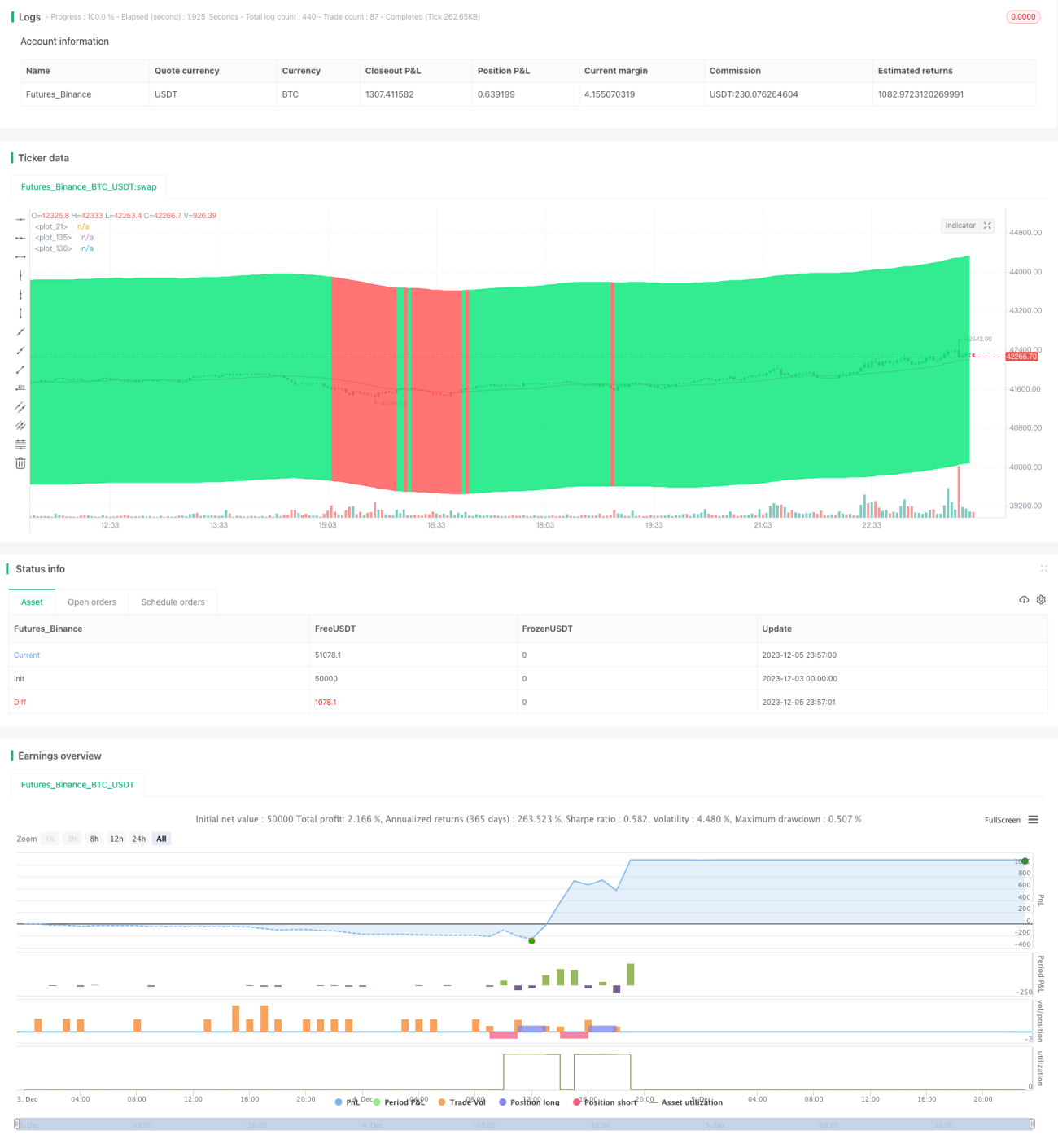
इस रणनीति का मुख्य विचार बाजार के रुझानों को गतिशील रूप से ट्रैक करना है, जब रुझान ऊपर होता है तो खरीदना और जब रुझान नीचे होता है तो बेचना। यह कई संकेतकों के संयोजन की गणना करके रुझान की दिशा का न्याय करता है, जैसे कि रैखिक प्रतिगमन, संशोधित हल चलती औसत आदि।
यह रणनीति प्रवृत्ति की दिशा का न्याय करने के लिए कई तकनीकी संकेतकों का उपयोग करती है। सबसे पहले, यह एक सीमा चैनल की गणना करता है, जिसकी ऊपरी और निचली सीमाओं को क्लोज़ के सरल चलती औसत और एक इनपुट पैरामीटर के आधार पर गणना की जाती है। फिर, यह संशोधित हल चलती औसत की गणना करता है, जिसे प्रवृत्ति का अधिक सटीक चित्रण माना जाता है। इसके अलावा, एक रैखिक प्रतिगमन सूचक की गणना की जाती है।
गलत संकेतों को कम करने के लिए, रणनीति में कई फ़िल्टर भी डिज़ाइन किए गए हैं, जैसे कि ईएमए का उपयोग यह निर्धारित करने के लिए कि क्या यह गिरावट की प्रवृत्ति में है, और आरएसआई के परिवर्तनों का आकलन करने के लिए एक विंडो इंडिकेटर का उपयोग करना। ये फ़िल्टर एक अस्थिर स्थिति में ट्रेडिंग सिग्नल उत्पन्न करने से बच सकते हैं।
प्रविष्टि और स्टॉप-लॉस के लिए, रणनीति अंतिम उद्घाटन मूल्य को रिकॉर्ड करती है और स्टॉप-लॉस का प्रतिशत निर्धारित करती है। उदाहरण के लिए, यदि अंतिम उद्घाटन मूल्य \( 100 है, तो स्टॉप-लॉस लक्ष्य \) 102 है और स्टॉप-लॉस मूल्य $ 95 है।
इस रणनीति के कुछ फायदे हैं:
इस रणनीति के कुछ जोखिम भी हैं:
जोखिम को नियंत्रित करने के लिए, आप स्टॉप लॉस, ट्रेल स्टॉप या ऑप्शन का उपयोग करके मुनाफे को लॉक कर सकते हैं। इसके अलावा, विश्वसनीय पैरामीटर रेंज खोजने के लिए पैरामीटर संयोजन का बार-बार परीक्षण किया जाना चाहिए। अंत में, संकेतकों की गणना के समय पर ध्यान दें और सिग्नल की वास्तविकता के लिए प्रयास करें।
इस रणनीति को निम्नलिखित पहलुओं से अनुकूलित किया जा सकता हैः
अनुकूलन प्रक्रिया में, सिग्नल की गुणवत्ता और रणनीति की स्थिरता का आकलन करने के लिए प्रतिक्रिया और सिमुलेशन लेनदेन का पूरा उपयोग किया जाना चाहिए। केवल पर्याप्त रूप से सत्यापित अनुकूलन समाधान को वास्तविक क्षेत्र में लागू किया जा सकता है।
यह रणनीति ओवरऑल एक बेहतर ट्रेंड ट्रैकिंग रणनीति है। यह कई संकेतकों का उपयोग करके ट्रेंड को निर्धारित करता है, गलत संकेतों को कम करने के लिए फ़िल्टर सेट करता है, और स्टॉपलॉस ट्रैकिंग ट्रेंड को स्वचालित रूप से समायोजित कर सकता है। यदि पैरामीटर सही तरीके से सेट किए जाते हैं, तो यह मध्य-लंबी रेखा की प्रवृत्ति को सफलतापूर्वक पकड़ सकता है। अगला काम सबसे अच्छा पैरामीटर ढूंढना है और रणनीति को सत्यापित और अनुकूलित करना जारी रखना है।
/*backtest
start: 2023-12-03 00:00:00
end: 2023-12-06 00:00:00
period: 3m
basePeriod: 1m
exchanges: [{"eid":"Futures_Binance","currency":"BTC_USDT"}]
*/
// This source code is subject to the terms of the Mozilla Public License 2.0 at https://mozilla.org/MPL/2.0/
// © RafaelZioni
//@version=4
strategy(title = " BTC 15 min", overlay = true, pyramiding=1,initial_capital = 10000, default_qty_type= strategy.percent_of_equity, default_qty_value = 20, calc_on_order_fills=false, slippage=0,commission_type=strategy.commission.percent,commission_value=0.075)
strat_dir_input = input(title="Strategy Direction", defval="all", options=["long", "short", "all"])
strat_dir_value = strat_dir_input == "long" ? strategy.direction.long : strat_dir_input == "short" ? strategy.direction.short : strategy.direction.all
strategy.risk.allow_entry_in(strat_dir_value)
price = close
length8 = input(30,title = 'length of channel')
upmult = input(title = 'upper percent',type=input.float, step=0.1, defval=5)
lowmult = input(title = 'lower percent',type=input.float, step=0.1, defval=5)
basis = sma(close, length8)
vup = upmult * price / 100
vlow = lowmult * price / 100
upper = basis + vup
lower = basis - vlow
plot(basis, color=color.red)
//
fastLength = input(3, title="Fast filter length ", minval=1)
slowLength = input(21,title="Slow filter length", minval=1)
source=close
v1=ema(source,fastLength)
v2=ema(source,slowLength)
//
leng=1
p1=close[1]
len55 = 10
//taken from https://www.tradingview.com/script/Ql1FjjfX-security-free-MTF-example-JD/
HTF = input("1D", type=input.resolution)
ti = change( time(HTF) ) != 0
T_c = fixnan( ti ? close : na )
vrsi = rsi(cum(change(T_c) * volume), leng)
pp=wma(vrsi,len55)
d=(vrsi[1]-pp[1])
len100 = 10
x=ema(d,len100)
//
zx=x/-1
col=zx > 0? color.lime : color.orange
//
tf10 = input("1", title = "Timeframe", type = input.resolution, options = ["1", "5", "15", "30", "60","120", "240","360","720", "D", "W"])
length = input(50, title = "Period", type = input.integer)
shift = input(1, title = "Shift", type = input.integer)
hma(_src, _length)=>
wma((2 * wma(_src, _length / 2)) - wma(_src, _length), round(sqrt(_length)))
hma3(_src, _length)=>
p = length/2
wma(wma(close,p/3)*3 - wma(close,p/2) - wma(close,p),p)
b =security(syminfo.tickerid, tf10, hma3(close[1], length)[shift])
//plot(a,color=color.gray)
//plot(b,color=color.yellow)
close_price = close[0]
len = input(25)
linear_reg = linreg(close_price, len, 0)
buy=crossover(linear_reg, b)
sell=crossunder(linear_reg, b) or crossunder(close[1],upper)
//
src2=low
src3=high
Min =input(15)
leni = timeframe.isintraday and timeframe.multiplier >= 1 ?
Min / timeframe.multiplier * 7 :
timeframe.isintraday and timeframe.multiplier < 60 ?
60 / timeframe.multiplier * 24 * 7 : 7
l1 = wma(src2,leni)
h1 = wma(src3,leni)
//
m=(h1+l1)/2
//
len5 = 100
src5=m
//
multi = 2
mean = ema(src5, len5)
stddev = multi * stdev(src5, len5)
b5 = mean + stddev
s5 = mean - stddev
var bool long = na
var bool short = na
long :=crossover(src5, s5)
short := crossunder(src5, b5)
var float last_open_long = na
var float last_open_short = na
last_open_long := long ? close : nz(last_open_long[1])
last_open_short := short ? close : nz(last_open_short[1])
entry_value =last_open_long
entry_value1=last_open_short
r=100
//
highb = highest(entry_value1, r)
lowb = lowest(entry_value, r)
d5 = highb - lowb
me = (highb + lowb) / 2
h4 = highb - d5 * 0.236
c3 = highb - d5 * 0.382
c4 = highb - d5 * 0.618
l4 = highb - d5 * 0.764
//
col2 = close >= me ? color.lime : color.red
p5 = plot(upper, color=col2)
p2 = plot(lower, color=col2)
fill(p5, p2,color=col2)
// Conditions
longCond = bool(na)
shortCond = bool(na)
longCond := crossover(zx,0) or buy
shortCond := sell
// Count your long short conditions for more control with Pyramiding
sectionLongs = 0
sectionLongs := nz(sectionLongs[1])
sectionShorts = 0
sectionShorts := nz(sectionShorts[1])
if longCond
sectionLongs := sectionLongs + 1
sectionShorts := 0
sectionShorts
if shortCond
sectionLongs := 0
sectionShorts := sectionShorts + 1
sectionShorts
// Pyramiding
pyrl = 1
// These check to see your signal and cross references it against the pyramiding settings above
longCondition = longCond and sectionLongs <= pyrl
shortCondition = shortCond and sectionShorts <= pyrl
// Get the price of the last opened long or short
last_open_longCondition = float(na)
last_open_shortCondition = float(na)
last_open_longCondition := longCondition ? open : nz(last_open_longCondition[1])
last_open_shortCondition := shortCondition ? open : nz(last_open_shortCondition[1])
// Check if your last postion was a long or a short
last_longCondition = float(na)
last_shortCondition = float(na)
last_longCondition := longCondition ? time : nz(last_longCondition[1])
last_shortCondition := shortCondition ? time : nz(last_shortCondition[1])
in_longCondition = last_longCondition > last_shortCondition
in_shortCondition = last_shortCondition > last_longCondition
// Take profit
isTPl = true
//isTPs = input(false, "Take Profit Short")
tp = input(2, "Exit Profit %", type=input.float)
long_tp = isTPl and crossover(high, (1 + tp / 100) * last_open_longCondition) and longCondition == 0 and in_longCondition == 1
//short_tp = isTPs and crossunder(low, (1 - tp / 100) * last_open_shortCondition) and
//shortCondition == 0 and in_shortCondition == 1
// Stop Loss
isSLl = input(true,"buy Loss Long")
//isSLs = input(false, "buy Loss Short")
sl = 0.0
sl := input(5, " rebuy %", type=input.float)
long_sl = isSLl and crossunder(low, (1 - sl / 100) * last_open_longCondition) and
longCondition == 0 and in_longCondition == 1
//short_sl = isSLs and crossover(high, (1 + sl / 100) * last_open_shortCondition) and
//shortCondition == 0 and in_shortCondition == 1
//
// Conditions
longCond5 = bool(na)
shortCond5 = bool(na)
longCond5 := longCondition
shortCond5 := long_tp
//
sectionLongs5 = 0
sectionLongs5 := nz(sectionLongs5[1])
sectionShorts5 = 0
sectionShorts5 := nz(sectionShorts5[1])
if longCond5
sectionLongs5 := sectionLongs5 + 1
sectionShorts5 := 0
sectionShorts5
if shortCond5
sectionLongs5 := 0
sectionShorts5 := sectionShorts5 + 1
sectionShorts5
//
pyr5 = 1
longCondition5 = longCond5 and sectionLongs5 <= pyr5
shortCondition5 = shortCond5 and sectionShorts5 <= pyr5
// Get the price of the last opened long or short
last_open_longCondition5 = float(na)
last_open_shortCondition5 = float(na)
last_open_longCondition5 := longCondition5 ? open : nz(last_open_longCondition5[1])
last_open_shortCondition5 := shortCondition5 ? open : nz(last_open_shortCondition5[1])
last_longCondition5 = float(na)
last_shortCondition5 = float(na)
last_longCondition5 := longCondition5 ? time : nz(last_longCondition5[1])
last_shortCondition5 := shortCondition5 ? time : nz(last_shortCondition5[1])
in_longCondition5 = last_longCondition5 > last_shortCondition5
in_shortCondition5 = last_shortCondition5 > last_longCondition5
//
filter=input(true)
g(v, p) => round(v * (pow(10, p))) / pow(10, p)
risk = input(100)
leverage = input(1)
c = g((strategy.equity * leverage / open) * (risk / 100), 4)
//
l =(v1 > v2 or filter == false ) and longCondition or long_sl
//
//l = longCondition or long_sl
s=shortCondition5
if l
strategy.entry("buy", strategy.long,c)
if s
strategy.entry("sell", strategy.short,c)
per(pcnt) =>
strategy.position_size != 0 ? round(pcnt / 100 * strategy.position_avg_price / syminfo.mintick) : float(na)
stoploss=input(title=" stop loss", defval=5, minval=0.01)
los = per(stoploss)
q1=input(title=" qty_percent1", defval=50, minval=1)
q2=input(title=" qty_percent2", defval=50, minval=1)
tp10=input(title=" Take profit1", defval=1, minval=0.01)
tp20=input(title=" Take profit2", defval=2, minval=0.01)
strategy.exit("x1", qty_percent = q1, profit = per(tp10), loss = los)
strategy.exit("x2", qty_percent = q2, profit = per(tp20), loss = los)