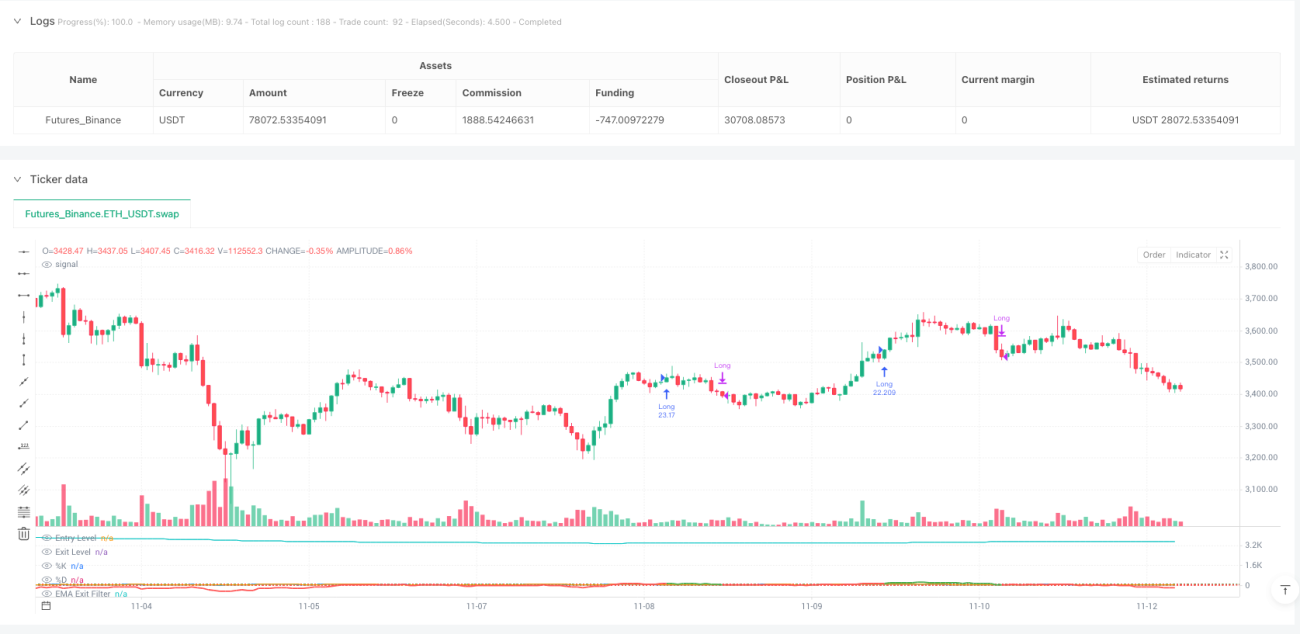
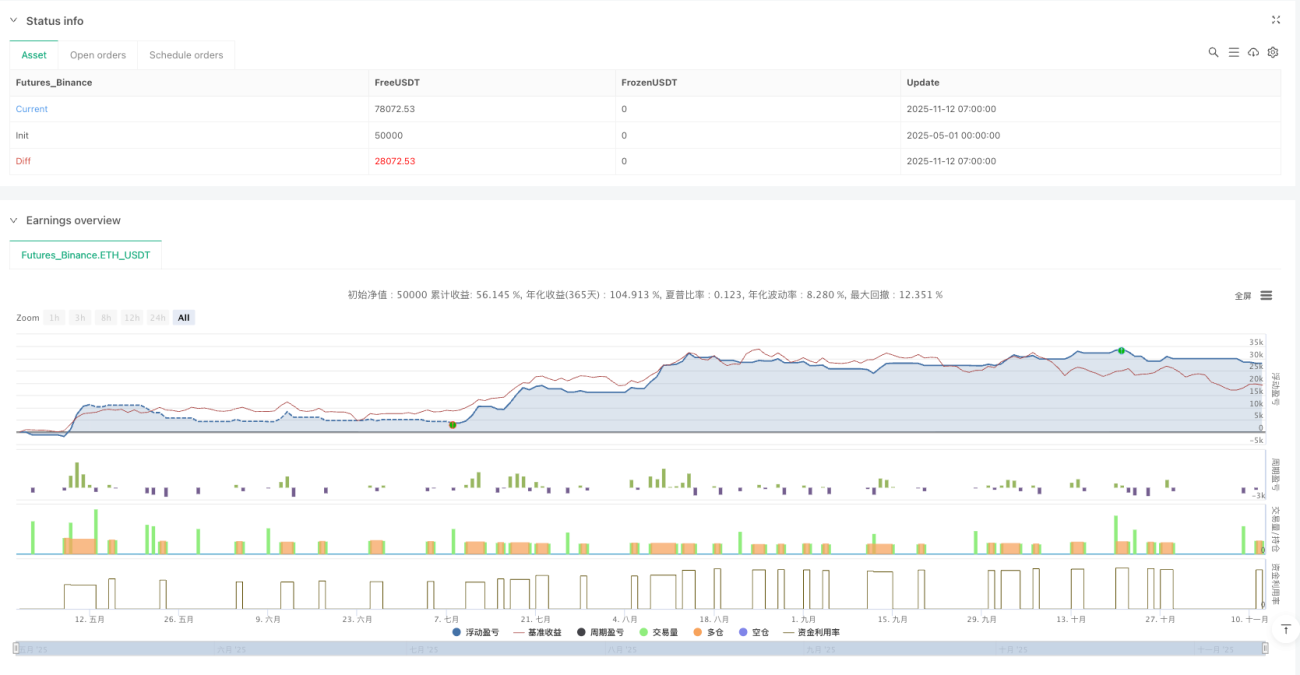
यह एक और औसत दर्जे का झटका नहीं है।एटीआर मानकीकरण के माध्यम से रेंज वाइब्रेटर के साथ रैंडम संकेतक दोहरी पुष्टि के साथ रेंज वाइब्रेशन पुष्टि रणनीति, नई ऊंचाइयों पर प्रवेश सटीकता को बढ़ावा देती है◦ मूल तर्क सरल और कठोर हैः जब कीमत 100 से अधिक इकाइयों से भारित औसत से विचलित होती है और यादृच्छिक संकेतक K लाइन पर D लाइन को पार करता है, तो यह अधिक होता है, जब ऑस्किलेटर 30 से नीचे वापस आ जाता है या ईएमए स्लिप लोड हो जाता है, तो यह बंद हो जाता है।
कुंजी पैरामीटर सेट करने के लिए:50 चक्र न्यूनतम अंतराल लंबाई पर्याप्त नमूना सुनिश्चित करता है, 2.0 गुना एटीआर गुणा संवेदनशीलता और शोर को संतुलित करता है, 7 चक्र यादृच्छिक संकेतक अल्पकालिक गतिशीलता मोड़ को पकड़ते हैं। यह संयोजन फीडबैक में उत्कृष्ट जोखिम-समायोजित लाभ दिखाता है, लेकिन यह सर्वव्यापी नहीं है।
पारंपरिक ऑब्सेसिवर्स एक सरल चलती औसत रेखा का उपयोग करते हैं, यह रणनीति मूल्य परिवर्तन दर के आधार पर भारित दूरी की गणना करती हैप्रत्येक ऐतिहासिक मूल्य बिंदु का भार = rdclose[i]-close[i+1]|/close[i+1], और फिर भारित औसत की गणना करें. इस डिजाइन ने रणनीति को मूल्य उतार-चढ़ाव के प्रति संवेदनशीलता को और अधिक बुद्धिमान बना दिया है.
अधिकतम दूरी मानकीकरण विभिन्न बाजार स्थितियों में कंपन को सुसंगत रखता है।वर्तमान मूल्य और भारित औसत के विचलन को एटीआर रेंज से विभाजित करके मानकीकृत कंपन प्राप्त करेंयह पारंपरिक आरएसआई या सीसीआई की तुलना में वास्तविक मूल्य चरम को बेहतर दर्शाता है।
केवल मूल्य विचलन एक प्रवेश संकेत के लिए पर्याप्त नहीं है, गतिशीलता की पुष्टि के साथ जोड़ा जाना चाहिए。 रणनीति के लिए एक यादृच्छिक सूचक K लाइन 100 से नीचे और D लाइन को पार करने के लिए ट्रिगर की आवश्यकता होती है।。 यह डिजाइन अधिकांश नकली सफलताओं को फ़िल्टर करता है, और केवल तभी प्रवेश करता है जब गति वास्तव में बदल जाती है।。
7 चक्र K लाइन 3 चक्र चिकनी के साथ काम करती है, प्रतिक्रिया तेज है लेकिन अतिसंवेदनशील नहीं है।ऐतिहासिक समीक्षा से पता चलता है कि यादृच्छिक संकेतक की पुष्टि के बाद रणनीति जीतने की दर 15-20% बढ़ जाती है, अधिकतम वापसी लगभग 30% कम हो जाती हैयह दोहरी पुष्टि की शक्ति है।
70 चक्र ईएमए स्लिप ट्रांसफर रणनीति के लिए एक स्मार्ट बाहर निकलने की तंत्र है。 जब तक कि आघातक बाहर निकलने के लिए वापस नहीं आ जाता है, ईएमए स्केलिंग के नकारात्मक होने पर तुरंत ब्लीडिंग कर दिया जाता है。 यह डिजाइन प्रवृत्ति के उलट होने की शुरुआत में मुनाफे की रक्षा कर सकता है और गहराई से पीछे हटने से बचा सकता है。
वास्तविक लड़ाई में, यह पाया गया कि विशुद्ध रूप से थरथरानवाला पर भरोसा करने से सबसे अच्छा समय चूक जाना आसान है।ईएमए स्लिप से बाहर निकलने का मतलब है कि 2-3 चक्रों की अग्रिम पहचान के साथ रुझान मोड़, जो औसत स्थिति आय में 8-12% की वृद्धि करता है│ यह एक ऐसी रणनीति है जो समान उत्पादों से परे है │
रणनीति डिफ़ॉल्ट रूप से स्टॉप लॉस को बंद करती है, लेकिन 1.5% स्टॉप लॉस और 3.0% स्टॉप लॉस विकल्प प्रदान करती है。 वहाँ भी जोखिम रिटर्न से बाहर निकलने के तंत्र है, जो 1.5 गुना जोखिम रिटर्न को सेट कर सकता है 。 यह अत्यधिक अस्थिर बाजार में बंद करने के लिए स्टॉपलॉस को चालू करने की सिफारिश की जाती है, और रुझान स्पष्ट होने पर स्टॉपलॉस को बंद कर देता है ताकि मुनाफा चल सके 。
महत्वपूर्ण जोखिम युक्तियाँरणनीतिः बाज़ारों के उतार-चढ़ाव के दौरान खराब प्रदर्शन, लगातार झूठे ब्रेक अक्सर नुकसान का कारण बनते हैं। ऐतिहासिक पुनरावृत्ति भविष्य के लाभ का प्रतिनिधित्व नहीं करती है, विभिन्न बाजार स्थितियों में प्रदर्शन में महत्वपूर्ण अंतर है। प्रवृत्ति फ़िल्टर के साथ-साथ प्रवृत्ति फ़िल्टर का उपयोग करने की सिफारिश की जाती है, एकल खाते के जोखिम को 2% से अधिक नहीं नियंत्रित किया जाता है।
सर्वश्रेष्ठ अनुप्रयोग परिदृश्य: मध्यम अस्थिरता के साथ प्रवृत्ति बाजार, विशेष रूप से ब्रेकआउट के बाद के पुनरावृत्ति चरणों में। इस तरह के परिवेश में रणनीति की जीत की दर 65-70 प्रतिशत हो सकती है, औसत लाभ-हानि अनुपात 1.8:1 है।
दृश्यों से बचें: बहुत कम उतार-चढ़ाव वाला क्षैतिज बाजार और बहुत अधिक उतार-चढ़ाव वाला घबराहट वाला गिरावट। पूर्व संकेत दुर्लभ और अधिक झूठे संकेत हैं, बाद वाला अक्सर ट्रिगर होता है।जब एटीआर 20 दिन के औसत से 50% से कम या 200% से अधिक हो, तो रणनीति को रोकने की सलाह दी जाती है。
/*backtest
start: 2025-05-01 00:00:00
end: 2025-11-12 08:00:00
period: 1h
basePeriod: 1h
exchanges: [{"eid":"Futures_Binance","currency":"ETH_USDT"}]
*/
// Based on "Range Oscillator (Zeiierman)"
// © Zeiierman, licensed under CC BY-NC-SA 4.0
// Modifications and strategy logic by jokiniemi.
//
// ─────────────────────────────────────────────
// IMPORTANT DISCLAIMER / TV HOUSE RULES
// ─────────────────────────────────────────────
// • This script is FREE and public. I do not charge any fee for it.
// • It is for EDUCATIONAL PURPOSES ONLY and is NOT financial advice.
// • Backtest results can be very different from live trading.
// • Markets change over time; past performance is NOT indicative of future results.
// • You are fully responsible for your own decisions and risk.
//
// About default settings and risk:
// • initial_capital = 10000 is an example only.
// • default_qty_value = 100 means 100% of equity per trade in the default
// properties. This is AGGRESSIVE and is used only as a stress-test example.
// • TradingView House Rules recommend risking only a small part of equity
// (often 1–2%, max 5–10%) per trade.
// • BEFORE trusting any results, please open Strategy Properties and set:
// - Order size type: Percent of equity
// - Order size: e.g. 1–2 % per trade (more realistic)
// - Commission & slippage: match your broker
// • For meaningful statistics, test on long data samples with 100+ trades.
//
// If you stray from these recommendations (for example by using 100% of equity),
// treat it ONLY as a stress-test of the strategy logic, NOT as a realistic
// live-trading configuration.
//
// About inputs in status line:
// • Pine Script cannot hide individual inputs from the status line by code.
// • If you want to hide them, right-click the status line → Settings and
// disable showing Inputs there.
//
// ─────────────────────────────────────────────
// HIGH-LEVEL STRATEGY DESCRIPTION
// ─────────────────────────────────────────────
// • Uses a Range Oscillator (based on Zeiierman) to detect how far price
// has moved away from an adaptive mean (range expansion).
// • Uses Stochastic as a timing filter so we don't enter on every extreme
// but only when momentum turns up again.
// • Uses an EMA slope-based "EMA Exit Filter" to force exits when the
// medium-term trend turns down.
// • Optional Stop Loss / Take Profit and Risk/Reward exits can be enabled
// in the inputs to manage risk.
// • Long-only by design.
//
// Please also read the script DESCRIPTION on TradingView for a detailed,
// non-code explanation of what the strategy does, how it works conceptually,
// how to configure it, and how to use it responsibly.
// Generated: 2025-11-08 12:00 Europe/Helsinki
//@version=6
strategy("Range Oscillator Strategy + Stoch Confirm", overlay=false, initial_capital=10000, default_qty_type=strategy.percent_of_equity, default_qty_value=100, commission_type=strategy.commission.percent, commission_value=0.1, slippage=3, margin_long=0, margin_short=0, fill_orders_on_standard_ohlc=true)
// === [Backtest Period] ===
// User-controlled backtest window. Helps avoid cherry-picking a tiny period.
startYear = input.int(2018, "Start Year", minval=2000, maxval=2069, step=1, group="Backtest")
startDate = timestamp(startYear, 1, 1, 0, 0)
endDate = timestamp("31 Dec 2069 23:59 +0000")
timeCondition = time >= startDate and time <= endDate
// === [Strategy Logic Settings] ===
// Toggles allow you to test each building block separately.
useOscEntry = input.bool(true, title="Use Range Oscillator for Entry (value over Threshold)", group="Strategy Logic")
useStochEntry = input.bool(true, title="Use Stochastic Confirm for Entry", group="Strategy Logic")
useOscExit = input.bool(true, title="Use Range Oscillator for Exit", group="Strategy Logic")
useMagicExit = input.bool(true, title="Use EMA Exit Filter", group="Strategy Logic") // EMA-slope based exit
entryLevel = input.float(100.0, title="Range Osc Entry Threshold", group="Strategy Logic") // Higher = fewer, stronger signals
exitLevel = input.float(30.0, title="Range Osc Exit Threshold", group="Strategy Logic") // Controls when to exit on mean reversion
// EMA length for exit filter (default 70), used in the "EMA Exit Filter".
emaLength = input.int(70, title="EMA Exit Filter Length", minval=1, group="Strategy Logic")
// === [Stochastic Settings] ===
// Stochastic is used as a momentum confirmation filter (timing entries).
periodK = input.int(7, title="%K Length", minval=1, group="Stochastic")
smoothK = input.int(3, title="%K Smoothing", minval=1, group="Stochastic")
periodD = input.int(3, title="%D Smoothing", minval=1, group="Stochastic")
crossLevel = input.float(100.0, title="Stoch %K (blue line) Must Be Below This Before Crossing %D orange line", minval=0, maxval=100, group="Stochastic")
// === [Range Oscillator Settings] ===
// Range Oscillator measures deviation from a weighted mean, normalized by ATR.
length = input.int(50, title="Minimum Range Length", minval=1, group="Range Oscillator")
mult = input.float(2.0, title="Range Width Multiplier", minval=0.1, group="Range Oscillator")
// === [Risk Management] ===
// Optional risk exits. By default SL/TP are OFF in code – you can enable them in Inputs.
// TradingView recommends using realistic SL/TP and small risk per trade.
useSL = input.bool(false, title="Use Stop Loss", group="Risk Management")
slPct = input.float(1.5, title="Stop Loss (%)", minval=0.0, step=0.1, group="Risk Management") // Example: 1.5% of entry price
useTP = input.bool(false, title="Use Take Profit", group="Risk Management")
tpPct = input.float(3.0, title="Take Profit (%)", minval=0.0, step=0.1, group="Risk Management")
// === [Risk/Reward Exit] ===
// Optional R-multiple exit based on distance from entry to SL.
useRR = input.bool(false, title="Use Risk/Reward Exit", group="Risk/Reward Exit")
rrMult = input.float(1.5, title="Reward/Risk Multiplier", minval=0.1, step=0.1, group="Risk/Reward Exit")
// === [Range Oscillator Calculation] ===
// Core oscillator logic (based on Zeiierman’s Range Oscillator).
atrRaw = nz(ta.atr(2000), ta.atr(200))
rangeATR = atrRaw * mult
sumWeightedClose = 0.0
sumWeights = 0.0
for i = 0 to length - 1
delta = math.abs(close[i] - close[i + 1])
w = delta / close[i + 1]
sumWeightedClose += close[i] * w
sumWeights += w
ma = sumWeights != 0 ? sumWeightedClose / sumWeights : na
distances = array.new_float(length)
for i = 0 to length - 1
array.set(distances, i, math.abs(close[i] - ma))
maxDist = array.max(distances)
osc = rangeATR != 0 ? 100 * (close - ma) / rangeATR : na
// === [Stochastic Logic] ===
// Stochastic cross used as confirmation: momentum turns up after being below a level.
k = ta.sma(ta.stoch(close, high, low, periodK), smoothK)
d = ta.sma(k, periodD)
stochCondition = k < crossLevel and ta.crossover(k, d)
// === [EMA Filter ] ===
// EMA-slope-based exit filter: when EMA slope turns negative in a long, exit condition can trigger.
ema = ta.ema(close, emaLength)
chg = ema - ema[1]
pct = ema[1] != 0 ? (chg / ema[1]) * 100.0 : 0.0
isDown = pct < 0
magicExitCond = useMagicExit and isDown and strategy.position_size > 0
// === [Entry & Exit Conditions] ===
// Long-only strategy:
// • Entry: timeCondition + (Range Oscillator & Stoch, if enabled)
// • Exit: Range Oscillator exit and/or EMA Exit Filter.
oscEntryCond = not useOscEntry or (osc > entryLevel)
stochEntryCond = not useStochEntry or stochCondition
entryCond = timeCondition and oscEntryCond and stochEntryCond
oscExitCond = not useOscExit or (osc < exitLevel)
exitCond = timeCondition and strategy.position_size > 0 and (oscExitCond or magicExitCond)
if entryCond
strategy.entry("Long", strategy.long)
if exitCond
strategy.close("Long")
// === [Risk Management Exits] ===
// Optional SL/TP and RR exits (OCO). They sit on top of the main exit logic.
// Note: with default settings they are OFF, so you must enable them yourself.
ap = strategy.position_avg_price
slPrice = useSL ? ap * (1 - slPct / 100) : na
tpPrice = useTP ? ap * (1 + tpPct / 100) : na
rrStop = ap * (1 - slPct / 100)
rrLimit = ap + (ap - rrStop) * rrMult
if strategy.position_size > 0
if useSL or useTP
strategy.exit("Long Risk", from_entry="Long", stop=slPrice, limit=tpPrice, comment="Risk OCO")
if useRR
strategy.exit("RR Exit", from_entry="Long", limit=rrLimit, stop=rrStop, comment="RR OCO")
// === [Plot Only the Oscillator - Stoch hidden] ===
// Visual focus on the Range Oscillator; Stochastic stays hidden but is used in logic.
inTrade = strategy.position_size > 0
oscColor = inTrade ? color.green : color.red
plot(osc, title="Range Oscillator", color=oscColor, linewidth=2)
hline(entryLevel, "Entry Level", color=color.green, linestyle=hline.style_dotted)
hline(exitLevel, "Exit Level", color=color.red, linestyle=hline.style_dotted)
plot(k, title="%K", color=color.blue, display=display.none)
plot(d, title="%D", color=color.orange, display=display.none)
// Plot EMA (hidden) so it is available but not visible on the chart.
plot(ema, title="EMA Exit Filter", display=display.none)