Strategi Pelacakan Tren Rata-Rata Bergerak Adaptif Kaufman

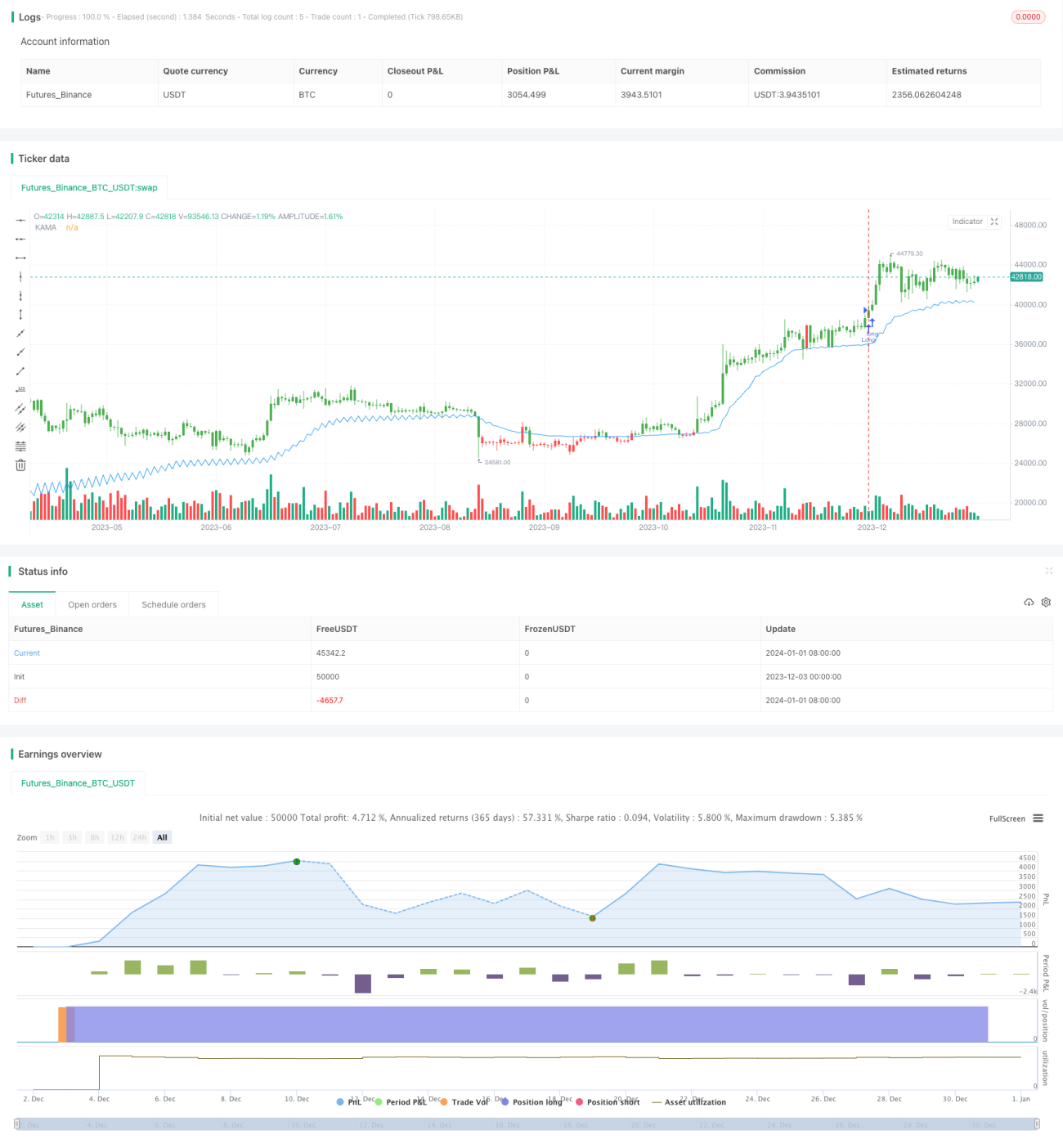
Ikhtisar
Strategi ini menggunakan indikator rata-rata bergerak adaptif Kaufman Adaptive Moving Average (KAMA) untuk melacak tren harga, sehingga dapat membeli di harga rendah dan menjual di harga tinggi untuk meraih keuntungan.
Prinsip Strategi
Rumus perhitungan indikator Kaufman Adaptive Moving Average (KAMA) adalah sebagai berikut:
nAMA = nz(nAMA[1]) + nsmooth * (Close - nz(nAMA[1]))
di mana:
nsmooth = (nefratio * (nfastend - nslowend) + nslowend)^2
nefratio = nsignal / nnoise
nsignal = |Close - Close[Length]|
nnoise = sum(|Close - Close[1]|, Length)
nfastend = 0.666
nslowend = 0.0645
Indikator ini mempertimbangkan volatilitas pasar dan tren perubahan harga, sehingga dapat melacak tren harga dengan lebih cepat. Secara spesifik:
- Ketika volatilitas pasar rendah, nsmooth mendekati nslowend, garis KAMA berubah lambat, meredam noise pasar.
- Ketika volatilitas pasar meningkat dan muncul tren, nsmooth mendekati nfastend, garis KAMA berubah cepat, melacak tren.
Dengan membandingkan hubungan antara harga dan KAMA, arah tren harga dapat ditentukan, sehingga keputusan untuk membeli (long) atau menjual (short) dapat diambil.
Keunggulan Strategi
Keunggulan terbesar dari strategi ini adalah penggunaan indikator rata-rata bergerak adaptif untuk melacak perubahan tren harga, yang secara efektif dapat mengurangi pengaruh noise, dengan efek pelacakan yang baik. Keunggulan spesifiknya adalah:
- Indikator KAMA meredam noise pasar, sehingga dapat mengurangi kombinasi transaksi yang tidak perlu.
- Indikator KAMA dapat merespons perubahan tren harga dengan cepat, efek pelacakan yang baik.
- Aturan pengambilan keputusan strategi sederhana dan jelas, mudah dipahami dan diimplementasikan.
- Dapat dikonfigurasi untuk trading terbalik (reverse), beradaptasi dengan kondisi pasar yang berbeda.
Risiko Strategi
Strategi ini juga memiliki beberapa risiko:
- Dalam kondisi pasar yang bergerak sideway (kisaran), indikator KAMA dapat menghasilkan sinyal yang salah. Hal ini dapat dioptimalkan dengan menyesuaikan parameter.
- Ada keterlambatan pelacakan (lag), yang dapat menyebabkan terlewatnya pembalikan harga jangka pendek. Dapat dikombinasikan dengan indikator lain untuk diagnosis.
- Tidak memperhitungkan biaya transaksi dan slippage, sehingga hasil di pasar nyata akan lebih rendah daripada backtest.
Arah Optimasi Strategi
Strategi ini juga dapat dioptimalkan dari beberapa aspek berikut:
- Optimalkan parameter KAMA untuk meningkatkan sensitivitas pelacakan indikator.
- Tambahkan mekanisme stop loss untuk mengontrol kerugian maksimum per transaksi.
- Gabungkan dengan indikator lain untuk memfilter sinyal, meningkatkan akurasi keputusan.
- Tambahkan mekanisme re-entry untuk melacak tren lebih lanjut.
Ringkasan
Strategi ini menggunakan indikator Kaufman Adaptive Moving Average untuk melacak tren harga, dengan aturan pengambilan keputusan yang sederhana dan jelas, serta mudah dioperasikan di pasar nyata. Indikator ini meredam noise sekaligus merespons perubahan harga dengan cepat, memberikan efek pelacakan yang baik. Ini adalah strategi pelacakan tren yang layak direkomendasikan.
/*backtest
start: 2023-12-03 00:00:00
end: 2024-01-02 00:00:00
period: 1d
basePeriod: 1h
exchanges: [{"eid":"Futures_Binance","currency":"BTC_USDT"}]
*/

//@version=2
////////////////////////////////////////////////////////////
//  Copyright by HPotter v1.0 25/08/2017
// Everyone wants a short-term, fast trading trend that works without large- 1