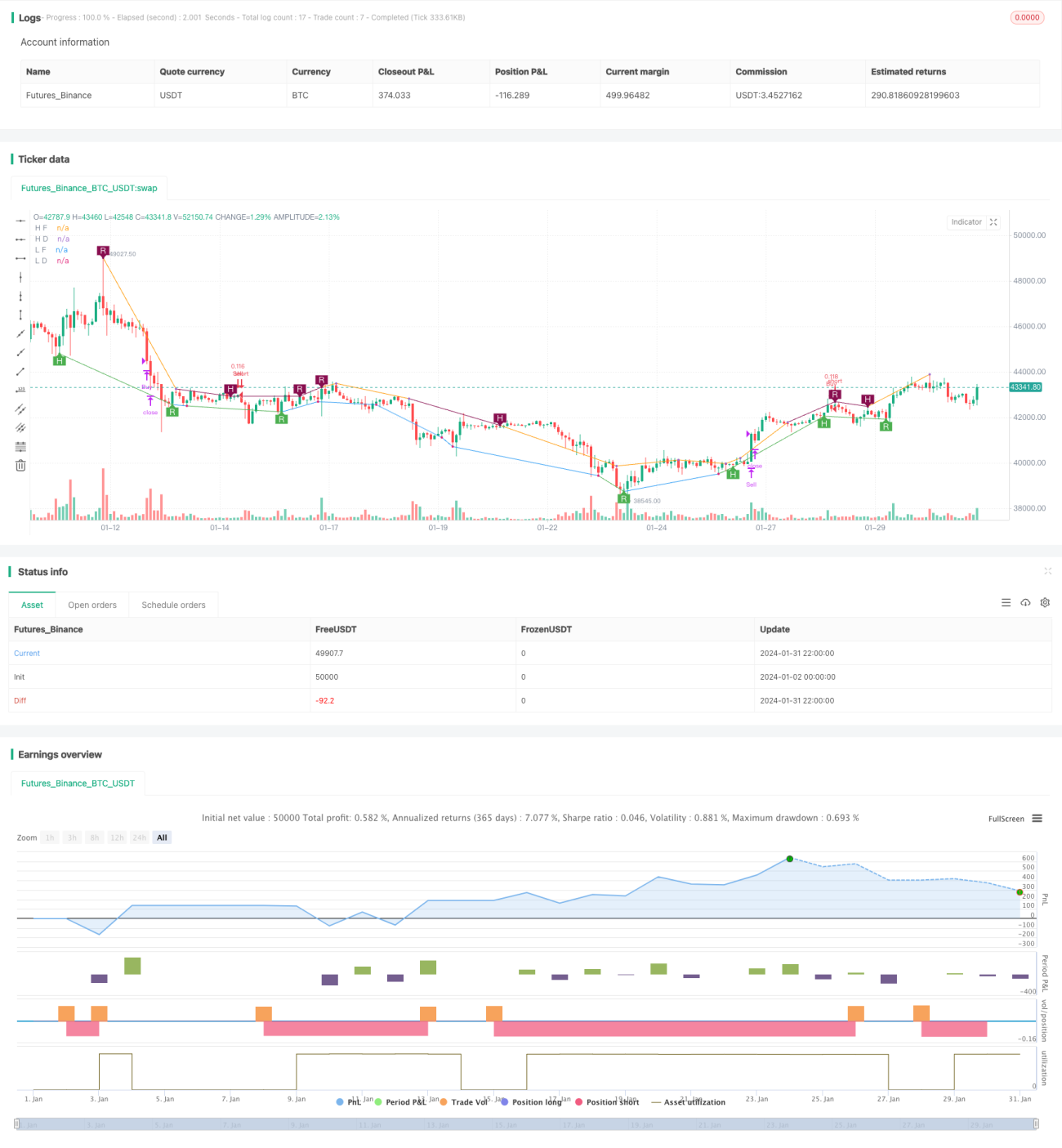
Strategi ini adalah strategi perdagangan tren berdasarkan sinyal dispersi harga. Ini menggunakan berbagai indikator untuk mendeteksi sinyal dispersi harga, seperti RSI, MACD, Stochastics, dan lain-lain, dan dikonfirmasi melalui oscillator Murray Math.
Inti dari strategi ini adalah teori price dispersion. Ketika harga berinovasi tinggi tetapi indikator tidak berinovasi tinggi, disebut sebagai price dispersion di bear market; Ketika harga berinovasi rendah tetapi indikator tidak berinovasi rendah, disebut sebagai price dispersion di bull market. Ini menunjukkan bahwa tren dapat berbalik.
Secara khusus, syarat masuk dalam strategi ini adalah:
Kondisi keluar adalah pada saat osilator kembali melewati garis tengah.
Strategi ini menggabungkan teori price dispersion dan konfirmasi tren, dengan keuntungan sebagai berikut:
Risiko utama berasal dari:
Disarankan untuk mengatur stop loss, menyesuaikan posisi, mengoptimalkan kombinasi parameter untuk mengurangi risiko.
Strategi ini masih bisa dioptimalkan lebih jauh:
Strategi ini mengintegrasikan teori price dispersion dan indikator analisis tren untuk secara efektif mendeteksi titik-titik konversi tren potensial. Dengan pengelolaan risiko yang dioptimalkan, strategi ini dapat menghasilkan tingkat pengembalian yang lebih baik. Di masa depan, strategi ini dapat dioptimalkan dengan metode canggih seperti pembelajaran mesin untuk mendapatkan keuntungan tambahan yang lebih stabil.
/*backtest
start: 2024-01-02 00:00:00
end: 2024-02-01 00:00:00
period: 2h
basePeriod: 15m
exchanges: [{"eid":"Futures_Binance","currency":"BTC_USDT"}]
*/
//@version=2
//
// Title: [STRATEGY][UL]Price Divergence Strategy V1
// Author: JustUncleL
// Date: 23-Oct-2016
// Version: v1.0
//
// Description:
// A trend trading strategy the uses Price Divergence detection signals, that
// are confirmed by the "Murrey's Math Oscillator" (Donchanin Channel based).
//
// *** USE AT YOUR OWN RISK ***
//
// Mofidifications:
// 1.0 - original
//
// References:
// Strategy Based on:
// - [RS]Price Divergence Detector V2 by RicardoSantos
// - UCS_Murrey's Math Oscillator by Ucsgears
// Some Code borrowed from:
// - "Strategy Code Example by JayRogers"
// Information on Divergence Trading:
// - http://www.babypips.com/school/high-school/trading-divergences
//
strategy(title='[STRATEGY][UL]Price Divergence Strategy v1.0', pyramiding=0, overlay=true, initial_capital=10000, calc_on_every_tick=false,
currency=currency.USD,default_qty_type=strategy.percent_of_equity,default_qty_value=10)
// || General Input:
method = input(title='Method (0=rsi, 1=macd, 2=stoch, 3=volume, 4=acc/dist, 5=fisher, 6=cci):', defval=1, minval=0, maxval=6)
SHOW_LABEL = input(title='Show Labels', type=bool, defval=true)
SHOW_CHANNEL = input(title='Show Channel', type=bool, defval=false)
uHid = input(true,title="Use Hidden Divergence in Strategy")
uReg = input(true,title="Use Regular Divergence in Strategy")
// || RSI / STOCH / VOLUME / ACC/DIST Input:
rsi_smooth = input(title='RSI/STOCH/Volume/ACC-DIST/Fisher/cci Smooth:', defval=5)
// || MACD Input:
macd_src = input(title='MACD Source:', defval=close)
macd_fast = input(title='MACD Fast:', defval=12)
macd_slow = input(title='MACD Slow:', defval=26)
macd_smooth = input(title='MACD Smooth Signal:', defval=9)
// || Functions:
f_top_fractal(_src)=>_src[4] < _src[2] and _src[3] < _src[2] and _src[2] > _src[1] and _src[2] > _src[0]
f_bot_fractal(_src)=>_src[4] > _src[2] and _src[3] > _src[2] and _src[2] < _src[1] and _src[2] < _src[0]
f_fractalize(_src)=>f_top_fractal(_src) ? 1 : f_bot_fractal(_src) ? -1 : 0
// ||••> START MACD FUNCTION
f_macd(_src, _fast, _slow, _smooth)=>
_fast_ma = sma(_src, _fast)
_slow_ma = sma(_src, _slow)
_macd = _fast_ma-_slow_ma
_signal = ema(_macd, _smooth)
_hist = _macd - _signal
// ||<•• END MACD FUNCTION
// ||••> START ACC/DIST FUNCTION
f_accdist(_smooth)=>_return=sma(cum(close==high and close==low or high==low ? 0 : ((2*close-low-high)/(high-low))*volume), _smooth)
// ||<•• END ACC/DIST FUNCTION
// ||••> START FISHER FUNCTION
f_fisher(_src, _window)=>
_h = highest(_src, _window)
_l = lowest(_src, _window)
_value0 = .66 * ((_src - _l) / max(_h - _l, .001) - .5) + .67 * nz(_value0[1])
_value1 = _value0 > .99 ? .999 : _value0 < -.99 ? -.999 : _value0
_fisher = .5 * log((1 + _value1) / max(1 - _value1, .001)) + .5 * nz(_fisher[1])
// ||<•• END FISHER FUNCTION
method_high = method == 0 ? rsi(high, rsi_smooth) :
method == 1 ? f_macd(macd_src, macd_fast, macd_slow, macd_smooth) :
method == 2 ? stoch(close, high, low, rsi_smooth) :
method == 3 ? sma(volume, rsi_smooth) :
method == 4 ? f_accdist(rsi_smooth) :
method == 5 ? f_fisher(high, rsi_smooth) :
method == 6 ? cci(high, rsi_smooth) :
na
method_low = method == 0 ? rsi(low, rsi_smooth) :
method == 1 ? f_macd(macd_src, macd_fast, macd_slow, macd_smooth) :
method == 2 ? stoch(close, high, low, rsi_smooth) :
method == 3 ? sma(volume, rsi_smooth) :
method == 4 ? f_accdist(rsi_smooth) :
method == 5 ? f_fisher(low, rsi_smooth) :
method == 6 ? cci(low, rsi_smooth) :
na
fractal_top = f_fractalize(method_high) > 0 ? method_high[2] : na
fractal_bot = f_fractalize(method_low) < 0 ? method_low[2] : na
high_prev = valuewhen(fractal_top, method_high[2], 1)
high_price = valuewhen(fractal_top, high[2], 1)
low_prev = valuewhen(fractal_bot, method_low[2], 1)
low_price = valuewhen(fractal_bot, low[2], 1)
regular_bearish_div = fractal_top and high[2] > high_price and method_high[2] < high_prev
hidden_bearish_div = fractal_top and high[2] < high_price and method_high[2] > high_prev
regular_bullish_div = fractal_bot and low[2] < low_price and method_low[2] > low_prev
hidden_bullish_div = fractal_bot and low[2] > low_price and method_low[2] < low_prev
plot(title='H F', series=fractal_top ? high[2] : na, color=regular_bearish_div or hidden_bearish_div ? maroon : not SHOW_CHANNEL ? na : silver, offset=-2)
plot(title='L F', series=fractal_bot ? low[2] : na, color=regular_bullish_div or hidden_bullish_div ? green : not SHOW_CHANNEL ? na : silver, offset=-2)
plot(title='H D', series=fractal_top ? high[2] : na, style=circles, color=regular_bearish_div or hidden_bearish_div ? maroon : not SHOW_CHANNEL ? na : silver, linewidth=3, offset=-2)
plot(title='L D', series=fractal_bot ? low[2] : na, style=circles, color=regular_bullish_div or hidden_bullish_div ? green : not SHOW_CHANNEL ? na : silver, linewidth=3, offset=-2)
plotshape(title='+RBD', series=not SHOW_LABEL ? na : regular_bearish_div ? high[2] : na, text='R', style=shape.labeldown, location=location.absolute, color=maroon, textcolor=white, offset=-2)
plotshape(title='+HBD', series=not SHOW_LABEL ? na : hidden_bearish_div ? high[2] : na, text='H', style=shape.labeldown, location=location.absolute, color=maroon, textcolor=white, offset=-2)
plotshape(title='-RBD', series=not SHOW_LABEL ? na : regular_bullish_div ? low[2] : na, text='R', style=shape.labelup, location=location.absolute, color=green, textcolor=white, offset=-2)
plotshape(title='-HBD', series=not SHOW_LABEL ? na : hidden_bullish_div ? low[2] : na, text='H', style=shape.labelup, location=location.absolute, color=green, textcolor=white, offset=-2)
// Code borrowed from UCS_Murrey's Math Oscillator by Ucsgears
// - UCS_MMLO
// Inputs
length = input(100, minval = 10, title = "MMLO Look back Length")
quad = input(2, minval = 1, maxval = 4, step = 1, title = "Mininum Quadrant for MMLO Support")
mult = 0.125
// Donchanin Channel
hi = highest(high, length)
lo = lowest(low, length)
range = hi - lo
multiplier = (range) * mult
midline = lo + multiplier * 4
oscillator = (close - midline)/(range/2)
a = oscillator > 0
b = oscillator > 0 and oscillator > mult*2
c = oscillator > 0 and oscillator > mult*4
d = oscillator > 0 and oscillator > mult*6
z = oscillator < 0
y = oscillator < 0 and oscillator < -mult*2
x = oscillator < 0 and oscillator < -mult*4
w = oscillator < 0 and oscillator < -mult*6
// Strategy: (Thanks to JayRogers)
// === STRATEGY RELATED INPUTS ===
//tradeInvert = input(defval = false, title = "Invert Trade Direction?")
// the risk management inputs
inpTakeProfit = input(defval = 0, title = "Take Profit Points", minval = 0)
inpStopLoss = input(defval = 0, title = "Stop Loss Points", minval = 0)
inpTrailStop = input(defval = 100, title = "Trailing Stop Loss Points", minval = 0)
inpTrailOffset = input(defval = 0, title = "Trailing Stop Loss Offset Points", minval = 0)
// === RISK MANAGEMENT VALUE PREP ===
// if an input is less than 1, assuming not wanted so we assign 'na' value to disable it.
useTakeProfit = inpTakeProfit >= 1 ? inpTakeProfit : na
useStopLoss = inpStopLoss >= 1 ? inpStopLoss : na
useTrailStop = inpTrailStop >= 1 ? inpTrailStop : na
useTrailOffset = inpTrailOffset >= 1 ? inpTrailOffset : na
// === STRATEGY - LONG POSITION EXECUTION ===
enterLong() => ((uReg and regular_bullish_div) or (uHid and hidden_bullish_div)) and (quad==1? a[1]: quad==2?b[1]: quad==3?c[1]: quad==4?d[1]: false)// functions can be used to wrap up and work out complex conditions
exitLong() => oscillator <= 0
strategy.entry(id = "Buy", long = true, when = enterLong() )// use function or simple condition to decide when to get in
strategy.close(id = "Buy", when = exitLong() )// ...and when to get out
// === STRATEGY - SHORT POSITION EXECUTION ===
enterShort() => ((uReg and regular_bearish_div) or (uHid and hidden_bearish_div)) and (quad==1? z[1]: quad==2?y[1]: quad==3?x[1]: quad==4?w[1]: false)
exitShort() => oscillator >= 0
strategy.entry(id = "Sell", long = false, when = enterShort())
strategy.close(id = "Sell", when = exitShort() )
// === STRATEGY RISK MANAGEMENT EXECUTION ===
// finally, make use of all the earlier values we got prepped
strategy.exit("Exit Buy", from_entry = "Buy", profit = useTakeProfit, loss = useStopLoss, trail_points = useTrailStop, trail_offset = useTrailOffset)
strategy.exit("Exit Sell", from_entry = "Sell", profit = useTakeProfit, loss = useStopLoss, trail_points = useTrailStop, trail_offset = useTrailOffset)
//EOF