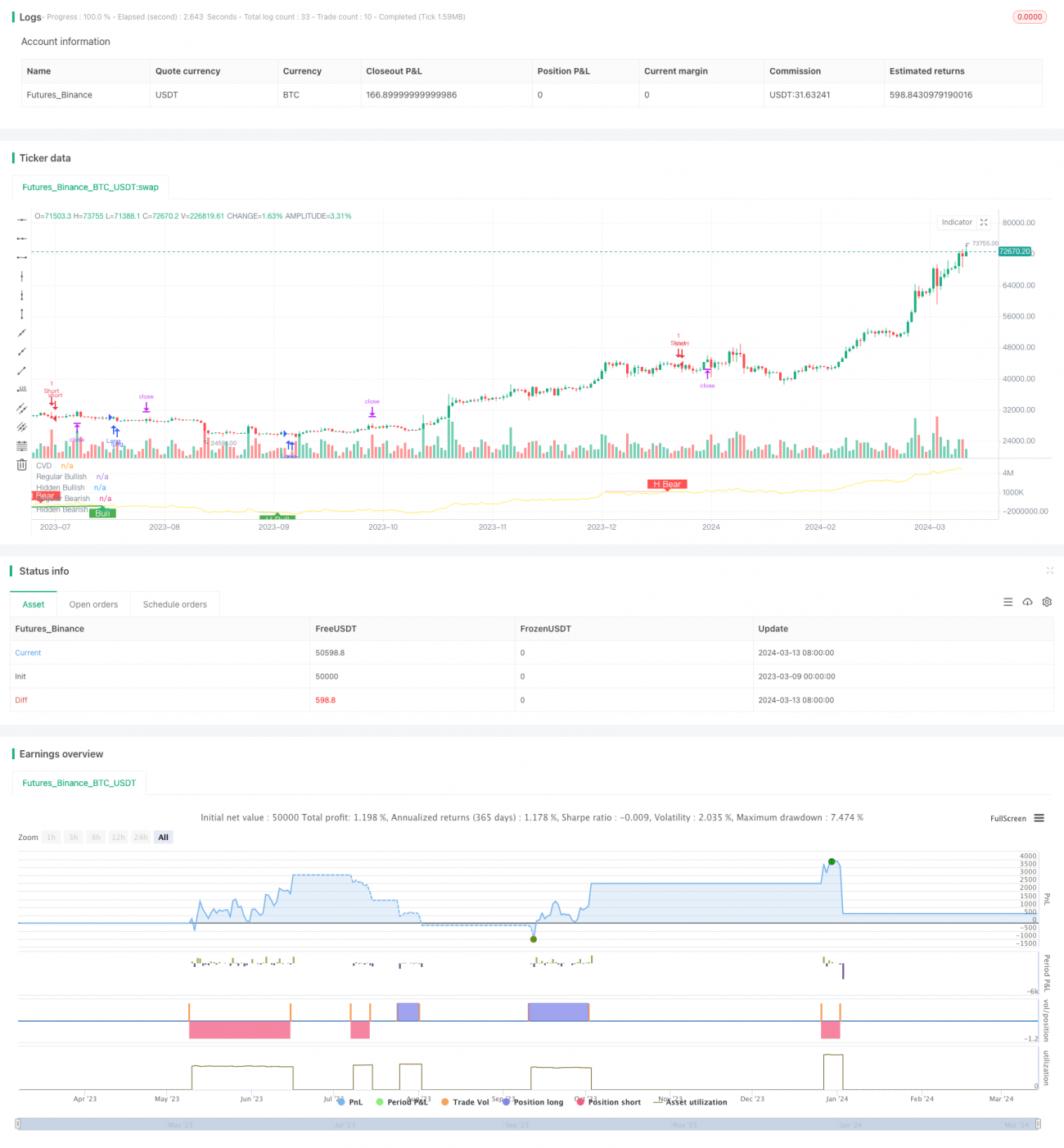
Strategi perdagangan kuantitatif divergensi CVD


Tanggal Pembuatan: 2024-03-15 16:47:47 Akhirnya memodifikasi: 2024-03-15 16:47:47
menyalin: 0 Jumlah klik: 1606
1
fokus pada
1617
Pengikut

Strategi perdagangan kuantitatif divergensi CVD

Strategi yang disusun: Strategi perdagangan kuantitatif CVD deviasi ini menggunakan indikator CVD dan deviasi pembentukan harga untuk menangkap sinyal pembalikan tren potensial. Strategi ini akan menghitung indikator CVD dan, dengan membandingkannya dengan harga, memutuskan apakah deviasi bullish atau bearish terbentuk.

Prinsip-prinsip Strategi:

  1. Hitung indikator CVD: Hitung indikator CVD dan rata-rata bergerak berdasarkan volume transaksi multihead dan volume transaksi head kosong.
  2. Identifikasi deviasi: menilai apakah deviasi terbentuk dengan membandingkan titik tinggi dan rendah indikator CVD dengan titik tinggi dan rendah harga.
    • Peningkatan Harga Berbeda dengan Peningkatan Harga, Namun Indeks CVD Lebih Tinggi dan Lebih Rendah
    • Hidden Pondok Pesantren: Harga Berinovasi Tinggi, Namun Indeks CVD Terbentuk Lebih Rendah
    • Kegagalan dalam penurunan harga: Harga baru tinggi, namun CVD lebih rendah dari titik tertinggi
    • Hidden Bearish Backtrack: Inovasi Harga Rendah, Namun Indeks CVD Membentuk Puncak Yang Lebih Tinggi
  3. Posisi terbuka: Ketika sinyal deviasi diidentifikasi, posisi terbuka atau kosong sesuai dengan jenis deviasi.
  4. Stop loss: menggunakan stop loss bergerak dan stop loss persentase tetap. Harga stop loss dihitung berdasarkan harga buka posisi dikali persentase stop loss, harga stop loss berdasarkan harga buka posisi dikali persentase stop loss.
  5. Penambahan posisi piramida: Strategi ini memungkinkan penambahan posisi piramida hingga 3 posisi.

Keuntungan dari strategi:

  1. Sinyal pembalikan tren: CVD deviasi adalah sinyal pembalikan tren yang efektif yang dapat membantu menangkap peluang pembalikan tren.
  2. Sinyal lanjutan tren: Hidden deviation dapat berfungsi sebagai sinyal lanjutan tren, membantu strategi untuk tetap berada di arah yang benar dalam tren.
  3. Kontrol risiko: Menggunakan stop loss bergerak dan stop loss persentase tetap, risiko dikendalikan secara efektif.
  4. Peningkatan posisi piramida: memungkinkan banyak posisi untuk ditingkatkan, sehingga lebih baik untuk memanfaatkan tren.

Risiko strategis:

  1. Efektivitas sinyal: sinyal yang menyimpang dari sinyal tidak sepenuhnya dapat diandalkan, kadang-kadang terjadi sinyal palsu.
  2. Konfigurasi parameter: hasil strategi lebih sensitif terhadap pengaturan parameter, dan parameter yang berbeda dapat menghasilkan hasil yang berbeda.
  3. Stop loss slippage: Dalam situasi yang ekstrim, stop loss order mungkin tidak dapat diperdagangkan pada harga default, membawa risiko tambahan.
  4. Biaya transaksi: Sering membuka posisi kosong dapat menyebabkan biaya transaksi yang lebih tinggi, yang mempengaruhi keuntungan strategi.

Cara Mengoptimalkan:

  1. Optimasi parameter dinamis: Menggunakan parameter yang beradaptasi dengan kondisi pasar yang berbeda untuk meningkatkan efektivitas sinyal.
  2. Kombinasi dengan indikator lain: Kombinasi dengan indikator teknis lainnya seperti RSI, MACD, dan lain-lain untuk meningkatkan keandalan sinyal.
  3. Meningkatkan Stop Loss: Menggunakan strategi stop loss yang lebih canggih, seperti tracking stop loss, stop loss volatilitas, dan lain-lain.
  4. Manajemen ukuran posisi: menyesuaikan ukuran posisi sesuai dengan fluktuasi pasar, modal akun dan lain-lain

Kesimpulannya: CVD deviasi kuantitatif strategi perdagangan dengan menangkap CVD indikator dan harga deviasi, mengidentifikasi potensi peluang reversal tren. Sementara menggunakan mobile stop loss dan tetap persentase stop stop kontrol risiko. Keuntungan utama dari strategi ini adalah dapat secara efektif menangkap reversal tren dan melanjutkan sinyal, dan lebih baik menangkap tren melalui penambahan posisi piramida. Tapi strategi ini juga ada risiko seperti efektivitas sinyal, konfigurasi parameter, stop loss slip dan biaya perdagangan.

Kode Sumber Strategi
/*backtest
start: 2023-03-09 00:00:00
end: 2024-03-14 00:00:00
period: 1d
basePeriod: 1h
exchanges: [{"eid":"Futures_Binance","currency":"BTC_USDT"}]
*/

// This source code is subject to the terms of the Mozilla Public License 2.0 at https://mozilla.org/MPL/2.0/

//@version=5
//@ mmattman

//Thank you to @ contrerae and Tradingview each for parts of the code to make 
//this indicator and matching strategy and also theCrypster for the clean concise TP/SL code.

// indicator(title="CVD Divergence Indicator 1", shorttitle='CVD Div1', format=format.price, timeframe="", timeframe_gaps=true)

strategy("CVD Divergence Strategy.1.mm", shorttitle = 'CVD Div Str 1', overlay=false)


//..................................................................................................................
// Inputs
periodMa = input.int(title='MA Length', minval=1, defval=20)
plotMa = input(title='Plot MA?', defval=false)

// Calculations (Bull & Bear Balance Indicator by Vadim Gimelfarb)
iff_1 = close[1] < open ? math.max(high - close[1], close - low) : math.max(high - open, close - low)
iff_2 = close[1] > open ? high - low : math.max(open - close[1], high - low)
iff_3 = close[1] < open ? math.max(high - close[1], close - low) : high - open
iff_4 = close[1] > open ? high - low : math.max(open - close[1], high - low)
iff_5 = close[1] < open ? math.max(open - close[1], high - low) : high - low
iff_6 = close[1] > open ? math.max(high - open, close - low) : iff_5
iff_7 = high - close < close - low ? iff_4 : iff_6
iff_8 = high - close > close - low ? iff_3 : iff_7
iff_9 = close > open ? iff_2 : iff_8
bullPower = close < open ? iff_1 : iff_9
iff_10 = close[1] > open ? math.max(close[1] - open, high - low) : high - low
iff_11 = close[1] > open ? math.max(close[1] - low, high - close) : math.max(open - low, high - close)
iff_12 = close[1] > open ? math.max(close[1] - open, high - low) : high - low
iff_13 = close[1] > open ? math.max(close[1] - low, high - close) : open - low
iff_14 = close[1] < open ? math.max(open - low, high - close) : high - low
iff_15 = close[1] > open ? math.max(close[1] - open, high - low) : iff_14
iff_16 = high - close < close - low ? iff_13 : iff_15
iff_17 = high - close > close - low ? iff_12 : iff_16
iff_18 = close > open ? iff_11 : iff_17
bearPower = close < open ? iff_10 : iff_18

// Calculations (Bull & Bear Pressure Volume)
bullVolume = bullPower / (bullPower + bearPower) * volume
bearVolume = bearPower / (bullPower + bearPower) * volume

// Calculations Delta
delta = bullVolume - bearVolume
cvd = ta.cum(delta)
cvdMa = ta.sma(cvd, periodMa)

// Plotting
customColor = cvd > cvdMa ? color.new(color.teal, 50) : color.new(color.red, 50)
plotRef1 = plot(cvd, style=plot.style_line, linewidth=1, color=color.new(color.yellow, 0), title='CVD')
plotRef2 = plot(plotMa ? cvdMa : na, style=plot.style_line, linewidth=1, color=color.new(color.white, 0), title='CVD MA')
fill(plotRef1, plotRef2, color=customColor)
//..................................................................................................................


// len = input.int(title="RSI Period", minval=1, defval=14)
// src = input(title="RSI Source", defval=close)
lbR = input(title="Pivot Lookback Right", defval=3)
lbL = input(title="Pivot Lookback Left", defval=7)
rangeUpper = input(title="Max of Lookback Range", defval=60)
rangeLower = input(title="Min of Lookback Range", defval=5)
plotBull = input(title="Plot Bullish", defval=true)
plotHiddenBull = input(title="Plot Hidden Bullish", defval=true)
plotBear = input(title="Plot Bearish", defval=true)
plotHiddenBear = input(title="Plot Hidden Bearish", defval=true)
bearColor = color.red
bullColor = color.green
hiddenBullColor = color.new(color.green, 80)
hiddenBearColor = color.new(color.red, 80)
textColor = color.white
noneColor = color.new(color.white, 100)
osc = cvd

// plot(osc, title="CVD", linewidth=2, color=#2962FF)
// hline(50, title="Middle Line", color=#787B86, linestyle=hline.style_dotted)
// obLevel = hline(70, title="Overbought", color=#787B86, linestyle=hline.style_dotted)
// osLevel = hline(30, title="Oversold", color=#787B86, linestyle=hline.style_dotted)
// fill(obLevel, osLevel, title="Background", color=color.rgb(33, 150, 243, 90))

plFound = na(ta.pivotlow(osc, lbL, lbR)) ? false : true
phFound = na(ta.pivothigh(osc, lbL, lbR)) ? false : true
_inRange(cond) =>
	bars = ta.barssince(cond == true)
	rangeLower <= bars and bars <= rangeUpper

//------------------------------------------------------------------------------
// Regular Bullish
// Osc: Higher Low

oscHL = osc[lbR] > ta.valuewhen(plFound, osc[lbR], 1) and _inRange(plFound[1])

// Price: Lower Low

priceLL = low[lbR] < ta.valuewhen(plFound, low[lbR], 1)
bullCondAlert = priceLL and oscHL and plFound
bullCond = plotBull and bullCondAlert

plot(
     plFound ? osc[lbR] : na,
     offset=-lbR,
     title="Regular Bullish",
     linewidth=2,
     color=(bullCond ? bullColor : noneColor)
     )

plotshape(
	 bullCond ? osc[lbR] : na,
	 offset=-lbR,
	 title="Regular Bullish Label",
	 text=" Bull ",
	 style=shape.labelup,
	 location=location.absolute,
	 color=bullColor,
	 textcolor=textColor
	 )

//------------------------------------------------------------------------------
// Hidden Bullish
// Osc: Lower Low

oscLL = osc[lbR] < ta.valuewhen(plFound, osc[lbR], 1) and _inRange(plFound[1])

// Price: Higher Low

priceHL = low[lbR] > ta.valuewhen(plFound, low[lbR], 1)
hiddenBullCondAlert = priceHL and oscLL and plFound
hiddenBullCond = plotHiddenBull and hiddenBullCondAlert

plot(
	 plFound ? osc[lbR] : na,
	 offset=-lbR,
	 title="Hidden Bullish",
	 linewidth=2,
	 color=(hiddenBullCond ? hiddenBullColor : noneColor)
	 )

plotshape(
	 hiddenBullCond ? osc[lbR] : na,
	 offset=-lbR,
	 title="Hidden Bullish Label",
	 text=" H Bull ",
	 style=shape.labelup,
	 location=location.absolute,
	 color=bullColor,
	 textcolor=textColor
	 )

//------------------------------------------------------------------------------
// Regular Bearish
// Osc: Lower High

oscLH = osc[lbR] < ta.valuewhen(phFound, osc[lbR], 1) and _inRange(phFound[1])

// Price: Higher High

priceHH = high[lbR] > ta.valuewhen(phFound, high[lbR], 1)

bearCondAlert = priceHH and oscLH and phFound
bearCond = plotBear and bearCondAlert

plot(
	 phFound ? osc[lbR] : na,
	 offset=-lbR,
	 title="Regular Bearish",
	 linewidth=2,
	 color=(bearCond ? bearColor : noneColor)
	 )

plotshape(
	 bearCond ? osc[lbR] : na,
	 offset=-lbR,
	 title="Regular Bearish Label",
	 text=" Bear ",
	 style=shape.labeldown,
	 location=location.absolute,
	 color=bearColor,
	 textcolor=textColor
	 )

//------------------------------------------------------------------------------
// Hidden Bearish
// Osc: Higher High

oscHH = osc[lbR] > ta.valuewhen(phFound, osc[lbR], 1) and _inRange(phFound[1])

// Price: Lower High

priceLH = high[lbR] < ta.valuewhen(phFound, high[lbR], 1)

hiddenBearCondAlert = priceLH and oscHH and phFound
hiddenBearCond = plotHiddenBear and hiddenBearCondAlert

plot(
	 phFound ? osc[lbR] : na,
	 offset=-lbR,
	 title="Hidden Bearish",
	 linewidth=2,
	 color=(hiddenBearCond ? hiddenBearColor : noneColor)
	 )

plotshape(
	 hiddenBearCond ? osc[lbR] : na,
	 offset=-lbR,
	 title="Hidden Bearish Label",
	 text=" H Bear ",
	 style=shape.labeldown,
	 location=location.absolute,
	 color=bearColor,
	 textcolor=textColor
	 )

// alertcondition(bullCondAlert, title='Regular Bullish CVD Divergence', message="Found a new Regular Bullish Divergence, `Pivot Lookback Right` number of bars to the left of the current bar")
// alertcondition(hiddenBullCondAlert, title='Hidden Bullish CVD Divergence', message='Found a new Hidden Bullish Divergence, `Pivot Lookback Right` number of bars to the left of the current bar')
// alertcondition(bearCondAlert, title='Regular Bearish CVD Divergence', message='Found a new Regular Bearish Divergence, `Pivot Lookback Right` number of bars to the left of the current bar')
// alertcondition(hiddenBearCondAlert, title='Hidden Bearisn CVD Divergence', message='Found a new Hidden Bearisn Divergence, `Pivot Lookback Right` number of bars to the left of the current bar')

le = bullCondAlert or hiddenBullCondAlert

se = bearCondAlert or hiddenBearCondAlert

ltp = se

stp = le

// Check if the entry conditions for a long position are met
if (le) //and (close > ema200)
    strategy.entry("Long", strategy.long, comment="EL")

 // Check if the entry conditions for a short position are met
if (se) //and (close < ema200)
    strategy.entry("Short", strategy.short, comment="ES")

// Close long position if exit condition is met
if (ltp) // or (close < ema200)
    strategy.close("Long", comment="XL")

    // Close short position if exit condition is met
if (stp) //or (close > ema200)
    strategy.close("Short", comment="XS")


// The Fixed Percent Stop Loss Code
// User Options to Change Inputs (%)
stopPer = input.float(5.0, title='Stop Loss %') / 100
takePer = input.float(10.0, title='Take Profit %') / 100

// Determine where you've entered and in what direction
longStop = strategy.position_avg_price * (1 - stopPer)
shortStop = strategy.position_avg_price * (1 + stopPer)
shortTake = strategy.position_avg_price * (1 - takePer)
longTake = strategy.position_avg_price * (1 + takePer)

if strategy.position_size > 0 
    strategy.exit("Close Long", "Long", stop=longStop, limit=longTake)
if strategy.position_size < 0 
    strategy.exit("Close Short", "Short", stop=shortStop, limit=shortTake)