Strategi Perdagangan Momentum Volatilitas yang Menggabungkan Filter Tren dan Momentum

ATR EMA RSI HH LL RR
Tanggal Pembuatan: 2025-02-20 15:13:31 Akhirnya memodifikasi: 2025-02-20 15:13:31
menyalin: 1 Jumlah klik: 401
2
fokus pada
319
Pengikut

Strategi Perdagangan Momentum Volatilitas yang Menggabungkan Filter Tren dan Momentum Strategi Perdagangan Momentum Volatilitas yang Menggabungkan Filter Tren dan Momentum

Ringkasan

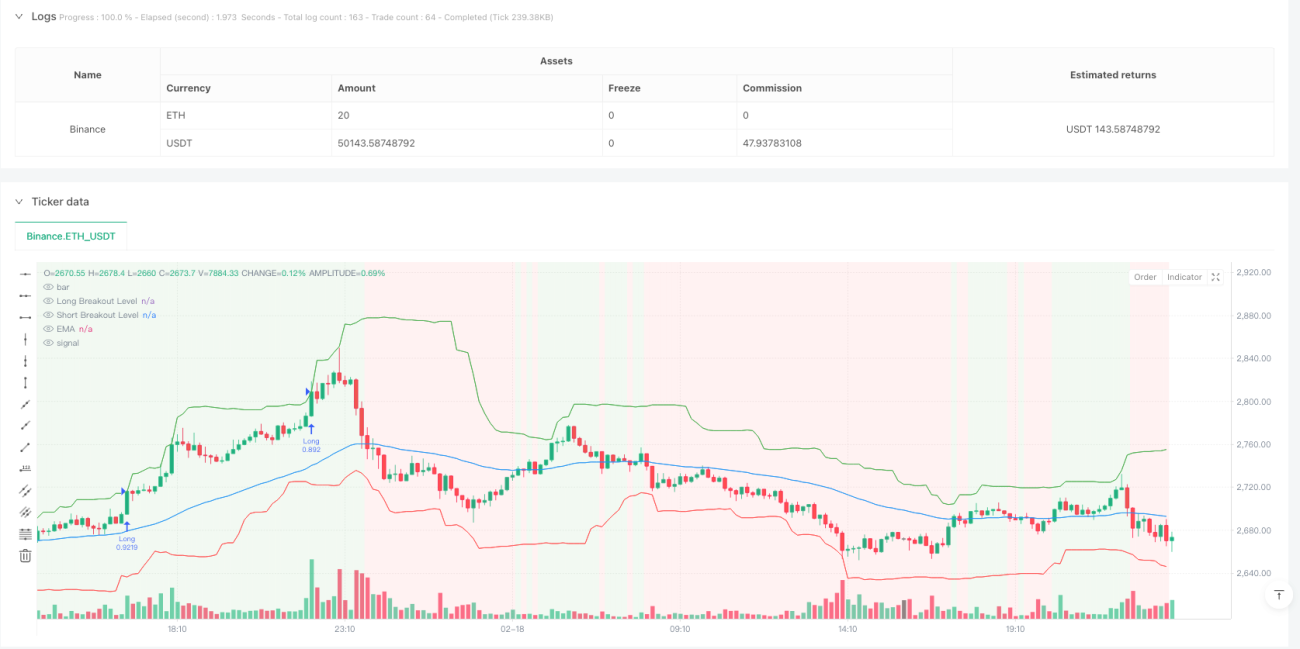
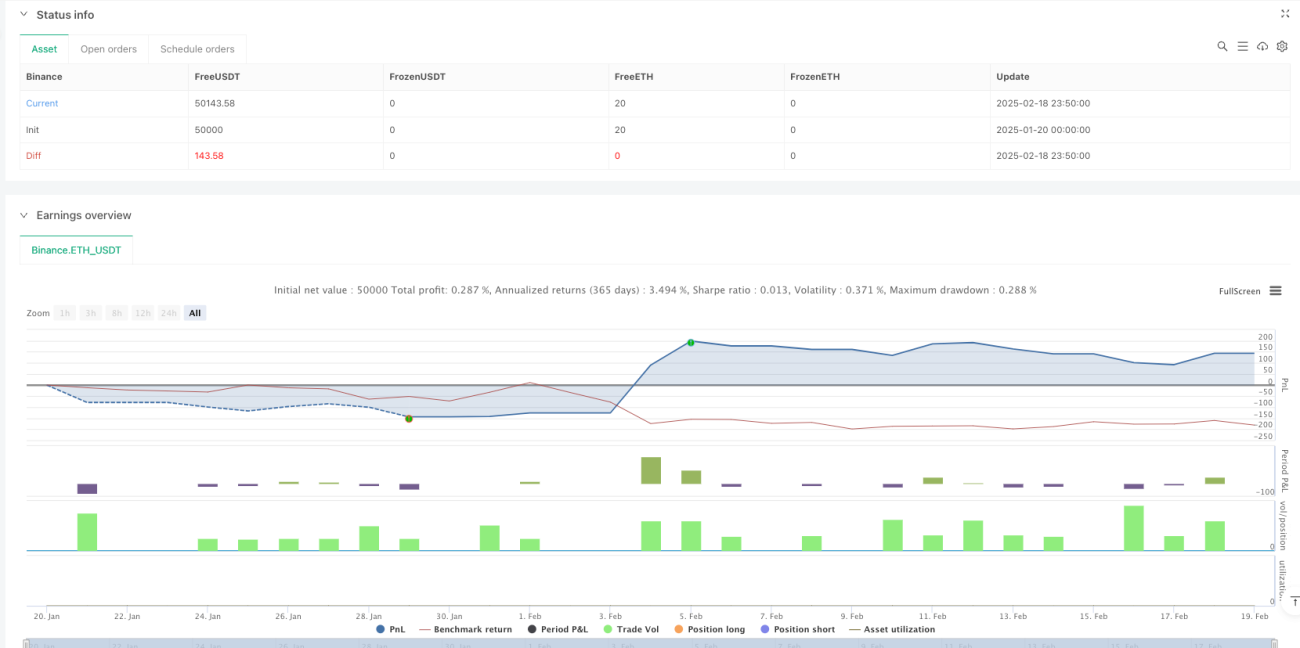
Strategi ini adalah sistem perdagangan kuantitatif yang menggabungkan volatilitas, pelacakan tren, dan pengakuan dinamika. Strategi ini mengidentifikasi peluang perdagangan dengan menghitung tingkat penembusan dinamis berdasarkan ATR dan menggabungkan penyaringan tren EMA dan indikator dinamika RSI. Strategi ini menggunakan langkah-langkah kontrol risiko yang ketat, termasuk manajemen risiko persentase tetap dan pengaturan stop loss dinamis.

Prinsip Strategi

Strategi ini terdiri dari tiga komponen utama:

  1. Penghitungan terobosan volatilitas: Menggunakan harga tertinggi dan terendah dalam periode retrospektif, dikombinasikan dengan perkalian ATR untuk menghitung nilai terendah terobosan dinamis, untuk menghindari defisit prospek.
  2. Filter tren: menggunakan EMA jangka pendek untuk menilai arah tren saat ini, hanya buka lebih banyak pesanan di atas harga EMA, buka tiket kosong di bawah EMA.
  3. Konfirmasi momentum: Menggunakan indikator RSI untuk mengkonfirmasi momentum pasar, masuk ke headline membutuhkan RSI lebih besar dari 50, dan masuk ke headline membutuhkan RSI kurang dari 50.

Keunggulan Strategis

  1. Adaptasi Dinamis: Tingkat terobosan akan secara otomatis menyesuaikan dengan fluktuasi pasar, sehingga strategi dapat beradaptasi dengan berbagai kondisi pasar.
  2. Multiple Filter: Mengurangi sinyal palsu dengan kombinasi trend dan momentum.
  3. Kontrol risiko yang ketat: Posisi dikelola dengan persentase risiko tetap dan menggunakan perlindungan stop loss dinamis.
  4. Kustomisasi yang kuat: Parameter kunci seperti siklus ATR, breakout multiples, dan siklus EMA dapat disesuaikan sesuai dengan kebutuhan spesifik.

Risiko Strategis

  1. Risiko keterbelakangan: Penggunaan indikator seperti moving average dapat menyebabkan keterbelakangan titik masuk.
  2. Risiko pasar yang bergoyang: Sering terjadi sinyal false breakout dalam pasar yang bergoyang.
  3. Sensitivitas Parameter: Kinerja strategi sangat sensitif terhadap pengaturan parameter dan perlu diuji secara penuh. Larutan:
  • Rekomendasi untuk melakukan optimasi retrospektif dalam kondisi pasar yang berbeda
  • Dapat menambahkan modul identifikasi lingkungan pasar
  • Rekomendasi untuk mengadopsi skema manajemen dana yang lebih konservatif

Arah optimasi strategi

  1. Adaptasi lingkungan pasar: penambahan penilaian rentang volatilitas, menggunakan pengaturan parameter yang berbeda dalam lingkungan yang berbeda.
  2. Optimasi sinyal: Anda dapat mempertimbangkan untuk menambahkan konfirmasi lalu lintas untuk meningkatkan keandalan sinyal penembusan.
  3. Optimalisasi Stop Loss: Rasio keuntungan dan kerugian yang dapat disesuaikan secara dinamis, sesuai dengan volatilitas pasar yang disesuaikan dengan tujuan.
  4. Penyaringan waktu: Menambahkan penyaringan jendela waktu perdagangan untuk menghindari perdagangan pada waktu yang tidak menguntungkan.

Meringkaskan

Ini adalah strategi perdagangan kuantitatif yang terstruktur, logis, dan jelas. Strategi ini menangkap fluktuasi harga yang signifikan sambil mengendalikan risiko dengan menggabungkan volatilitas, pelacakan tren, dan konfirmasi dinamis. Strategi ini sangat dapat disesuaikan dan dapat dioptimalkan lebih lanjut untuk menyesuaikan dengan varietas perdagangan dan lingkungan pasar yang berbeda.

Kode Sumber Strategi
/*backtest
start: 2025-01-20 00:00:00
end: 2025-02-19 00:00:00
period: 10m
basePeriod: 10m
exchanges: [{"eid":"Binance","currency":"ETH_USDT"}]
*/

//@version=5
// Volatility Momentum Breakout Strategy
//
// Description:
// This strategy is designed to capture significant price moves by combining a volatility breakout method
// with a momentum filter. Volatility is measured by the Average True Range (ATR), which is used to set dynamic
// breakout levels. A short‑term Exponential Moving Average (EMA) is applied as a trend filter, and the Relative
// Strength Index (RSI) is used to help avoid entries when the market is overextended.
// 
// Signal Logic:
// • Long Entry: When the current close is above the highest high of the previous N bars (excluding the current bar)
//   plus a multiple of ATR, provided that the price is above the short‑term EMA and the RSI is above 50.
// • Short Entry: When the current close is below the lowest low of the previous N bars (excluding the current bar)
//   minus a multiple of ATR, provided that the price is below the short‑term EMA and the RSI is below 50.
// 
// Risk Management:
// • Trades are sized to risk 2% of account equity.
// • A stop loss is placed at a fixed ATR multiple away from the entry price.
// • A take profit target is set to achieve a 1:2 risk‑reward ratio.
// 
// Backtesting Parameters:
// • Initial Capital: $10,000
// • Commission: 0.1% per trade
// • Slippage: 1 tick per bar
//
// Disclaimer:
// Past performance is not indicative of future results. This strategy is experimental and provided solely for educational
// purposes. Always backtest and paper trade before any live deployment.
//
// Author: [Your Name]
// Date: [Date]

strategy("Volatility Momentum Breakout Strategy", overlay=true, initial_capital=10000, default_qty_type=strategy.percent_of_equity, default_qty_value=5, commission_type=strategy.commission.percent, commission_value=0.1, slippage=1)

// ─── INPUTS ─────────────────────────────────────────────────────────────
atrPeriod       = input.int(14, "ATR Period", minval=1)
atrMultiplier   = input.float(1.5, "ATR Multiplier for Breakout", step=0.1)
lookback        = input.int(20, "Breakout Lookback Period", minval=1)
emaPeriod       = input.int(50, "EMA Period", minval=1)
rsiPeriod       = input.int(14, "RSI Period", minval=1)
rsiLongThresh   = input.float(50, "RSI Long Threshold", step=0.1)
rsiShortThresh  = input.float(50, "RSI Short Threshold", step=0.1)

// Risk management inputs:
riskPercent     = input.float(2.0, "Risk Percent per Trade (%)", step=0.1) * 0.01   // 2% risk per trade
riskReward      = input.float(2.0, "Risk-Reward Ratio", step=0.1)                    // Target profit is 2x risk
atrStopMult     = input.float(1.0, "ATR Multiplier for Stop Loss", step=0.1)         // Stop loss distance in ATRs

// ─── INDICATOR CALCULATIONS ───────────────────────────────────────────────
atrVal   = ta.atr(atrPeriod)
emaVal   = ta.ema(close, emaPeriod)
rsiVal   = ta.rsi(close, rsiPeriod)

// Calculate breakout levels using the highest high and lowest low of the previous N bars,
// excluding the current bar (to avoid look-ahead bias).
highestHigh = ta.highest(high[1], lookback)
lowestLow   = ta.lowest(low[1], lookback)

// Define breakout thresholds.
longBreakoutLevel  = highestHigh + atrMultiplier * atrVal
shortBreakoutLevel = lowestLow  - atrMultiplier * atrVal

// ─── SIGNAL LOGIC ─────────────────────────────────────────────────────────
// Long Entry: Price closes above the long breakout level,
// the close is above the EMA, and RSI > 50.
longCondition = (close > longBreakoutLevel) and (close > emaVal) and (rsiVal > rsiLongThresh)
// Short Entry: Price closes below the short breakout level,
// the close is below the EMA, and RSI < 50.
shortCondition = (close < shortBreakoutLevel) and (close < emaVal) and (rsiVal < rsiShortThresh)

if (longCondition)
    strategy.entry("Long", strategy.long)
if (shortCondition)
    strategy.entry("Short", strategy.short)

// ─── RISK MANAGEMENT ──────────────────────────────────────────────────────
// For each new trade, use the entry price as the basis for stop loss and target calculations.
// We assume the entry price equals the close on the bar where the trade is triggered.
var float longEntryPrice  = na
var float shortEntryPrice = na

// Record entry prices when a trade is opened.
if (strategy.position_size > 0 and na(longEntryPrice))
    longEntryPrice := strategy.position_avg_price
if (strategy.position_size < 0 and na(shortEntryPrice))
    shortEntryPrice := strategy.position_avg_price

// Calculate stop loss and take profit levels based on ATR.
longStop   = longEntryPrice - atrStopMult * atrVal
longTarget = longEntryPrice + (longEntryPrice - longStop) * riskReward
shortStop  = shortEntryPrice + atrStopMult * atrVal
shortTarget= shortEntryPrice - (shortStop - shortEntryPrice) * riskReward

// Issue exit orders if a position is open.
if (strategy.position_size > 0 and not na(longEntryPrice))
    strategy.exit("Long Exit", from_entry="Long", stop=longStop, limit=longTarget)
if (strategy.position_size < 0 and not na(shortEntryPrice))
    strategy.exit("Short Exit", from_entry="Short", stop=shortStop, limit=shortTarget)

// Reset recorded entry prices when the position is closed.
if (strategy.position_size == 0)
    longEntryPrice  := na
    shortEntryPrice := na

// ─── CHART VISUAL AIDS ─────────────────────────────────────────────────────
// Plot the breakout levels and EMA.
plot(longBreakoutLevel, color=color.new(color.green, 0), title="Long Breakout Level", style=plot.style_linebr)
plot(shortBreakoutLevel, color=color.new(color.red, 0), title="Short Breakout Level", style=plot.style_linebr)
plot(emaVal, color=color.blue, title="EMA")

// Optionally, shade the background: green when price is above the EMA (bullish) and red when below.
bgcolor(close > emaVal ? color.new(color.green, 90) : color.new(color.red, 90), title="Trend Background")