[tran]
Sistem strategi perdagangan Fibonacci multi-tingkat adalah strategi perdagangan kuantitatif yang komprehensif yang mengintegrasikan berbagai indikator analisis teknis. Strategi ini didasarkan pada teori Fibonacci retracement dan menggabungkan beberapa indikator teknis seperti Moving Average Index (EMA), Average True Rate (ATR), Average Trend Index (ADX) dan Directional Moving Indicator (DMI) untuk membangun kerangka analisis pasar multi-dimensi. Strategi ini tidak hanya memiliki fungsi pelacakan tren tradisional, tetapi juga mengintegrasikan mekanisme perdagangan bouncing dan fungsi penjaminan, yang bertujuan untuk menangkap peluang keuntungan dan mengendalikan risiko secara efektif di berbagai pasar.
Keunikan strategi ini adalah sistem manajemen risiko bertingkat dan modus perdagangan yang fleksibel. Strategi ini dapat memaksimalkan potensi keuntungan sambil melindungi modal dengan menetapkan beberapa target stop (TP1 dan TP2) dan mekanisme stop loss dinamis berbasis ATR.
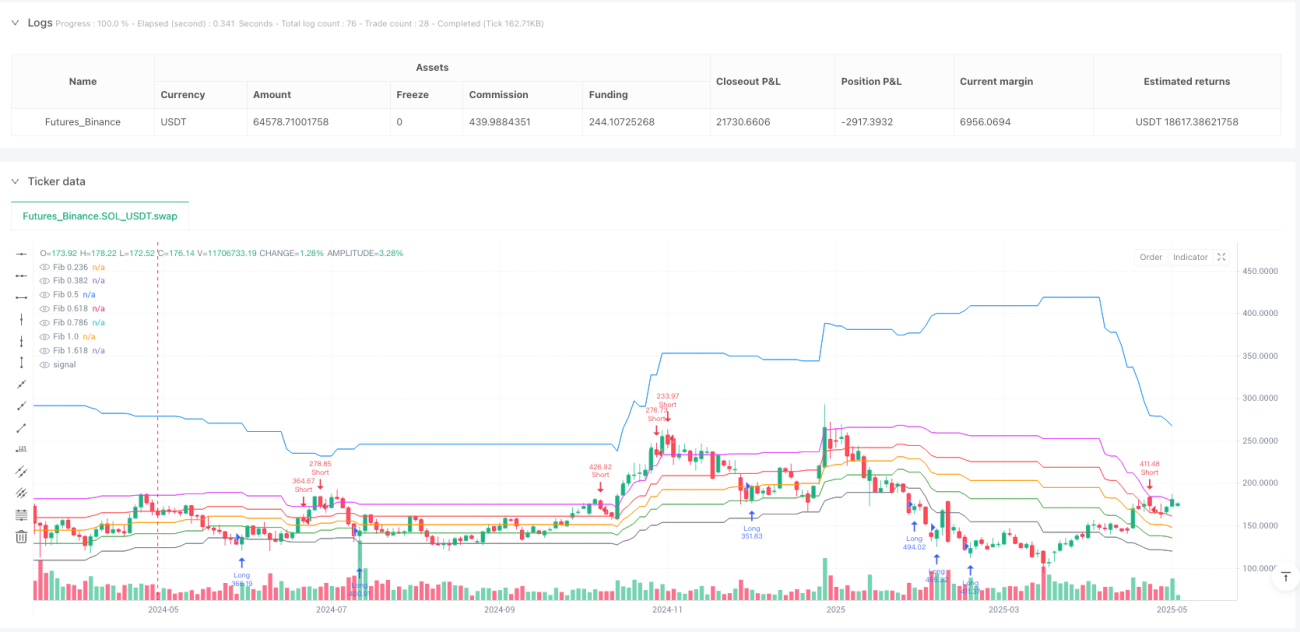
Logika inti dari strategi ini didasarkan pada kombinasi teori Fibonacci retracement dan analisis tren. Pertama, strategi ini menentukan tingkat retracement Fibonacci dengan menghitung titik tertinggi dan terendah dalam periode yang ditentukan, termasuk posisi kunci seperti 23,6%, 38,2%, 50%, 61,8%, 78,6%, 100% dan 161,8%.
Dalam identifikasi tren, strategi menggunakan indeks bergerak rata-rata 50 periode sebagai alat penilaian tren utama. Ketika harga berada di atas tiga garis K berturut-turut EMA, dianggap sebagai tren naik; sebaliknya adalah tren turun. Pada saat yang sama, strategi juga menganalisis struktur harga, mengkonfirmasi struktur multihead dengan mengidentifikasi titik rendah yang lebih tinggi dan titik tinggi yang lebih tinggi, untuk mengkonfirmasi struktur headless dengan titik tinggi yang lebih rendah dan titik rendah yang lebih rendah.
Pengenalan indikator ADX dan DMI meningkatkan keakuratan penilaian kekuatan tren. Nilai ADX lebih dari 20 dianggap sebagai kriteria untuk tren yang kuat, sedangkan kekuatan relatif + DI dan -DI digunakan untuk menentukan arah tren. Analisis volume transaksi juga merupakan bagian penting dari strategi, yang dianggap sebagai konfirmasi kuantitatif yang efektif ketika volume transaksi melebihi 1,2 kali rata-rata 20 periode.
Generasi sinyal perdagangan perlu memenuhi beberapa kondisi sekaligus: arah tren jelas, harga mendekati tingkat Fibonacci kunci, intensitas tren cukup, indikator arah dikonfirmasi dan volume transaksi meningkat. Ini mekanisme penyaringan ganda sangat meningkatkan keandalan sinyal dan mengurangi kemungkinan sinyal palsu.
Strategi ini memiliki beberapa keunggulan yang signifikan, pertama-tama dalam kerangka analisis teknis yang komprehensif. Dengan mengintegrasikan teori Fibonacci, analisis tren, indikator dinamika, dan analisis volume transaksi, strategi dapat menilai kondisi pasar dari beberapa dimensi, memberikan sinyal perdagangan yang lebih komprehensif dan akurat. Pendekatan integrasi multi-indikator ini secara efektif mengurangi sinyal yang menyesatkan yang mungkin dihasilkan oleh satu indikator, meningkatkan stabilitas dan keandalan strategi keseluruhan.
Sistem manajemen risiko dari strategi ini adalah keuntungan besar lainnya. Mekanisme double stop memungkinkan trader untuk mengunci sebagian dari keuntungan ketika mencapai tujuan pertama, sementara mempertahankan sisa posisi untuk mengejar keuntungan yang lebih besar. Pengaturan stop loss dinamis berbasis ATR dapat secara otomatis menyesuaikan tingkat kontrol risiko sesuai dengan volatilitas pasar, baik untuk memperketat stop loss untuk melindungi keuntungan pada saat turun naik rendah, dan untuk melonggarkan stop loss pada saat turun naik tinggi untuk menghindari terguncang oleh pergerakan normal.
Fungsi perdagangan rebound menambah peluang keuntungan tambahan untuk strategi. Strategi dapat dengan cepat mengidentifikasi dan berpartisipasi dalam reversal jangka pendek ini ketika harga melesat ke titik-titik dukungan atau resistensi penting, sehingga meningkatkan peluang perdagangan lebih banyak berdasarkan perdagangan tren.
Integrasi fungsi hedging adalah fitur inovatif dari strategi tersebut. Jika ada sinyal kosong saat memegang posisi multihead, strategi tersebut akan membuka posisi kosong yang terlindung; dan sebaliknya.
Pengaturan filter waktu mencegah masalah overtrading. Dengan meminta jarak antara sinyal berturut-turut minimal 5 K-line, strategi ini menghindari sering membuka posisi dalam waktu singkat, mengurangi biaya transaksi dan meningkatkan kualitas sinyal.
Meskipun ada banyak keuntungan dari strategi ini, masih ada beberapa faktor risiko yang perlu diperhatikan. Pertama adalah risiko ketergantungan parameter. Strategi melibatkan beberapa pengaturan parameter, termasuk siklus Fibonacci, toleransi, kelipatan ATR, dan lain-lain, pilihan parameter ini memiliki dampak penting pada kinerja strategi.
Adaptasi lingkungan pasar adalah risiko potensial lainnya. Strategi didasarkan pada analisis teknis, yang dapat berkinerja buruk dalam kondisi pasar tertentu, misalnya, indikator teknis dapat gagal dalam situasi unilateral yang kuat yang didorong oleh fundamental. Selain itu, dalam lingkungan pasar yang sangat rendah atau sangat tinggi, frekuensi dan akurasi pembuatan sinyal dari strategi dapat terpengaruh.
Slippage dan risiko eksekusi juga perlu dipertimbangkan. Dalam perdagangan aktual, terutama dalam kondisi pasar yang lebih volatile, mungkin ada perbedaan antara harga eksekusi pesanan dan harga yang diharapkan. Biaya slippage ini dapat mengikis keuntungan teoretis dari strategi, terutama untuk strategi yang sering diperdagangkan.
Fungsi hedging, meskipun memberikan perlindungan tambahan, juga meningkatkan kompleksitas strategi. Dalam beberapa kasus, operasi hedging dapat menyebabkan kerugian pada posisi kosong atau biaya tambahan dalam hal biaya proses. Oleh karena itu, perlu hati-hati dalam menilai efek praktis dari fungsi hedging dan mempertimbangkan apakah untuk mengaktifkan fitur dalam kondisi pasar tertentu.
Untuk lebih meningkatkan kinerja strategi, dapat dioptimalkan dari beberapa arah. Pertama adalah pengenalan mekanisme penyesuaian parameter dinamis. Fibonacci Cycle, ATR multiplier, dan parameter kunci lainnya dapat secara dinamis disesuaikan dengan faktor-faktor seperti volatilitas pasar, kekuatan tren. Misalnya, meningkatkan ATR multiplier di pasar yang berfluktuasi tinggi untuk memberikan ruang stop loss yang lebih besar, mengurangi ATR multiplier di pasar yang berfluktuasi rendah untuk memperketat kontrol risiko.
Integrasi teknologi pembelajaran mesin adalah arah optimasi penting lainnya. Algoritma pembelajaran mesin dapat digunakan untuk mengidentifikasi waktu masuk yang optimal, atau konfigurasi optimal berdasarkan kombinasi parameter pembelajaran data historis. Selain itu, teknologi pemrosesan bahasa alami dapat digunakan untuk menganalisis pengaruh sentimen pasar dan peristiwa berita pada harga, untuk menambah dimensi analisis fundamental pada strategi.
Integrasi analisis multi-frame waktu dapat memberikan perspektif pasar yang lebih komprehensif. Anda dapat mengkonfirmasi arah tren besar pada jangka waktu yang lebih lama dan mencari titik masuk yang tepat pada jangka waktu yang lebih pendek. Analisis koordinasi multi-frame waktu ini dapat meningkatkan kualitas sinyal dan mengurangi risiko perdagangan berlawanan.
Optimasi manajemen dana juga merupakan cara penting untuk meningkatkan kinerja strategi. Ukuran posisi dapat disesuaikan secara dinamis sesuai dengan kondisi pasar, kepercayaan strategi dan faktor-faktor lainnya. Misalnya, meningkatkan posisi pada sinyal kepercayaan tinggi, mengurangi posisi pada sinyal kepercayaan rendah. Selain itu, mekanisme kontrol penarikan maksimum dapat diperkenalkan, mengurangi posisi secara otomatis atau menangguhkan perdagangan ketika strategi mengalami kerugian besar.
Perbaikan lebih lanjut pada logika stop loss juga perlu dipertimbangkan. Anda dapat memperkenalkan mekanisme stop loss yang melacak dan menyesuaikan posisi stop loss sesuai dengan pergerakan harga yang dinamis untuk mengunci lebih banyak keuntungan. Selain itu, Anda dapat mengatur target stop yang lebih cerdas berdasarkan karakteristik struktur pasar, seperti stop loss lebih awal di dekat titik resistensi penting.
Sistem strategi perdagangan Fibonacci multi-tingkat yang melacak tren dan hedging mewakili arah perkembangan penting dalam teknologi perdagangan kuantitatif modern. Strategi ini membangun kerangka perdagangan yang kuat dan fleksibel dengan mengintegrasikan dengan cerdik berbagai alat analisis teknis klasik.
Implementasi strategi yang sukses membutuhkan pemahaman yang lengkap tentang prinsip-prinsip dasar dan mekanisme operasinya, dan penyesuaian dan pengoptimalan parameter yang sesuai sesuai dengan lingkungan perdagangan tertentu. Meskipun strategi ini dirancang dengan baik secara teoritis, namun dalam aplikasi praktis, dampak dari faktor-faktor nyata seperti struktur mikro pasar, biaya transaksi, dan slippage masih perlu dipertimbangkan.
Dengan perkembangan teknologi kecerdasan buatan dan pembelajaran mesin, strategi ini memiliki ruang untuk pengoptimalan yang sangat besar. Kinerja strategi diharapkan dapat ditingkatkan lebih lanjut dengan memperkenalkan teknologi analisis data yang lebih canggih dan mekanisme adaptasi. ||
The Multi-Level Fibonacci Trend Following and Hedging Trading Strategy System is a comprehensive quantitative trading strategy that integrates multiple technical analysis indicators. This strategy centers on Fibonacci retracement theory, combining Exponential Moving Average (EMA), Average True Range (ATR), Average Directional Index (ADX), and Directional Movement Indicator (DMI) to construct a multi-dimensional market analysis framework. The strategy not only features traditional trend-following capabilities but also integrates bounce trading mechanisms and hedging functionality, aiming to capture profitable opportunities under different market conditions while effectively controlling risk.
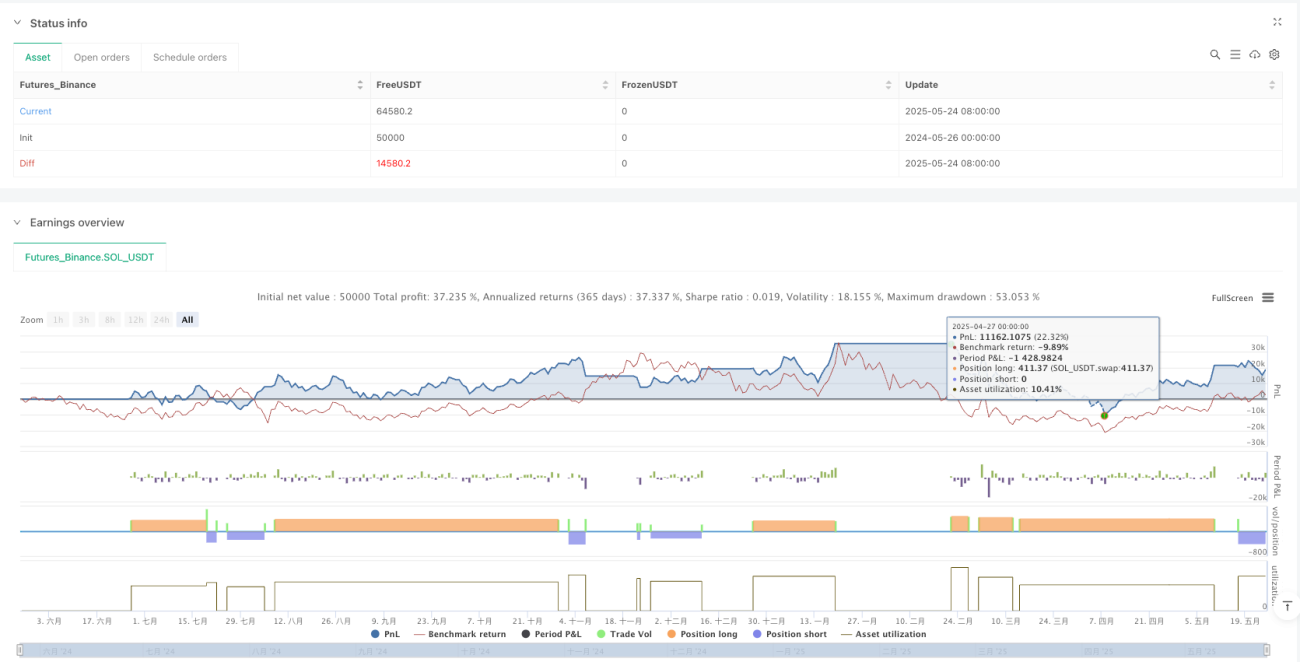
The unique aspect of this strategy lies in its multi-layered risk management system and flexible trading modes. By setting multiple take-profit targets (TP1 and TP2) and dynamic stop-loss mechanisms based on ATR, the strategy can maximize profit potential while protecting capital. Additionally, the built-in hedging function adds an extra risk buffer to the strategy, enabling it to maintain relatively stable performance even in highly volatile market environments.
The core logic of the strategy is based on the combination of Fibonacci retracement theory and trend analysis. First, the strategy calculates the highest and lowest points within a specified period to determine Fibonacci retracement levels, including key positions at 23.6%, 38.2%, 50%, 61.8%, 78.6%, 100%, and 161.8%. These levels serve as important support and resistance zones, providing crucial references for trading signal generation.
For trend identification, the strategy employs a 50-period Exponential Moving Average as the primary trend determination tool. When prices remain above the EMA for three consecutive candlesticks, it’s identified as an uptrend; conversely, it’s considered a downtrend. Simultaneously, the strategy analyzes price structure by identifying higher lows and higher highs to confirm bullish structure, and lower highs and lower lows to confirm bearish structure.
The introduction of ADX and DMI indicators enhances the precision of trend strength assessment. An ADX value greater than 20 is considered the standard for a strong trend, while the relative strength of +DI and -DI is used to determine trend direction. Volume analysis is also an important component of the strategy, where volume exceeding 1.2 times the 20-period average is considered effective volume confirmation.
Trade signal generation requires multiple conditions to be met simultaneously: clear trend direction, price proximity to key Fibonacci levels, sufficient trend strength, directional indicator confirmation, and volume expansion. This multi-filter mechanism significantly improves signal reliability and reduces the probability of false signals.
This strategy possesses multiple significant advantages, first manifested in its comprehensive technical analysis framework. By integrating Fibonacci theory, trend analysis, momentum indicators, and volume analysis, the strategy can evaluate market conditions from multiple dimensions, providing more comprehensive and accurate trading signals. This multi-indicator fusion approach effectively reduces misleading signals that might be generated by single indicators, improving the overall stability and reliability of the strategy.
The strategy’s risk management system represents another major advantage. The dual take-profit mechanism allows traders to lock in partial profits upon reaching the first target while maintaining remaining positions to pursue greater returns. ATR-based dynamic stop-loss settings can automatically adjust risk control levels according to market volatility, tightening stops during low volatility to protect profits and relaxing stops during high volatility to avoid being stopped out by normal fluctuations.
The bounce trading functionality adds additional profit opportunities to the strategy. When prices bounce at key support or resistance levels, the strategy can quickly identify and participate in such short-term reversal movements, thereby adding more trading opportunities beyond trend trading. This flexibility enables the strategy to adapt to different market conditions, finding suitable trading opportunities whether in strong trending markets or range-bound markets.
The integration of hedging functionality is an innovative feature of this strategy. When holding long positions and a short signal appears, the strategy will open a hedge short position; vice versa. This mechanism can provide additional protection during rapid market reversals, reducing potential losses and possibly converting them into new profit opportunities.
The time filter setting prevents overtrading issues. By requiring at least 5 candlesticks between consecutive signals, the strategy avoids frequent position opening within short periods, reducing trading costs and improving signal quality.
Despite the strategy’s multiple advantages, several risk factors require attention. First is parameter dependency risk. The strategy involves multiple parameter settings, including Fibonacci period, tolerance, ATR multipliers, etc. The selection of these parameters significantly impacts strategy performance. Inappropriate parameter settings may lead to overfitting historical data or poor performance in actual markets. Therefore, sufficient backtesting and parameter optimization are needed to find the most suitable parameter combinations for specific markets and timeframes.
Market environment adaptability represents another potential risk. The strategy is primarily based on technical analysis and may underperform in certain market conditions, such as during fundamental-driven strong unidirectional moves where technical indicators might fail. Additionally, in extremely low or high volatility market environments, both signal generation frequency and accuracy may be affected.
Slippage and execution risks also need consideration. In actual trading, particularly during high volatility market conditions, there may be differences between order execution prices and expected prices. This slippage cost could erode the strategy’s theoretical returns, especially for frequently trading strategies.
While the hedging function provides additional protection, it also increases strategy complexity. In certain situations, hedging operations might result in simultaneous losses on both long and short positions, or generate additional costs in terms of commissions. Therefore, careful evaluation of the hedging function’s actual effectiveness is needed, along with consideration of whether to enable this function under specific market conditions.
To further enhance strategy performance, optimization can be pursued in multiple directions. First is the introduction of dynamic parameter adjustment mechanisms. Key parameters such as Fibonacci period and ATR multipliers can be dynamically adjusted based on market volatility, trend strength, and other factors. For example, increasing ATR multipliers in high volatility markets to provide larger stop-loss space, and decreasing ATR multipliers in low volatility markets to tighten risk control.
Integration of machine learning technology represents another important optimization direction. Machine learning algorithms can be used to identify optimal entry timing or learn optimal parameter combination configurations based on historical data. Additionally, natural language processing technology can be utilized to analyze market sentiment and news event impacts on prices, adding fundamental analysis dimensions to the strategy.
Integration of multi-timeframe analysis can provide a more comprehensive market perspective. Larger timeframes can be used to confirm major trend direction, while shorter timeframes can be used to find precise entry points. This coordinated multi-timeframe analysis can improve signal quality and reduce counter-trend trading risks.
Money management optimization is also an important avenue for enhancing strategy performance. Position sizes can be dynamically adjusted based on market conditions, strategy confidence levels, and other factors. For example, increasing positions during high-confidence signals and reducing positions during low-confidence signals. Additionally, maximum drawdown control mechanisms can be introduced to automatically reduce positions or pause trading when the strategy experiences significant losses.
Further refinement of take-profit and stop-loss logic is also worth considering. Trailing stop mechanisms can be introduced to dynamically adjust stop-loss positions based on price movements to lock in more profits. Simultaneously, more intelligent take-profit targets can be set based on market structure characteristics, such as taking profits early near key resistance levels.
The Multi-Level Fibonacci Trend Following and Hedging Trading Strategy System represents an important development direction in modern quantitative trading technology. This strategy cleverly integrates multiple classic technical analysis tools to construct a trading framework that is both robust and flexible. Its multi-filter mechanism ensures signal quality, the multi-layered risk management system provides effective capital protection, and the hedging function adds an additional safety margin to the strategy.
Successful implementation of this strategy requires thorough understanding of its fundamental principles and operational mechanisms, along with appropriate parameter adjustments and optimizations based on specific trading environments. While the strategy has excellent theoretical design, practical application still requires consideration of real-world factors such as market microstructure, trading costs, and slippage.
With the continuous development of artificial intelligence and machine learning technologies, this strategy still has enormous optimization potential. Through the introduction of more advanced data analysis techniques and adaptive mechanisms, strategy performance is expected to be further enhanced. For quantitative traders, such comprehensive strategies provide a valuable learning and improvement platform, helping to deepen understanding of market dynamics and the importance of risk management.[/trans]
/*backtest
start: 2024-05-26 00:00:00
end: 2025-05-25 00:00:00
period: 2d
basePeriod: 2d
exchanges: [{"eid":"Futures_Binance","currency":"SOL_USDT"}]
*/
//@version=5
strategy("Fibonacci Trend v6.4 - TP/SL Labels", overlay=true, default_qty_type=strategy.percent_of_equity, default_qty_value=100)
// === Parameters ===
fibLen = input.int(50, "Fibonacci Range")
fibTol = input.float(0.01, "Fib Proximity Tolerance (%)", step=0.001)
slMult = input.float(1.5, "SL - ATR", step=0.1)
tp2Mult = input.float(2.0, "TP2 - ATR", step=0.1)
srLookback = input.int(20, "Support/Resistance Lookback Bars")
useBounce = input.bool(true, "Enable Bounce Entry")
// === Indicators ===
ema50 = ta.ema(close, 50)
atr = ta.atr(14)
volAvg = ta.sma(volume, 20)
volHigh = volume > volAvg * 1.2
// === Fibonacci Levels ===
lowWick = ta.lowest(low, fibLen)
highWick = ta.highest(high, fibLen)
rangeWick = highWick - lowWick
fib236 = lowWick + 0.236 * rangeWick
fib382 = lowWick + 0.382 * rangeWick
fib5 = lowWick + 0.5 * rangeWick
fib618 = lowWick + 0.618 * rangeWick
fib786 = lowWick + 0.786 * rangeWick
fib1 = highWick
fib1618 = lowWick + 1.618 * rangeWick
nearSupport = math.abs(low - fib382)/close < fibTol or math.abs(low - fib5)/close < fibTol
nearResist = math.abs(high - fib618)/close < fibTol
// === Trend Structure ===
higherLow = low > low[1] and low[1] > low[2]
higherHigh = high > high[1]
lowerHigh = high < high[1] and high[1] < high[2]
lowerLow = low < low[1]
longStruct = higherLow and higherHigh
shortStruct = lowerHigh and lowerLow
// === ADX / DMI ===
dmiLen = 14
upMove = high - high[1]
downMove = low[1] - low
plusDM = (upMove > downMove and upMove > 0) ? upMove : 0
minusDM = (downMove > upMove and downMove > 0) ? downMove : 0
tr = ta.tr(true)
tr14 = ta.rma(tr, dmiLen)
plusDI = 100 * ta.rma(plusDM, dmiLen) / tr14
minusDI = 100 * ta.rma(minusDM, dmiLen) / tr14
dx = 100 * math.abs(plusDI - minusDI) / (plusDI + minusDI)
adx = ta.rma(dx, dmiLen)
trendStrong = adx > 20
// === EMA Momentum Break ===
emaBreakLong = close > ema50 and close[1] < ema50 and volume > volAvg
emaBreakShort = close < ema50 and close[1] > ema50 and volume > volAvg
// === Time Filter ===
var int lastLongBar = na
var int lastShortBar = na
canLong = na(lastLongBar) or (bar_index - lastLongBar > 5)
canShort = na(lastShortBar) or (bar_index - lastShortBar > 5)
priceAboveEMA = close > ema50 and close[1] > ema50 and close[2] > ema50
priceBelowEMA = close < ema50 and close[1] < ema50 and close[2] < ema50
// === Support / Resistance ===
support = ta.lowest(low, srLookback)
resist = ta.highest(high, srLookback)
// === Entry Conditions ===
longTrend = priceAboveEMA and nearSupport and trendStrong and plusDI > minusDI and longStruct and (volHigh or emaBreakLong) and canLong
shortTrend = priceBelowEMA and nearResist and trendStrong and minusDI > plusDI and shortStruct and (volHigh or emaBreakShort) and canShort
bounceLong = useBounce and math.abs(low - support)/close < fibTol and close > open and close > close[1]
bounceShort = useBounce and math.abs(high - resist)/close < fibTol and close < open and close < close[1]
longSignal = longTrend or bounceLong
shortSignal = shortTrend or bounceShort
// === TP/SL Calculations ===
tp1Long = resist
tp2Long = close + atr * tp2Mult
slLong = close - atr * slMult
tp1Short = support
tp2Short = close - atr * tp2Mult
slShort = close + atr * slMult
tp1ColorLong = bounceLong ? color.blue : color.yellow
tp1ColorShort = bounceShort ? color.blue : color.yellow
// === Long Entry ===
if (longSignal and strategy.position_size <= 0)
strategy.entry("Long", strategy.long)
strategy.exit("TP1", from_entry="Long", limit=tp1Long, stop=slLong, qty_percent=50)
strategy.exit("TP2", from_entry="Long", limit=tp2Long, stop=slLong)
lastLongBar := bar_index
label.new(bar_index, close, text="ENTRY: " + str.tostring(close, "#.##"), style=label.style_label_down, color=color.green, textcolor=color.white)
label.new(bar_index, tp1Long, text="TP1: " + str.tostring(tp1Long, "#.##"), style=label.style_label_down, color=tp1ColorLong)
label.new(bar_index, tp2Long, text="TP2: " + str.tostring(tp2Long, "#.##"), style=label.style_label_down, color=color.green)
label.new(bar_index, slLong, text="SL: " + str.tostring(slLong, "#.##"), style=label.style_label_up, color=color.red)
// === Short Entry ===
if (shortSignal and strategy.position_size >= 0)
strategy.entry("Short", strategy.short)
strategy.exit("TP1", from_entry="Short", limit=tp1Short, stop=slShort, qty_percent=50)
strategy.exit("TP2", from_entry="Short", limit=tp2Short, stop=slShort)
lastShortBar := bar_index
label.new(bar_index, close, text="ENTRY: " + str.tostring(close, "#.##"), style=label.style_label_up, color=color.red, textcolor=color.white)
label.new(bar_index, tp1Short, text="TP1: " + str.tostring(tp1Short, "#.##"), style=label.style_label_up, color=tp1ColorShort)
label.new(bar_index, tp2Short, text="TP2: " + str.tostring(tp2Short, "#.##"), style=label.style_label_up, color=color.green)
label.new(bar_index, slShort, text="SL: " + str.tostring(slShort, "#.##"), style=label.style_label_down, color=color.red)
// === Hedge Orders ===
if (strategy.position_size > 0 and shortSignal)
strategy.entry("HedgeShort", strategy.short)
if (strategy.position_size < 0 and longSignal)
strategy.entry("HedgeLong", strategy.long)
// === Fibonacci Plotting ===
plot(fib236, "Fib 0.236", color=color.gray)
plot(fib382, "Fib 0.382", color=color.green)
plot(fib5, "Fib 0.5", color=color.orange)
plot(fib618, "Fib 0.618", color=color.red)
plot(fib786, "Fib 0.786", color=color.fuchsia)
plot(fib1, "Fib 1.0", color=color.white)
plot(fib1618, "Fib 1.618", color=color.blue)