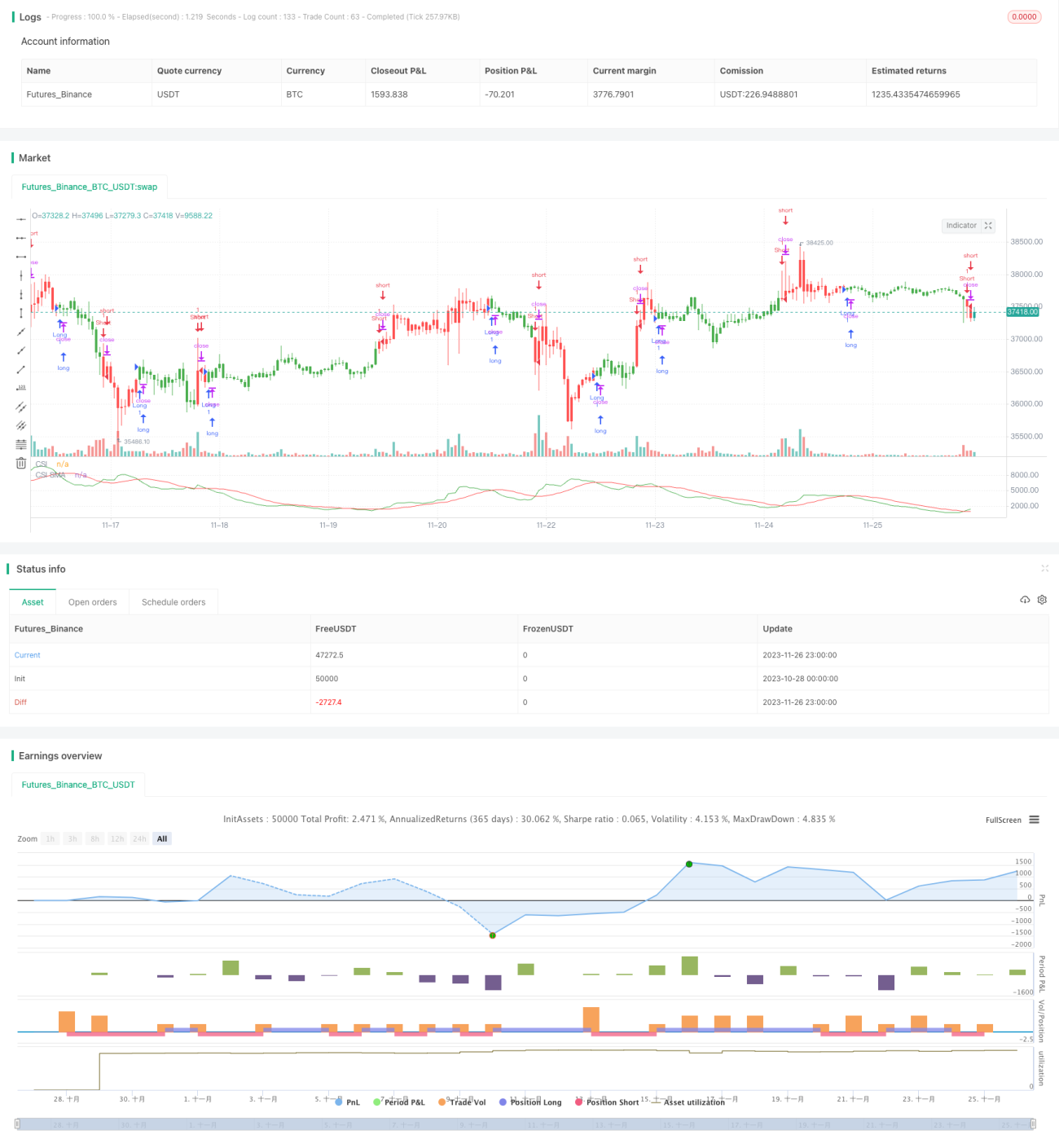
モメンタム商品選択指数戦略


作成日: 2023-11-28 16:27:55 最終変更日: 2023-11-28 16:27:55
コピー: 0 クリック数: 724
1
フォロー
1619
フォロワー

モメンタム商品選択指数戦略

概要

動量商品選択指数 (CSI) 戦略は,市場の動力を追跡するショートライン取引戦略である.それは,商品の傾向性と波動性を計算して,強力な動量を持つ商品を識別するために取引する.この戦略は,ウェルズ・ワイルダー (Welles Wilder) が彼の新技術分析取引システム概念で提唱した.

戦略原則

この戦略の核心指標はCSI指数で,商品のトレンド性と変動性を総合的に考慮している.具体的には以下の計算方法があります.

CSI = K × ATR × (ADX + ADXのn日平均線) /2)

その中で,Kは縮小系数であり,ATRは市場の波動性を測定する平均実際の波動幅を表す.ADXは市場の傾向性を反映する平均方向指数を表す.

各商品のCSI指数値を計算し,n日間の単純移動平均線と比較することで,CSIが移動平均線より高くなったら買い,CSIが移動平均線より低かったら売るシグナルが生成される.

この戦略は,CSI指数が高い商品を取引する.これらの商品は,強い傾向性および変動性があるため,短期間により大きな利益の可能性を得ることができます.

優位分析

この戦略には以下の利点があります.

  1. 商品のトレンド性や波動性の特性を活用する.
  2. 双重指数は,取引信号をより信頼性のあるものにします.
  3. 自動化された取引に適した,シンプルで明確な取引ルール
  4. 短線取引に特化して設計されていて,短期間の機会を迅速に把握できます.

リスク分析

この戦略にはいくつかのリスクがあります.

  1. 電子機器の技術的な指標に過度に依存すると,誤信号が発生する可能性があります.
  2. 動力を追跡する特性により,短線操作のみに適している.
  3. 波動が大きすぎると,ストップ・ロスが起こり,取引に損失が及ぶ可能性があります.
  4. 投資家は,その投資の利害を考慮して,より大きな資金リスクを負う必要があります.

リスクを制御するために,合理的にストップ・ポジションを設定し,単一のポジションのサイズを制御し,異なる市場環境に対応するためにパラメータを適切に調整する必要があります.

最適化の方向

この戦略は以下の点で最適化できます.

  1. 複数のパラメータの組み合わせをテストし,最適なパラメータを探します.
  2. 他の補助指標と合わさって信号をフィルターする.
  3. 波動率の逆転などの他の戦略と組み合わせた組み合わせ.
  4. 機械学習の訓練モデルを用いて,より信頼性の高い取引信号を生成する.

要約する

動量商品選択指数戦略は,市場における傾向が強い,波動性が大きい商品を捕捉することによって,簡易で迅速な短線取引を実現する.この動量を追跡する方法は,その信号を明確にして,自動化を容易に実施する.もちろん,リスク管理に注意を払い,市場環境の変化に適応するために継続的に改良・アップグレードする必要がある.

ストラテジーソースコード
/*backtest
start: 2023-10-28 00:00:00
end: 2023-11-27 00:00:00
period: 1h
basePeriod: 15m
exchanges: [{"eid":"Futures_Binance","currency":"BTC_USDT"}]
*/

//@version=3
////////////////////////////////////////////////////////////
//  Copyright by HPotter v1.0 20/03/2019
// The Commodity Selection Index ("CSI") is a momentum indicator. It was 
// developed by Welles Wilder and is presented in his book New Concepts in 
// Technical Trading Systems. The name of the index reflects its primary purpose. 
// That is, to help select commodities suitable for short-term trading.
// A high CSI rating indicates that the commodity has strong trending and volatility 
// characteristics. The trending characteristics are brought out by the Directional 
// Movement factor in the calculation--the volatility characteristic by the Average 
// True Range factor.
// Wilder's approach is to trade commodities with high CSI values (relative to other 
// commodities). Because these commodities are highly volatile, they have the potential 
// to make the "most money in the shortest period of time." High CSI values imply 
// trending characteristics which make it easier to trade the security.
// The Commodity Selection Index is designed for short-term traders who can handle 
// the risks associated with highly volatile markets.
//
// WARNING:
// - For purpose educate only
// - This script to change bars colors.
////////////////////////////////////////////////////////////
fADX(Len) =>
    up = change(high)
    down = -change(low)
    trur = rma(tr, Len)
    plus = fixnan(100 * rma(up > down and up > 0 ? up : 0, Len) / trur)
    minus = fixnan(100 * rma(down > up and down > 0 ? down : 0, Len) / trur)
    sum = plus + minus 
    100 * rma(abs(plus - minus) / (sum == 0 ? 1 : sum), Len)

strategy(title="Commodity Selection Index Backtest", shorttitle="CSI Backtest")
PointValue = input(50)
Margin = input(3000)
Commission = input(10)
Length = input(14)
reverse = input(false, title="Trade reverse")
K = 100 * ((PointValue / sqrt(Margin) / (150 + Commission)))
xATR = atr(Length)
xADX = fADX(Length)
nADXR = (xADX + xADX[Length]) * 0.5
xCSI = K * xATR * nADXR
xMACSI = sma(xCSI, Length)
pos = 0.0
pos := iff(xCSI < xMACSI, 1,
	   iff(xCSI > xMACSI, -1, nz(pos[1], 0))) 
possig = iff(reverse and pos == 1, -1,
          iff(reverse and pos == -1, 1, pos))	   
if (possig == 1) 
    strategy.entry("Long", strategy.long)
if (possig == -1)
    strategy.entry("Short", strategy.short)	   	    
barcolor(possig == -1 ? red: possig == 1 ? green : blue ) 
plot(xCSI, color=green, title="CSI")
plot(xMACSI, color=red, title="CSI SMA")