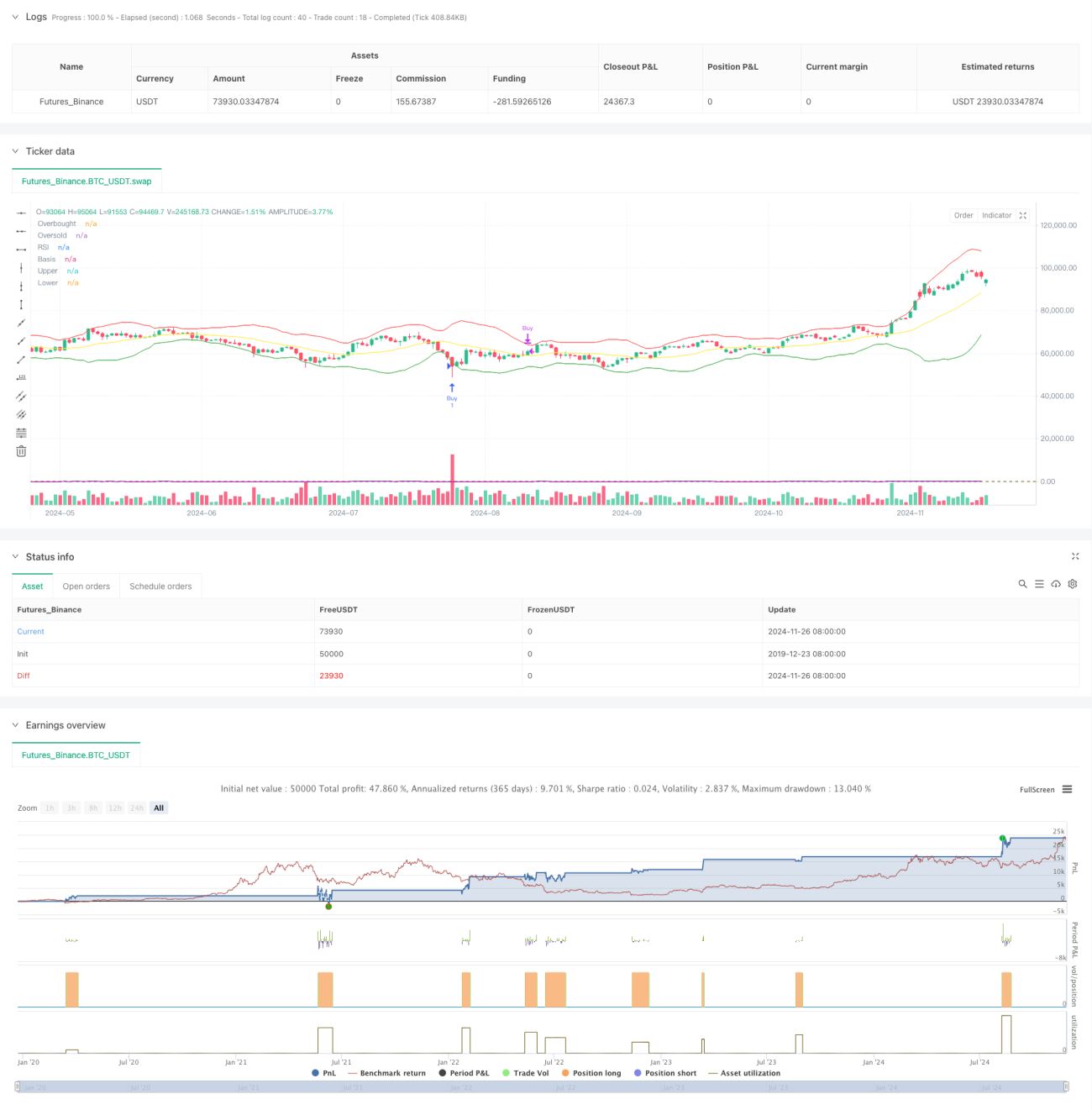
この戦略は,ポーリン帯 ((Bollinger Bands) と相対的に強い指標 ((RSI) の2つのクラシックな技術指標を組み合わせて,完全な取引システムを形成します. この戦略は,市場の波動性や動力の変化を捕捉することによって取引機会を探し,特に日内トレーダーが使用するのに適しています.ポーリンによって市場の波動性を測定し,同時にRSI指標と組み合わせて,価格の超買い超売り状態を確認し,より信頼性の高い取引信号を生成します.
策略の核心的な論理は,価格の波動性指標と動量指標を組み合わせることにある.ポーリン帯は20日単調移動平均を中軌道として,上下軌道は中軌道加減2.5倍標準差である.価格が下軌道に触れて,RSIが30を下回ると,システムは複数の信号を発信し,価格が上軌道に突破し,RSIが70を下回ると,システムは平仓信号を発信する.さらに,策略は,RSIが50以上に戻ると,追加の平仓条件を設定し,これは利益をタイミング的にロックするのに役立ちます.策略の設計は,市場の波動的特性と価格変動量の変化の法則を十分に考慮している.
この戦略は,ポーリン帯とRSI指標を巧妙に組み合わせて,論理的に厳格で操作性の高い取引システムを構築している.この戦略の主要な優点は,信号の信頼性が高いこと,リスク管理の完善であり,強い適応性があることである.特定の市場環境でいくつかの課題に直面する可能性があるが,継続的な最適化と改善によって,戦略の全体的なパフォーマンスは,依然として優れた応用価値を有している.
This strategy combines Bollinger Bands and Relative Strength Index (RSI) to form a comprehensive trading system. It primarily seeks trading opportunities by capturing market volatility and momentum changes, particularly suitable for intraday traders. The strategy uses Bollinger Bands to measure market volatility while incorporating RSI to confirm overbought and oversold conditions, generating more reliable trading signals.
The core logic combines volatility and momentum indicators. Bollinger Bands consist of a 20-day simple moving average as the middle band, with upper and lower bands set at 2.5 standard deviations. Buy signals are generated when price touches the lower band and RSI is below 30, while exit signals occur when price breaks above the upper band and RSI exceeds 70. Additionally, the strategy includes an extra exit condition when RSI rises above 50, helping to secure profits. The design thoroughly considers market volatility characteristics and price momentum patterns.
The strategy cleverly combines Bollinger Bands and RSI indicators to build a logically rigorous and highly operable trading system. Its main advantages lie in high signal reliability and comprehensive risk control, while maintaining strong adaptability. Although it may face challenges in certain market environments, the strategy maintains good practical value through continuous optimization and improvement. Traders should pay attention to changing market conditions, flexibly adjust strategy parameters, and always maintain proper risk control in practical applications.
/*backtest
start: 2019-12-23 08:00:00
end: 2024-11-27 00:00:00
period: 1d
basePeriod: 1d
exchanges: [{"eid":"Futures_Binance","currency":"BTC_USDT"}]
*/
//@version=5
strategy("Bollinger Bands + RSI Strategy", shorttitle="BB_RSI", overlay=true)
// Define the Bollinger Bands parameters
length = input(20, title="Length")
mult = input(2.5, title="Multiplier")
basis = ta.sma(close, length)
dev = mult * ta.stdev(close, length)
upper = basis + dev
lower = basis - dev
// Define the RSI parameters
rsiLength = input(14, title="RSI Length")
rsiOverbought = input(70, title="RSI Overbought Level")
rsiOversold = input(30, title="RSI Oversold Level")
rsi = ta.rsi(close, rsiLength)
// Plot the Bollinger Bands and RSI
plot(basis, "Basis", color=color.yellow)
p1 = plot(upper, "Upper", color=color.red)
p2 = plot(lower, "Lower", color=color.green)
fill(p1, p2, color=color.rgb(255, 255, 255, 90))
hline(rsiOverbought, "Overbought", color=color.red)
hline(rsiOversold, "Oversold", color=color.green)
// Generate Buy and Sell signals
buyCondition = close < lower and rsi < rsiOversold
sellCondition = close > upper and rsi > rsiOverbought
if (buyCondition)
strategy.entry("Buy", strategy.long)
if (sellCondition)
strategy.close("Buy")
// Optional: Add exit strategy for buys
exitCondition = rsi > 50
if (exitCondition)
strategy.close("Buy")
// Plot RSI on a separate panel
plot(rsi, "RSI", color=color.purple)