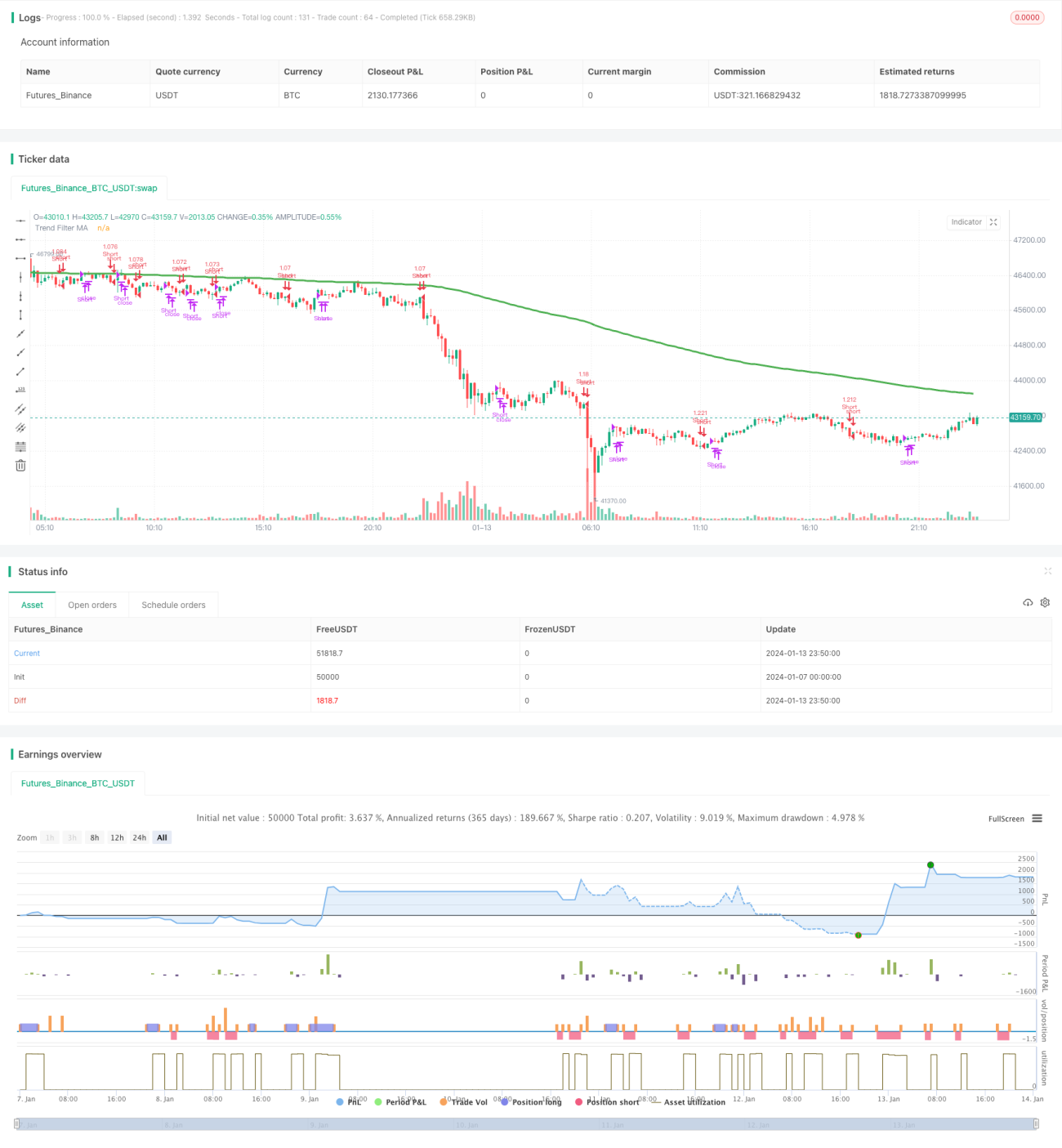
ADX 동적 평균 추세 지표 전략


생성 날짜: 2024-01-15 15:32:45 마지막으로 수정됨: 2024-01-15 15:32:45
복사: 0 클릭수: 584
avatar of ChaoZhang ChaoZhang
1
집중하다
1617
수행원

ADX 동적 평균 추세 지표 전략

개요

ADX 동적 평균 트렌드 지표 전략은 ADX 지표를 사용하여 시장의 경향 강도와 트렌드 방향을 판단하는 양적 거래 전략이다. 이 전략은 평균 방향 지표 ((ADX) 를 계산하여 시장의 경향이 있는지 판단하고, 긍정적 인 지표 ((DI+) 와 부정적인 지표 ((DI-) 를 계산하여 트렌드 방향을 판단하여 구매 및 판매 신호를 생성한다.

전략 원칙

이 전략은 먼저 ADX 지표를 사용하여 시장의 경향을 판단한다. ADX가 사용자가 설정한 핵심값보다 높을 때 (기본 23), 시장의 추세가 강하다는 것을 나타냅니다. ADX의 현재 값이 ADX 이전 n 일의 값보다 높을 때 (기본 3 일) ADX가 상승하고 있으며 시장의 추세가 형성되고 있음을 나타냅니다.

다음 전략은 DI+와 DI-를 사용하여 시장 추세의 방향을 판단한다. DI+가 DI-보다 높으면 시장이 상승 추세에 있음을 나타냅니다. DI+가 DI-보다 낮으면 시장이 하락 추세에 있음을 나타냅니다.

마지막으로, ADX와 DI의 상황을 분석하여 구체적인 구매 및 판매 신호를 생성합니다.

  1. ADX가 상승하면, 중요한 값보다 높고, DI+가 DI-보다 높을 때, 구매 신호가 발생한다
  2. ADX가 상승하면, 중요한 값보다 높고, DI+가 DI-보다 낮으면, 판매 신호가 발생한다
  3. ADX가 하향으로 전환되면 평행 신호가 발생

이 정책은 또한 이동 평균 필터링 및 사용자 정의 재검토 시간 범위와 같은 기능을 제공하며, 필요에 따라 구성할 수 있다.

우위 분석

ADX 동적 평균 트렌드 지표 전략은 다음과 같은 장점을 가지고 있다:

  1. 시장의 동향을 자동으로 판단하여 무효 거래를 방지합니다.
  2. 자동으로 시장의 방향을 판단하고 트렌드를 추적할 수 있습니다.
  3. 트렌드가 존재할 때 구매/트렌드가 사라질 때 청산하는 명확한 논리를 제공합니다.
  4. 조작 가능한 이동 평균 필터링, 가짜 돌파구를 방지
  5. 역시 테스트를 위한 재검토 시간 범위를 구성할 수 있습니다.
  6. 지표와 매개 변수는 조정 가능하며, 다른 품종에 최적화 할 수 있습니다.

위험 분석

이 전략에는 몇 가지 위험도 있습니다.

  1. ADX 지표는 추세 초기에 놓친 기회를 놓치고 있습니다.
  2. 다공간 판단은 DI 지표에 의존하며, DI 지표는 민감하여 잘못된 신호를 생성할 수 있다.
  3. 이동 평균 필터링은 단선 기회를 놓칠 수 있습니다.
  4. 부적절한 회수 시간 범위가 과응을 초래할 수 있다.
  5. 지표 파라미터를 잘못 설정하면 정책 효과에 영향을 미칠 수 있습니다.

위험성을 줄이기 위해 다음과 같은 점들을 고려해 볼 수 있습니다.

  1. ADX 매개 변수를 적절히 줄여서 지연을 줄이십시오.
  2. 잘못된 신호를 방지하기 위해 DI 필터를 조정하거나 삭제합니다.
  3. 이동 평균 주기를 적절히 줄여라
  4. 전체 샘플 테스트를 위해 재검토 시간 범위를 확장합니다.
  5. 지표 변수를 최적화하여 최적의 설정을 찾습니다.

최적화 방향

이 전략은 다음과 같은 부분에서 최적화될 수 있습니다.

  1. 단일 주식 위험을 분산하기 위해 여러 주식과 결합하여 포트폴리오 테스트를 수행합니다.
  2. 단편 손실을 제어하기 위해 Stop Loss Logic을 추가합니다.
  3. 다른 지표와 결합하여 조합 검증하여 신호 정확도를 향상시킵니다.
  4. 기계 학습 알고리즘을 도입하여 구매 및 판매 신호를 판단합니다.
  5. 자동 변수 최적화 모듈을 추가하여 동적 변수 조정이 가능함

요약하다

ADX 동적 평균 트렌드 지표 전략은 ADX 판단 트렌드 존재와 DI 판단 트렌드 방향, 트렌드 존재 할 때 거래 신호를 생성, 전략 아이디어는 명확하다. 이 전략은 자동으로 트렌드를 판단, 트렌드를 추적, 어느 정도 비 트렌드 시장의 비효율 거래를 회피 할 수 있습니다. 약간의 최적화, 이 전략은 중장선 수량 거래의 강력한 도구가 될 수 있습니다.

전략 소스 코드
/*backtest
start: 2024-01-07 00:00:00
end: 2024-01-14 00:00:00
period: 10m
basePeriod: 1m
exchanges: [{"eid":"Futures_Binance","currency":"BTC_USDT"}]
*/

//@version=4
// This source code is subject to the terms of the Mozilla Public License 2.0 at https://mozilla.org/MPL/2.0/
// © millerrh with inspiration from @9e52f12edd034d28bdd5544e7ff92e 
//The intent behind this study is to look at ADX when it has an increasing slope and is above a user-defined key level (23 default). 
//This is to identify when it is trending.
//It then looks at the DMI levels.  If D+ is above D- and the ADX is sloping upwards and above the key level, it triggers a buy condition.  Opposite for short.
//Can use a user-defined moving average to filter long/short if desried.
// NOTE: THIS IS MEANT TO BE USED IN CONJUNCTION WITH MY "ATX TRIGGER" INDICATOR FOR VISUALIZATION. MAKE SURE SETTINGS ARE THE SAME FOR BOTH.

strategy("ADX | DMI Trend", overlay=true, initial_capital=10000, currency='USD', 
   default_qty_type=strategy.percent_of_equity, default_qty_value=100, commission_type=strategy.commission.percent, commission_value=0.04)

// === BACKTEST RANGE ===
From_Year  = input(defval = 2019, title = "From Year")
From_Month = input(defval = 1, title = "From Month", minval = 1, maxval = 12)
From_Day   = input(defval = 1, title = "From Day", minval = 1, maxval = 31)
To_Year    = input(defval = 9999, title = "To Year")
To_Month   = input(defval = 1, title = "To Month", minval = 1, maxval = 12)
To_Day     = input(defval = 1, title = "To Day", minval = 1, maxval = 31)
Start  = timestamp(From_Year, From_Month, From_Day, 00, 00)  // backtest start window
Finish = timestamp(To_Year, To_Month, To_Day, 23, 59)        // backtest finish window

// == INPUTS ==
// ADX Info
adxlen = input(14, title="ADX Smoothing")
dilen = input(14, title="DI Period")
keyLevel = input(23, title="Keylevel for ADX")
adxLookback = input(3, title="Lookback Period for Slope")

// == FILTERING ==
// Inputs
useMaFilter = input(title = "Use MA for Filtering?", type = input.bool, defval = true)
maType = input(defval="EMA", options=["EMA", "SMA"], title = "MA Type For Filtering")
maLength   = input(defval = 200, title = "MA Period for Filtering", minval = 1)

// Declare function to be able to swap out EMA/SMA
ma(maType, src, length) =>
    maType == "EMA" ? ema(src, length) : sma(src, length) //Ternary Operator (if maType equals EMA, then do ema calc, else do sma calc)
maFilter = ma(maType, close, maLength)
plot(maFilter, title = "Trend Filter MA", color = color.green, linewidth = 3, style = plot.style_line, transp = 50)

// Check to see if the useMaFilter check box is checked, this then inputs this conditional "maFilterCheck" variable into the strategy entry 
maFilterCheck = if useMaFilter == true
    maFilter
else
    close

// == USE BUILT-IN DMI FUNCTION TO DETERMINE ADX AND BULL/BEAR STRENGTH
[diplus, diminus, adx] = dmi(dilen, adxlen)

buySignal = (adx[0]-adx[adxLookback] > 0) and adx > keyLevel and diplus > diminus  and close >= maFilterCheck
// buySignalValue = valuewhen(buySignal, close, 0)
shortSignal = (adx[0]-adx[adxLookback] > 0) and adx > keyLevel and diplus < diminus  and close <= maFilterCheck
// shortSignalValue = valuewhen(shortSignal, close, 0)
sellCoverSignal = adx[0]-adx[adxLookback] < 0

// == ENTRY & EXIT CRITERIA
// Triggers to be TRUE for it to fire of the BUY Signal : (opposite for the SELL signal).
// (1): Price is over the 200 EMA line. (EMA level configurable by the user)
// (2): "D+" is OVER the "D-" line
// (3): RSI 7 is under 30 (for SELL, RSI 7 is over 70)
// 1* = The ultimate is to have a combination line of 3 EMA values, EMA 14, EMA 50 and EMA 200 - And if price is over this "combo" line, then it's a strong signal

// == STRATEGY ENTRIES/EXITS == 
strategy.entry("Long", strategy.long, when = buySignal)
strategy.close("Long", when = sellCoverSignal)
strategy.entry("Short", strategy.short, when = shortSignal)
strategy.close("Short", when = sellCoverSignal)
    
// == ALERTS == 
// alertcondition(buySignal, title='ADX Trigger Buy', message='ADX Trigger Buy')
// alertcondition(sellSignal, title='ADX Trigger Sell', message='ADX Trigger Sell')