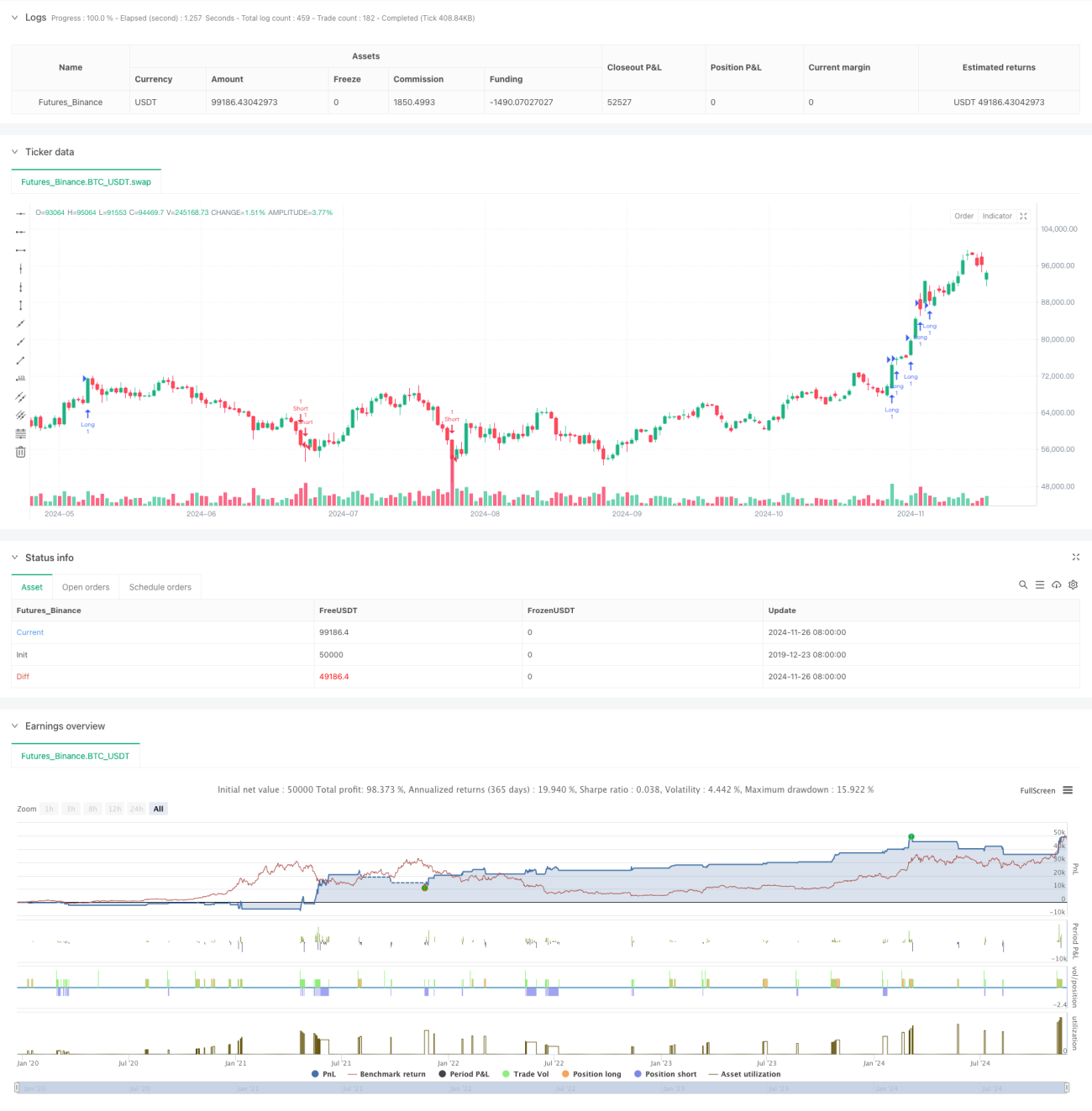
이 전략은 Elder’s strength index (EFI) 를 기반으로 한 정량 거래 시스템으로, 표준 차와 이동 평균을 결합하여 신호 판단을 하고, ATR를 사용하여 동적으로 중지 손실을 조정합니다. 이 전략은 빠른 속도와 느린 EFI 지표를 계산하고, 표준화 된 후 교차 신호 판단을 통해 전체 거래 시스템을 구현합니다. 전략은 동적인 중지 및 추적 중지 장치를 채택하여 위험을 효과적으로 제어하면서 더 큰 수익을 추구합니다.
이 전략은 다음과 같은 핵심 요소들에 기반을 두고 있습니다.
이 전략은 EFI 지표, 표준 차수 및 ATR을 결합하여 완전한 거래 시스템을 구축한다. 이 전략의 장점은 신호 시스템의 신뢰성이 높고, 위험 관리가 합리적이지만, 여전히 다양한 시장 환경에 맞게 최적화해야 한다는 것이다. 시장 환경 판단, 거래량 필터링과 같은 메커니즘을 추가함으로써 전략의 안정성과 수익성을 더욱 향상시킬 수 있다.
/*backtest
start: 2019-12-23 08:00:00
end: 2024-11-27 00:00:00
period: 1d
basePeriod: 1d
exchanges: [{"eid":"Futures_Binance","currency":"BTC_USDT"}]
*/
//@version=5
strategy("Elder's Force Index Strategy with ATR-Based SL and TP", overlay=true)
// Input parameters for fast and long EFI
efi_fast_length = input.int(13, "Fast EFI Length", minval=1)
efi_long_length = input.int(50, "Long EFI Length", minval=1)
stdev_length = input.int(50, "Standard Deviation Length", minval=2, maxval=300)
numdev = input.float(2, "Number of Deviations", minval=1, maxval=20, step=0.1)
atr_length = input.int(14, "ATR Length", minval=1)
atr_multiplier_sl = input.float(1.5, "ATR Multiplier for Stop Loss", step=0.1)
trailing_tp_multiplier = input.float(0.5, "Multiplier for Trailing Take Profit", step=0.1)
// Elder's Force Index Calculation for Fast and Long EFI
efi_fast = ta.ema((close - close[1]) * volume, efi_fast_length)
efi_long = ta.ema((close - close[1]) * volume, efi_long_length)
// Calculate Standard Deviation for Fast EFI
efi_fast_average = ta.sma(efi_fast, stdev_length)
efi_fast_stdev = ta.stdev(efi_fast, stdev_length)
efi_fast_diff = efi_fast - efi_fast_average
efi_fast_result = efi_fast_diff / efi_fast_stdev
// Calculate Standard Deviation for Long EFI
efi_long_average = ta.sma(efi_long, stdev_length)
efi_long_stdev = ta.stdev(efi_long, stdev_length)
efi_long_diff = efi_long - efi_long_average
efi_long_result = efi_long_diff / efi_long_stdev
// Define upper and lower standard deviation levels
upper_sd = numdev
lower_sd = -numdev
// Define entry conditions based on crossing upper and lower standard deviations
long_condition = efi_fast_result > upper_sd and efi_long_result > upper_sd
short_condition = efi_fast_result < lower_sd and efi_long_result < lower_sd
// Check if a position is already open
is_position_open = strategy.position_size != 0
// Calculate ATR for stop loss and take profit
atr = ta.atr(atr_length)
// Initialize stop loss and take profit variables
var float stop_loss = na
var float take_profit = na
// Execute trades based on conditions, ensuring only one trade at a time
if (long_condition and not is_position_open)
strategy.entry("Long", strategy.long)
stop_loss := close - atr * atr_multiplier_sl // Set initial stop loss based on ATR
take_profit := close + atr * trailing_tp_multiplier // Set initial take profit based on ATR
if (short_condition and not is_position_open)
strategy.entry("Short", strategy.short)
stop_loss := close + atr * atr_multiplier_sl // Set initial stop loss based on ATR
take_profit := close - atr * trailing_tp_multiplier // Set initial take profit based on ATR
// Update exit conditions
if (is_position_open)
// Update stop loss for trailing
if (strategy.position_size > 0) // For long positions
stop_loss := math.max(stop_loss, close - atr * atr_multiplier_sl)
// Adjust take profit based on price movement
take_profit := math.max(take_profit, close + atr * trailing_tp_multiplier)
else if (strategy.position_size < 0) // For short positions
stop_loss := math.min(stop_loss, close + atr * atr_multiplier_sl)
// Adjust take profit based on price movement
take_profit := math.min(take_profit, close - atr * trailing_tp_multiplier)
// Set exit conditions
strategy.exit("Long Exit", from_entry="Long", stop=stop_loss, limit=take_profit)
strategy.exit("Short Exit", from_entry="Short", stop=stop_loss, limit=take_profit)