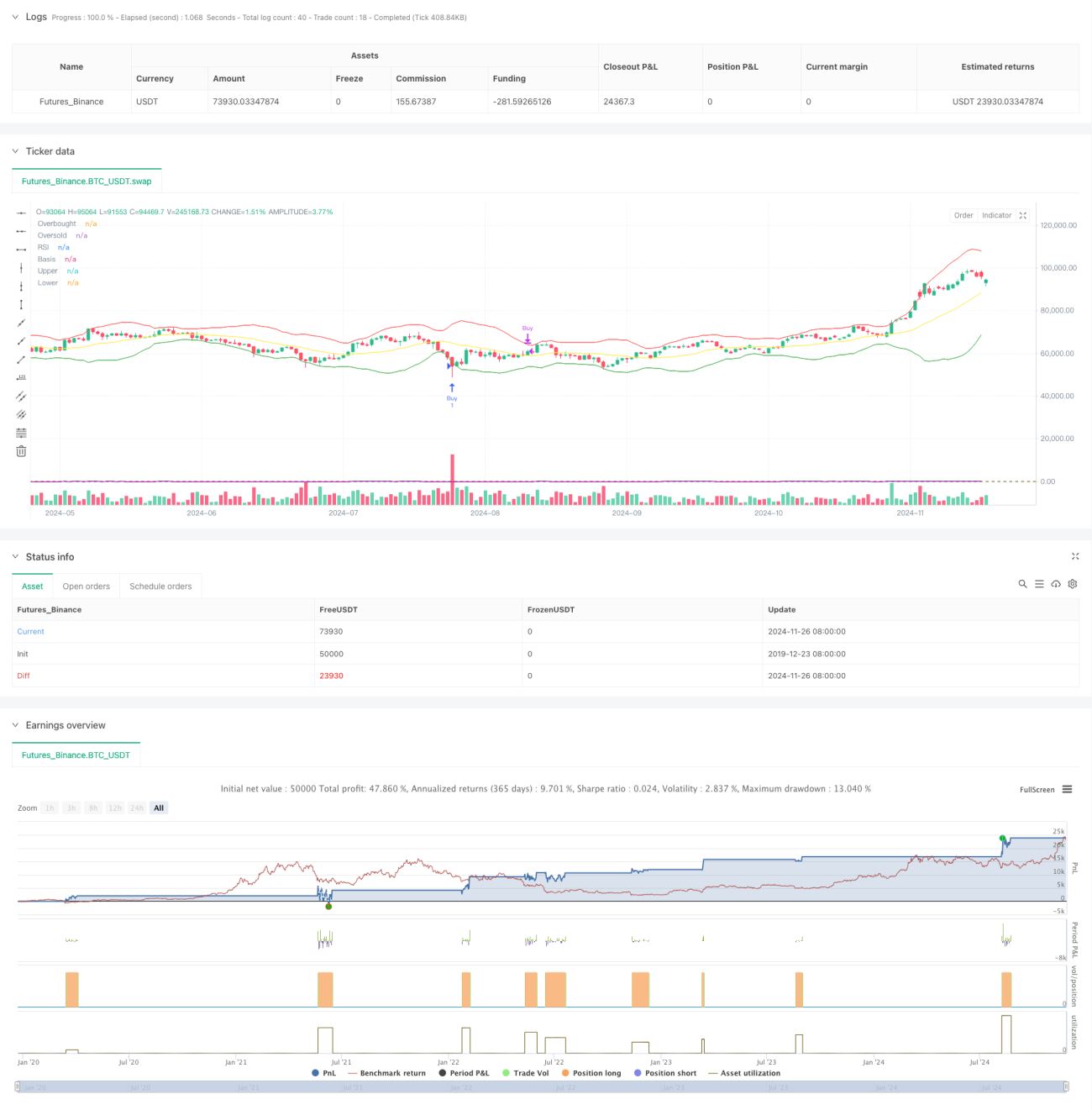
이 전략은 볼링거 밴드 (Bollinger Bands) 와 상대적으로 약한 지표 (RSI) 를 결합하여 두 가지의 고전적인 기술 지표를 결합하여 완전한 거래 시스템을 형성합니다. 전략은 주로 시장의 변동성과 동력의 변화를 포착하여 거래 기회를 찾으며, 특히 일일 거래자의 사용에 적합합니다. 볼링을 통해 시장의 변동성을 측정하면서 RSI 지표와 함께 가격의 과매 과매 상태를 확인하여 더 신뢰할 수있는 거래 신호를 생성합니다.
이 전략의 핵심 논리는 가격 변동성 지표와 동력 지표를 결합하는 것입니다. 폴린 띠는 20 일 간소 이동 평균을 중간 궤도로 삼고, 상하 궤도는 중간 궤도와 2.5 배의 표준 차이를 줄입니다. 가격이 하향 궤도를 건드리고 RSI가 30보다 낮으면 시스템이 여러 신호를 냅니다. 가격이 궤도를 돌파하고 RSI가 70보다 높으면 시스템이 평소 신호를 냅니다.
이 전략은 폴린 밴드와 RSI 지표를巧妙하게 결합하여 논리적으로 엄격하고 동작성이 강한 거래 시스템을 구축한다. 전략의 주요 장점은 신호의 신뢰성이 높고, 위험 통제가 완벽하며, 강한 적응력을 가지고 있다. 특정 시장 환경에서 몇 가지 도전이 있을 수 있지만, 지속적인 최적화 및 개선으로 전략의 전체적인 성능은 여전히 좋은 응용 가치가 있다.
This strategy combines Bollinger Bands and Relative Strength Index (RSI) to form a comprehensive trading system. It primarily seeks trading opportunities by capturing market volatility and momentum changes, particularly suitable for intraday traders. The strategy uses Bollinger Bands to measure market volatility while incorporating RSI to confirm overbought and oversold conditions, generating more reliable trading signals.
The core logic combines volatility and momentum indicators. Bollinger Bands consist of a 20-day simple moving average as the middle band, with upper and lower bands set at 2.5 standard deviations. Buy signals are generated when price touches the lower band and RSI is below 30, while exit signals occur when price breaks above the upper band and RSI exceeds 70. Additionally, the strategy includes an extra exit condition when RSI rises above 50, helping to secure profits. The design thoroughly considers market volatility characteristics and price momentum patterns.
The strategy cleverly combines Bollinger Bands and RSI indicators to build a logically rigorous and highly operable trading system. Its main advantages lie in high signal reliability and comprehensive risk control, while maintaining strong adaptability. Although it may face challenges in certain market environments, the strategy maintains good practical value through continuous optimization and improvement. Traders should pay attention to changing market conditions, flexibly adjust strategy parameters, and always maintain proper risk control in practical applications.
/*backtest
start: 2019-12-23 08:00:00
end: 2024-11-27 00:00:00
period: 1d
basePeriod: 1d
exchanges: [{"eid":"Futures_Binance","currency":"BTC_USDT"}]
*/
//@version=5
strategy("Bollinger Bands + RSI Strategy", shorttitle="BB_RSI", overlay=true)
// Define the Bollinger Bands parameters
length = input(20, title="Length")
mult = input(2.5, title="Multiplier")
basis = ta.sma(close, length)
dev = mult * ta.stdev(close, length)
upper = basis + dev
lower = basis - dev
// Define the RSI parameters
rsiLength = input(14, title="RSI Length")
rsiOverbought = input(70, title="RSI Overbought Level")
rsiOversold = input(30, title="RSI Oversold Level")
rsi = ta.rsi(close, rsiLength)
// Plot the Bollinger Bands and RSI
plot(basis, "Basis", color=color.yellow)
p1 = plot(upper, "Upper", color=color.red)
p2 = plot(lower, "Lower", color=color.green)
fill(p1, p2, color=color.rgb(255, 255, 255, 90))
hline(rsiOverbought, "Overbought", color=color.red)
hline(rsiOversold, "Oversold", color=color.green)
// Generate Buy and Sell signals
buyCondition = close < lower and rsi < rsiOversold
sellCondition = close > upper and rsi > rsiOverbought
if (buyCondition)
strategy.entry("Buy", strategy.long)
if (sellCondition)
strategy.close("Buy")
// Optional: Add exit strategy for buys
exitCondition = rsi > 50
if (exitCondition)
strategy.close("Buy")
// Plot RSI on a separate panel
plot(rsi, "RSI", color=color.purple)