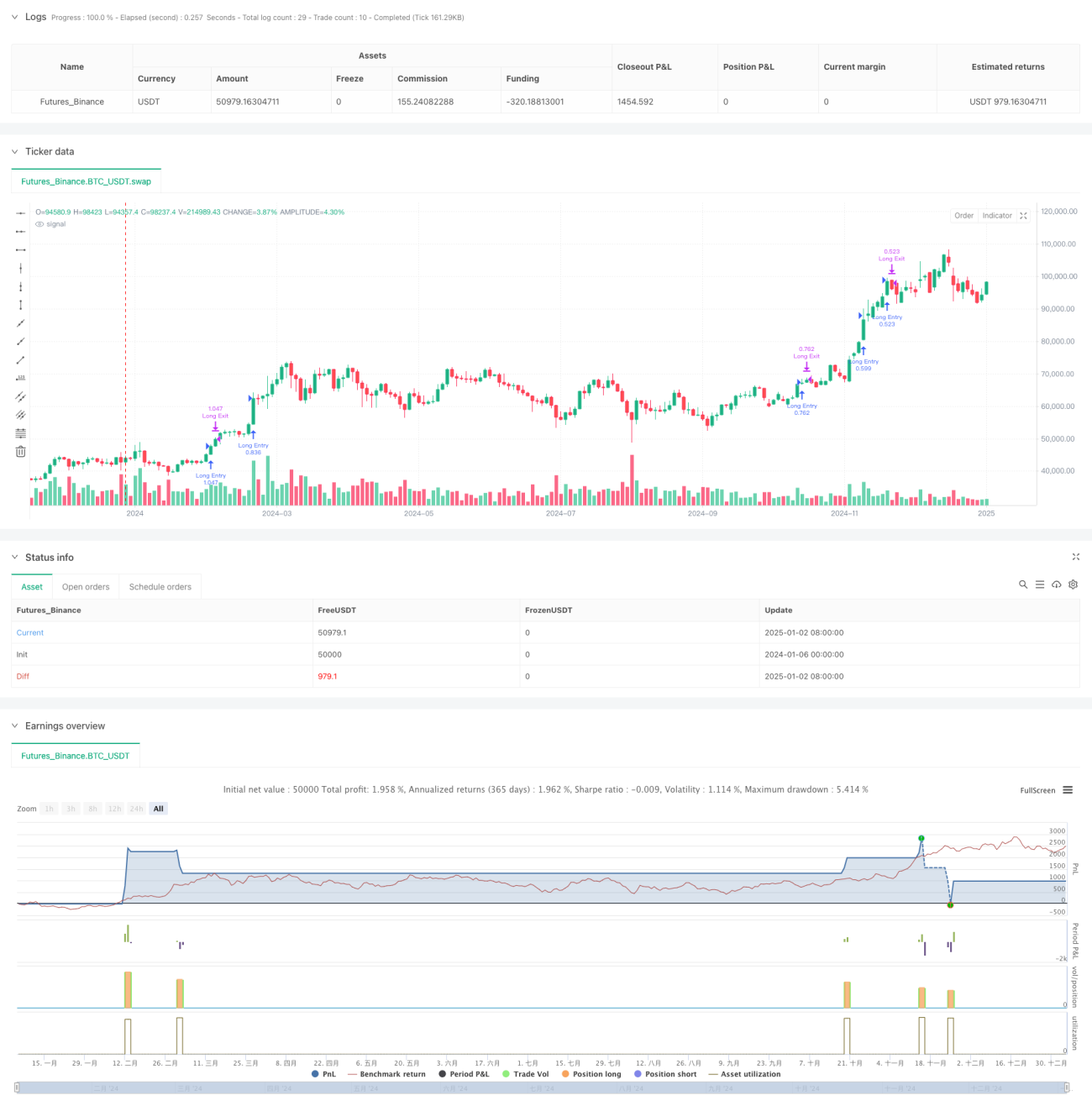
다중 시간대 동적 신호 조합을 기반으로 한 ICT 지능형 구조 혁신 전략

RSI MACD EMA BOS FVG HTF LTF ICT
생성 날짜: 2025-01-06 14:09:05 마지막으로 수정됨: 2025-01-06 14:09:05
복사: 0 클릭수: 456
avatar of ChaoZhang ChaoZhang
1
집중하다
1617
수행원

다중 시간대 동적 신호 조합을 기반으로 한 ICT 지능형 구조 혁신 전략

개요

이 전략은 여러 기술 지표와 ICT(Institutional Trading Concept)를 결합한 포괄적인 거래 시스템입니다. 전통적인 기술 분석 지표(RSI, 확률 지표, MACD, EMA)와 현대 ICT 거래 개념(공정 가치 갭, 구조적 돌파, 높은 기간 편향 분석)을 다양한 기간으로 통합하고 엄격한 거래 기간을 필터링합니다. 정확한 시장 달성 접근 제어.

전략 원칙

이 전략은 핵심 구성 요소 5가지의 조정을 기반으로 운영됩니다.

  1. 높은 기간 편향 분석: 200일 이동 평균을 사용하여 더 높은 기간의 시장 추세 방향을 결정합니다.
  2. 거래 시간 필터: 특정 “킬 존”(07:00-10:00)으로 거래를 제한합니다.
  3. 공정가치 갭(FVG) 식별: 3가지 K-라인 패턴을 통해 시장의 구조적 갭 식별
  4. 구조 돌파(BOS) 결정: 주요 가격 수준을 기반으로 한 돌파는 방향성 변화를 확인합니다.
  5. 저시간대 지표 확인 : RSI, 확률지표, MACD, 200이동평균선을 이용한 다중검증

전략적 이점

  1. 다차원 신호 통합: 여러 독립적인 기술 지표와 ICT 개념을 결합하여 신호 안정성 향상
  2. 시간 주기 조정: 높은 시간 주기와 낮은 시간 주기의 조정은 신호의 안정성을 향상시킵니다.
  3. 구조적 기회 포착: FVG 및 BOS 식별을 통해 높은 확률의 구조적 거래 기회에 집중
  4. 완벽한 위험 관리: 손절매 및 이익 정지 메커니즘, 표준화된 자금 관리 포함
  5. 거래 시간 최적화: 시간 필터링을 통해 비거래 시간 동안 간섭을 줄입니다.

전략적 위험

  1. 신호 지연: 여러 지표의 조합으로 인해 진입 타이밍이 지연될 수 있습니다.
  2. 불안정한 시장 성과: 횡보 시장에서는 빈번한 거짓 신호가 발생할 수 있습니다.
  3. 매개변수 민감도: 다중 지표 매개변수 설정에는 충분한 과거 데이터 검증이 필요합니다.
  4. 실행 위험: 복잡한 조건 조합으로 인해 실제 거래에서 일부 거래 기회를 놓칠 수 있습니다.
  5. 시장 환경 의존성: 다양한 시장 환경에서 전략의 성과는 크게 다를 수 있습니다.

전략 최적화 방향

  1. 동적 매개변수 조정: 시장 변동성에 따라 각 지표의 매개변수를 적응적으로 조정합니다.
  2. 시장 환경 분류: 시장 환경 식별 모듈을 추가하고 다양한 시장 조건에 따라 다양한 매개변수 조합을 사용합니다.
  3. 신호 가중치 최적화: 다양한 지표의 가중치 분포를 최적화하기 위한 머신러닝 방법 도입
  4. 시간 기간 확장: 분석을 위한 시간 기간을 더 추가하고 신호 안정성을 향상시킵니다.
  5. 강화된 위험 관리: 역동적인 손절매 메커니즘 도입 및 펀드 관리 전략 최적화

요약하다

이 전략은 전통적인 기술 분석과 현대 ICT 개념을 통합하여 포괄적인 거래 시스템을 구축합니다. 이 방법은 다차원적 신호 확인과 엄격한 위험 관리가 장점이지만, 매개변수 최적화와 시장 적응력 측면에서도 어려움에 직면합니다. 지속적인 최적화와 개선을 통해 이 전략은 다양한 시장 환경에서도 안정적인 성과를 유지할 것으로 기대됩니다.

전략 소스 코드
/*backtest
start: 2024-01-06 00:00:00
end: 2025-01-04 08:00:00
period: 2d
basePeriod: 2d
exchanges: [{"eid":"Futures_Binance","currency":"BTC_USDT"}]
*/

// -----------------------------------------------------
// Multi-Signal Conservative Strategy (Pine Script v5)
// + More ICT Concepts (HTF Bias, FVG, Killzone, BOS)
// -----------------------------------------------------
//
// Combines:
// - RSI, Stochastic, MACD, 200 EMA (lower TF)
// - Higher Timeframe (HTF) bias check via 200 EMA
// - Kill Zone time filter
// - Fair Value Gap (FVG) detection (simplified 3-candle approach)
// - Break of Structure (BOS) using pivot highs/lows
// - Only trade markers on chart (no extra indicator plots).
//
// Use on lower timeframes: 1m to 15m
// Always backtest thoroughly and manage risk properly.
//
// -----------------------------------------------------
//@version=5
strategy(title="Multi-Signal + ICT Concepts (HTF/FVG/Killzone/BOS)", shorttitle="ICTStrategyExample",overlay=true, pyramiding=0, initial_capital=10000, default_qty_type=strategy.percent_of_equity, default_qty_value=100)

// -----------------------------------------------------
// User Inputs
// -----------------------------------------------------
/////////////// Lower TF Inputs ///////////////
emaLength       = input.int(200,   "LTF EMA Length",           group="Lower TF")
rsiLength       = input.int(14,    "RSI Length",               group="Lower TF")
rsiUpper        = input.int(60,    "RSI Overbought Thresh",    group="Lower TF", minval=50, maxval=80)
rsiLower        = input.int(40,    "RSI Oversold Thresh",      group="Lower TF", minval=20, maxval=50)
stochLengthK    = input.int(14,    "Stoch K Length",           group="Lower TF")
stochLengthD    = input.int(3,     "Stoch D Smoothing",        group="Lower TF")
stochSmooth     = input.int(3,     "Stoch Smoothing",          group="Lower TF")
macdFast        = input.int(12,    "MACD Fast Length",         group="Lower TF")
macdSlow        = input.int(26,    "MACD Slow Length",         group="Lower TF")
macdSignal      = input.int(9,     "MACD Signal Length",       group="Lower TF")

/////////////// ICT Concepts Inputs ///////////////
htfTimeframe    = input.timeframe("60", "HTF for Bias (e.g. 60, 240)", group="ICT Concepts")
htfEmaLen       = input.int(200,  "HTF EMA Length",                   group="ICT Concepts")
sessionInput    = input("0700-1000:1234567", "Kill Zone Window", group="ICT Concepts")
fvgLookbackBars = input.int(2,    "FVG Lookback Bars (3-candle check)",  group="ICT Concepts", minval=1, maxval=10)

/////////////// Risk Management ///////////////
stopLossPerc    = input.float(0.5, "Stop-Loss %",  step=0.1, group="Risk")
takeProfitPerc  = input.float(1.0, "Take-Profit %", step=0.1, group="Risk")

// -----------------------------------------------------
// 1) Higher Timeframe Bias
// -----------------------------------------------------
//
// We'll request the HTF close, then compute the HTF EMA on that data
// to decide if it's bullish or bearish overall.

htfClose       = request.security(syminfo.tickerid, htfTimeframe, close)
htfEma         = request.security(syminfo.tickerid, htfTimeframe, ta.ema(close, htfEmaLen))
isBullHTF      = htfClose > htfEma
isBearHTF      = htfClose < htfEma

// -----------------------------------------------------
// 2) Kill Zone / Session Filter
// -----------------------------------------------------
//
// We'll only consider trades if the current bar is within
// the user-defined session time (e.g., 07:00 to 10:00 local or exchange time).

isInKillZone = time(timeframe.period, sessionInput) != 0

// -----------------------------------------------------
// 3) Fair Value Gap (FVG) Detection (Simplified)
//
// For a "Bullish FVG" among bars [2], [1], [0]:
//     high[2] < low[0] => there's a gap that bar [1] didn't fill
// For a "Bearish FVG":
//     low[2] > high[0] => there's a gap that bar [1] didn't fill
//
// Real ICT usage might check partial fill, candle bodies vs wicks, etc.
// This is just a minimal example for demonstration.

fvgBarsAgo = fvgLookbackBars // default = 2
bullFVG = high[fvgBarsAgo] < low  // e.g. high[2] < low[0]
bearFVG = low[fvgBarsAgo]  > high // e.g. low[2]  > high[0]

// -----------------------------------------------------
// 4) Break of Structure (BOS)
// -----------------------------------------------------
// Using pivot detection from previous example:

swingLen = 2  // pivot detection length (bars on each side)
// Identify a pivot high at bar [1]
swingHigh = high[1] > high[2] and high[1] > high[0]
// Identify a pivot low at bar [1]
swingLow  = low[1]  < low[2]  and low[1]  < low[0]

// Track the most recent pivot high & low
var float lastPivotHigh = na
var float lastPivotLow  = na

if swingHigh
    lastPivotHigh := high[1]

if swingLow
    lastPivotLow := low[1]

bosUp   = not na(lastPivotHigh) and (close > lastPivotHigh)
bosDown = not na(lastPivotLow)  and (close < lastPivotLow)

// -----------------------------------------------------
// 5) Lower TF Indicator Calculations
// -----------------------------------------------------
ema200      = ta.ema(close, emaLength)  // 200 EMA on LTF
rsiValue    = ta.rsi(close, rsiLength)
kValue      = ta.stoch(high, low, close, stochLengthK)
dValue      = ta.sma(kValue, stochLengthD)
stochSignal = ta.sma(dValue, stochSmooth)
[macdLine, signalLine, histLine] = ta.macd(close, macdFast, macdSlow, macdSignal)

// LTF trend filter
isBullTrend = close > ema200
isBearTrend = close < ema200

// -----------------------------------------------------
// Combine All Conditions
// -----------------------------------------------------
//
// We'll require that all filters line up for a long or short:
//  - HTF bias
//  - kill zone
//  - bullish/bearish FVG
//  - BOS up/down
//  - RSI, Stoch, MACD alignment
//  - Price above/below LTF 200 EMA

longCondition = isInKillZone                     // must be in session
 and isBullHTF                                   // HTF bias bullish
 and bullFVG                                     // bullish FVG
 and bosUp                                       // BOS up
 and (rsiValue > rsiUpper)                       // RSI > threshold
 and (kValue > dValue)                           // stoch K above D
 and (macdLine > signalLine)                     // MACD bullish
 and isBullTrend                                 // above LTF 200 EMA

shortCondition = isInKillZone                    // must be in session
 and isBearHTF                                   // HTF bias bearish
 and bearFVG                                     // bearish FVG
 and bosDown                                     // BOS down
 and (rsiValue < rsiLower)                       // RSI < threshold
 and (kValue < dValue)                           // stoch K below D
 and (macdLine < signalLine)                     // MACD bearish
 and isBearTrend                                 // below LTF 200 EMA

// -----------------------------------------------------
// Strategy Entries
// -----------------------------------------------------
if longCondition
    strategy.entry("Long Entry", strategy.long)

if shortCondition
    strategy.entry("Short Entry", strategy.short)

// -----------------------------------------------------
// Risk Management (Stop-Loss & Take-Profit)
// -----------------------------------------------------
if strategy.position_size > 0
    // Long position exit
    strategy.exit("Long Exit", stop  = strategy.position_avg_price * (1.0 - stopLossPerc/100.0), limit = strategy.position_avg_price * (1.0 + takeProfitPerc/100.0))

if strategy.position_size < 0
    // Short position exit
    strategy.exit("Short Exit",  stop  = strategy.position_avg_price * (1.0 + stopLossPerc/100.0), limit = strategy.position_avg_price * (1.0 - takeProfitPerc/100.0))

// -----------------------------------------------------
// Hide All Indicator Plots
// (We only show trade markers for entry & exit)
// -----------------------------------------------------
// Comment out or remove any plot() calls so chart stays clean.
//
// Example (commented out):
// plot(ema200, title="EMA 200", color=color.new(color.yellow, 0), linewidth=2)
// plot(rsiValue, title="RSI", color=color.new(color.blue, 0))
// plot(macdLine, title="MACD", color=color.new(color.teal, 0))
// plot(signalLine, title="Signal", color=color.new(color.purple, 0))