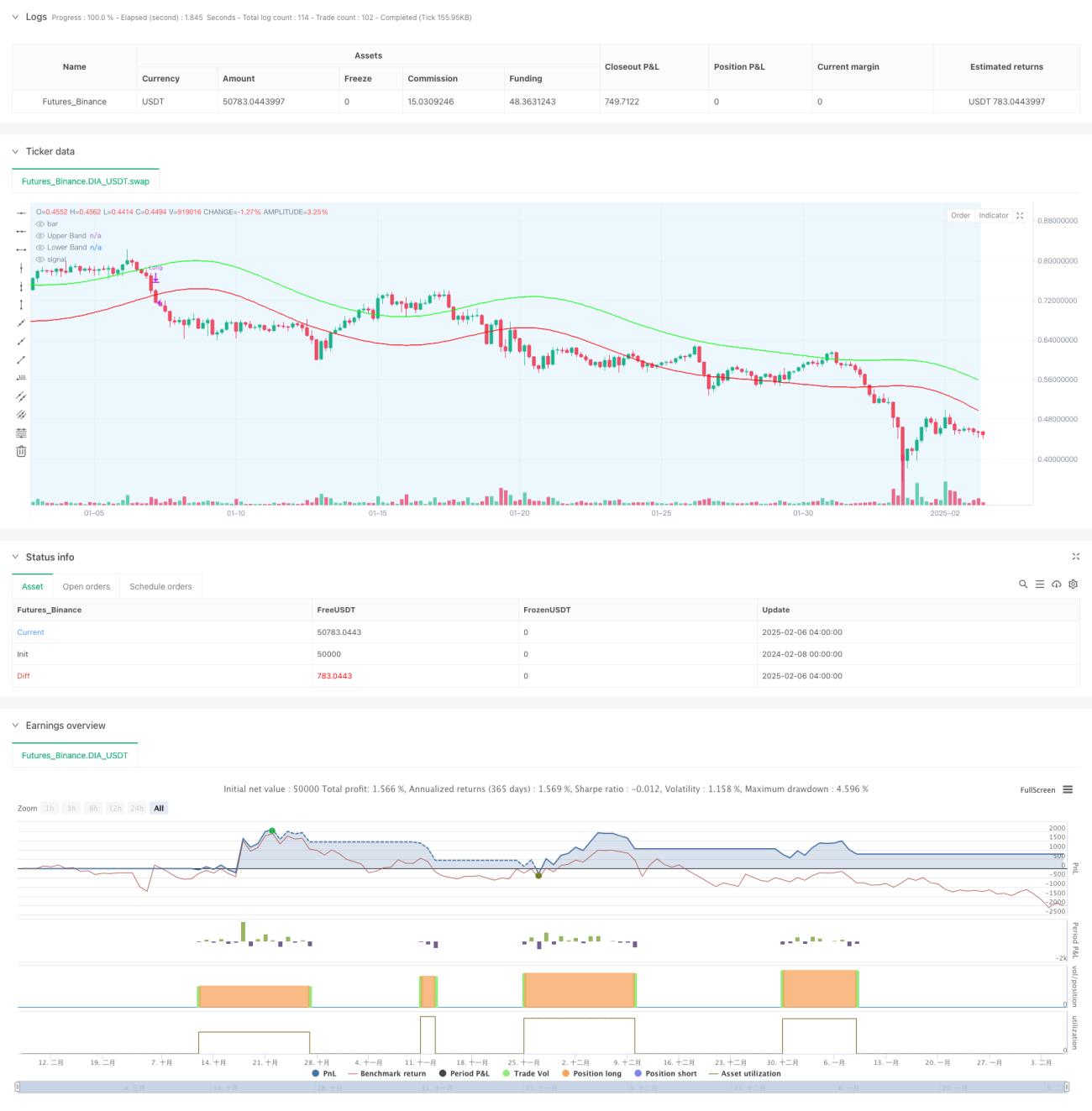
이 전략은 고스 채널과 무작위 RSI 지표를 기반으로 한 동적 거래 시스템으로, 계절적 필터링과 변동률 관리를 결합합니다. 이 전략은 고스 채널에 적응하여 시장 추세를 식별하고, 무작위 RSI를 사용하여 동력을 확인하고, 특정 계절적 창 내에서 거래를 수행합니다. 이 시스템은 또한 ATR 기반의 포지션 관리를 통합하여 각 거래의 리스크 을 제어합니다.
전략의 핵심은 다극점 고스피 필터를 기반으로 만들어진 가격 채널이다. 이 채널은 HLC3 가격의 고스피 파동 값을 계산하고 실제 파동의 폭 ((TR) 의 파동 결과와 결합하여 동적인 상하 궤도를 형성한다. 거래 신호의 생성은 다음과 같은 조건을 충족해야합니다.
평지 신호는 가격 하락으로 촉발된다. 전체 시스템은 다중 필터링 메커니즘을 통해 거래의 안정성을 높인다.
이것은 다층의 필터링과 위험 관리 메커니즘을 통해 거래의 안정성을 향상시키는 완벽한 트렌드 추적 시스템을 구축했습니다. 약간의 최적화 공간이 있지만 전체적인 디자인 아이디어는 현대적인 양적 거래의 요구 사항에 부합합니다. 전략의 성공은 매개 변수의 정밀한 조정과 시장 환경에 대한 적응에 달려 있습니다.
/*backtest
start: 2024-02-08 00:00:00
end: 2025-02-06 08:00:00
period: 4h
basePeriod: 4h
exchanges: [{"eid":"Futures_Binance","currency":"DIA_USDT"}]
*/
//@version=6
strategy("Demo GPT - Gold Gaussian Strategy", overlay=true, commission_type=strategy.commission.percent, commission_value=0.1)
// ====== INPUTS ======
// Gaussian Channel
lengthGC = input.int(144, "Gaussian Period", minval=20)
poles = input.int(4, "Poles", minval=1, maxval=9)
multiplier = input.float(1.414, "Volatility Multiplier", minval=1)
// Stochastic RSI
smoothK = input.int(3, "Stoch K", minval=1)
lengthRSI = input.int(14, "RSI Length", minval=1)
lengthStoch = input.int(14, "Stoch Length", minval=1)
overbought = input.int(80, "Overbought Level", minval=50)
// Seasonal Filter (corrected)
startMonth = input.int(9, "Start Month (1-12)", minval=1, maxval=12)
endMonth = input.int(2, "End Month (1-12)", minval=1, maxval=12)
// Volatility Management
atrLength = input.int(22, "ATR Length", minval=5)
riskPercent = input.float(0.5, "Risk per Trade (%)", minval=0.1, step=0.1)
// ====== GAUSSIAN CHANNEL ======
f_filt9x(alpha, source, iterations) =>
float f = 0.0
float x = 1 - alpha
int m2 = iterations == 9 ? 36 : iterations == 8 ? 28 : iterations == 7 ? 21 :
iterations == 6 ? 15 : iterations == 5 ? 10 : iterations == 4 ? 6 :
iterations == 3 ? 3 : iterations == 2 ? 1 : 0
int m3 = iterations == 9 ? 84 : iterations == 8 ? 56 : iterations == 7 ? 35 :
iterations == 6 ? 20 : iterations == 5 ? 10 : iterations == 4 ? 4 :
iterations == 3 ? 1 : 0
int m4 = iterations == 9 ? 126 : iterations == 8 ? 70 : iterations == 7 ? 35 :
iterations == 6 ? 15 : iterations == 5 ? 5 : iterations == 4 ? 1 : 0
int m5 = iterations == 9 ? 126 : iterations == 8 ? 56 : iterations == 7 ? 21 :
iterations == 6 ? 6 : iterations == 5 ? 1 : 0
int m6 = iterations == 9 ? 84 : iterations == 8 ? 28 : iterations == 7 ? 7 :
iterations == 6 ? 1 : 0
int m7 = iterations == 9 ? 36 : iterations == 8 ? 8 : iterations == 7 ? 1 : 0
int m8 = iterations == 9 ? 9 : iterations == 8 ? 1 : 0
int m9 = iterations == 9 ? 1 : 0
f := math.pow(alpha, iterations) * nz(source) +
iterations * x * nz(f[1]) -
(iterations >= 2 ? m2 * math.pow(x, 2) * nz(f[2]) : 0) +
(iterations >= 3 ? m3 * math.pow(x, 3) * nz(f[3]) : 0) -
(iterations >= 4 ? m4 * math.pow(x, 4) * nz(f[4]) : 0) +
(iterations >= 5 ? m5 * math.pow(x, 5) * nz(f[5]) : 0) -
(iterations >= 6 ? m6 * math.pow(x, 6) * nz(f[6]) : 0) +
(iterations >= 7 ? m7 * math.pow(x, 7) * nz(f[7]) : 0) -
(iterations >= 8 ? m8 * math.pow(x, 8) * nz(f[8]) : 0) +
(iterations == 9 ? m9 * math.pow(x, 9) * nz(f[9]) : 0)
f
f_pole(alpha, source, iterations) =>
float fn = na
float f1 = f_filt9x(alpha, source, 1)
float f2 = iterations >= 2 ? f_filt9x(alpha, source, 2) : na
float f3 = iterations >= 3 ? f_filt9x(alpha, source, 3) : na
float f4 = iterations >= 4 ? f_filt9x(alpha, source, 4) : na
float f5 = iterations >= 5 ? f_filt9x(alpha, source, 5) : na
float f6 = iterations >= 6 ? f_filt9x(alpha, source, 6) : na
float f7 = iterations >= 7 ? f_filt9x(alpha, source, 7) : na
float f8 = iterations >= 8 ? f_filt9x(alpha, source, 8) : na
float f9 = iterations == 9 ? f_filt9x(alpha, source, 9) : na
fn := iterations == 1 ? f1 :
iterations == 2 ? f2 :
iterations == 3 ? f3 :
iterations == 4 ? f4 :
iterations == 5 ? f5 :
iterations == 6 ? f6 :
iterations == 7 ? f7 :
iterations == 8 ? f8 :
iterations == 9 ? f9 : na
[fn, f1]
beta = (1 - math.cos(4 * math.asin(1) / lengthGC)) / (math.pow(1.414, 2 / poles) - 1)
alpha = -beta + math.sqrt(math.pow(beta, 2) + 2 * beta)
lag = int((lengthGC - 1) / (2 * poles))
srcAdjusted = hlc3 + (hlc3 - hlc3[lag])
[mainFilter, filt1] = f_pole(alpha, srcAdjusted, poles)
[trFilter, tr1] = f_pole(alpha, ta.tr(true), poles)
upperBand = mainFilter + trFilter * multiplier
lowerBand = mainFilter - trFilter * multiplier
// ====== STOCHASTIC RSI ======
rsiValue = ta.rsi(close, lengthRSI)
k = ta.sma(ta.stoch(rsiValue, rsiValue, rsiValue, lengthStoch), smoothK)
stochSignal = k >= overbought
// ====== SEASONAL FILTER (FIXED) ======
currentMonth = month(time)
inSeason = (currentMonth >= startMonth and currentMonth <= 12) or
(currentMonth >= 1 and currentMonth <= endMonth)
// ====== VOLATILITY MANAGEMENT ======
atr = ta.atr(atrLength)
positionSize = math.min((strategy.equity * riskPercent/100) / atr, strategy.equity * 0.5 / close)
// ====== TRADING LOGIC ======
trendUp = mainFilter > mainFilter[1]
priceAbove = close > upperBand
longCondition = trendUp and priceAbove and stochSignal and inSeason
exitCondition = ta.crossunder(close, lowerBand)
// ====== EXECUTION ======
if longCondition
strategy.entry("Long", strategy.long, qty=positionSize)
if exitCondition
strategy.close("Long")
// ====== VISUALIZATION ======
plot(upperBand, "Upper Band", color=color.new(#00FF00, 0))
plot(lowerBand, "Lower Band", color=color.new(#FF0000, 0))
bgcolor(inSeason ? color.new(color.blue, 90) : na, title="Season Filter")