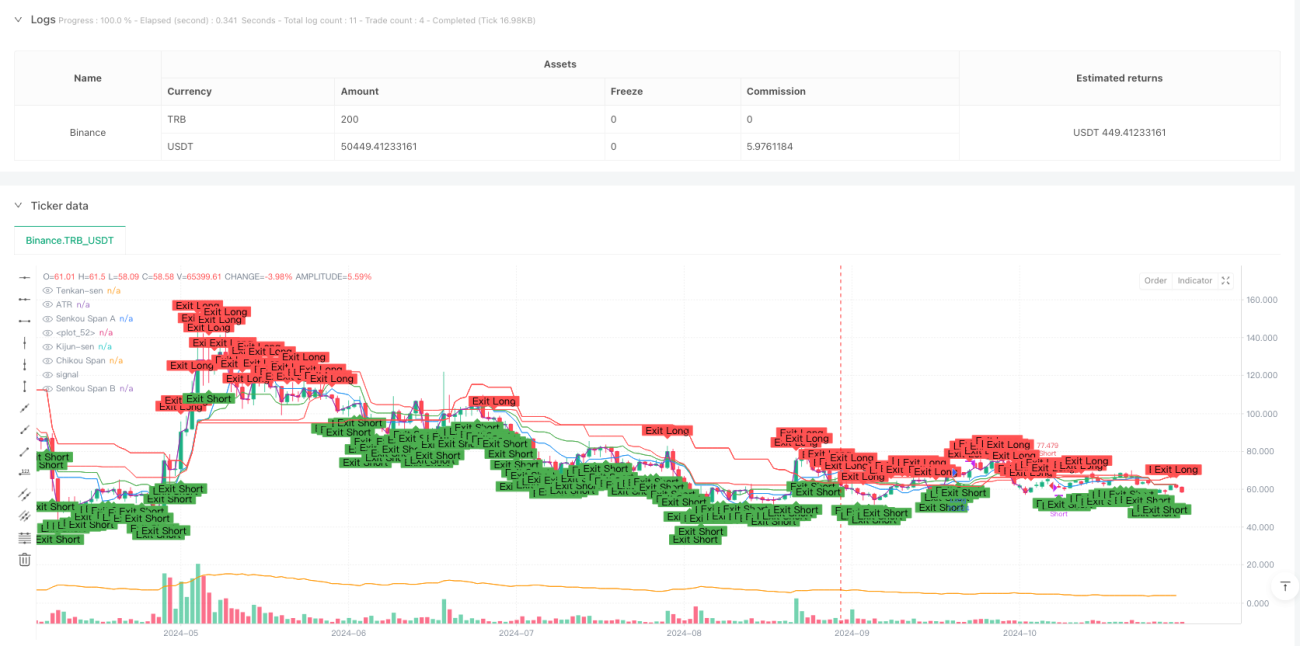
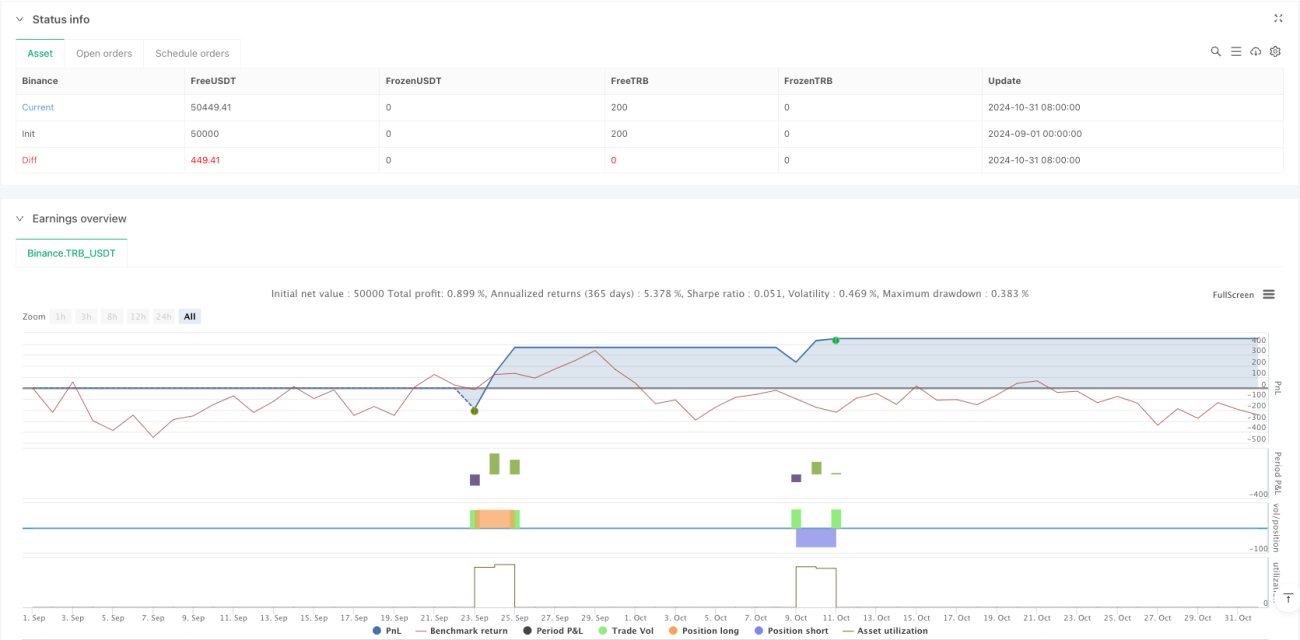
이 전략은 일회성 그래프 ((Ichimoku Cloud) 와 실제 변동의 평균값 ((ATR) 을 결합한 완전한 거래 시스템이다. 그것은 클라우드 그래프 구성 요소를 통해 시장의 추세를 식별하고, 동시에 ATR을 사용하여 동적으로 중지 위치를 조정하며, 트렌드 추적과 위험 관리를 유기적으로 결합한다. 전략은 동력과 변동률의 두 차원의 시장 정보를 통합하여 거래 결정을위한 전체적인 분석 프레임 워크를 제공합니다.
전략의 핵심 논리는 초점 평형 도표의 다섯 줄과 ATR 지표 위에 있다. 시스템은 전환선 ((Tenkan-Sen) 과 기준선 ((Kijun-Sen) 의 교차로 거래 신호를 유발하며, 동시에 가격이 구름 (Senkou Span A 및 B) 의 올바른 쪽에 위치하도록 요구하며, 지연선 (Chikou Span) 의 확인을 받는다. 구체적으로:
동적 파동 클라우드 트렌드 ATR 중지 전략은 고전적인 기술 분석 도구를 통합 한 완전한 거래 시스템입니다. 그것은 일목요연한 균형 도표의 여러 확인 메커니즘을 통해 트렌드를 식별하고 ATR을 사용하여 동적 위험을 제어하여 거래자에게 체계화된 의사 결정 프레임 워크를 제공합니다. 전략에는 약간의 지연성과 변수 민감성 문제가 있지만, 합리적인 최적화 및 위험 관리를 통해 트렌드 시장에서 안정적인 성능을 얻을 수 있습니다. 전략의 시각적 특성과 명확한 규칙은 체계화된 거래를 수행하려는 투자자에게 특히 적합합니다.
/*backtest
start: 2024-09-01 00:00:00
end: 2025-02-18 00:00:00
period: 1h
basePeriod: 1h
exchanges: [{"eid":"Binance","currency":"TRB_USDT"}]
*/
//@version=5
strategy("Ichimoku Cloud + ATR Strategy", overlay=true, default_qty_type=strategy.percent_of_equity, default_qty_value=10)
// === Inputs ===
conversionPeriods = input.int(9, title="Tenkan-sen Period", minval=1)
basePeriods = input.int(26, title="Kijun-sen Period", minval=1)
laggingSpan2Periods = input.int(52, title="Senkou Span B Period", minval=1)
displacement = input.int(26, title="Displacement", minval=1)
atrLength = input.int(14, title="ATR Period", minval=1)
atrMultiplier = input.float(1.5, title="ATR Multiplier for Stop-Loss", minval=0.1, step=0.1)
// === Indicator Calculations ===
// Ichimoku Cloud
tenkan = (ta.highest(high, conversionPeriods) + ta.lowest(low, conversionPeriods)) / 2
kijun = (ta.highest(high, basePeriods) + ta.lowest(low, basePeriods)) / 2
senkouSpanA = ta.sma((tenkan + kijun) / 2, 1)
senkouSpanB = (ta.highest(high, laggingSpan2Periods) + ta.lowest(low, laggingSpan2Periods)) / 2
chikouSpan = close[displacement]
// ATR
atr = ta.atr(atrLength)
// === Entry Conditions ===
longCondition = ta.crossover(tenkan, kijun) and close > senkouSpanA and close > senkouSpanB and chikouSpan > close
shortCondition = ta.crossunder(tenkan, kijun) and close < senkouSpanA and close < senkouSpanB and chikouSpan < close
// === Entry Signals with Stop-Loss ===
if (longCondition)
longStop = close - (atrMultiplier * atr)
strategy.entry("Long", strategy.long)
strategy.exit("Long Exit", from_entry="Long", stop=longStop)
if (shortCondition)
shortStop = close + (atrMultiplier * atr)
strategy.entry("Short", strategy.short)
strategy.exit("Short Exit", from_entry="Short", stop=shortStop)
// === Exit Conditions ===
exitLongCondition = ta.crossunder(tenkan, kijun) or chikouSpan < close
exitShortCondition = ta.crossover(tenkan, kijun) or chikouSpan > close
if (exitLongCondition)
strategy.close("Long")
if (exitShortCondition)
strategy.close("Short")
// === Plotting Indicators on the Chart ===
// Ichimoku Cloud
plot(senkouSpanA, color=color.green, title="Senkou Span A")
plot(senkouSpanB, color=color.red, title="Senkou Span B")
fill(plot(senkouSpanA, color=color.green), plot(senkouSpanB, color=color.red), color=close > senkouSpanA ? color.new(color.green, 90) : color.new(color.red, 90), title="Ichimoku Cloud")
// Tenkan-sen and Kijun-sen
plot(tenkan, color=color.blue, title="Tenkan-sen")
plot(kijun, color=color.red, title="Kijun-sen")
// Chikou Span
plot(chikouSpan, color=color.purple, title="Chikou Span", offset=-displacement)
// ATR (hidden)
plot(atr, color=color.orange, title="ATR", linewidth=1, display=display.none)
// === Signal Visualization ===
// Markers for Long and Short entries
plotshape(series=longCondition, title="Long Entry", location=location.belowbar, color=color.green, style=shape.labelup, text="Long")
plotshape(series=shortCondition, title="Short Entry", location=location.abovebar, color=color.red, style=shape.labeldown, text="Short")
// Markers for Long and Short exits
plotshape(series=exitLongCondition, title="Long Exit", location=location.abovebar, color=color.red, style=shape.labeldown, text="Exit Long")
plotshape(series=exitShortCondition, title="Short Exit", location=location.belowbar, color=color.green, style=shape.labelup, text="Exit Short")