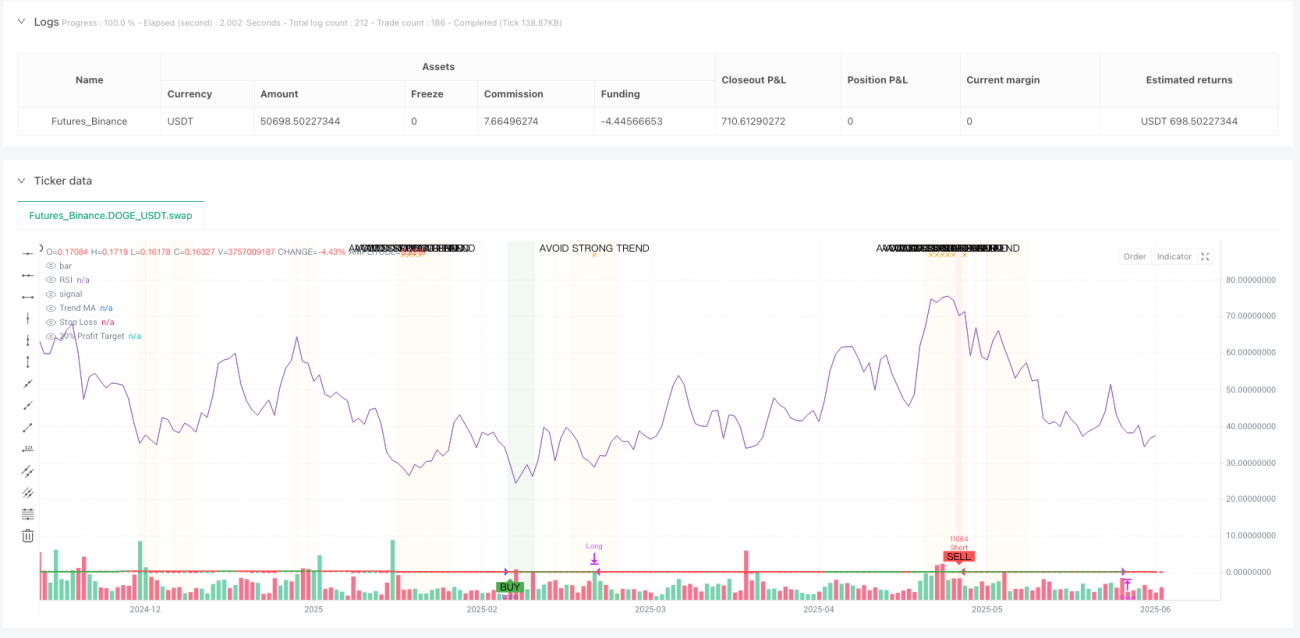
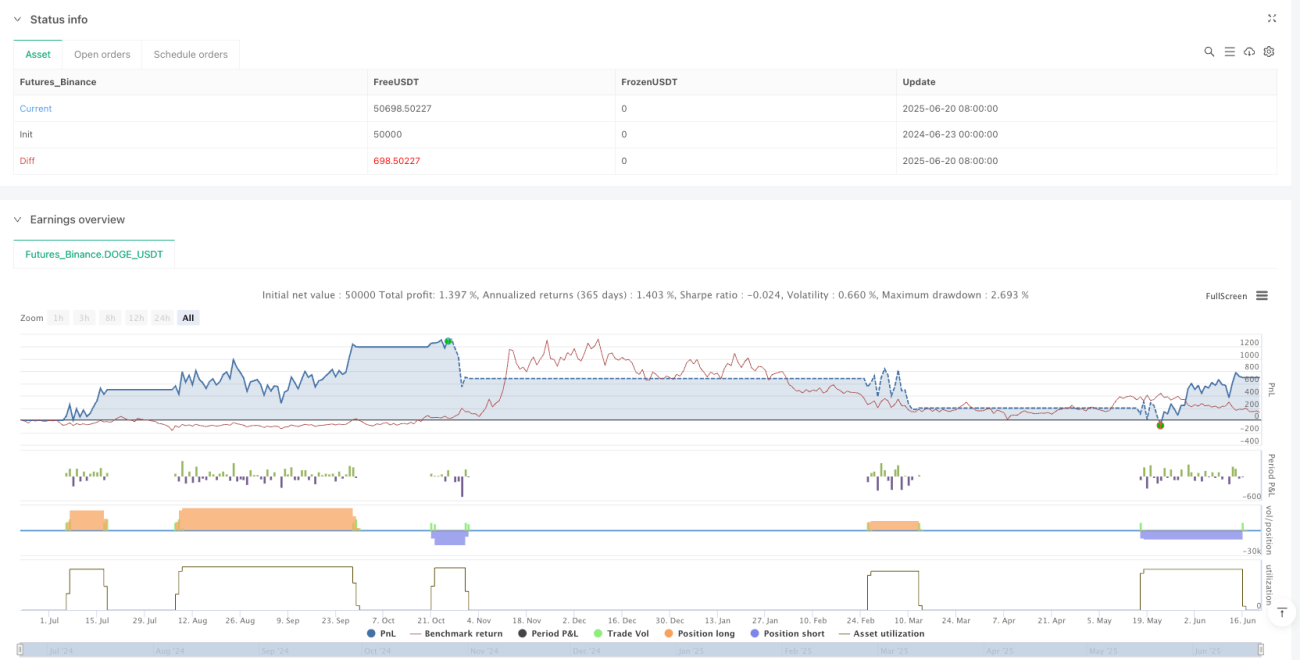
변동성 최적화 RSI 평균 회귀 거래 전략은 RSI (대비적으로 강한 지표) 평균 회귀 신호, 지능형 시장 필터링, 그리고 변동성이 위험 관리에 적응하는 양적 거래 전략입니다. 이 전략은 RSI가 극한 수준에 도달했을 때 높은 확률의 역전 기회를 주로 식별합니다. (RSI≤30은 과매, RSI≥70은 과매), 그러나 시장 조건이 평균 회귀 전략에 유리한 경우에만 거래합니다. 코드를 깊이 분석하면 전략의 핵심은 기술 지표와 시장 상태 분석을 결합하여 거래 결정을 최적화하고 다양한 시장 조건에서의 성능을 극대화하는 것으로 볼 수 있습니다.
변동률을 최적화한 RSI 평균 회귀 거래 전략의 원리는 다음과 같은 몇 가지 핵심 구성 요소에 기반합니다.
RSI 신호 시스템14주기 RSI 지표를 사용하여 시장의 과매매 상태를 식별한다. RSI가 30보다 낮으면 시장은 과매매 상태로 간주되어 구매 신호를 발생시킨다. RSI가 70보다 높으면 시장은 과매매 상태로 간주되어 판매 신호를 발생시킨다.
트렌드 분석이 전략은 50주기 간단한 이동 평균 (SMA) 을 사용하여 시장 방향을 결정한다. 이동 평균보다 높은 가격은 상승 추세를 나타내고, 이동 평균보다 낮은 가격은 하향 추세를 나타낸다. 더욱 중요한 것은 전략이 트렌드 강도를 계산하고, 강한 트렌드 시장에서 트렌드 강도가 >25%인 경우 거래하는 것을 피하는 것입니다. 평균 회귀 전략은 이러한 조건에서 일반적으로 좋지 않습니다.
시장 적응성 분석코드는 근래의 변동률을 계산하여 시장의 변동이 충분히 크다는 것을 확인합니다. (일당 변동률> 1%) 평균 회귀 전략을 지원하기 위해. 전략은 또한 트렌드 강도가 허용 가능한 범위 (≤ 25%) 에 있는지 확인합니다. 시장 조건이 이러한 기준을 충족하면 전략은 입시를 고려합니다.
위험 관리전략: 20%의 스톱로드를 실행하여 변동성 자산의 가격 변동에 충분한 공간을 제공하면서 20%의 수익 목표를 설정하여 1:1의 위험 / 수익 비율을 보장합니다. 거래당 5%의 자금을 사용하며 최대 두 개의 포지션의 피라미드 가공을 허용하여 강도 설정에서 포지션을 확장합니다.
신호 확인 및 종료: 진입 신호는 RSI가 극한에 도달하고 시장 조건이 적합하도록 요구한다. 탈퇴 조건은 RSI 반전 ((반대의 극한에 도달하는 것), 손실 트리거 또는 수익 목표에 도달하는 것을 포함한다.
코드에 대한 심층적인 분석을 통해, 이 전략은 다음과 같은 중요한 장점을 보여준다:
시장 환경에 대한 적응력기본 RSI 전략과는 달리, 이 전략은 시장 상태를 분석하여 거래 신호를 필터링하여 평균 회귀 전략에 적합하지 않은 시장 환경에서 거래하는 것을 피하여 신호 품질을 크게 향상시킵니다.
변동률은 위험 관리에 적응합니다.20%의 스톱 레벨을 설정하여, 변동성 자산에 대한 설계로, 정상적인 시장 변동으로 인한 조기 퇴출을 방지하고, 충분한 보호 조치를 제공합니다.
정확한 입학 조건RSI 극한, 트렌드 분석 및 변동성 검사를 결합하여 높은 확률 설정에서만 입장을 보장하고 거짓 신호를 줄입니다.
시각화된 의사결정 지원전략은 배경색의 변화를 제공합니다. 녹색 배경은 구매 영역에 적합하며 빨간 배경은 판매 영역에 적합합니다. 경고 표시는 강한 추세가 감지되어 거래가 피되어야한다는 것을 의미합니다. 거래 의사 결정의 직관성을 강화합니다.
자동화 우호: 내부에 완전한 경보 조건 시스템, 자동 거래 실행을 지원하고, 수동으로 시장을 감시할 필요가 없습니다.
동적 정보 표: 시장 상태와 거래 상태를 실시간으로 표시합니다. 현재 RSI 값, 트렌드 강도, 변동성 및 시장 적응성 평가를 포함하여 거래자에게 전체 시장 관점을 제공합니다.
이 전략은 합리적으로 설계되었지만, 몇 가지 잠재적인 위험이 있습니다.
매개변수 민감도전략의 성능은 RSI 길이, 과매매 수준, 최대 트렌드 강도 및 변동률 경량과 같은 입력 매개 변수에 크게 의존합니다. 다른 시장 환경에는 다른 매개 변수의 최적화가 필요할 수 있으며 잘못된 매개 변수는 전략의 부실 성능을 초래할 수 있습니다.
극단적인 시장 조건시장 붕괴 또는 극심한 변동의 기간 동안, 20%의 스톱을 설정하더라도 전략은 슬라이드 포인트 위험에 직면할 수 있으며, 이는 실제 손실이 예상보다 높을 수 있습니다.
재원 분배 위험기본은 거래당 5%의 자금을 사용하며 최대 두 개의 포지션을 허용합니다. (총 10%) 이는 일부 거래자에게는 너무 급진적일 수 있습니다. 특히 시장의 변동이 큰 경우입니다.
트렌드 판단의 시간적 지연성: 50주기 이동 평균을 사용하여 추세를 판단하는 것은 지연성을 도입할 수 있으며, 추세가 막 바뀌었을 때 잘못된 판단을 초래할 수 있다.
과도한 과열의 위험엄격한 시장 적응성 검사 (약한 추세 + 충분한 변동성) 는 거래 기회를 지나치게 필터링하여 특정 시장 환경에서 거래 빈도가 너무 낮아질 수 있습니다.
해결 방법은 다음과 같습니다: 다른 시장과 시간 프레임에 대한 파라미터 최적화; 극한 시장 조건에서 자동 거래를 중지; 개인 위험 용도에 따라 재원 분배 비율을 조정; 추세 판단의 지연성을 줄이기 위해 더 짧은 주기의 이동 평균을 사용하는 것을 고려; 거래 빈도를 높이기 위해 적절한 시장 적응성 기준을 완화하십시오.
코드 분석을 바탕으로, 이 전략은 다음과 같은 방향으로 최적화될 수 있습니다:
동적 변수 조정: RSI의 오버 바이 오버 시드 을 동적인 변수로 설계하여 역사적인 변동에 따라 자동으로 조정한다. 낮은 변동률 환경에서 좁은 범위 (예: 35⁄65), 높은 변동률 환경에서 넓은 범위 (예: 25⁄75) 를 사용한다. 이것은 전략이 다른 시장 상태에 더 잘 적응할 수 있도록 할 것이다.
다중 시간 프레임 분석: 더 많은 시간 프레임 확인 메커니즘을 추가, 예를 들어, 더 긴 시간 프레임에 시장 상태를 확인, 더 짧은 시간 프레임에 진입 신호를 찾습니다. 이 방법은 신호 품질을 향상시키고 가짜 돌파구를 줄일 수 있습니다.
역동적 상쇄 전략ATR (평균 실제 범위) 를 기반으로 손실 수준을 설정합니다. 고정된 비율이 아닙니다. 이것은 스톱 포인트를 현재 시장의 변동 상태에 더 잘 적응시켜 높은 변동의 시간에 너무 가까이 중지하거나 낮은 변동의 시간에 너무 멀리 중지하는 것을 피합니다.
일부 수익 메커니즘: 20%의 수익 목표에 모든 포지션이 퇴출되는 대신 단계적으로 수익을 창출하는 전략을 시행하십시오. 예를 들어, 10%의 수익에 50%의 포지션을 퇴출하고 20%의 수익에 나머지 포지션을 퇴출하십시오. 이것은 수익의 일부를 잠금 할 수 있지만 나머지 포지션이 더 큰 수익을 얻을 수 있습니다.
계절성 및 시장 주기 분석: 시장의 계절성 및 주기적 분석을 통합하여, 역사적으로 평균값 회귀 전략이 더 잘 작동하는 시기에 거래 주파수를 높이고, 트렌딩이 더 강한 시기에 거래 주파수를 줄이거나 파라미터를 조정한다.
기계 학습 최적화: 기계 학습 기술을 사용하여 현재 시장 환경에서 평균 회귀 전략의 성공 가능성을 동적으로 예측하고 그에 따라 입시 기준과 포지션 크기를 조정합니다. 이것은 전략이 시장 변화에 더 현명하게 적응 할 수있게합니다.
변동성 최적화 RSI 평균 회귀 거래 전략은 기본 RSI 전략의 주요 결점을 해결하는 포괄적이고 지능적인 거래 시스템이며, 시장의 맥락 분석과 변동성 적응성 위험 관리를 추가하여 전략의 성능을 크게 향상시킵니다. 이 전략은 특히 1% 이상의 일일 변동성을 가진 자산에 적합합니다.
이 전략의 핵심 장점은 시장 조건이 평균 회귀 거래에 적합할 때만 신호를 생성하는 지능형 시장 필터링 메커니즘과 적절한 위험 관리 조치로 자금을 보호하는 데 있습니다. 동시에, 전체 시각화 시스템과 정보 표는 시장 상태의 명확한 개요를 제공하며, 보다 현명한 거래 결정을 지원합니다.
약간의 위험과 최적화 공간이 있음에도 불구하고, 이 전략의 기본 설계는 튼튼하며, 제안된 최적화 방향을 통해 다양한 시장 환경에서의 적응력과 성능을 더욱 향상시킬 수 있다. 변동성있는 시장에서 평균 반환 기회를 포착하려는 거래자에게는 가치있는 전략 프레임워크이다.
/*backtest
start: 2024-06-23 00:00:00
end: 2025-06-21 08:00:00
period: 1d
basePeriod: 1d
exchanges: [{"eid":"Futures_Binance","currency":"DOGE_USDT"}]
*/
// This Pine Script™ code is subject to the terms of the Mozilla Public License 2.0 at https://mozilla.org/MPL/2.0/
// © cindycrijns
//@version=6
strategy("RSI Mean Reversion", shorttitle="RSI_MR2", overlay=true, initial_capital=10000, default_qty_type=strategy.percent_of_equity, default_qty_value=5, pyramiding=2)
// Input parameters
rsiLength = input.int(14, "RSI Length")
rsiOversold = input.int(30, "RSI Oversold Level")
rsiOverbought = input.int(70, "RSI Overbought Level")
riskPercent = input.float(20.0, "Max Loss Per Trade (%)", minval=1.0, maxval=50.0)
profitTarget = input.float(20.0, "Profit Target (%)", minval=5.0, maxval=100.0)
// Trend analysis parameters
maLength = input.int(50, "Moving Average Length")
trendStrengthPeriod = input.int(20, "Trend Strength Period")
maxTrendStrength = input.float(25.0, "Max Trend Strength % (avoid above this)", minval=5.0, maxval=50.0)
// Calculate indicators
rsi = ta.rsi(close, rsiLength)
ma = ta.sma(close, maLength)
// Trend analysis
trendStrength = math.abs(close - close[trendStrengthPeriod]) / close[trendStrengthPeriod] * 100
isStrongTrend = trendStrength > maxTrendStrength
isUptrend = close > ma
isDowntrend = close < ma
isWeakTrend = trendStrength <= maxTrendStrength
// Market suitability check
priceAboveMA = close > ma
priceBelowMA = close < ma
recentVolatility = ta.stdev(ta.change(close), 20) / close * 100
isVolatileEnough = recentVolatility > 1.0 // At least 1% daily volatility
// Suitability for mean reversion strategy
isSuitableForStrategy = isWeakTrend and isVolatileEnough
// Enhanced RSI signals with trend filtering
longCondition = rsi <= rsiOversold and (isUptrend or isWeakTrend) and isSuitableForStrategy
shortCondition = rsi >= rsiOverbought and (isDowntrend or isWeakTrend) and isSuitableForStrategy
// Exit conditions
longExitCondition = rsi >= rsiOverbought
shortExitCondition = rsi <= rsiOversold
// Prevent overlapping trades
validLong = longCondition and strategy.position_size == 0
validShort = shortCondition and strategy.position_size == 0
// Strategy entries
if validLong
strategy.entry("Long", strategy.long, comment="RSI Oversold Buy")
if validShort
strategy.entry("Short", strategy.short, comment="RSI Overbought Sell")
// Risk management variables
var float entryPrice = na
var float stopLossPrice = na
var float profitTargetPrice = na
// Set levels when entering a trade
if strategy.position_size != 0 and na(entryPrice)
entryPrice := strategy.position_avg_price
stopLossPrice := strategy.position_size > 0 ? entryPrice * (1 - riskPercent/100) : entryPrice * (1 + riskPercent/100)
profitTargetPrice := strategy.position_size > 0 ? entryPrice * (1 + profitTarget/100) : entryPrice * (1 - profitTarget/100)
// Stop Loss
if strategy.position_size > 0 and close <= stopLossPrice
strategy.close("Long", comment="Stop Loss")
entryPrice := na
if strategy.position_size < 0 and close >= stopLossPrice
strategy.close("Short", comment="Stop Loss")
entryPrice := na
// Profit Target - Close 100% at 20% profit
if strategy.position_size > 0 and close >= profitTargetPrice
strategy.close("Long", comment="20% Profit Target")
entryPrice := na
if strategy.position_size < 0 and close <= profitTargetPrice
strategy.close("Short", comment="20% Profit Target")
entryPrice := na
// Signal-based exits (RSI reversal)
if longExitCondition and strategy.position_size > 0
strategy.close("Long", comment="RSI Exit")
entryPrice := na
if shortExitCondition and strategy.position_size < 0
strategy.close("Short", comment="RSI Exit")
entryPrice := na
// Reset variables when position is closed
if strategy.position_size == 0
entryPrice := na
stopLossPrice := na
profitTargetPrice := na
// Plot moving average and trend analysis
plot(ma, color=isUptrend ? color.green : color.red, linewidth=2, title="Trend MA")
plot(rsi, title="RSI", display=display.none) // Hidden plot for alerts
// Plot signals
plotshape(validLong, style=shape.labelup, location=location.belowbar, color=color.green, text="BUY", title="Long Signal")
plotshape(validShort, style=shape.labeldown, location=location.abovebar, color=color.red, text="SELL", title="Short Signal")
// Plot risk management levels
plot(strategy.position_size != 0 ? stopLossPrice : na, color=color.red, linewidth=1, title="Stop Loss", style=plot.style_linebr)
plot(strategy.position_size != 0 ? profitTargetPrice : na, color=color.green, linewidth=1, title="20% Profit Target", style=plot.style_linebr)
// Background colors for market conditions
bgcolor(rsi <= rsiOversold and isSuitableForStrategy ? color.new(color.green, 90) : na, title="Good Buy Zone")
bgcolor(rsi >= rsiOverbought and isSuitableForStrategy ? color.new(color.red, 90) : na, title="Good Sell Zone")
bgcolor(isStrongTrend ? color.new(color.orange, 95) : na, title="Strong Trend - Avoid Trading")
// Warning labels for unsuitable conditions
plotshape(isStrongTrend and (rsi <= rsiOversold or rsi >= rsiOverbought),
style=shape.xcross, location=location.top, color=color.orange,
text="AVOID\nSTRONG TREND", title="Avoid Strong Trend Warning", size=size.small)
plotshape(not isVolatileEnough and (rsi <= rsiOversold or rsi >= rsiOverbought),
style=shape.diamond, location=location.top, color=color.gray,
text="LOW VOL", title="Low Volatility Warning", size=size.tiny)
// Enhanced info table with market analysis
if strategy.position_size != 0 or not isSuitableForStrategy
var table infoTable = table.new(position.top_right, 2, 7, bgcolor=color.white, border_width=1)
table.cell(infoTable, 0, 0, "Position", text_color=color.black, bgcolor=color.gray)
table.cell(infoTable, 1, 0, strategy.position_size > 0 ? "LONG" : strategy.position_size < 0 ? "SHORT" : "NONE", text_color=color.black)
table.cell(infoTable, 0, 1, "RSI", text_color=color.black, bgcolor=color.gray)
table.cell(infoTable, 1, 1, str.tostring(rsi, "#.##"), text_color=color.black)
table.cell(infoTable, 0, 2, "Trend Strength", text_color=color.black, bgcolor=color.gray)
table.cell(infoTable, 1, 2, str.tostring(trendStrength, "#.##") + "%",
text_color=isStrongTrend ? color.red : color.green)
table.cell(infoTable, 0, 3, "Volatility", text_color=color.black, bgcolor=color.gray)
table.cell(infoTable, 1, 3, str.tostring(recentVolatility, "#.##") + "%",
text_color=isVolatileEnough ? color.green : color.red)
table.cell(infoTable, 0, 4, "Market Status", text_color=color.black, bgcolor=color.gray)
table.cell(infoTable, 1, 4, isSuitableForStrategy ? "GOOD FOR MR" : "AVOID TRADING",
text_color=isSuitableForStrategy ? color.green : color.red)
table.cell(infoTable, 0, 5, "Target", text_color=color.black, bgcolor=color.gray)
table.cell(infoTable, 1, 5, strategy.position_size != 0 ? str.tostring(profitTargetPrice, "#.###") : "N/A", text_color=color.green)
table.cell(infoTable, 0, 6, "P&L", text_color=color.black, bgcolor=color.gray)
table.cell(infoTable, 1, 6, strategy.position_size != 0 ? str.tostring(strategy.openprofit, "#.##") : "N/A",
text_color=strategy.openprofit >= 0 ? color.green : color.red)
// Alert conditions for automated trading
alertcondition(validLong, title="RSI Buy Signal",
message='BUY {{ticker}} at {{close}} - RSI: {{plot_0}} - Strategy: RSI_MR')
alertcondition(validShort, title="RSI Sell Signal",
message='SELL {{ticker}} at {{close}} - RSI: {{plot_0}} - Strategy: RSI_MR')
alertcondition(strategy.position_size > 0 and close >= profitTargetPrice, title="Long Profit Target",
message='CLOSE LONG {{ticker}} at {{close}} - Profit Target Hit')
alertcondition(strategy.position_size < 0 and close <= profitTargetPrice, title="Short Profit Target",
message='CLOSE SHORT {{ticker}} at {{close}} - Profit Target Hit')
alertcondition(strategy.position_size > 0 and close <= stopLossPrice, title="Long Stop Loss",
message='CLOSE LONG {{ticker}} at {{close}} - Stop Loss Hit')
alertcondition(strategy.position_size < 0 and close >= stopLossPrice, title="Short Stop Loss",
message='CLOSE SHORT {{ticker}} at {{close}} - Stop Loss Hit')