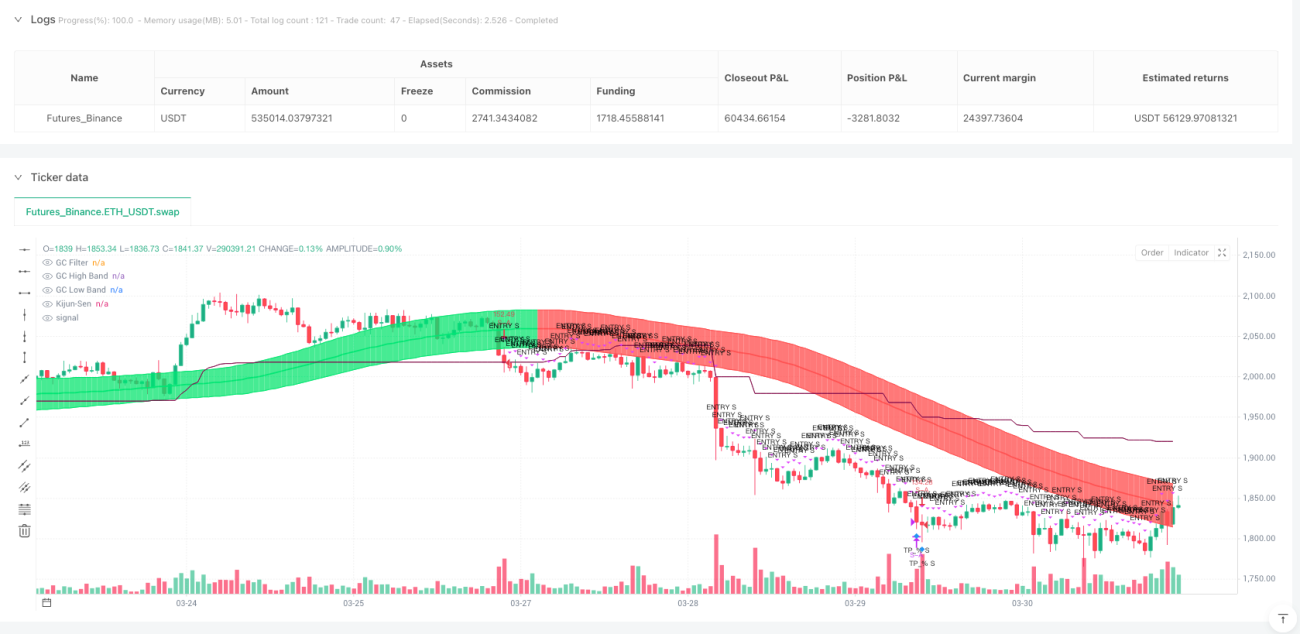
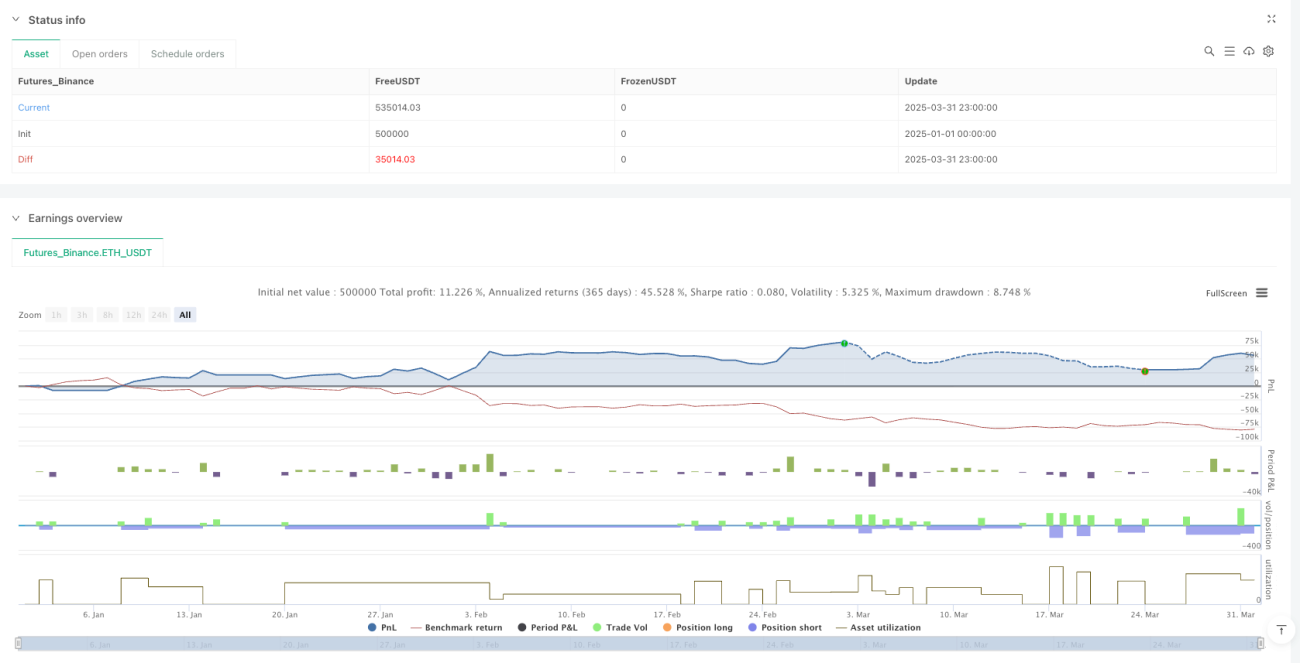
양자 거래의 핵심적인 문제는 단일 기술 지표가 시장의 소음 속에서 잘못된 신호를 만들어서 자주 스톱로스와 금전 철수를 초래한다는 것입니다. 그렇다면 어떻게 트렌드를 포착하면서도 소음을 효과적으로 필터링하는 거래 시스템을 구축할 수 있을까요?
오늘 우리가 분석한 고스 채널의 다중 필터링 전략은 4개의 다른 차원의 기술적인 지표들을 교묘하게 조합하여 우리에게 깊이 있게 연구할 가치가 있는 해결책을 제공합니다.
1. 가우시안 채널 - 트렌드 식별의 핵심
전략의 기초는 144주기의 샘플링 창을 사용하는 4단 고스피 필터이다. 전통적인 이동 평균과 달리 고스피 필터는 수학적인 모델링을 통해 대부분의 시장 소음을 제거하면서도 가격 변화에 대한 민감성을 유지한다.
키변수 설정:
2. 키-센 선 ((130주기) - 중·장기 경향 확인
여기서는 전통적인 26주기보다는 130주기 키-센 선이 트렌드 필터로 사용되었다. 이 조정의 의미는 무엇입니까?
더 긴 주기 설정은:
3. VAPI 지표 - 거래량 가격 분석
VAPI (Volume Adjusted Price Indicator) 는 거래량과 가격 변화의 관계를 분석하여 시장 참가자의 진정한 의도를 판단합니다. VAPI > 0일 때 더 많은 것을 지원하고, < 0일 때는 공백을 지원합니다.
4. ATR 동적 상쇄 - 위험 제어 메커니즘
11주기 ATR의 4.5배를 절감 거리로 사용해서, 이 설정은 시장의 변동성을 고려하면서도 시장 소음으로 촉발되는 너무 밀린 절감을 피한다.
이 전략에서 가장 배울만한 것은 이 전략의 독특한 재무 관리 방식입니다.
분주 논리:
왜 이런 식으로 설계되었을까요?
1. 입국 위험 제어
2. 포지션 리스크 관리
3. 신호 필터링 메커니즘 네 가지 기술 지표가 동시에 확인되어 가짜 신호의 확률이 크게 감소했다.
핵심 장점:
잠재적인 한계:
1. 품종 선택 주요 통화 쌍, 주식 지수 선물 등과 같은 강한 추세를 가진 품종을 선호하십시오.
2. 변수 최적화 특정 거래 품종에 대한 역사적 데이터에 따라 재검토 최적화를 권장하고, 특히 다음을 고려하십시오:
3. 시장 환경 적응 명백하게 흔들리는 시장에서, 전략을 일시 중지하거나 매개 변수 설정을 조정하는 것을 고려할 수 있다.
이 전략의 가치는 단지 기술적인 실현에만 있는 것이 아니라 체계적인 사고로 나타난다:
이 전략은 양자 거래자에게 좋은 프레임워크 참조를 제공합니다. 중요한 것은 변수를 따라다니는 것이 아니라, 설계 사상을 이해하고 자신의 거래 종류와 위험 선호도에 따라 적절하게 조정하는 것입니다.
기억하세요, 최고의 전략은 가장 복잡한 것이 아니라, 당신의 거래 스타일과 시장 환경에 가장 적합한 것입니다.
/*backtest
start: 2025-01-01 00:00:00
end: 2025-04-01 00:00:00
period: 1h
basePeriod: 1h
exchanges: [{"eid":"Futures_Binance","currency":"ETH_USDT","balance":500000}]
*/
// @version=6
strategy("Gaussian Channel Strategy – GC + Kijun (120) + VAPI Gate + ATR(4.5x) + 75/25 TP-TRAIL + Extra %TP",
overlay=true)
// =============================
// ======= INPUTS ==============
// =============================
N_poles = input.int(4, "Gaussian Poles", minval=1, maxval=9)
per = input.int(144, "Sampling Period", minval=2)
mult = input.float(1.414, "Filtered TR Multiplier", step=0.001)
src = input.source(hlc3, "Source")
modeLag = input.bool(false, "Reduced Lag Mode")
modeFast = input.bool(false, "Fast Response Mode")
kijunLen = input.int(130, "Kijun-Sen Period")
vapiLen = input.int(10, "VAPI Length")
vapiThresh= input.float(0.0, "VAPI Threshold (0 = zero line)")
atrLen = input.int(11, "ATR Length (RMA)")
slATRmul = input.float(4.5, "SL = ATR ×", step=0.1)
rr_fixed = input.float(3.5, "Fixed TP RR (Leg A)", step=0.1)
allocA = input.float(75, "Allocation %: Fixed TP Leg", minval=1, maxval=99)
riskPct = input.float(3.0, "Risk % of Equity per Trade", step=0.1, minval=0.1, maxval=10)
tpEnable = input.bool(true, "Enable Extra % Take Profit")
tpPctLong = input.float(10.0, "Extra Long TP % of Entry", step=0.1, minval=0)
tpPctShort = input.float(10.0, "Extra Short TP % of Entry", step=0.1, minval=0)
// =============================
// ===== CORE COMPONENTS =======
// =============================
atr = ta.rma(ta.tr(true), atrLen)
donchian_avg(len) => (ta.highest(high, len) + ta.lowest(low, len)) / 2.0
kijun = donchian_avg(kijunLen)
// --- VAPI_LB (LazyBear) ---
rs(x, len) => ta.cum(x) - nz(ta.cum(x)[len])
v_x = (2*close - high - low) / math.max(high - low, syminfo.mintick)
v_tva = rs(volume * v_x, vapiLen)
v_tv = rs(volume, vapiLen)
v_va = 100 * (v_tva / v_tv)
// =============================
// ===== Gaussian Channel ======
// =============================
f_filt9x(_a, _s, _i) =>
int _m2 = 0, int _m3 = 0, int _m4 = 0, int _m5 = 0, int _m6 = 0,
int _m7 = 0, int _m8 = 0, int _m9 = 0, float _f = 0.0, _x = (1 - _a)
_m2 := _i == 9 ? 36 : _i == 8 ? 28 : _i == 7 ? 21 : _i == 6 ? 15 : _i == 5 ? 10 : _i == 4 ? 6 : _i == 3 ? 3 : _i == 2 ? 1 : 0
_m3 := _i == 9 ? 84 : _i == 8 ? 56 : _i == 7 ? 35 : _i == 6 ? 20 : _i == 5 ? 10 : _i == 4 ? 4 : _i == 3 ? 1 : 0
_m4 := _i == 9 ? 126 : _i == 8 ? 70 : _i == 7 ? 35 : _i == 6 ? 15 : _i == 5 ? 5 : _i == 4 ? 1 : 0
_m5 := _i == 9 ? 126 : _i == 8 ? 56 : _i == 7 ? 21 : _i == 6 ? 6 : _i == 5 ? 1 : 0
_m6 := _i == 9 ? 84 : _i == 8 ? 28 : _i == 7 ? 7 : _i == 6 ? 1 : 0
_m7 := _i == 9 ? 36 : _i == 8 ? 8 : _i == 7 ? 1 : 0
_m8 := _i == 9 ? 9 : _i == 8 ? 1 : 0
_m9 := _i == 9 ? 1 : 0
_f := math.pow(_a, _i) * nz(_s) +
_i * _x * nz(_f[1]) - (_i >= 2 ?
_m2 * math.pow(_x, 2) * nz(_f[2]) : 0) + (_i >= 3 ?
_m3 * math.pow(_x, 3) * nz(_f[3]) : 0) - (_i >= 4 ?
_m4 * math.pow(_x, 4) * nz(_f[4]) : 0) + (_i >= 5 ?
_m5 * math.pow(_x, 5) * nz(_f[5]) : 0) - (_i >= 6 ?
_m6 * math.pow(_x, 6) * nz(_f[6]) : 0) + (_i >= 7 ?
_m7 * math.pow(_x, 7) * nz(_f[7]) : 0) - (_i >= 8 ?
_m8 * math.pow(_x, 8) * nz(_f[8]) : 0) + (_i == 9 ?
_m9 * math.pow(_x, 9) * nz(_f[9]) : 0)
f_pole(_a, _s, _i) =>
_f1 = f_filt9x(_a, _s, 1), _f2 = (_i >= 2 ? f_filt9x(_a, _s, 2) : 0), _f3 = (_i >= 3 ? f_filt9x(_a, _s, 3) : 0)
_f4 = (_i >= 4 ? f_filt9x(_a, _s, 4) : 0), _f5 = (_i >= 5 ? f_filt9x(_a, _s, 5) : 0), _f6 = (_i >= 6 ? f_filt9x(_a, _s, 6) : 0)
_f7 = (_i >= 7 ? f_filt9x(_a, _s, 7) : 0), _f8 = (_i >= 8 ? f_filt9x(_a, _s, 8) : 0), _f9 = (_i == 9 ? f_filt9x(_a, _s, 9) : 0)
_fn = _i == 1 ? _f1 : _i == 2 ? _f2 : _i == 3 ? _f3 : _i == 4 ? _f4 : _i == 5 ? _f5 : _i == 6 ? _f6 : _i == 7 ? _f7 : _i == 8 ? _f8 : _i == 9 ? _f9 : na
[_fn, _f1]
beta = (1 - math.cos(4*math.asin(1)/per)) / (math.pow(1.414, 2/N_poles) - 1)
alpha = - beta + math.sqrt(math.pow(beta, 2) + 2*beta)
lag = (per - 1) / (2.0 * N_poles)
srcdata = modeLag ? src + (src - nz(src[lag])) : src
tr_raw = ta.tr(true)
trdata = modeLag ? tr_raw + (tr_raw - nz(tr_raw[lag])) : tr_raw
[filt_n, filt_1] = f_pole(alpha, srcdata, N_poles)
[filt_n_tr, filt_1_tr] = f_pole(alpha, trdata, N_poles)
filt = modeFast ? (filt_n + filt_1)/2.0 : filt_n
filttr = modeFast ? (filt_n_tr + filt_1_tr)/2.0 : filt_n_tr
hband = filt + filttr * mult
lband = filt - filttr * mult
// =============================
// ===== Signals & Filters =====
// =============================
doLong = close > filt and close > kijun and v_va > vapiThresh
doShort = close < filt and close < kijun and v_va < -vapiThresh
// =============================
// ===== Position Sizing =======
// =============================
riskValue = strategy.equity * (riskPct/100.0)
slDist = atr * slATRmul
qtyTotal = slDist > 0 ? riskValue / slDist : 0.0
qtyA = qtyTotal * (allocA/100.0)
qtyB = qtyTotal * ((100 - allocA)/100.0)
// =============================
// ===== Order Execution =======
// =============================
var float trailStopL = na
var float trailStopS = na
inLong = strategy.position_size > 0
inShort = strategy.position_size < 0
entryPx = strategy.position_avg_price
// Entries
if doLong and not inLong and strategy.position_size <= 0
strategy.order("L-A", strategy.long, qty=qtyA)
strategy.order("L-B", strategy.long, qty=qtyB)
trailStopL := na
if doShort and not inShort and strategy.position_size >= 0
strategy.order("S-A", strategy.short, qty=qtyA)
strategy.order("S-B", strategy.short, qty=qtyB)
trailStopS := na
// LONG management
if inLong
slL = entryPx - slDist
tpA = entryPx + rr_fixed * slDist
// Leg A: 固定RR止盈 + 止损
strategy.exit("TP/SL-LA", from_entry="L-A", limit=tpA, stop=slL)
// Leg B: 追踪止损
trailStopL := na(trailStopL[1]) or strategy.position_size[1] <= 0 ? slL : math.max(trailStopL[1], close - slDist)
strategy.exit("Trail-LB", from_entry="L-B", stop=trailStopL)
// 额外百分比止盈
if tpEnable and high >= entryPx * (1 + tpPctLong/100.0)
strategy.close("L-A", comment="ExtraTP")
strategy.close("L-B", comment="ExtraTP")
// SHORT management
if inShort
slS = entryPx + slDist
tpA = entryPx - rr_fixed * slDist
// Leg A: 固定RR止盈 + 止损
strategy.exit("TP/SL-SA", from_entry="S-A", limit=tpA, stop=slS)
// Leg B: 追踪止损
trailStopS := na(trailStopS[1]) or strategy.position_size[1] >= 0 ? slS : math.min(trailStopS[1], close + slDist)
strategy.exit("Trail-SB", from_entry="S-B", stop=trailStopS)
// 额外百分比止盈
if tpEnable and low <= entryPx * (1 - tpPctShort/100.0)
strategy.close("S-A", comment="ExtraTP")
strategy.close("S-B", comment="ExtraTP")
// =============================
// ===== 图表绘制 ==============
// =============================
fcolor = filt > nz(filt[1]) ? color.new(color.lime, 0) : filt < nz(filt[1]) ? color.new(color.red, 0) : color.new(color.gray, 0)
plotFilter = plot(filt, title="GC Filter", color=fcolor, linewidth=2)
plotH = plot(hband, title="GC High Band", color=fcolor)
plotL = plot(lband, title="GC Low Band", color=fcolor)
fill(plotH, plotL, color=color.new(fcolor, 80))
plot(kijun, "Kijun-Sen", color=color.new(color.maroon, 0))
// 信号标记
plotshape(doLong, title="Long Setup", style=shape.triangleup, location=location.belowbar, color=color.new(color.lime, 0), size=size.tiny, text="ENTRY L")
plotshape(doShort, title="Short Setup", style=shape.triangledown, location=location.abovebar, color=color.new(color.fuchsia, 0), size=size.tiny, text="ENTRY S")