Strategi Pengesanan Trend Purata Bergerak Suai Suai Kaufman

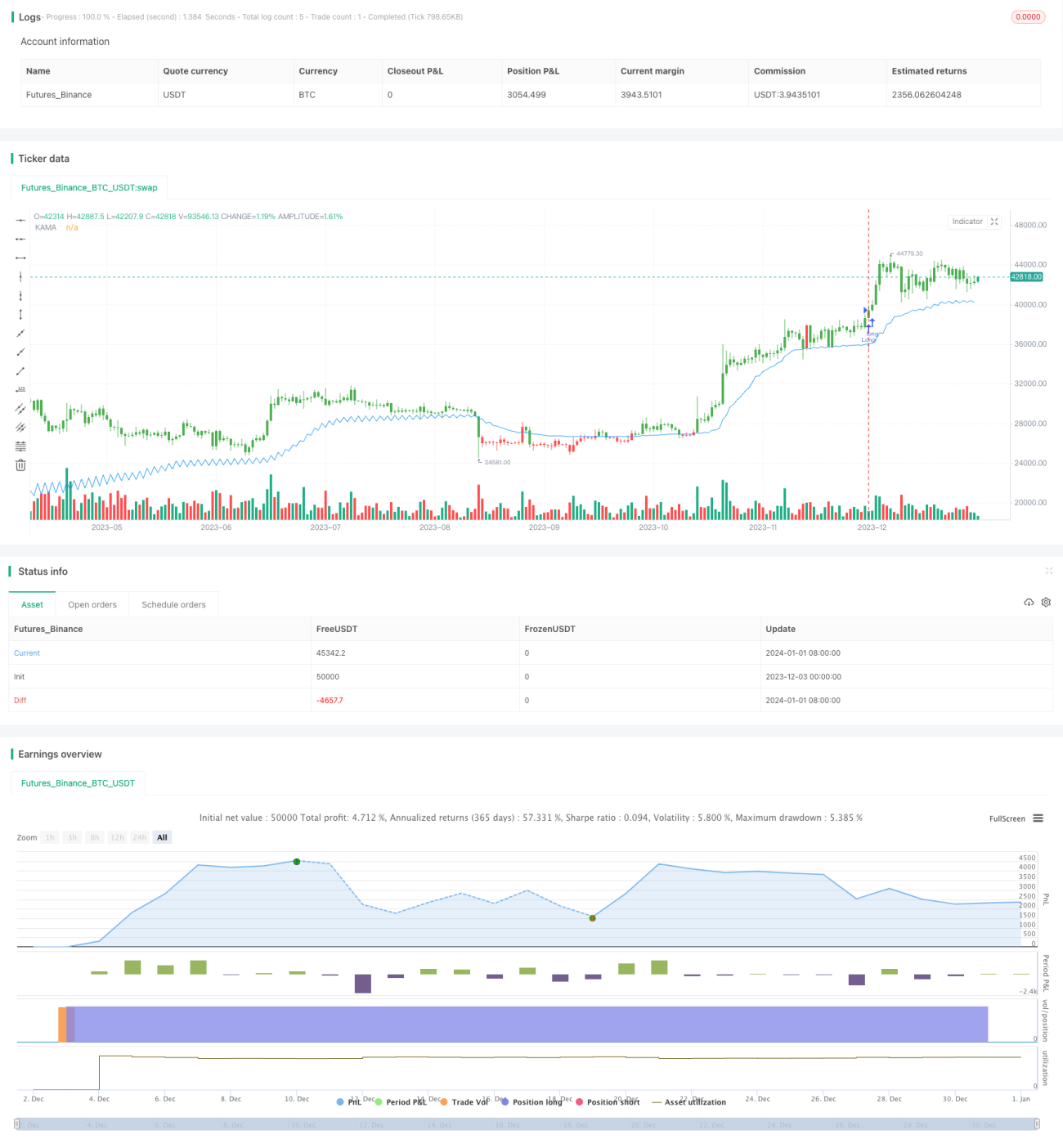
Gambaran Keseluruhan
Strategi ini menggunakan penunjuk purata bergerak adaptif Kaufman Adaptive Moving Average (KAMA) untuk mengesan arah aliran harga, membolehkan pembelian rendah dan penjualan tinggi untuk meraih keuntungan.
Prinsip Strategi
Formula pengiraan penunjuk Kaufman Adaptive Moving Average (KAMA) adalah seperti berikut:
nAMA = nz(nAMA[1]) + nsmooth * (Close - nz(nAMA[1]))
di mana:
nsmooth = (nefratio * (nfastend - nslowend) + nslowend)^2
nefratio = nsignal / nnoise
nsignal = |Close - Close[Length]|
nnoise = sum(|Close - Close[1]|, Length)
nfastend = 0.666
nslowend = 0.0645
Penunjuk ini mempertimbangkan turun naik pasaran dan perubahan arah aliran harga, membolehkan pengesanan arah aliran harga yang lebih pantas. Secara khusus:
- Apabila turun naik pasaran kecil, nsmooth menghampiri nslowend, garis KAMA berubah perlahan, menekan bunyi pasaran.
- Apabila turun naik pasaran meningkat dan trend muncul, nsmooth menghampiri nfastend, garis KAMA berubah dengan pantas, mengikuti arah aliran.
Dengan membandingkan hubungan antara harga dan KAMA, arah aliran harga dapat ditentukan, seterusnya memutuskan sama ada untuk membuat pesanan beli (long) atau jual (short).
Kelebihan Strategi
Kelebihan terbesar strategi ini adalah penggunaan penunjuk purata bergerak adaptif untuk mengesan perubahan arah aliran harga, yang berkesan mengurangkan pengaruh bunyi dan memberikan kesan penjejakan yang baik. Kelebihan khusus adalah seperti berikut:
- Penunjuk KAMA menekan bunyi pasaran, mengurangkan gabungan perdagangan yang tidak perlu.
- Penunjuk KAMA boleh bertindak balas dengan pantas terhadap perubahan arah aliran harga, kesan penjejakan yang baik.
- Peraturan keputusan strategi adalah mudah dan jelas, mudah difahami dan dilaksanakan.
- Boleh dikonfigurasikan untuk perdagangan songsang, menyesuaikan diri dengan pelbagai persekitaran pasaran.
Risiko Strategi
Strategi ini juga mempunyai beberapa risiko:
- Dalam pasaran yang bergelora (sideways), penunjuk KAMA mungkin memberikan isyarat yang salah. Parameter boleh dioptimumkan untuk memperbaiki prestasi penunjuk.
- Terdapat kelewatan dalam penjejakan, yang mungkin menyebabkan terlepas pembalikan harga jangka pendek. Boleh digabungkan dengan penunjuk lain untuk diagnosis.
- Tidak mengambil kira kos transaksi dan gelinciran (slippage), prestasi sebenar akan lebih lemah berbanding ujian balik (backtest).
Arah Pengoptimuman Strategi
Strategi ini boleh dioptimumkan dari beberapa aspek berikut:
- Mengoptimumkan parameter KAMA untuk meningkatkan kepekaan penjejakan penunjuk.
- Menambahkan mekanisme henti rugi (stop loss) untuk mengawal kerugian maksimum setiap perdagangan.
- Menggabungkan penunjuk lain untuk menapis isyarat, meningkatkan ketepatan keputusan.
- Menambah mekanisme kemasukan semula untuk menjejaki arah aliran dengan lebih lanjut.
Kesimpulan
Strategi ini menggunakan penunjuk Kaufman Adaptive Moving Average untuk mengesan arah aliran harga, dengan peraturan keputusan yang mudah dan jelas, serta mudah dilaksanakan dalam dagangan sebenar. Penunjuk ini menekan bunyi sambil bertindak balas dengan pantas terhadap perubahan harga, memberikan kesan penjejakan yang baik, menjadikannya strategi penjejakan arah aliran yang disyorkan.
/*backtest
start: 2023-12-03 00:00:00
end: 2024-01-02 00:00:00
period: 1d
basePeriod: 1h
exchanges: [{"eid":"Futures_Binance","currency":"BTC_USDT"}]
*/

//@version=2
////////////////////////////////////////////////////////////
//  Copyright by HPotter v1.0 25/08/2017
// Everyone wants a short-term, fast trading trend that works without large- 1