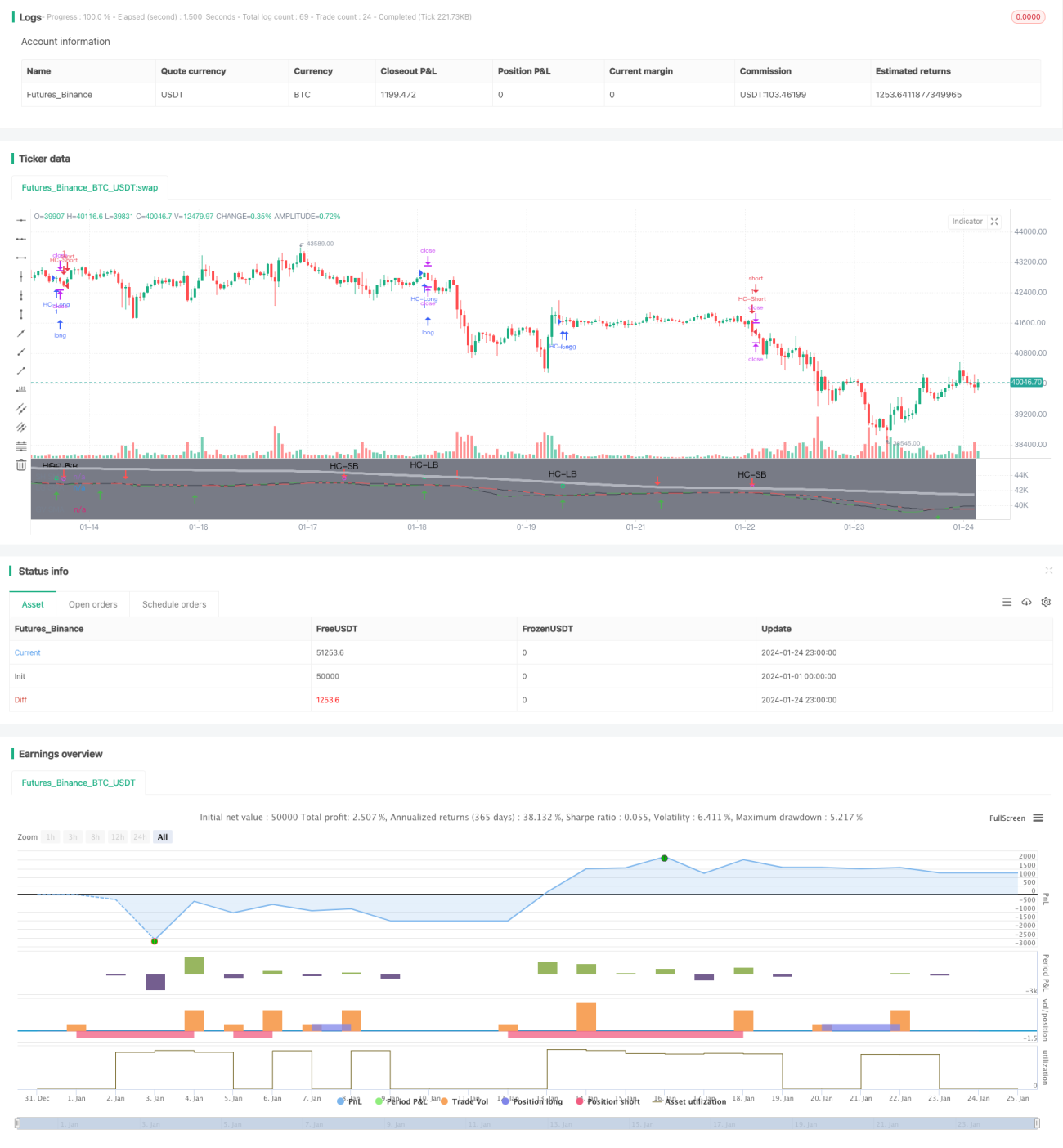
Strategi Perdagangan Golden Cross


Tarikh penciptaan: 2024-01-26 14:29:01 Akhirnya diubah suai: 2024-01-26 14:29:01
Salin: 4 Bilangan klik: 613
1
fokus pada
1617
Pengikut

Strategi Perdagangan Golden Cross

Gambaran keseluruhan

Strategi perdagangan golden cross menggunakan persilangan purata bergerak dua kitaran yang berbeza sebagai isyarat membeli dan menjual. Khususnya, apabila purata bergerak kitaran pendek menembusi purata bergerak kitaran panjang dari arah bawah, menghasilkan isyarat persilangan emas, yang menunjukkan kenaikan harga; apabila purata bergerak kitaran pendek jatuh dari arah atas dan menembusi purata bergerak kitaran panjang, menghasilkan isyarat persilangan mati, yang menunjukkan kenaikan harga.

Prinsip Strategi

Strategi ini berasaskan dua prinsip:

  1. Purata bergerak mencerminkan trend dan kekuatan pasaran. Purata bergerak jangka pendek menangkap pergerakan dan titik perubahan pasaran baru-baru ini; purata bergerak jangka panjang menunjukkan trend utama pasaran.

  2. Apabila purata bergerak jangka pendek dan purata bergerak jangka panjang membentuk persilangan emas, menunjukkan kekuatan pasaran jangka pendek melebihi kekuatan trend jangka panjang, jadi kemungkinan besar untuk memulakan pergerakan naik baru. Apabila membentuk persilangan mati, menunjukkan trend menurun jangka panjang yang dominan, jadi kemungkinan besar untuk terus turun.

Secara khusus, strategi ini menetapkan purata bergerak sederhana 13 dan 30 kitaran dan menghasilkan isyarat perdagangan apabila mereka bersilang. Prinsip persilangan adalah seperti berikut:

  1. Apabila purata bergerak jangka pendek melintasi purata bergerak jangka panjang, menghasilkan isyarat silang emas, yang menunjukkan peluang untuk melakukan lebih banyak. Pada masa ini, masuk melalui penilaian kecenderungan ketahanan: jika harga terus meningkat melebihi jangka masa tertentu, yakinlah bahawa tren kenaikan sekarang, maka lakukan lebih banyak.

  2. Apabila purata bergerak jangka pendek menembusi purata bergerak jangka panjang, ia menghasilkan isyarat silang mati yang menunjukkan peluang untuk melakukan pemotongan. Pada masa ini, masuk melalui penilaian kecenderungan ketahanan: jika harga terus menurun lebih dari satu kitaran tertentu, yakinlah bahawa tren turun sedang berlaku, maka lakukan pemotongan.

  3. Penilaian kekuatan isyarat silang melalui kemiringan purata bergerak. Isyarat silang dianggap cukup kuat untuk masuk hanya apabila kemiringan purata bergerak jangka pendek dan jangka panjang lebih besar daripada nilai terendah tertentu. Ini menekan gangguan isyarat palsu biasa.

  4. Hentikan kerosakan ditetapkan pada 20%, Hentikan kerosakan ditetapkan pada 100%.

Analisis kelebihan

Kaedah ini mempunyai kelebihan berikut:

  1. Idea yang jelas, mudah difahami dan dilaksanakan, sesuai untuk pemula.

  2. Menggunakan ciri-ciri purata harga, terdapat kesan kebisingan tertentu, untuk mengelakkan tertipu oleh turun naik harga jangka pendek.

  3. Untuk menilai trend yang kukuh, elakkan membuat banyak kerosakan secara mekanikal, dan gunakan penilaian saham besar.

  4. Memperkenalkan faktor kemiringan pendaratan rata-rata bergerak untuk menjadikan isyarat lebih dipercayai.

  5. Pengoptimuman pengulangan mudah, hanya perlu menyesuaikan beberapa parameter utama seperti parameter purata bergerak dan masa trend yang kuat.

Analisis risiko

Strategi ini juga mempunyai risiko:

  1. Pada hakikatnya, persimpangan dua garis sejajar masih merupakan isyarat ketinggalan, tidak dapat meramalkan titik perubahan dengan sempurna, dan terdapat tahap kelewatan tertentu. Siklus purata bergerak harus dikurangkan dengan sewajarnya, atau digunakan bersama faktor yang dapat meramalkan titik perubahan.

  2. Sistem perdagangan mekanikal mudah menyerang secara serentak, sehingga meningkatkan keadaan yang berlebihan, sehingga menghentikan kerugian atau halangan tidak berkesan. Halangan kerugian harus disiapkan sebagai halangan kerugian tangga, atau campur tangan manusia yang sesuai.

  3. Tidak dapat menangani keadaan gegaran dengan baik, anda harus mengelakkan varieti yang berulang-ulang dalam kitaran ini, dan pilih varieti yang jelas untuk berdagang.

  4. Jendela masa untuk menilai trend ketahanan ditetapkan apabila terdapat kesan yang besar terhadap keputusan, dan ujian berulang untuk menentukan nilai optimum.

Arah pengoptimuman

Strategi penyeberangan dua garis sejajar juga boleh dioptimumkan dengan:

  1. Menambah indikator untuk menilai trend peringkat besar, mengelakkan operasi berlawanan arah. Sebagai contoh, tambah kedudukan garis perbandingan atau garis bulan.

  2. Menambah pengesahan jumlah urus niaga, hanya menghantar isyarat jika jumlah urus niaga meningkat, untuk mengelakkan isyarat palsu.

  3. Mengoptimumkan parameter purata bergerak untuk mencari kombinasi kitaran terbaik. Anda boleh cuba menyesuaikan parameter purata bergerak.

  4. Gabungan dengan petunjuk formula utama, seperti MACD, KD dan penilaian tambahan, meningkatkan ketepatan isyarat.

  5. Tetapkan penghadang kerosakan tangga untuk mengawal risiko.

ringkaskan

Strategi persilangan dua garis sejajar secara keseluruhannya adalah strategi yang sangat intuitif dan dapat ditafsirkan. Ia menggabungkan ciri-ciri penghapusan bunyi rata-rata bergerak dengan kemampuan untuk mengenali trend yang mudah untuk menentukan persilangan. Pada masa yang sama, pengujian tertentu dilakukan terhadap isyarat untuk mengelakkan mengikuti angin secara buta, yang juga meningkatkan kegunaan dan kestabilan.

Kod sumber strategi
/*backtest
start: 2024-01-01 00:00:00
end: 2024-01-25 00:00:00
period: 1h
basePeriod: 15m
exchanges: [{"eid":"Futures_Binance","currency":"BTC_USDT"}]
*/

//@version=4

// This source code is subject to the terms of the Mozilla Public License 2.0 at https://mozilla.org/MPL/2.0/
// © MakeMoneyCoESTB2020


//*********************Notes for continued work***************

//************************************************************

//Hello my fellow investors
//I am creating a simple non-cluttered strategy that uses 3(+1) simple means to determine: viability, entry, and exit
//1) Has a consistent trend been maintained for several days/weeks
//2) SH SMA crossover LG SMA = Bullish entry/LG SMA crossover SH SMA = Bearish entry
//3) Use the Slope factor & Weeks in Trend (WiT) to dertermine how strong of an entry signal you are comfortable with
//4) Exit position based on next SMA cross and trend reversal or stop loss%
//3+1) For added confidence in trend detection: Apply MACD check - buy--> MACD line above signal line and corssover below histogram \\ sell --> MACD line below signal line and crossover above histogram.
//*)This code also allows you to determine your desired backtesting date compliments of alanaster


//This code is the product of many hours of hard work on the part of the greater tradingview community.  The credit goes to everyone in the community who has put code out there for the greater good.

//Happy Hunting!

// 1. Define strategy settings*************************************************************************************************************************************************************************

//Title
strategy("KISS Strategy: SMA + EMA", shorttitle="KISS Strat")

//define calculations price source
price = input(title="Price Source", defval=close)

// 2. Calculate strategy values*************************************************************************************************************************************************************************

//Calculate 13/30/200SMA 
SH_SMA_length= input(title="SH SMA Length", defval=13) //short SMA length
LG_SMA_length= input(title="LG SMA Length", defval=30) //long SMA length
GV_SMA_length= input(title="SH SMA Length", defval=200) //Gravitational SMA length

SH_SMA=sma(price, SH_SMA_length) //short SMA 
LG_SMA=sma(price, LG_SMA_length) //long SMA
GV_SMA=sma(price, GV_SMA_length) //gravitational SMA

//calculate MACD
//define variables for speed
fast = 12, slow = 26
//define parameters to calculate MACD
fastMA = ema(price, fast)
slowMA = ema(price, slow)
//define MACD line
macd = fastMA - slowMA
//define SIGNAL line
signal = sma(macd, 9)

//Determine what type of trend we are in
dcp = security(syminfo.tickerid, 'D', close)   //daily close price 
wcp = security(syminfo.tickerid, 'W', close)   //weekly close price 

WiT = input(title="Weeks In Trend", defval=1, maxval=5, minval=1)    //User input for how many weeks of price action to evaluate (Weeks in Trend = WiT)
BearTrend = false       //initialize trend variables as false
BullTrend = false       //initialize trend variables as false

// BullTrend := (wcp > SH_SMA) and (SH_SMA > LG_SMA)  //true if price is trending up based on weekly price close
// BearTrend := (wcp < SH_SMA) and (SH_SMA < LG_SMA)  //true if price is trending down based on weekly price close


// BullTrend := (price > SH_SMA) and (SH_SMA > LG_SMA)  //true if price is trending up
// BearTrend := (price < SH_SMA) and (SH_SMA < LG_SMA)  //true if price is trending down

//Determine if the market has been in a trend for 'n' weeks

n=WiT                           //create loop internal counting variable
for i=1 to WiT                  //create loop to determine if BearTrend=true to set number of weeks
    if (wcp[n] < price)         //evaluate if BearTrend=false comparing the current price to a paticular week close
        BearTrend := false      //set value to false if older price value is less than newer: trending up
        break                   //break out of for loop when trend first falters
    if (wcp[n] > price)         //evaluate if BearTrend=true comparing the current price to a paticular week close
        BearTrend := true       //set value to true if older price value is greater than newer: trending down
    n:=n-1                      //set internal counter one day closer to present

m=WiT                           //create loop internal counting variable
for j=1 to WiT                  //create loop to determine if BearTrend=true to set number of weeks
    if (wcp[m] > price)         //evaluate if BullTrend=false comparing the current price to a paticular week close
        BullTrend := false      //set value to false if older price value is greater than newer: trending down
        break                   //break out of for loop when trend first falters
    if (wcp[m] < price)         //evaluate if BullTrend=true comparing the current price to a paticular week close
        BullTrend := true       //set value to true if older price value is less than newer: trending up
    m:=m-1                      //set internal counter one day closer to present


//Determine if crossings occur
SH_LGcrossover = crossover(SH_SMA, LG_SMA)  //returns true if short crosses over long
SH_LGcrossunder = crossunder(SH_SMA, LG_SMA)    //returns true if short crosses under long

//Determine the slope of the SMAs when a cross over occurs
SlopeFactor= input(title="Slope Factor", defval=.01, minval=0, step = 0.001) //user input variable for what slope to evaluate against
XSlopeSH = abs(SH_SMA-SH_SMA[2]) //slope of short moving average (time cancels out)
XSlopeLG = abs(LG_SMA-LG_SMA[2]) //slope of long moving average (time cancels out)
StrongSlope = iff (abs(XSlopeSH-XSlopeLG)>SlopeFactor, true, false) //create a boolean variable to determine is slope intensity requirement is met

// ************************************ INPUT BACKTEST RANGE ******************************************=== coutesy of alanaster
fromMonth = input(defval = 4,    title = "From Month",      type = input.integer, minval = 1, maxval = 12)
fromDay   = input(defval = 1,    title = "From Day",        type = input.integer, minval = 1, maxval = 31)
fromYear  = input(defval = 2020, title = "From Year",       type = input.integer, minval = 1970)
thruMonth = input(defval = 1,    title = "Thru Month",      type = input.integer, minval = 1, maxval = 12)
thruDay   = input(defval = 1,    title = "Thru Day",        type = input.integer, minval = 1, maxval = 31)
thruYear  = input(defval = 2112, title = "Thru Year",       type = input.integer, minval = 1970)

// === INPUT SHOW PLOT ===
showDate  = input(defval = true, title = "Show Date Range", type = input.bool)

// === FUNCTION EXAMPLE ===
start     = timestamp(fromYear, fromMonth, fromDay, 00, 00)        // backtest start window
finish    = timestamp(thruYear, thruMonth, thruDay, 23, 59)        // backtest finish window
window()  => true

bgcolor(color = showDate and window() ? color.gray : na, transp = 90) 
// === EXECUTION ===
//strategy.entry("L", strategy.long, when = window() and crossOv)    // enter long when "within window of time" AND crossover
//strategy.close("L", when = window() and crossUn)                   // exit long when "within window of time" AND crossunder

// 3. Output strategy data*************************************************************************************************************************************************************************

//Embolden line if a trend exists
trendcolorLG = BearTrend?color.red:color.black //highlights beartrend condition met graphically
trendcolorSH = BullTrend?color.green:color.black //highlights beartrend condition met graphically

//plot SMAs
plot(SH_SMA, title = "SH SMA", color = trendcolorSH)
plot(LG_SMA, title = "LG SMA", color = trendcolorLG)
plot(GV_SMA, title = "GV SMA", color = color.silver, linewidth = 4, transp = 70)

//Highlight crossovers
plotshape(series=SH_LGcrossover, style=shape.arrowup, location=location.belowbar,size=size.normal, color=color.green)
plotshape(series=SH_LGcrossunder, style=shape.arrowdown, location=location.abovebar,size=size.normal, color=color.red)

// 4. Determine Long & Short Entry Calculations*************************************************************************************************************************************************************************

//Define countback variable
countback=input(minval=0, maxval=5, title="Price CountBack", defval=0)
//User input for what evaluations to run: SMA or SMA + EMA
SMA_Y_N=input(defval = "Y", title="Run SMA", type=input.string, options=["Y", "N"])
MACD_Y_N=input(defval = "N", title="Run MACD", type=input.string, options=["Y", "N"])

//Calculate SMA Cross entry conditions
SMAbuy=false
SMAsell=false
SMAbuy := SH_LGcrossover and StrongSlope and BearTrend[WiT*7]   //enter long if short SMA crosses over long SMA & security has been in a BearTrend for 'n' days back
SMAsell := SH_LGcrossunder and StrongSlope and BullTrend[WiT*7] //enter short if short SMA crosses under long SMA & security has been in a BullTrend for 'n' days back

//Calculate MACD Cross entry conditions
MACDbuy = iff(MACD_Y_N=="Y", crossunder(signal[countback], macd[countback]), true) and iff(MACD_Y_N=="Y", macd[countback]<0, true) and StrongSlope and BearTrend     //enter long if fast MACD crosses over slow MACD & there is a strong slope & security has been in a BearTrend for 'n' days back
MACDsell = iff(MACD_Y_N=="Y", crossunder(macd[countback], signal[countback]), true) and iff(MACD_Y_N=="Y", signal[countback]>0, true) and StrongSlope and BullTrend  //enter short if fast MACD crosses under slow MACD & there is a strong slope & security has been in a BullTrend for 'n' days back

//long entry condition
dataHCLB=(iff(SMA_Y_N=="Y", SMAbuy, true) and iff(MACD_Y_N=="Y", MACDbuy, true))
plotshape(dataHCLB, title= "HC-LB", color=color.lime, style=shape.circle, text="HC-LB")
strategy.entry("HC-Long", strategy.long, comment="HC-Long", when = dataHCLB and window())

//short entry condition
dataHCSB=(iff(SMA_Y_N=="Y", SMAsell, true) and iff(MACD_Y_N=="Y", MACDsell, true))
plotshape(dataHCSB, title= "HC-SB", color=color.fuchsia, style=shape.circle, text="HC-SB")
strategy.entry("HC-Short", strategy.short, comment="HC-Short", when=dataHCSB and window())


// 5. Submit Profit and Loss Exit Calculations Orders*************************************************************************************************************************************************************************

// User Options to Change Inputs (%)
stopPer = input(12, title='Stop Loss %', type=input.float) / 100
takePer = input(25, title='Take Profit %', type=input.float) / 100

// Determine where you've entered and in what direction
longStop = strategy.position_avg_price * (1 - stopPer)
shortStop = strategy.position_avg_price * (1 + stopPer)
shortTake = strategy.position_avg_price * (1 - takePer)
longTake = strategy.position_avg_price * (1 + takePer)

//exit position conditions and orders
if strategy.position_size > 0//or crossunder(price[countback], upperBB)
    strategy.exit(id="Close Long", when = window(), stop=longStop, limit=longTake)
if strategy.position_size < 0 //or crossover(price[countback], lowerBB)
    strategy.exit(id="Close Short", when = window(), stop=shortStop, limit=shortTake)


//Evaluate/debug equation***************************************************************************************************************************************************************************
// plotshape((n==5? true : na), title='n=5', style=shape.labeldown, location=location.abovebar, text='5', color=color.white, textcolor=color.black, transp=0) //print n value if 5
// plotshape((n==4? true : na), title='n=4', style=shape.labeldown, location=location.abovebar, text='4', color=color.white, textcolor=color.black, transp=0) //print n value if 4 
// plotshape((n==3? true : na), title='n=3', style=shape.labeldown, location=location.abovebar, text='3', color=color.white, textcolor=color.black, transp=0) //print n value if 3
// plotshape((n==2? true : na), title='n=2', style=shape.labeldown, location=location.abovebar, text='2', color=color.white, textcolor=color.black, transp=0) //print n value if 2
// plotshape((n==1? true : na), title='n=1', style=shape.labeldown, location=location.abovebar, text='1', color=color.white, textcolor=color.black, transp=0) //print n value if 1
// lineValue = 11                                           //set random visible line value to check when equation is true
// colorP = (BearTrend==true) ? color.green : color.red
// plot (lineValue, title = "BearTrend", color = colorP)   //Plot when condition true=green, false=red
// plot (XSlopeLG+15, color=color.white) //used for code debugging
// plot (XSlopeSH+15, color=color.blue) //used for code debugging
// plot (abs(XSlopeSH-XSlopeLG)+20, color=color.fuchsia) //used for code debugging