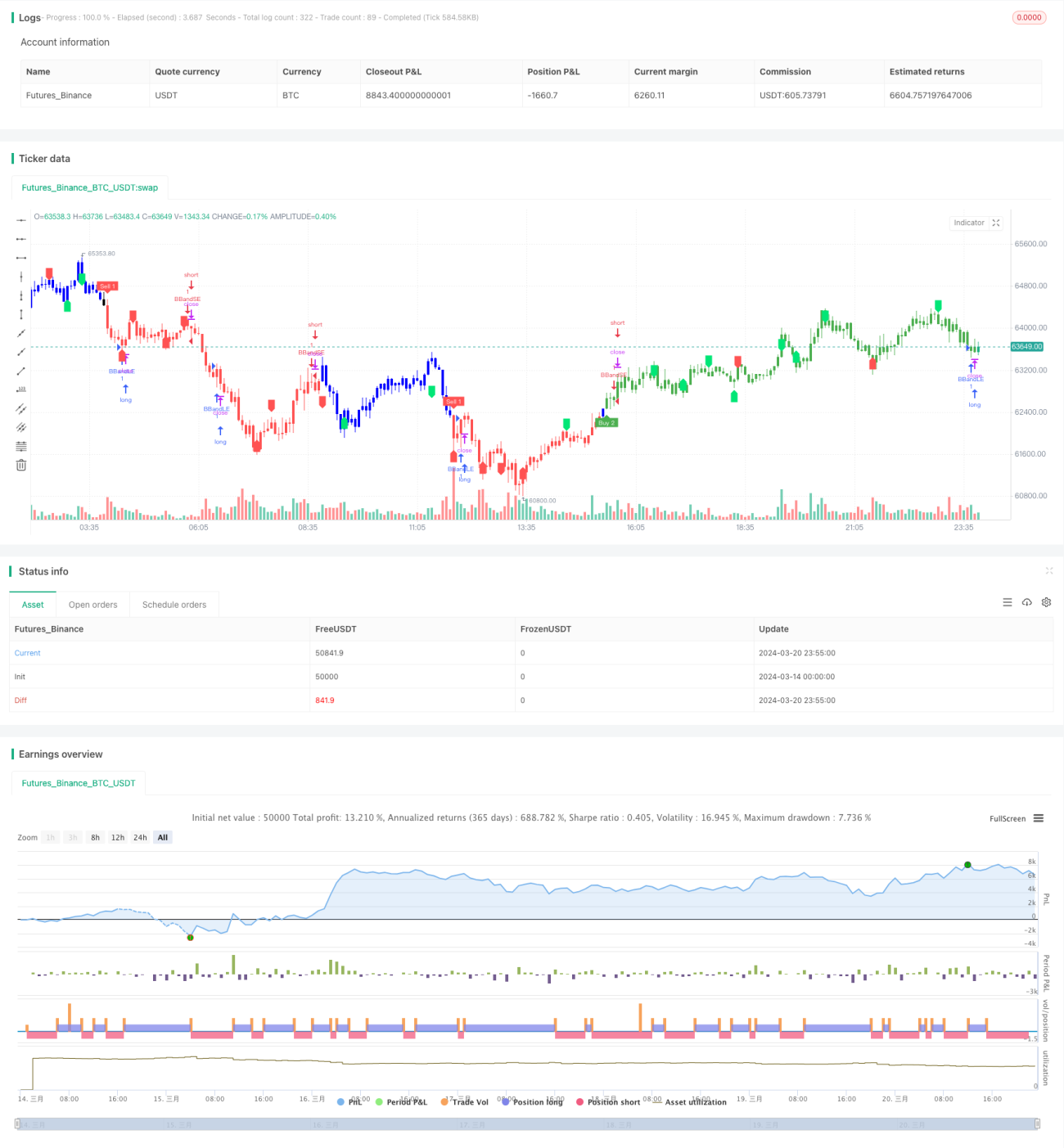
Strategi Kuberan: Strategi Persimpangan untuk Kawalan Pasaran


Tarikh penciptaan: 2024-03-22 14:08:11 Akhirnya diubah suai: 2024-03-22 14:08:11
Salin: 0 Bilangan klik: 557
1
fokus pada
1617
Pengikut

Strategi Kuberan: Strategi Persimpangan untuk Kawalan Pasaran

Gambaran Keseluruhan Strategi

Strategi Kuberan adalah strategi perdagangan yang kuat yang ditulis oleh Kathir. Ia menggabungkan pelbagai teknik analisis untuk membentuk satu kaedah perdagangan yang unik dan kuat. Strategi ini dinamakan selepas Kuberan, dewa kekayaan, yang melambangkan matlamatnya untuk memperkaya portfolio pedagang.

Kuberan adalah lebih daripada sekadar strategi, ia adalah sistem perdagangan yang komprehensif. Ia menggabungkan analisis trend, indikator momentum, dan indikator kuantiti transaksi untuk mengenal pasti peluang perdagangan yang berkemungkinan tinggi. Dengan menggunakan sinergi elemen-elemen ini, Kuberan menyediakan isyarat masuk dan keluar yang jelas, sesuai untuk semua peringkat pedagang.

Prinsip Strategi

Inti strategi Kuberan adalah prinsip pertukaran pelbagai indikator. Ia menggunakan kombinasi indikator yang unik yang saling berkolaborasi untuk mengurangkan bunyi dan isyarat yang salah. Secara khusus, strategi ini menggunakan beberapa komponen utama:

  1. Keputusan arah trend: menilai arah trend semasa dengan membandingkan harga semasa dengan tahap sokongan dan rintangan.
  2. Tahap sokongan dan rintangan: mengenal pasti tahap sokongan dan rintangan yang kritikal melalui indikator zigzag dan titik-titik pusat.
  3. Keputusannya adalah untuk membandingkan pergerakan harga dengan indikator momentum untuk menentukan sama ada terdapat keputusannya atau tidak.
  4. Kadar turun naik menyesuaikan diri: menyesuaikan stop loss secara dinamik melalui penunjuk ATR untuk menyesuaikan diri dengan kadar turun naik pasaran yang berbeza.
  5. Penghakiman K-Line: Mengakui trend dan isyarat pembalikan melalui kombinasi K-Line tertentu.

Dengan mempertimbangkan faktor-faktor di atas secara menyeluruh, strategi Kuberan dapat menyesuaikan diri dengan pelbagai keadaan pasaran untuk menangkap peluang perdagangan dengan kebarangkalian tinggi.

Kelebihan Strategik

  1. Multi-indicator convergence: Strategi Kuberan menggunakan sinergi pelbagai indikator, meningkatkan kebolehpercayaan isyarat dan mengurangkan gangguan bunyi.
  2. Adaptif: Dengan menyesuaikan parameter secara dinamik, strategi ini dapat menyesuaikan diri dengan keadaan pasaran yang berubah-ubah dan tidak mudah gagal.
  3. Isyarat yang jelas: Kuberan menyediakan isyarat masuk dan keluar yang jelas, memudahkan proses membuat keputusan perdagangan.
  4. Pelaburan yang stabil: Strategi ini telah diuji secara ketat dalam sejarah dan telah menunjukkan prestasi yang stabil dalam pelbagai keadaan pasaran.
  5. Kebolehgunaan yang meluas: Kuberan boleh digunakan untuk pelbagai pasaran dan varieti, tidak terhad kepada tanda dagangan tertentu.

Risiko Strategik

  1. Sensitiviti parameter: Prestasi strategi Kuberan lebih sensitif terhadap pilihan parameter, parameter yang tidak betul boleh menyebabkan penurunan prestasi.
  2. Kejadian yang tidak dijangka: Strategi ini adalah berdasarkan kepada isyarat teknikal dan mempunyai keupayaan yang terhad untuk menangani kejadian yang tidak dijangka.
  3. Risiko terlalu sesuai: Jika terlalu banyak data sejarah dipertimbangkan semasa pengoptimuman parameter, ia boleh menyebabkan strategi terlalu sesuai dengan masa lalu dan kurang sesuai dengan keadaan masa depan.
  4. Risiko Leverage: Jika anda menggunakan Leverage yang tinggi, anda akan menghadapi risiko pecah kedudukan apabila anda menghadapi pengunduran yang lebih besar.

Mengenai risiko di atas, langkah-langkah kawalan yang sesuai boleh diambil, seperti penyesuaian parameter secara berkala, menetapkan hentian yang munasabah, mengawal leverage secara sederhana, memberi perhatian kepada perubahan asas, dan sebagainya.

Arah pengoptimuman

  1. Pengoptimuman Pembelajaran Mesin: Algoritma pembelajaran mesin boleh diperkenalkan untuk mengoptimumkan parameter strategi secara dinamik dan meningkatkan daya serap.
  2. Menambah faktor asas: Pertimbangkan untuk memasukkan analisis asas ke dalam keputusan perdagangan untuk menangani kegagalan isyarat teknikal.
  3. Pengurusan Portfolio: Di peringkat pengurusan wang, strategi Kuberan boleh dimasukkan ke dalam portfolio untuk melindungi dengan berkesan dengan strategi lain.
  4. Pengoptimuman segmen pasaran: ciri-ciri untuk pelbagai jenis pasaran, parameter strategi pengoptimuman khusus.
  5. Pengubahsuaian frekuensi tinggi: mengubah strategi untuk versi perdagangan frekuensi tinggi, menangkap lebih banyak peluang perdagangan garis pendek.

ringkaskan

Kuberan adalah strategi perdagangan yang kuat, selamat dan dipercayai. Ia mengintegrasikan pelbagai kaedah analisis teknikal dengan cerdik, dengan prinsip pertukaran penunjuk, yang sangat baik dalam menangkap trend dan memahami titik-titik perubahan. Walaupun strategi apa pun tidak dapat mengelakkan risiko, Kuberan telah membuktikan kestabihannya dalam retrospeksi, dengan kawalan dan pengoptimuman risiko yang sesuai.

Kod sumber strategi
/*backtest
start: 2024-03-14 00:00:00
end: 2024-03-21 00:00:00
period: 5m
basePeriod: 1m
exchanges: [{"eid":"Futures_Binance","currency":"BTC_USDT"}]
*/

// This source code is subject to the terms of the Mozilla Public License 2.0 at https://mozilla.org/MPL/2.0/
// © LonesomeThecolor.blue
// This source code is subject to the terms of the Mozilla Public License 2.0 at https://mozilla.org/MPL/2.0/
// © LonesomeThecolor.blue

//@version=5
strategy('Kuberan*', overlay=true, max_lines_count=500)
lb = input.int(5, title='Left Bars', minval=1)
rb = input.int(5, title='Right Bars', minval=1)
showsupres = input.bool(false, title='Support/Resistance', inline='srcol')
supcol = input.color(color.lime, title='', inline='srcol')
rescol = input.color(color.red, title='', inline='srcol')
// srlinestyle = input(line.style_dotted, title='Line Style/Width', inline='style')
srlinewidth = input.int(3, title='', minval=1, maxval=5, inline='style')
changebarcol = input.bool(true, title='Change Bar Color', inline='bcol')
bcolup = input.color(color.blue, title='', inline='bcol')
bcoldn = input.color(color.black, title='', inline='bcol')

ph = ta.pivothigh(lb, rb)
pl = ta.pivotlow(lb, rb)

iff_1 = pl ? -1 : na  // Trend direction
hl = ph ? 1 : iff_1
iff_2 = pl ? pl : na  // similar to zigzag but may have multTLiple highs/lows
zz = ph ? ph : iff_2
valuewhen_1 = ta.valuewhen(hl, hl, 1)
valuewhen_2 = ta.valuewhen(zz, zz, 1)
zz := pl and hl == -1 and valuewhen_1 == -1 and pl > valuewhen_2 ? na : zz
valuewhen_3 = ta.valuewhen(hl, hl, 1)
valuewhen_4 = ta.valuewhen(zz, zz, 1)
zz := ph and hl == 1 and valuewhen_3 == 1 and ph < valuewhen_4 ? na : zz

valuewhen_5 = ta.valuewhen(hl, hl, 1)
valuewhen_6 = ta.valuewhen(zz, zz, 1)
hl := hl == -1 and valuewhen_5 == 1 and zz > valuewhen_6 ? na : hl
valuewhen_7 = ta.valuewhen(hl, hl, 1)
valuewhen_8 = ta.valuewhen(zz, zz, 1)
hl := hl == 1 and valuewhen_7 == -1 and zz < valuewhen_8 ? na : hl
zz := na(hl) ? na : zz

findprevious() =>  // finds previous three points (b, c, d, e)
    ehl = hl == 1 ? -1 : 1
    loc1 = 0.0
    loc2 = 0.0
    loc3 = 0.0
    loc4 = 0.0
    xx = 0
    for x = 1 to 1000 by 1
        if hl[x] == ehl and not na(zz[x])
            loc1 := zz[x]
            xx := x + 1
            break
    ehl := hl
    for x = xx to 1000 by 1
        if hl[x] == ehl and not na(zz[x])
            loc2 := zz[x]
            xx := x + 1
            break
    ehl := hl == 1 ? -1 : 1
    for x = xx to 1000 by 1
        if hl[x] == ehl and not na(zz[x])
            loc3 := zz[x]
            xx := x + 1
            break
    ehl := hl
    for x = xx to 1000 by 1
        if hl[x] == ehl and not na(zz[x])
            loc4 := zz[x]
            break
    [loc1, loc2, loc3, loc4]

float a = na
float b = na
float c = na
float d = na
float e = na
if not na(hl)
    [loc1, loc2, loc3, loc4] = findprevious()
    a := zz
    b := loc1
    c := loc2
    d := loc3
    e := loc4
    e

_hh = zz and a > b and a > c and c > b and c > d
_ll = zz and a < b and a < c and c < b and c < d
_hl = zz and (a >= c and b > c and b > d and d > c and d > e or a < b and a > c and b < d)
_lh = zz and (a <= c and b < c and b < d and d < c and d < e or a > b and a < c and b > d)

plotshape(_hl, title='Higher Low', style=shape.labelup, color=color.new(color.lime, 0), textcolor=color.new(color.black, 0), location=location.belowbar, offset=-rb)
plotshape(_hh, title='Higher High', style=shape.labeldown, color=color.new(color.lime, 0), textcolor=color.new(color.black, 0), location=location.abovebar, offset=-rb)
plotshape(_ll, title='Lower Low', style=shape.labelup, color=color.new(color.red, 0), textcolor=color.new(color.white, 0), location=location.belowbar, offset=-rb)
plotshape(_lh, title='Lower High', style=shape.labeldown, color=color.new(color.red, 0), textcolor=color.new(color.white, 0), location=location.abovebar, offset=-rb)

float res = na
float sup = na
res := _lh ? zz : res[1]
sup := _hl ? zz : sup[1]

int trend = na
iff_3 = close < sup ? -1 : nz(trend[1])
trend := close > res ? 1 : iff_3

res := trend == 1 and _hh or trend == -1 and _lh ? zz : res
sup := trend == 1 and _hl or trend == -1 and _ll ? zz : sup
rechange = res != res[1]
suchange = sup != sup[1]

var line resline = na
var line supline = na
if showsupres
    if rechange
        line.set_x2(resline, bar_index)
        line.set_extend(resline, extend=extend.none)
        resline := line.new(x1=bar_index - rb, y1=res, x2=bar_index, y2=res, color=rescol, extend=extend.right, style=line.style_dotted, width=srlinewidth)
        resline

    if suchange
        line.set_x2(supline, bar_index)
        line.set_extend(supline, extend=extend.none)
        supline := line.new(x1=bar_index - rb, y1=sup, x2=bar_index, y2=sup, color=supcol, extend=extend.right, style=line.style_dotted, width=srlinewidth)
        supline

iff_4 = trend == 1 ? bcolup : bcoldn
barcolor(color=changebarcol ? iff_4 : na)


// Inputs
A1 = input(5, title='Key Value. \'This changes the sensitivity\' for sell1')
C1 = input(400, title='ATR Period for sell1')
A2 = input(6, title='Key Value. \'This changes the sensitivity\' for buy2')
C2 = input(1, title='ATR Period for buy2')
h = input(false, title='Signals from Heikin Ashi Candles')

xATR1 = ta.atr(C1)
xATR2 = ta.atr(C2)
nLoss1 = A1 * xATR1
nLoss2 = A2 * xATR2

src = h ? request.security(ticker.heikinashi(syminfo.tickerid), timeframe.period, close, lookahead=barmerge.lookahead_off) : close

xATRTrailingStop1 = 0.0
iff_5 = src > nz(xATRTrailingStop1[1], 0) ? src - nLoss1 : src + nLoss1
iff_6 = src < nz(xATRTrailingStop1[1], 0) and src[1] < nz(xATRTrailingStop1[1], 0) ? math.min(nz(xATRTrailingStop1[1]), src + nLoss1) : iff_5
xATRTrailingStop1 := src > nz(xATRTrailingStop1[1], 0) and src[1] > nz(xATRTrailingStop1[1], 0) ? math.max(nz(xATRTrailingStop1[1]), src - nLoss1) : iff_6

xATRTrailingStop2 = 0.0
iff_7 = src > nz(xATRTrailingStop2[1], 0) ? src - nLoss2 : src + nLoss2
iff_8 = src < nz(xATRTrailingStop2[1], 0) and src[1] < nz(xATRTrailingStop2[1], 0) ? math.min(nz(xATRTrailingStop2[1]), src + nLoss2) : iff_7
xATRTrailingStop2 := src > nz(xATRTrailingStop2[1], 0) and src[1] > nz(xATRTrailingStop2[1], 0) ? math.max(nz(xATRTrailingStop2[1]), src - nLoss2) : iff_8

pos1 = 0
iff_9 = src[1] > nz(xATRTrailingStop1[1], 0) and src < nz(xATRTrailingStop1[1], 0) ? -1 : nz(pos1[1], 0)
pos1 := src[1] < nz(xATRTrailingStop1[1], 0) and src > nz(xATRTrailingStop1[1], 0) ? 1 : iff_9

pos2 = 0
iff_10 = src[1] > nz(xATRTrailingStop2[1], 0) and src < nz(xATRTrailingStop2[1], 0) ? -1 : nz(pos2[1], 0)
pos2 := src[1] < nz(xATRTrailingStop2[1], 0) and src > nz(xATRTrailingStop2[1], 0) ? 1 : iff_10

xcolor1 = pos1 == -1 ? color.red : pos1 == 1 ? color.green : color.blue
xcolor2 = pos2 == -1 ? color.red : pos2 == 1 ? color.green : color.blue

ema1 = ta.ema(src, 1)
ema2 = ta.ema(src, 1)
above1 = ta.crossover(ema1, xATRTrailingStop1)
below1 = ta.crossover(xATRTrailingStop1, ema1)
above2 = ta.crossover(ema2, xATRTrailingStop2)
below2 = ta.crossover(xATRTrailingStop2, ema2)

buy1 = src > xATRTrailingStop1 and above1
sell1 = src < xATRTrailingStop1 and below1
buy2 = src > xATRTrailingStop2 and above2
sell2 = src < xATRTrailingStop2 and below2

barbuy1 = src > xATRTrailingStop1
barsell1 = src < xATRTrailingStop1
barbuy2 = src > xATRTrailingStop2
barsell2 = src < xATRTrailingStop2

// plotshape(buy1, title="Buy 1", text='Buy 1', style=shape.labelup, location=location.belowbar, color=color.green, textcolor=color.white, transp=0, size=size.tiny)
plotshape(sell1, title='Sell 1', text='Sell 1', style=shape.labeldown, location=location.abovebar, color=color.new(color.red, 0), textcolor=color.new(color.white, 0), size=size.tiny)
plotshape(buy2, title='Buy 2', text='Buy 2', style=shape.labelup, location=location.belowbar, color=color.new(color.green, 0), textcolor=color.new(color.white, 0), size=size.tiny)
// plotshape(sell2, title="Sell 2", text='Sell 2', style=shape.labeldown, location=location.abovebar, color=color.red, textcolor=color.white, transp=0, size=size.tiny)

// barcolor(barbuy1 ? color.green : na)
barcolor(barsell1 ? color.red : na)
barcolor(barbuy2 ? color.green : na)
// barcolor(barsell2 ? color.red : na)

// alertcondition(buy1, "UT Long 1", "UT Long 1")
alertcondition(sell1, 'UT Short 1', 'UT Short 1')
alertcondition(buy2, 'UT Long 2', 'UT Long 2')

// strategy.entry('long', strategy.long, when=buy2)
source = close
length = input.int(20, minval=1)
mult = input.float(2.0, minval=0.001, maxval=50)
basis = ta.sma(source, length)
dev = mult * ta.stdev(source, length)
upper = basis + dev
lower = basis - dev
buyEntry = ta.crossover(source, lower)
sellEntry = ta.crossunder(source, upper)
if (ta.crossover(source, lower) )
	strategy.entry("BBandLE", strategy.long, stop=lower, oca_name="BollingerBands",  comment="BBandLE")
else
	strategy.cancel(id="BBandLE")
if (ta.crossunder(source, upper))
	strategy.entry("BBandSE", strategy.short, stop=upper, oca_name="BollingerBands",comment="BBandSE")
else
	strategy.cancel(id="BBandSE")
//plot(strategy.equity, title="equity", color=color.red, linewidth=2, style=plot.style_areabr)

lengthTL = input.int(14, 'Swing Detection Lookback')
multTL = input.float(1., 'Slope', minval = 0, step = .1)
calcMethod = input.string('Atr', 'Slope Calculation Method', options = ['Atr','Stdev','Linreg'])
backpaint = input(true, tooltip = 'Backpainting offset displayed elements in the past. Disable backpainting to see real time information returned by the indicator.')

//Style
upCss = input.color(color.teal, 'Up Trendline Color', group = 'Style')
dnCss = input.color(color.red, 'Down Trendline Color', group = 'Style')
showExt = input(true, 'Show Extended Lines')

//-----------------------------------------------------------------------------}
//Calculations
//-----------------------------------------------------------------------------{
var upperTL = 0.
var lowerTL = 0.
var slope_phTL = 0.
var slope_plTL = 0.

var offset = backpaint ? lengthTL : 0

n = bar_index
srcTL = close

phTL = ta.pivothigh(lengthTL, lengthTL)
plTL = ta.pivotlow(lengthTL, lengthTL)

//Slope Calculation Method
slope = switch calcMethod
    'Atr'    => ta.atr(lengthTL) / lengthTL * multTL
    'Stdev'  => ta.stdev(srcTL,lengthTL) / lengthTL * multTL
    'Linreg' => math.abs(ta.sma(srcTL * n, lengthTL) - ta.sma(srcTL, lengthTL) * ta.sma(n, lengthTL)) / ta.variance(n, lengthTL) / 2 * multTL

//Get slopes and calculate trendlines
slope_phTL := phTL ? slope : slope_phTL
slope_plTL := plTL ? slope : slope_plTL

upperTL := phTL ? phTL : upperTL - slope_phTL
lowerTL := pl ? pl : lowerTL + slope_plTL

var upos = 0
var dnos = 0
upos := phTL ? 0 : close > upperTL - slope_phTL * lengthTL ? 1 : upos
dnos := pl ? 0 : close < lowerTL + slope_plTL * lengthTL ? 1 : dnos