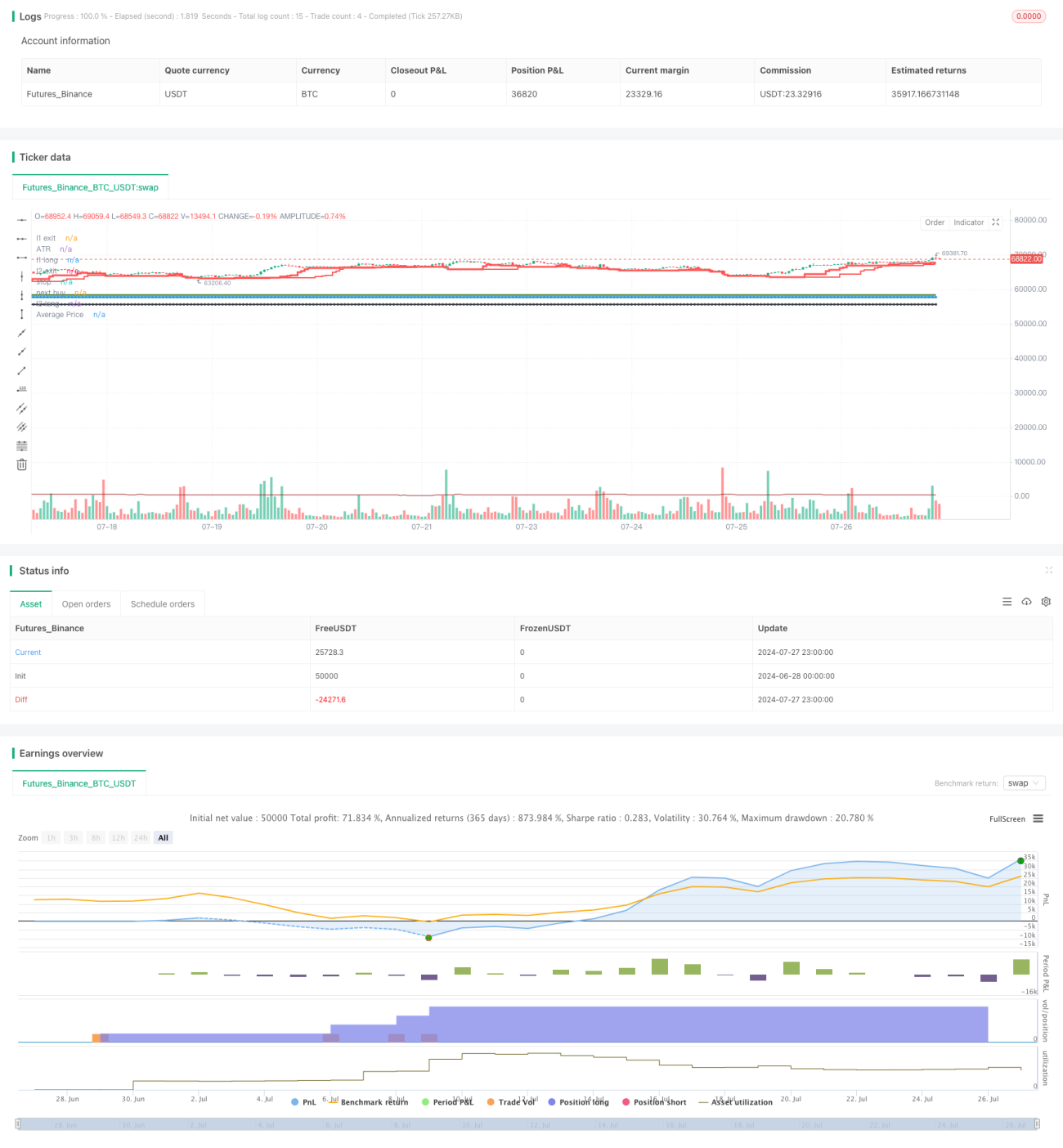
Sistem mengikut aliran dinamik berbilang peringkat

ATR MA RSI
Tarikh penciptaan: 2024-07-29 17:19:43 Akhirnya diubah suai: 2024-07-29 17:19:43
Salin: 0 Bilangan klik: 507
1
fokus pada
1617
Pengikut

Sistem mengikut aliran dinamik berbilang peringkat

Gambaran keseluruhan

Sistem mengikuti trend dinamik bertingkat adalah strategi penambahbaikan berdasarkan peraturan perdagangan pantai. Strategi ini menggunakan isyarat trend dalam beberapa kitaran masa, menggabungkan berhenti dinamik dan kenaikan harga piramid, untuk mencapai trend jangka panjang dan sederhana. Sistem ini menangkap trend dengan kelajuan yang berbeza dengan menetapkan dua kitaran mengikuti trend ((L1 dan L2)), dan menggunakan penunjuk ATR yang menyesuaikan diri untuk secara dinamik menyesuaikan masuk, kenaikan harga dan kedudukan berhenti.

Prinsip Strategi

  1. Pengiktirafan trend: Menggunakan dua kitaran purata bergerak ((L1 dan L2) untuk mengenal pasti trend dengan kelajuan yang berbeza. L1 digunakan untuk menangkap trend yang lebih cepat, L2 digunakan untuk menangkap trend yang lebih perlahan tetapi lebih dipercayai.

  2. Isyarat masuk: Membuat isyarat lebih banyak apabila harga menembusi titik tertinggi L1 atau L2. Jika perdagangan L1 yang lalu menguntungkan, melangkau isyarat L1 seterusnya sehingga isyarat L2 muncul.

  3. Hentian dinamik: menggunakan kelipatan ATR (default 3x) sebagai jarak hentian awal, dengan peningkatan masa pegangan, kedudukan hentian akan meningkat secara beransur-ansur.

  4. Peningkatan Piramida: Setiap kali harga naik 0.5 ATR, kenaikan maksimum 5 kali.

  5. Kawalan risiko: risiko setiap urus niaga tidak melebihi 2% daripada nilai bersih akaun, dengan mengira jumlah pegangan secara dinamik.

  6. Mekanisme Keluar: Melepaskan kedudukan apabila harga jatuh ke bawah 10 hari rendah (L1) atau 20 hari rendah (L2), atau melepas kedudukan apabila triggering garis berhenti bergerak.

Kelebihan Strategik

  1. Tangkapan trend pelbagai peringkat: Dengan dua kitaran L1 dan L2, kedua-dua trend cepat dan jangka panjang dapat ditangkap, meningkatkan daya serap dan kestabilan strategi.

  2. Pengurusan risiko dinamik: Menggunakan ATR sebagai penunjuk turun naik, membolehkan penyesuaian dinamik kedudukan masuk, hentikan kerugian dan menambah kedudukan, untuk menyesuaikan diri dengan perubahan pasaran.

  3. Peningkatan Piramida: Peningkatan kedudukan secara beransur-ansur apabila trend berterusan, untuk mengawal risiko dan memaksimumkan potensi keuntungan.

  4. Tetapan parameter yang fleksibel: Pelbagai parameter yang boleh disesuaikan membolehkan strategi menyesuaikan diri dengan gaya pasaran dan perdagangan yang berbeza.

  5. Automasi pelaksanaan: Strategi boleh dijalankan secara automatik sepenuhnya, mengurangkan campur tangan manusia dan kesan emosi.

Risiko Strategik

  1. Risiko trend reversal: Berkesan dengan baik dalam pasaran yang sedang maju, tetapi dalam pasaran yang bergolak mungkin sering berdagang menyebabkan kerugian.

  2. Penarikan dan kos dagangan: Penarikan dan penarikan rugi yang kerap boleh membawa kepada kos dagangan yang lebih tinggi.

  3. Risiko pengoptimuman berlebihan: Terdapat banyak parameter yang boleh menyebabkan data sejarah terlalu sesuai.

  4. Risiko pengurusan wang: jika modal awal kecil, mungkin tidak dapat melaksanakan kenaikan harga yang berkesan.

  5. Risiko kecairan pasaran: Dalam pasaran yang kurang kecairan, mungkin sukar untuk melakukan perdagangan mengikut harga yang ideal.

Arah pengoptimuman strategi

  1. Memperkenalkan penapis keadaan pasaran: Indikator kekuatan trend (seperti ADX) boleh ditambah untuk menilai keadaan pasaran, mengurangkan frekuensi perdagangan di pasaran yang bergolak.

  2. Strategi optimum untuk menaikkan kedudukan: anda boleh mempertimbangkan untuk menyesuaikan selang dan jumlah kenaikan secara dinamik mengikut kekuatan trend, dan bukannya 0.5 ATR dan 5 kali tetap.

  3. Memperkenalkan mekanisme penutupan: Dalam trend jangka panjang, penutupan separa boleh ditetapkan untuk mengunci keuntungan, seperti menebus separuh kedudukan apabila keuntungan ATR 3 kali ganda dicapai.

  4. Analisis perkaitan antara varieti: Analisis perkaitan antara varieti boleh dimasukkan untuk mengoptimumkan nisbah keuntungan risiko keseluruhan apabila digunakan dalam kombinasi.

  5. Menambah penapis kadar turun naik: Dalam tempoh turun naik yang sangat tinggi, perdagangan boleh ditangguhkan atau parameter risiko boleh disesuaikan untuk menghadapi pasaran yang tidak normal.

  6. Mekanisme keluar yang dioptimumkan: penggunaan penunjuk keluar yang lebih fleksibel seperti parabolic SAR atau Chandelier Exit boleh dipertimbangkan.

ringkaskan

Sistem mengikuti trend dinamik bertingkat adalah strategi komprehensif yang menggabungkan undang-undang perdagangan pantai klasik dan teknologi kuantitatif moden. Strategi ini meningkatkan keupayaan untuk menangkap trend dan potensi keuntungan sambil mengekalkan kestabilan melalui kaedah seperti pengenalan trend bertingkat, pengurusan risiko dinamik dan penambahan kedudukan piramid. Walaupun menghadapi cabaran di pasaran yang bergolak, strategi ini dijangka mengekalkan prestasi yang stabil di bawah keadaan pasaran yang berbeza melalui pengoptimuman parameter dan kawalan risiko yang munasabah.

Kod sumber strategi
/*backtest
start: 2024-06-28 00:00:00
end: 2024-07-28 00:00:00
period: 1h
basePeriod: 15m
exchanges: [{"eid":"Futures_Binance","currency":"BTC_USDT"}]
*/

//@version=5
// This is a strategy based on the famous turtle system.
// https://www.tradingblox.com/originalturtles/originalturtlerules.htm
//
// In a nutshell, it a trend trading system where you are buying on strength, selling on weakness.
// positions should be entered when the price crosses over the 20-day high (L1 high) or 55-day high (L2 high).
// positions should be exited when the prices crosses below the 10-day low (L1 low) or 20-day low (L2 low)
// you can add positions at every unit (measured by multiple of n, where n=1 ATR)
// stops should be placed at 2*n below every position entered, when the stop is hit exit your entire position.
// positions should be entered everytime price crosses over L1 or L2, with one exception:
// if the last trade was an L1 trade and it was a winning trade, skip the next trade unless the price crosses
// over L2, if that is the case, you should take it.
// L1 and L2 levels are also configurable for high and lows.
// N multiple for stops and pyramid are also configurable

// To change this from a strategy to a study:
// 1) uncomment the next line and comment out the strategy line.
// 2) at the end of the file comment out the last 2 lines


// study(title="Turtle Study", overlay=true)
strategy(title='kTF-VNI', overlay=true, initial_capital=100000000, commission_type=strategy.commission.percent, commission_value=0.0, pyramiding=100, process_orders_on_close=true, calc_on_every_tick=true)

stopInput = input.float(3, 'Stop N', step=.05)
riskPercent = input.float(.01, 'Risk % of capital', step=.005)
pyramidInput = input.float(0.5, 'Pyramid N', step=.05)
maxUnits = input.int(5, 'Max Pyramid Units', step=1)
atrPeriod = input(20, 'ATR period')

l1LongInput = 10
l2LongInput = 20
l1LongExitInput = 20
l2LongExitInput = 40

l1LongInput := input.int(20, 'L1 Long', minval=2)
l2LongInput := input.int(60, 'L2 Long', minval=2)
l1LongExitInput := input.int(10, 'L1 Long Exit', minval=2)
l2LongExitInput := input.int(20, 'L2 Long Exit', minval=2)

FromYear = input.int(1970, 'From Year', minval=1900)
FromMonth = input.int(1, 'From Month', minval=1, maxval=12)
FromDay = input.int(1, 'From Day', minval=1, maxval=31)
ToYear = input.int(9999, 'To Year', minval=1900)
ToMonth = input.int(1, 'To Month', minval=1, maxval=12)
ToDay = input.int(1, 'To Day', minval=1, maxval=31)
FromDate = timestamp(FromYear, FromMonth, FromDay, 00, 00)
ToDate = timestamp(ToYear, ToMonth, ToDay, 23, 59)
TradeDateIsAllowed() =>
    time >= FromDate and time <= ToDate

l1Long = ta.highest(l1LongInput)
l1LongExit = ta.lowest(l1LongExitInput)
l2Long = ta.highest(l2LongInput)
l2LongExit = ta.lowest(l2LongExitInput)

bool win = false  // tracks if last trade was winning trade of losing trade.
float buyPrice = 0.0  // tracks the buy price of the last long position.
float nextBuyPrice = 0.0  // tracks the next buy price
float stopPrice = na  // tracks the stop price
int totalBuys = 0  // tracks the total # of pyramid buys
bool inBuy = false  // tracks if we are in a long position or not.
float l1LongPlot = ta.highest(l1LongInput)  // tracks the L1 price to display
float l2LongPlot = ta.highest(l2LongInput)  // tracks the L2 price to display
float n = ta.atr(atrPeriod)  // tracks the n used to calculate stops and pyramid buys
string mode = 'L1'  // tracks whether we are in a L1 position or L2 position.
bool fake = na  // tracks if this is a fake trade, see comments below.
string longLevel = na  // tracks where long positions, stops, pyramid buys occur.
float capitalLeft = strategy.initial_capital
var shares = 0
float fakeBuyPrice = 0.0

// by default use the last value from the previous bar.
buyPrice := buyPrice[1]
totalBuys := totalBuys[1]
nextBuyPrice := nextBuyPrice[1]
stopPrice := stopPrice[1]
win := win[1]
capitalLeft := capitalLeft[1]
inBuy := inBuy[1]
n := ta.atr(atrPeriod)
fakeBuyPrice := fakeBuyPrice[1]

// State to track if we are in a long positon or not.

if not inBuy[1] and (high > l1Long[1] or high > l2Long[1])
    inBuy := true
    inBuy
else
    inBuy := inBuy[1] and low < stopPrice[1] ? false : inBuy
    inBuy := inBuy[1] and mode[1] == 'L1' and low < l1LongExit[1] ? false : inBuy
    inBuy := inBuy[1] and mode[1] == 'L2' and low < l2LongExit[1] ? false : inBuy
    inBuy

// State to track if we are ia a fake trade.  If the last trade was a winning, we need to skip the next trade.
// We still track it though as a fake trade (not counted against us). as the outcome determines if we can
// can take the next trade.

if not inBuy[1] and high > l1Long[1] and win[1]
    fake := true
    fakeBuyPrice := close
    fakeBuyPrice
else
    fake := fake[1]
    fake

if fake[1] and inBuy[1] and not inBuy
    fake := false
    win := close >= fakeBuyPrice
    win

fake := high > l2Long[1] ? false : fake

// Series representing the l1 and l2 levels.   If we break out above the l1 or l2 level, we want the
// line to stay at the breakout level, not follow it up.
l1LongPlot := not inBuy[1] or inBuy[1] and mode == 'L1' and fake[1] ? l1Long[1] : l1LongPlot[1]
l2LongPlot := not inBuy[1] or inBuy[1] and mode == 'L1' and fake[1] ? l2Long[1] : l2LongPlot[1]

// Variable in the series is only set when it happens.   Possible values is L1, L2, SR 
// (stopped out with a loss), SG (exited with a gain), and 'P' for pyramid buy.
longLevel := not inBuy[1] and high > l1Long[1] ? 'L1' : na
longLevel := (not inBuy[1] or inBuy[1] and fake[1]) and high > l2Long[1] ? 'L2' : longLevel

// Either 'L1' or 'L2' depending on what breakout level we are in.
mode := longLevel == na ? mode[1] : longLevel

// Variables to track calculating nextBuyPrice for pyramiding.
if longLevel == 'L1' or longLevel == 'L2'
    buyPrice := close
    totalBuys := 1
    stopPrice := close - stopInput * n
    nextBuyPrice := close + pyramidInput * n
    nextBuyPrice

// Marks if we hit our next buy price, if so mark it with a 'P'
longLevel := longLevel == na and inBuy[1] and high > nextBuyPrice and TradeDateIsAllowed() and totalBuys < maxUnits ? 'P' : longLevel

if longLevel == 'P'
    buyPrice := close
    totalBuys := totalBuys[1] + 1
    stopPrice := close - stopInput * n
    nextBuyPrice := close + pyramidInput * n
    nextBuyPrice

// Tracks stops and exits, marking them with SG or SR
longLevel := longLevel == na and inBuy[1] and low < stopPrice and close >= strategy.position_avg_price ? 'SG' : longLevel
longLevel := longLevel == na and inBuy[1] and low < stopPrice and close < strategy.position_avg_price ? 'SR' : longLevel
longLevel := longLevel == na and mode[1] == 'L1' and inBuy[1] and low < l1LongExit[1] and close >= strategy.position_avg_price ? 'SG' : longLevel
longLevel := longLevel == na and mode[1] == 'L2' and inBuy[1] and low < l2LongExit[1] and close >= strategy.position_avg_price ? 'SG' : longLevel
longLevel := longLevel == na and mode[1] == 'L1' and inBuy[1] and low < l1LongExit[1] and close < strategy.position_avg_price ? 'SR' : longLevel
longLevel := longLevel == na and mode[1] == 'L2' and inBuy[1] and low < l2LongExit[1] and close < strategy.position_avg_price ? 'SR' : longLevel

// Tracks if the trade was a win or loss.
win := longLevel == 'SG' ? true : win
win := longLevel == 'SR' ? false : win

// Variables used to tell strategy when to enter/exit trade.
//plotarrow(fake ? 1 : 0, colordown=color.red, colorup=color.purple, transp=40) // down arrow for winning trade
enterLong = (longLevel == 'L1' or longLevel == 'L2' or longLevel == 'P') and not fake and TradeDateIsAllowed()
exitLong = (longLevel == 'SG' or longLevel == 'SR') and not fake and TradeDateIsAllowed()

p1 = plot(l1LongPlot, title='l1 long', linewidth=3, style=plot.style_stepline, color=color.new(color.green, 0))
p2 = plot(l1LongExit[1], title='l1 exit', linewidth=3, style=plot.style_stepline, color=color.new(color.red, 0))
p3 = plot(l2LongPlot, title='l2 long', linewidth=2, style=plot.style_stepline, color=color.new(color.green, 0))
p4 = plot(l2LongExit[1], title='l2 exit', linewidth=2, style=plot.style_stepline, color=color.new(color.red, 0))
color1 = color.new(color.black, 0)
color2 = color.new(color.black, 100)
col = inBuy ? color1 : color2
p5 = plot(stopPrice, title='stop', linewidth=2, style=plot.style_circles, join=true, color=color.new(color.black, 0))
p6 = plot(nextBuyPrice, title='next buy', linewidth=2, style=plot.style_circles, join=true, color=color.new(color.blue, 0))

fill(p1, p3, color=color.new(color.green, 90))
fill(p2, p4, color=color.new(color.red, 90))

risk = (strategy.initial_capital + strategy.netprofit) * riskPercent
shares := math.floor(risk / (stopInput * n))
capitalLeft := strategy.initial_capital + strategy.netprofit - strategy.position_size * strategy.position_avg_price

if shares * close > capitalLeft
    shares := math.max(0, math.floor(capitalLeft / close))
    shares

shares := math.max(0, shares)

plotshape(longLevel == 'L1' and not fake and strategy.position_size == 0 ? true : false, color=color.new(color.green, 40), style=shape.triangleup, text='L1 ')  // up arrow for entering L1 trade
plotshape(not fake[1] and fake and longLevel == 'L1' and strategy.position_size == 0 ? true : false, color=color.new(color.gray, 40), style=shape.triangleup, text='L1')  // up arrow for entering L1 trade
plotshape(longLevel == 'L2' and strategy.position_size == 0 ? true : false, color=color.new(color.green, 40), style=shape.triangleup, text='L2')  // up arrow for entering L2 trade
plotshape((mode == 'L1' or mode == 'L2') and shares > 0 and enterLong and strategy.position_size > 0 ? true : false, color=color.new(color.green, 40), style=shape.triangleup, text='P')

plotarrow(strategy.position_size == 0 and longLevel == 'L1' and enterLong ? 1 : 0, colordown=color.new(color.black, 40), colorup=color.new(color.green, 40))  // up arrow for entering L1 trade
plotarrow(strategy.position_size == 0 and longLevel == 'L2' and enterLong ? 1 : 0, colordown=color.new(color.black, 40), colorup=color.new(color.green, 40))  // up arrow for entering L2 trade
plotarrow(strategy.position_size > 0 and longLevel == 'SR' and exitLong ? -1 : 0, colordown=color.new(color.red, 40), colorup=color.new(color.purple, 40))  // down arrow for losing trade
plotarrow(strategy.position_size > 0 and longLevel == 'SG' and exitLong ? -1 : 0, colordown=color.new(color.green, 40), colorup=color.new(color.purple, 40))  // down arrow for winning trade
plotshape(longLevel == na and inBuy[1] and not inBuy, color=color.new(color.gray, 40), style=shape.triangleup, text='Exit')  // up arrow for entering L1 trade

plot(ta.atr(atrPeriod), title='ATR', color=color.new(#991515, 0))
plot(strategy.position_avg_price, title='Average Price', color=color.new(#991515, 0))

alertcondition(low < stopPrice, title='crosses under stop price', message='price crossed under stop price')
alertcondition(high > l1Long, title='crosses over L1 price', message='price crossed over L1 price')
alertcondition(high > l2Long, title='crosses over L2 price', message='price crossed over L2 price')
alertcondition(low < l1LongExit, title='crosses under L1 exit price', message='price crossed under L1 exit price')
alertcondition(low < l2LongExit, title='crosses under L2 exit price', message='price crossed under L2 exit price')

strategy.entry('long', strategy.long, qty=shares, comment='long', when=enterLong)
strategy.close('long', when=exitLong)

// simulate_amount = 100000
// simulate_risk = simulate_amount*0.005
// simulate_shares = floor(simulate_risk/(n*stopInput))
// plot(simulate_shares, "Shares", color=#991515, transp=0)
// if (enterLong)
//     label.new(bar_index, high, text=tostring(simulate), style=label.style_none)