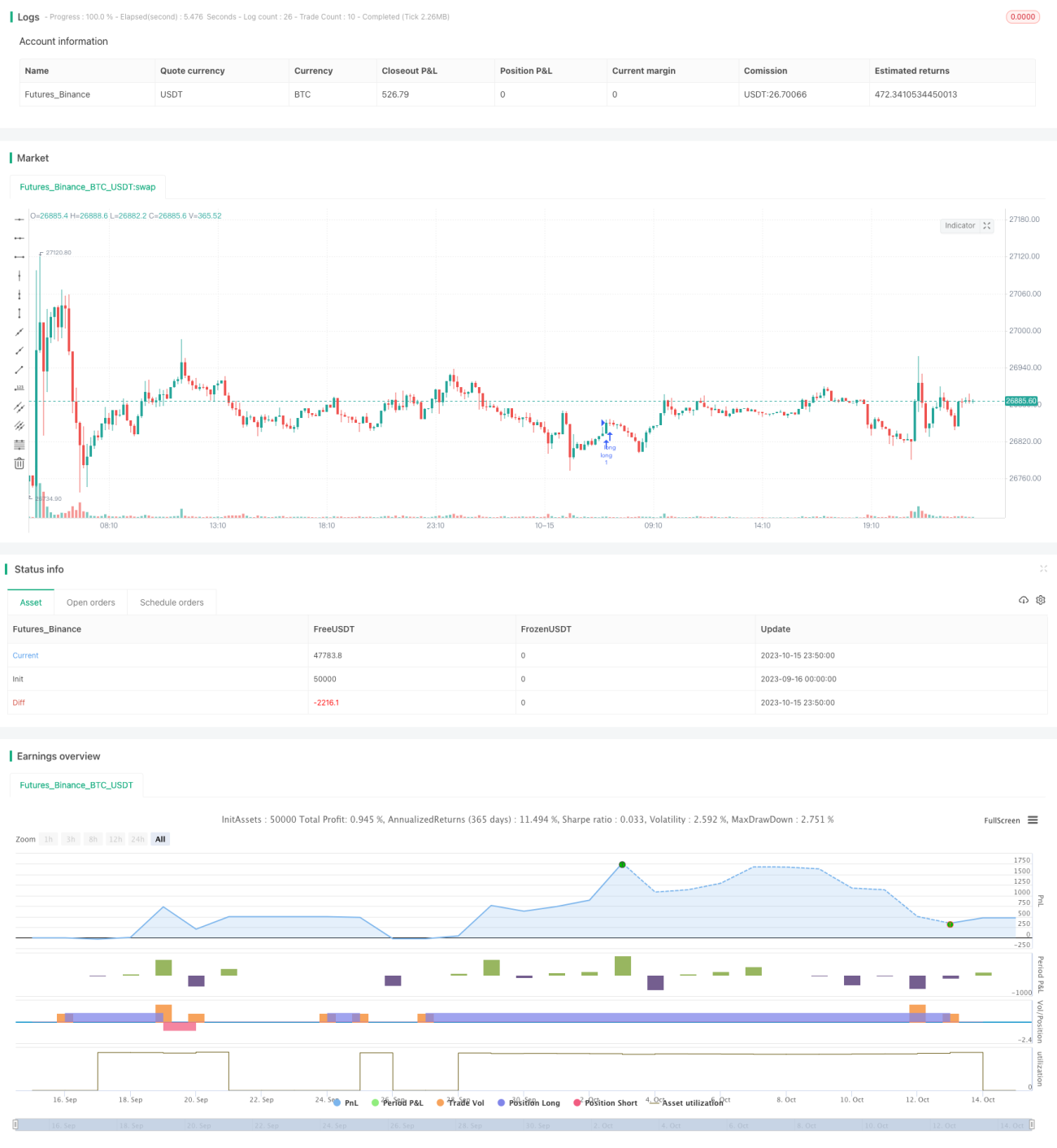
Esta estratégia utiliza um conjunto de indicadores técnicos, como MACD, RSI, PSAR, e princípios de gestão dinâmica de fundos, para permitir o acompanhamento de tendências e inversão de negociações em quadros de tempo múltiplos. A estratégia pode ser aplicada a negociações de linha curta, média e longa.
A estratégia usa o indicador PSAR para determinar a direção da tendência. A linha rápida EMA cruza a linha média BB como o primeiro ponto de confirmação. A direção do MACD como o segundo ponto de confirmação. O RSI cruza a área de compra e venda como o terceiro ponto de confirmação.
Após a entrada, configure um ponto de parada de perda. O ponto de parada é definido por um determinado múltiplo do valor do ATR. O ponto de parada é igual. Ao mesmo tempo, configure um ponto de parada de porcentagem de perda flutuante.
A flutuação também tem uma configuração de porcentagem. A flutuação é interrompida quando o lucro atinge uma determinada proporção do total de direitos da conta.
Gerenciamento dinâmico de fundos O tamanho da posição é calculado com base no ATR, o múltiplo de parada definido pela conta. Ao mesmo tempo, o volume mínimo de negociação é definido.
Confirmação por múltiplos fatores, prevenção de brechas falsas e melhoria da precisão de entrada.
Gestão dinâmica de fundos controla o risco individual e protege eficazmente a conta.
O ponto de parada de perda é definido pelo ATR e pode ser ajustado de acordo com a volatilidade do mercado.
A percentagem de flutuação e flutuação é definida para bloquear o lucro e evitar o retorno.
A combinação de múltiplos fatores pode ter perdido algumas oportunidades de negociação.
A definição de percentagens muito altas pode aumentar os prejuízos.
A configuração inadequada do valor ATR pode levar a que o Stop Loss seja muito relaxado ou muito radical.
Uma má gestão do capital pode levar a posições individuais excessivas.
Ajustar o peso dos fatores de entrada e otimizar a precisão do sinal.
Teste diferentes configurações de parâmetros percentuais para encontrar a melhor combinação.
Escolha um coeficiente ATR razoável de acordo com as características de cada variedade.
Ajustar os parâmetros de gestão de fundos de forma dinâmica de acordo com os resultados da avaliação.
Optimizar a configuração do intervalo de tempo e testar o intervalo de negociação.
Esta estratégia utiliza um conjunto de indicadores técnicos para avaliar as tendências, juntando riscos de controle de gerenciamento dinâmico de fundos e alcançando lucros estáveis em um quadro de tempo múltiplo. De acordo com os resultados da avaliação, os fatores de peso, os parâmetros de controle de risco e as configurações de gerenciamento de fundos podem ser continuamente otimizados para obter melhores resultados.
/*backtest
start: 2023-09-16 00:00:00
end: 2023-10-16 00:00:00
period: 10m
basePeriod: 1m
exchanges: [{"eid":"Futures_Binance","currency":"BTC_USDT"}]
*/
// This source code is subject to the terms of the Mozilla Public License 2.0 at https://mozilla.org/MPL/2.0/
// © SoftKill21
//@version=4
strategy("EURUSD 1min strat RISK %% ", overlay=false, initial_capital = 1000)
// BACKTESTING RANGE
// From Date Inputs
fromDay = input(defval = 1, title = "From Day", minval = 1, maxval = 31)
fromMonth = input(defval = 6, title = "From Month", minval = 1, maxval = 12)
fromYear = input(defval = 2020, title = "From Year", minval = 1970)
// To Date Inputs
toDay = input(defval = 1, title = "To Day", minval = 1, maxval = 31)
toMonth = input(defval = 12, title = "To Month", minval = 1, maxval = 12)
toYear = input(defval = 2020, title = "To Year", minval = 1970)
// Calculate start/end date and time condition
DST = 1 //day light saving for usa
//--- Europe
London = iff(DST==0,"0000-0900","0100-1000")
//--- America
NewYork = iff(DST==0,"0400-1500","0500-1600")
//--- Pacific
Sydney = iff(DST==0,"1300-2200","1400-2300")
//--- Asia
Tokyo = iff(DST==0,"1500-2400","1600-0100")
//-- Time In Range
timeinrange(res, sess) => time(res, sess) != 0
london = timeinrange(timeframe.period, London)
newyork = timeinrange(timeframe.period, NewYork)
startDate = timestamp(fromYear, fromMonth, fromDay, 00, 00)
finishDate = timestamp(toYear, toMonth, toDay, 00, 00)
time_cond = true
//
//
// rsi
length = input( 5 )
overSold = input( 23 )
overBought = input( 72 )
price = close
vrsi = rsi(price, length)
co = crossover(vrsi, overSold)
cu = crossunder(vrsi, overBought)
// macd
fast_length_macd = input(title="Fast Length", type=input.integer, defval=12)
slow_length_macd = input(title="Slow Length", type=input.integer, defval=26)
src_macd = input(title="Source", type=input.source, defval=close)
signal_length = input(title="Signal Smoothing", type=input.integer, minval = 1, maxval = 50, defval = 9)
sma_source = input(title="Simple MA(Oscillator)", type=input.bool, defval=true)
sma_signal = input(title="Simple MA(Signal Line)", type=input.bool, defval=true)
// Plot colors
col_grow_above = #26A69A
col_grow_below = #FFCDD2
col_fall_above = #B2DFDB
col_fall_below = #EF5350
col_macd = #0094ff
col_signal = #ff6a00
// Calculating
fast_ma = sma_source ? sma(src_macd, fast_length_macd) : ema(src_macd, fast_length_macd)
slow_ma = sma_source ? sma(src_macd, slow_length_macd) : ema(src_macd, slow_length_macd)
macd = fast_ma - slow_ma
signal = sma_signal ? sma(macd, signal_length) : ema(macd, signal_length)
hist = macd - signal
//plot(hist, title="Histogram", style=plot.style_columns, color=(hist>=0 ? (hist[1] < hist ? col_grow_above : col_fall_above) : (hist[1] < hist ? col_grow_below : col_fall_below) ), transp=0 )
// sar
start = input(0.02)
increment = input(0.02)
maximum = input(0.2)
var bool uptrend = na
var float EP = na
var float SAR = na
var float AF = start
var float nextBarSAR = na
if bar_index > 0
firstTrendBar = false
SAR := nextBarSAR
if bar_index == 1
float prevSAR = na
float prevEP = na
lowPrev = low[1]
highPrev = high[1]
closeCur = close
closePrev = close[1]
if closeCur > closePrev
uptrend := true
EP := high
prevSAR := lowPrev
prevEP := high
else
uptrend := false
EP := low
prevSAR := highPrev
prevEP := low
firstTrendBar := true
SAR := prevSAR + start * (prevEP - prevSAR)
if uptrend
if SAR > low
firstTrendBar := true
uptrend := false
SAR := max(EP, high)
EP := low
AF := start
else
if SAR < high
firstTrendBar := true
uptrend := true
SAR := min(EP, low)
EP := high
AF := start
if not firstTrendBar
if uptrend
if high > EP
EP := high
AF := min(AF + increment, maximum)
else
if low < EP
EP := low
AF := min(AF + increment, maximum)
if uptrend
SAR := min(SAR, low[1])
if bar_index > 1
SAR := min(SAR, low[2])
else
SAR := max(SAR, high[1])
if bar_index > 1
SAR := max(SAR, high[2])
nextBarSAR := SAR + AF * (EP - SAR)
//plot(SAR, style=plot.style_cross, linewidth=3, color=color.orange)
//plot(nextBarSAR, style=plot.style_cross, linewidth=3, color=color.aqua)
//plot(strategy.equity, title="equity", color=color.red, linewidth=2, style=plot.style_areabr)
//bb
length_bb = input(17, minval=1)
src_bb = input(close, title="Source")
mult_bb = input(2.0, minval=0.001, maxval=50, title="StdDev")
basis_bb = sma(src_bb, length_bb)
dev_bb = mult_bb * stdev(src_bb, length_bb)
upper_bb = basis_bb + dev_bb
lower_bb = basis_bb - dev_bb
offset = input(0, "Offset", type = input.integer, minval = -500, maxval = 500)
//plot(basis_bb, "Basis", color=#872323, offset = offset)
//p1_bb = plot(upper_bb, "Upper", color=color.teal, offset = offset)
//p2_bb = plot(lower_bb, "Lower", color=color.teal, offset = offset)
//fill(p1_bb, p2_bb, title = "Background", color=#198787, transp=95)
//ema
len_ema = input(10, minval=1, title="Length")
src_ema = input(close, title="Source")
offset_ema = input(title="Offset", type=input.integer, defval=0, minval=-500, maxval=500)
out_ema = ema(src_ema, len_ema)
//plot(out_ema, title="EMA", color=color.blue, offset=offset_ema)
//out_ema e emaul
//basis_bb e middle de la bb
//hist e histograma
// rsi cu band0 cross pt rsi
// confirmarea
shortCondition = (uptrend==false and crossunder(ema(src_ema, len_ema),sma(src_bb, length_bb)) and hist < 0 and vrsi < overSold) //and time_cond
longCondition = (uptrend==true and crossover(ema(src_ema, len_ema),sma(src_bb, length_bb)) and hist > 0 and vrsi > overBought ) //and time_cond
//tp=input(0.0025,type=input.float, title="tp")
//sl=input(0.001,type=input.float, title="sl")
//INDICATOR---------------------------------------------------------------------
//Average True Range (1. RISK)
atr_period = input(14, "Average True Range Period")
atr = atr(atr_period)
strategy.initial_capital = 50000
//MONEY MANAGEMENT--------------------------------------------------------------
balance = strategy.netprofit + strategy.initial_capital //current balance
floating = strategy.openprofit //floating profit/loss
risk = input(2,type=input.float,title="Risk %")/100 //risk % per trade
isTwoDigit = input(false,"Is this a 2 digit pair? (JPY, XAU, XPD...")
equity_protector = input(1 ,type=input.float, title="Equity Protection %")/100 //equity protection %
equity_protectorTP = input(2 ,type=input.float, title="Equity TP %")/100 //equity protection %
multtp = input(5,type=input.float, title="multi atr tp")
multsl = input(5,type=input.float, title="multi atr sl")
stop = atr*100000*input(1,"SL X")* multsl //Stop level
if(isTwoDigit)
stop := stop/100
target = atr*100000*input(1,"TP X")*multtp //Stop level
//Calculate current DD and determine if stopout is necessary
equity_stopout = false
if(floating<0 and abs(floating/balance)>equity_protector)
equity_stopout := true
equity_stopout2 = false
if(floating>0 and abs(floating/balance)>equity_protectorTP)
equity_stopout2 := true
//Calculate the size of the next trade
temp01 = balance * risk //Risk in USD
temp02 = temp01/stop //Risk in lots
temp03 = temp02*100000 //Convert to contracts
size = temp03 - temp03%1000 //Normalize to 1000s (Trade size)
if(size < 10000)
size := 10000 //Set min. lot size
//TRADE EXECUTION---------------------------------------------------------------
strategy.close_all(equity_stopout, comment="equity sl", alert_message = "equity_sl") //Close all trades w/equity protector
//strategy.close_all(equity_stopout2, comment="equity tp", alert_message = "equity_tp") //Close all trades w/equity protector
is_open = strategy.opentrades > 0
strategy.entry("long",true,oca_name="a",when=longCondition and not is_open) //Long entry
strategy.entry("short",false,oca_name="a",when=shortCondition and not is_open) //Short entry
strategy.exit("exit_long","long",loss=stop, profit=target) //Long exit (stop loss)
strategy.close("long",when=shortCondition) //Long exit (exit condition)
strategy.exit("exit_short","short",loss=stop, profit=target) //Short exit (stop loss)
strategy.close("short",when=longCondition) //Short exit (exit condition)
//strategy.entry("long", strategy.long,size,when=longCondition , comment="long" , alert_message = "long")
//strategy.entry("short", strategy.short, size,when=shortCondition , comment="short" , alert_message = "short")
//strategy.exit("closelong", "long" , profit = close * tp / syminfo.mintick, alert_message = "closelong")
//strategy.exit("closeshort", "short" , profit = close * tp / syminfo.mintick, alert_message = "closeshort")
//strategy.exit("closelong", "long" ,size, profit = close * tp / syminfo.mintick, loss = close * sl / syminfo.mintick, alert_message = "closelong")
//strategy.exit("closeshort", "short" , size, profit = close * tp / syminfo.mintick, loss = close * sl / syminfo.mintick, alert_message = "closeshort")
//strategy.close("long" , when=not (time_cond), comment="time", alert_message = "closelong" )
//strategy.close("short" , when=not (time_cond), comment="time", alert_message = "closeshort")
//strategy.close_all(when=not (time_cond), comment ='time')