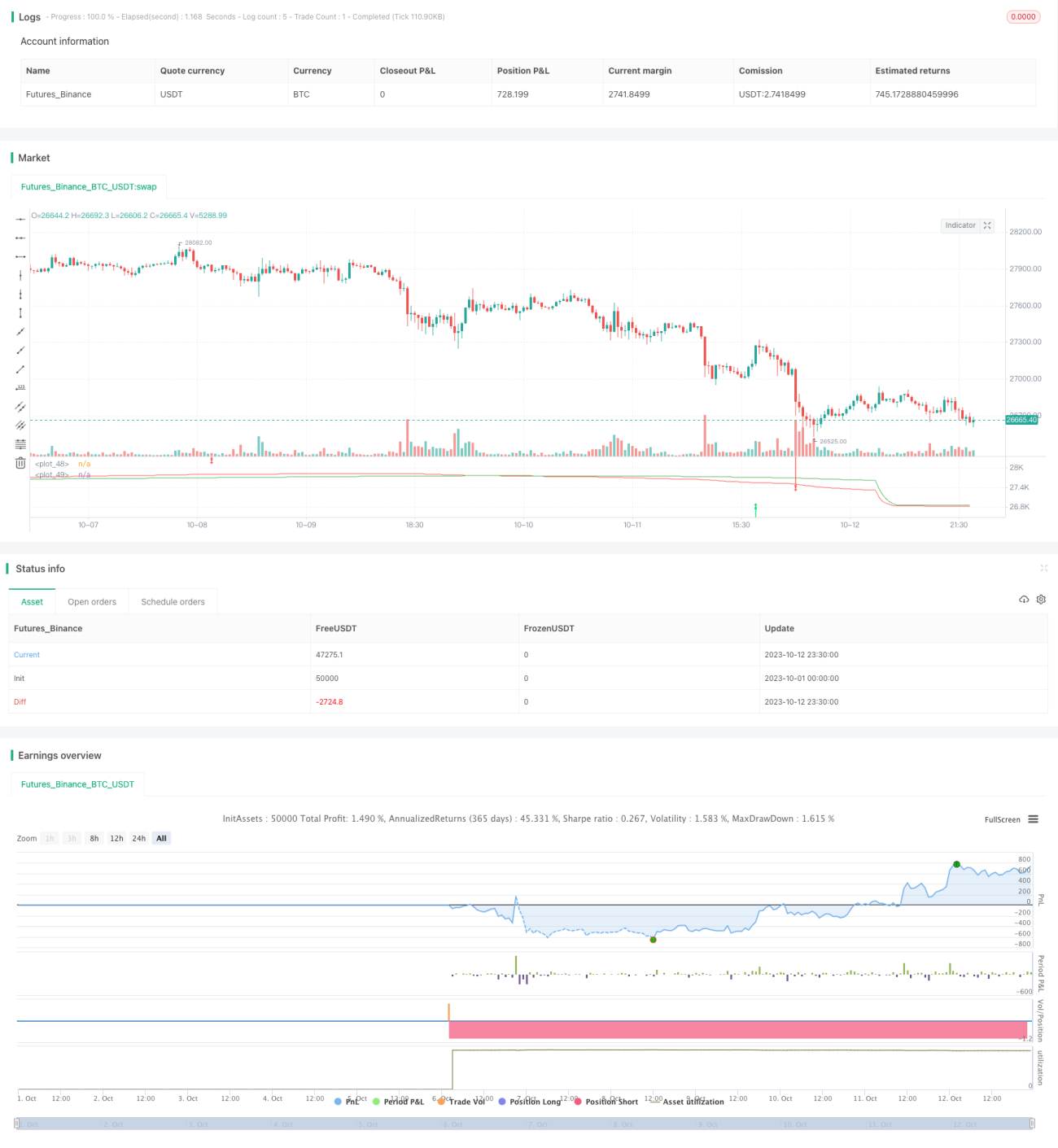
A estratégia combina o indicador de média móvel e o indicador de supertrend, permitindo uma estratégia de acompanhamento de tendências com a função de parada de perdas. A estratégia aproveita ao máximo a capacidade de discernimento de tendências das médias móveis e a função de parada de supertrends para acompanhar a tendência de forma eficaz e, ao mesmo tempo, controlar o risco.
A estratégia usa duas linhas médias FRAMA para julgar sinais de compra e venda e filtragem em combinação com indicadores de tendência super.
Concretamente, quando a linha rápida atravessa a linha lenta, gera um sinal de compra, e quando a linha rápida atravessa a linha lenta, gera um sinal de venda. Para evitar uma falsa ruptura, a estratégia adiciona uma condição de filtragem do indicador de tendência super, que só é negociada quando o indicador de tendência super é sincronizado.
Na gestão de posições, a estratégia usa a mudança do indicador de tendência super como sinal de parada de perda. Quando o indicador de tendência super se reverte, a saída de parada de perda é realizada.
Além disso, a estratégia também possui uma opção de tracking stop loss. Depois de atingir um determinado lucro, você pode ativar o tracking stop loss para bloquear o lucro.
Os riscos podem ser reduzidos através da adaptação dos parâmetros das médias móveis, da otimização da configuração dos indicadores de tendências superficiais e do uso racional de tracking stops.
A estratégia pode ser melhorada em vários aspectos:
A combinação de diferentes parâmetros de ciclo pode ser testada para encontrar o melhor equilíbrio entre o efeito suave e a sensibilidade.
É possível testar diferentes ciclos de ATR e parâmetros de multiplicadores para otimizar o efeito de stop loss.
Pode-se testar a adição de indicadores de canal de mercadorias, indicadores de taxa de flutuação, etc. para filtrar ainda mais os sinais.
É possível testar diferentes tracking stop loss amplitudes para encontrar os melhores parâmetros para maximizar o lucro e o controle de risco.
Pode ser testado em combinação com outras estratégias, tais como parada geral, parada por vibração e parada por movimento.
A estratégia integra o julgamento de tendências de médias móveis e o gerenciamento de perdas de supertrends, formando uma estratégia de acompanhamento de tendências mais completa com a função de rastreamento de perdas. A estabilidade e a lucratividade da estratégia podem ser aumentadas ainda mais com a otimização de parâmetros e o gerenciamento de risco. A estratégia é adequada para o uso de comerciantes de quantificação com uma certa base.
/*backtest
start: 2023-10-01 00:00:00
end: 2023-10-13 00:00:00
period: 30m
basePeriod: 15m
exchanges: [{"eid":"Futures_Binance","currency":"BTC_USDT"}]
*/
// This source code is subject to the terms of the Mozilla Public License 2.0 at https://mozilla.org/MPL/2.0/
// © 03.freeman
//@version=4
// strategy("FRAMA strategy", overlay=true,precision=6, initial_capital=1000,calc_on_every_tick=true, pyramiding=0, default_qty_type=strategy.fixed, default_qty_value=10000, currency=currency.EUR)
ma_src = input(title="MA FRAMA Source", type=input.source, defval=close)
ma_frama_len = input(title="MA FRAMA Length", type=input.integer, defval=12)
res = input(title="Resolution", type=input.resolution, defval="1W")
frama_FC = input(defval=1,minval=1, title="* Fractal Adjusted (FRAMA) Only - FC")
frama_SC = input(defval=200,minval=1, title="* Fractal Adjusted (FRAMA) Only - SC")
High = security(syminfo.tickerid, res, high)
Low = security(syminfo.tickerid, res, low)
source = security(syminfo.tickerid, res, ma_src)
enterRule = input(false,title = "Use supertrend for enter")
exitRule = input(false,title = "Use supertrend for exit")
ma(src, len) =>
float result = 0
int len1 = len/2
e = 2.7182818284590452353602874713527
w = log(2/(frama_SC+1)) / log(e) // Natural logarithm (ln(2/(SC+1))) workaround
H1 = highest(High,len1)
L1 = lowest(Low,len1)
N1 = (H1-L1)/len1
H2_ = highest(High,len1)
H2 = H2_[len1]
L2_ = lowest(Low,len1)
L2 = L2_[len1]
N2 = (H2-L2)/len1
H3 = highest(High,len)
L3 = lowest(Low,len)
N3 = (H3-L3)/len
dimen1 = (log(N1+N2)-log(N3))/log(2)
dimen = iff(N1>0 and N2>0 and N3>0,dimen1,nz(dimen1[1]))
alpha1 = exp(w*(dimen-1))
oldalpha = alpha1>1?1:(alpha1<0.01?0.01:alpha1)
oldN = (2-oldalpha)/oldalpha
N = (((frama_SC-frama_FC)*(oldN-1))/(frama_SC-1))+frama_FC
alpha_ = 2/(N+1)
alpha = alpha_<2/(frama_SC+1)?2/(frama_SC+1):(alpha_>1?1:alpha_)
frama = 0.0
frama :=(1-alpha)*nz(frama[1]) + alpha*src
result := frama
result
frama = ma(sma(source,1),ma_frama_len)
signal = ma(frama,ma_frama_len)
plot(frama, color=color.red)
plot(signal, color=color.green)
longCondition = crossover(frama,signal)
shortCondition = crossunder(frama,signal)
Factor=input(3, minval=1,maxval = 100)
Pd=input(7, minval=1,maxval = 100)
Up=hl2-(Factor*atr(Pd))
Dn=hl2+(Factor*atr(Pd))
TrendUp = 0.0
TrendDown = 0.0
Trend = 0.0
Tsl = 0.0
TrendUp :=close[1]>TrendUp[1]? max(Up,TrendUp[1]) : Up
TrendDown :=close[1]<TrendDown[1]? min(Dn,TrendDown[1]) : Dn
Trend := close > TrendDown[1] ? 1: close< TrendUp[1]? -1: nz(Trend[1],1)
Tsl := Trend==1? TrendUp: TrendDown
linecolor = Trend == 1 ? color.green : color.red
//plot(Tsl, color = linecolor , style = plot.style_line , linewidth = 2,title = "SuperTrend")
plotshape(cross(close,Tsl) and close>Tsl , "Up Arrow", shape.triangleup,location.belowbar,color.green,0,0)
plotshape(cross(Tsl,close) and close<Tsl , "Down Arrow", shape.triangledown , location.abovebar, color.red,0,0)
plotarrow(Trend == 1 and Trend[1] == -1 ? Trend : na, title="Up Entry Arrow", colorup=color.lime, maxheight=60, minheight=50, transp=0)
plotarrow(Trend == -1 and Trend[1] == 1 ? Trend : na, title="Down Entry Arrow", colordown=color.red, maxheight=60, minheight=50, transp=0)
// Strategy: (Thanks to JayRogers)
// === STRATEGY RELATED INPUTS ===
//tradeInvert = input(defval = false, title = "Invert Trade Direction?")
// the risk management inputs
inpTakeProfit = input(defval = 0, title = "Take Profit Points", minval = 0)
inpStopLoss = input(defval = 0, title = "Stop Loss Points", minval = 0)
inpTrailStop = input(defval = 0, title = "Trailing Stop Loss Points", minval = 0)
inpTrailOffset = input(defval = 0, title = "Trailing Stop Loss Offset Points", minval = 0)
// === RISK MANAGEMENT VALUE PREP ===
// if an input is less than 1, assuming not wanted so we assign 'na' value to disable it.
useTakeProfit = inpTakeProfit >= 1 ? inpTakeProfit : na
useStopLoss = inpStopLoss >= 1 ? inpStopLoss : na
useTrailStop = inpTrailStop >= 1 ? inpTrailStop : na
useTrailOffset = inpTrailOffset >= 1 ? inpTrailOffset : na
// === STRATEGY - LONG POSITION EXECUTION ===
enterLong() => enterRule? (longCondition and Trend ==1):longCondition // functions can be used to wrap up and work out complex conditions
exitLong() => exitRule and Trend == -1
strategy.entry(id = "Buy", long = true, when = enterLong() ) // use function or simple condition to decide when to get in
strategy.close(id = "Buy", when = exitLong() ) // ...and when to get out
// === STRATEGY - SHORT POSITION EXECUTION ===
enterShort() => enterRule? (shortCondition and Trend ==-1):shortCondition
exitShort() => exitRule and Trend == 1
strategy.entry(id = "Sell", long = false, when = enterShort())
strategy.close(id = "Sell", when = exitShort() )
// === STRATEGY RISK MANAGEMENT EXECUTION ===
// finally, make use of all the earlier values we got prepped
strategy.exit("Exit Buy", from_entry = "Buy", profit = useTakeProfit, loss = useStopLoss, trail_points = useTrailStop, trail_offset = useTrailOffset)
strategy.exit("Exit Sell", from_entry = "Sell", profit = useTakeProfit, loss = useStopLoss, trail_points = useTrailStop, trail_offset = useTrailOffset)
// === Backtesting Dates === thanks to Trost
testPeriodSwitch = input(false, "Custom Backtesting Dates")
testStartYear = input(2020, "Backtest Start Year")
testStartMonth = input(1, "Backtest Start Month")
testStartDay = input(1, "Backtest Start Day")
testStartHour = input(0, "Backtest Start Hour")
testPeriodStart = timestamp(testStartYear,testStartMonth,testStartDay,testStartHour,0)
testStopYear = input(2020, "Backtest Stop Year")
testStopMonth = input(12, "Backtest Stop Month")
testStopDay = input(31, "Backtest Stop Day")
testStopHour = input(23, "Backtest Stop Hour")
testPeriodStop = timestamp(testStopYear,testStopMonth,testStopDay,testStopHour,0)
testPeriod() =>
time >= testPeriodStart and time <= testPeriodStop ? true : false
isPeriod = true
// === /END
if not isPeriod
strategy.cancel_all()
strategy.close_all()