Estratégia de tendência de curto prazo baseada na tomada de decisão de indicadores multidimensionais


Data de criação: 2023-10-25 15:31:30 última modificação: 2023-10-25 15:31:30
cópia: 0 Cliques: 615
1
focar em
1617
Seguidores

Estratégia de tendência de curto prazo baseada na tomada de decisão de indicadores multidimensionais

Visão geral

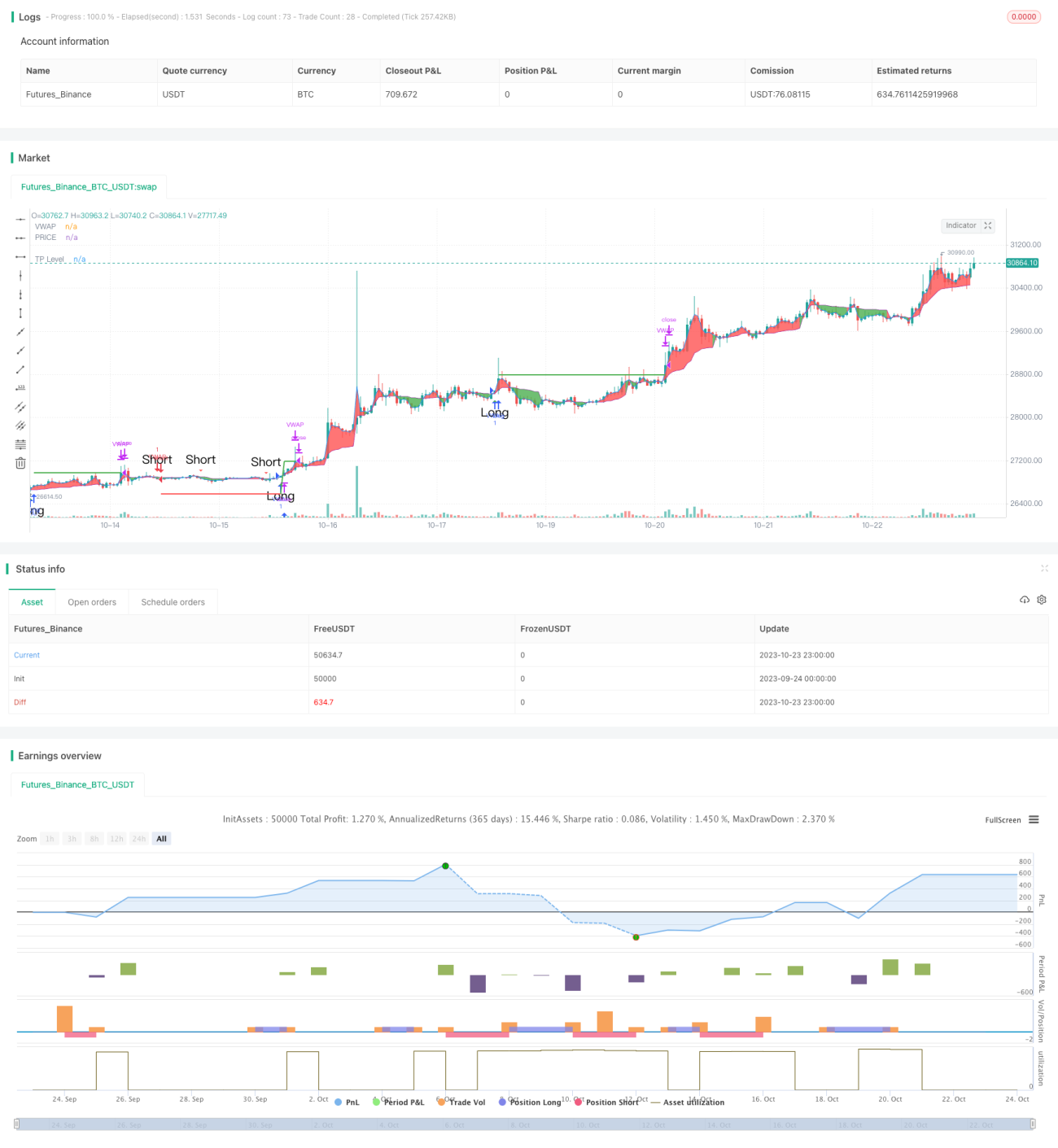
A estratégia combina três dimensões diferentes de indicadores técnicos, o nível de resistência de suporte, o sistema de linha média e o indicador de sobrevenda e sobrevenda, para determinar a direção da tendência de curto prazo com base em seus sinais combinados, a fim de obter uma maior taxa de vitória.

Princípio da estratégia

O código primeiro calcula os pontos de resistência de suporte do preço, incluindo o eixo de oscilação padrão e os pontos de resistência de suporte de Fibonacci, e os traça em um gráfico. Quando o preço quebra esses pontos críticos, é considerado um sinal de tendência importante.

Em seguida, calcula-se a média móvel ponderada VWAP e o preço médio para julgar os sinais de cruzamento dourado e de morte. Isso é um julgamento de tendência de médio e longo prazo.

Finalmente, o Stochastic RSI é calculado para avaliar se o sinal de cruzamento do ouro e o sinal de forca morta pertencem ao indicador de overbought/oversold.

Combinando esses três indicadores, se o suporte de resistência, a linha média VWAP e o RSI estocástico emitirem sinais de compra ao mesmo tempo, será aberto mais; se os três emitirem sinais de venda ao mesmo tempo, será aberto.

Análise de vantagens

A maior vantagem da estratégia é que a combinação de três diferentes dimensões de indicadores, para que o julgamento mais abrangente e mais preciso, maior probabilidade de vitória. Em primeiro lugar, apoiar o ponto de resistência para julgar a tendência maior; em seguida, o VWAP julgar a tendência de linha média longa; e, finalmente, o Stochastic RSI julgar o supermercado sobrevendas.

Além disso, a estratégia inclui a função de bloqueio, que permite bloquear uma determinada porcentagem de receita, o que é útil para a gestão de fundos.

Análise de Riscos

O principal risco desta estratégia é que a tomada de decisão em excesso depende de sinais de indicadores em sincronia, o que pode levar a erros de decisão se alguns indicadores emitirem sinais errados. Por exemplo, o RSI estocástico emite um sinal de supercompra, mas o VWAP e a resistência de suporte ainda são pessimistas, e nesse momento pode perder o ponto de compra e não entrar em jogo.

Além disso, a configuração inadequada dos parâmetros do indicador também pode levar a erros de julgamento do sinal, e é necessário encontrar o parâmetro ideal através da repetição do teste.

Além disso, o mercado de ações frequentemente tem eventos de cisne negro em curto prazo, o que leva o indicador a falhar. Para evitar esse risco, pode-se adotar uma estratégia de parada de perdas para evitar perdas individuais excessivas.

Direção de otimização

A estratégia pode ser melhorada nos seguintes aspectos:

  1. Adicionar mais sinais de indicadores, como indicadores de volume de negócios, para avaliar a força e a fraqueza das tendências e melhorar a precisão das decisões.

  2. Adicionar modelos de aprendizado de máquina, treinamento em indicadores multidimensionais e busca automática de estratégias de negociação ótimas.

  3. Optimização de acordo com os parâmetros de diferentes variedades, configuração de parâmetros de adaptação.

  4. Aumentar a estratégia de stop loss e controlar melhor o risco com base no tamanho da posição de controle de retirada.

  5. Optimizar o agrupamento, encontrar variedades de baixa relevância para agrupamento e reduzir o recuo do agrupamento.

Resumir

A estratégia é muito adequada para a negociação de tendências de curto prazo. Ela usa indicadores multidimensionais para tomar decisões, pode filtrar um grande número de ruídos e tem uma alta taxa de vitória. No entanto, é necessário ter em mente o risco de que os indicadores enviem sinais errados.

Código-fonte da estratégia
/*backtest
start: 2023-09-24 00:00:00
end: 2023-10-24 00:00:00
period: 1h
basePeriod: 15m
exchanges: [{"eid":"Futures_Binance","currency":"BTC_USDT"}]
*/

// EmperorBTC's VWAP Indicator & Strategy
//              v2.1
// 
//      coded by Bogdan Vaida

// This indicator was created after EmperorBTC's conditions on Twitter. 
// Good timeframes for it: 30', 15', 5'
// To convert from strategy to study switch the commented lines in the beginning
// and at the end of the script and vice versa.

// What this indicator does is to check if:
// o Pivot Point was crossed
// o Stoch-RSI and VWAP were crossed in current or previous candle
// o Candle (or previous candle) close is in the trend direction
// If all these are true then it will go long or short based on direction.


// FUTURE IDEAS: 
//  - Volume Expansion
//  - Candle Stick patterns

//@version=4

// 🔥Uncomment the line below for the indicator and comment the strategy lines
// study(title="EmperorBTC's VWAP Indicator", shorttitle="EMP-VWAP", overlay=true)

// 🔥 Uncomment the line below for the strategy and comment the above line
strategy(title="EmperorBTC's VWAP Strategy", shorttitle="EMP-VWAP", overlay=true, pyramiding=1)

plotAveragePriceCrossedPivotPoint = input(false, title="Plot Close Price Crossing Pivot Points?", group="Pivot Points")
plotPivotPoints = input(false, title="Plot Pivot Points?", group="Pivot Points")
pivotPointsType = input(title="Pivot Points type", defval="Fibonacci", options=["Fibonacci", "Traditional"], group="Pivot Points")

pivotPointCircleWidth = input(2, title="Width of Pivot Point circles", minval=1, group="Pivot Points")

plotVWAP = input(true, title="Plot VWAP?", group="VWAP")
plotAvgPrice = input(true, title="Plot Average Price?", group="VWAP")
plotVWAPCrossPrice = input(false, title="Plot Price Crossing VWAP?", group="VWAP")
reso = input(title="Period", type=input.resolution, defval="D", group="VWAP")
cumulativePeriod = input(14, "VWAP Cumulative Period", group="VWAP")

plotStochRSICross = input(false, title="Plot StochRSI Cross?", group="StochRSI")
smoothK = input(3, "K", minval=1, group="StochRSI", inline="K&D")
smoothD = input(3, "D", minval=1, group="StochRSI", inline="K&D")
lengthRSI = input(14, "RSI Length", minval=1, group="Stochastic-RSI", inline="length")
lengthStoch = input(14, "Stochastic Length", minval=1, group="Stochastic-RSI", inline="length")
rsiSrc = input(close, title="RSI Source", group="Stochastic-RSI")

plotLong = input(true, title="Plot Long Opportunity?", group="Strategy only")
plotShort = input(true, title="Plot Short Opportunity?", group="Strategy only")
tradingDirection = input(title="Strategy trading Direction: ", defval="L&S", options=["L&S", "L", "S"], group="Strategy only")
takeProfit = input(1.0, title='Take Profit %', group="Strategy only") / 100
plotTP = input(true, title="Plot Take Profit?", group="Strategy only")
startDate = input(title="Start Date", type=input.integer,
     defval=1, minval=1, maxval=31, group="Backtesting range", inline="Start Date")
startMonth = input(title="Start Month", type=input.integer,
     defval=1, minval=1, maxval=12, group="Backtesting range", inline="Start Date")
startYear = input(title="Start Year", type=input.integer,
     defval=2017, minval=1800, maxval=2100, group="Backtesting range", inline="Start Date")
endDate = input(title="End Date", type=input.integer,
     defval=31, minval=1, maxval=31, group="Backtesting range", inline="End Date")
endMonth = input(title="End Month", type=input.integer,
     defval=12, minval=1, maxval=12, group="Backtesting range", inline="End Date")
endYear = input(title="End Year", type=input.integer,
     defval=2050, minval=1800, maxval=2100, group="Backtesting range", inline="End Date")


// PivotPoint code (PVTvX by DGT has some nice code on PP)
candleHigh  = security(syminfo.tickerid,"D", high[1], lookahead=barmerge.lookahead_on)
candleLow   = security(syminfo.tickerid,"D", low[1], lookahead=barmerge.lookahead_on)
candleClose = security(syminfo.tickerid,"D", close[1], lookahead=barmerge.lookahead_on)

pivotPoint = (candleHigh+candleLow+candleClose) / 3

float resistance1 = na
float resistance2 = na
float resistance3 = na
float support1 = na
float support2 = na
float support3 = na

if pivotPointsType == "Fibonacci"
    resistance1 := pivotPoint + 0.382 * (candleHigh - candleLow)
    resistance2 := pivotPoint + 0.618 * (candleHigh - candleLow)
    resistance3 := pivotPoint + (candleHigh - candleLow)
    support1 := pivotPoint - 0.382 * (candleHigh - candleLow)
    support2 := pivotPoint - 0.618 * (candleHigh - candleLow)
    support3 := pivotPoint - (candleHigh - candleLow)
else if pivotPointsType == "Traditional"
    resistance1 := 2 * pivotPoint - candleLow
    resistance2 := pivotPoint + (candleHigh - candleLow)
    resistance3 := candleHigh + 2 * (pivotPoint - candleLow) 
    support1 := 2 * pivotPoint - candleHigh
    support2 := pivotPoint - (candleHigh - candleLow)
    support3 := candleLow - 2 * (candleHigh - pivotPoint)

plot(series = plotPivotPoints ? support1 : na, color=#ff0000, title="S1", style = plot.style_circles, linewidth = pivotPointCircleWidth)
plot(series = plotPivotPoints ? support2 : na, color=#800000, title="S2", style = plot.style_circles, linewidth = pivotPointCircleWidth)
plot(series = plotPivotPoints ? support3 : na, color=#330000, title="S3", style = plot.style_circles, linewidth = pivotPointCircleWidth)
plot(series = plotPivotPoints ? pivotPoint : na, color=#FFA500, title="PP", style = plot.style_circles, linewidth = pivotPointCircleWidth)
plot(series = plotPivotPoints ? resistance1 : na, color=#00FF00, title="R1", style = plot.style_circles, linewidth = pivotPointCircleWidth)
plot(series = plotPivotPoints ? resistance2 : na, color=#008000, title="R2", style = plot.style_circles, linewidth = pivotPointCircleWidth)
plot(series = plotPivotPoints ? resistance3 : na, color=#003300, title="R3", style = plot.style_circles, linewidth = pivotPointCircleWidth)

pivotPointCrossedUp = ((low < support3) and (close > support3)) or ((low < support2) and (close > support2)) or ((low < support1) and (close > support1)) or  ((low < pivotPoint) and (close > pivotPoint))
pivotPointCrossedDown = ((high > support3) and (close < support3)) or ((high > support2) and (close < support2)) or ((high > support1) and (close < support1)) or  ((high > pivotPoint) and (close < pivotPoint))
plotPPColor = pivotPointCrossedUp ? color.green :
     pivotPointCrossedDown ? color.red :
     na

plotshape(series = plotAveragePriceCrossedPivotPoint ? (pivotPointCrossedUp or pivotPointCrossedDown) : na, title="PP Cross", style = shape.triangleup, location=location.belowbar, color=plotPPColor, text="PP", size=size.small)

// VWAP (taken from the TV code)
// There are five steps in calculating VWAP:
//
// 1. Calculate the Typical Price for the period. [(High + Low + Close)/3)]
// 2. Multiply the Typical Price by the period Volume (Typical Price x Volume)
// 3. Create a Cumulative Total of Typical Price. Cumulative(Typical Price x Volume)
// 4. Create a Cumulative Total of Volume. Cumulative(Volume)
// 5. Divide the Cumulative Totals. 
//
// VWAP = Cumulative(Typical Price x Volume) / Cumulative(Volume)

// Emperor's Edition
t = time(reso)
debut = na(t[1]) or t > t[1]

addsource = ohlc4 * volume
addvol = volume
addsource := debut ? addsource : addsource + addsource[1]
addvol := debut ? addvol : addvol + addvol[1]
vwapValue = addsource / addvol

pVWAP = plot(series = plotVWAP ? vwapValue : na, color=color.purple, title="VWAP")
pAvgPrice = plot(series = plotAvgPrice ? ohlc4 : na, color=color.blue, title="PRICE")
fill(pVWAP, pAvgPrice, color = ohlc4 > vwapValue ? color.red : color.green, title="VWAP PRICE FILL")

vwapCrossUp = (low < vwapValue) and (vwapValue < high) and (close > open) // added green candle check
vwapCrossDown = (high > vwapValue) and (vwapValue > low) and (close < open) // added red candle check

plotVWAPColor = vwapCrossUp ? color.green :
     vwapCrossDown ? color.red :
     na
plotshape(series = plotVWAPCrossPrice ? (vwapCrossUp or vwapCrossDown) : na, title="VWAP Cross Price", style=shape.triangleup, location=location.belowbar, color=plotVWAPColor, text="VWAP", size=size.small)


// Stochastic RSI

rsi1 = rsi(rsiSrc, lengthRSI)
k = sma(stoch(rsi1, rsi1, rsi1, lengthStoch), smoothK)
d = sma(k, smoothD)

sRsiCrossUp = k[1] < d[1] and k > d
sRsiCrossDown = k[1] > d[1] and k < d

plotColor = sRsiCrossUp ? color.green :
     sRsiCrossDown ? color.red :
     na
plotshape(series = plotStochRSICross ? (sRsiCrossUp or sRsiCrossDown) : na, title="StochRSI Cross Up", style=shape.triangleup, location=location.belowbar, color=plotColor, text="StochRSI", size=size.small)

// Long Trades
sRsiCrossedUp = sRsiCrossUp or sRsiCrossUp[1]
vwapCrossedUp = vwapCrossUp or vwapCrossUp[1]
// longCond1 = (sRsiCross and vwapCross) or (sRsiCross[1] and vwapCross) or (sRsiCross and vwapCross[1])
longCond1 = (sRsiCrossedUp[1] and vwapCrossedUp[1])
longCond2 = pivotPointCrossedUp[1]
longCond3 = (close[1] > open[1]) and (close > open) // check this
longCond = longCond1 and longCond2 and longCond3
plotshape(series = plotLong ? longCond : na, title="Long", style=shape.triangleup, location=location.belowbar, color=color.green, text="Long", size=size.normal)

// Short Trades
sRsiCrossedDown = sRsiCrossDown or sRsiCrossDown[1]
vwapCrossedDown = vwapCrossDown or vwapCrossDown[1]
shortCond1 = (sRsiCrossedDown[1] and vwapCrossedDown[1])
shortCond2 = pivotPointCrossedDown[1]
shortCond3 = (close[1] < open[1]) and (close < open)
shortCond = shortCond1 and shortCond2 and shortCond3
plotshape(series = plotShort ? shortCond : na, title="Short", style=shape.triangledown, location=location.abovebar, color=color.red, text="Short", size=size.normal)

// alertcondition(condition=longCond, title="Long", message="Going long")
// alertcondition(condition=shortCond, title="Short", message="Going short")

// 🔥 Uncomment the lines below for the strategy and revert for the study
takeProfitLong     = strategy.position_avg_price * (1 + takeProfit)
takeProfitShort     = strategy.position_avg_price * (1 - takeProfit)
exitTp = ((strategy.position_size > 0) and (close > takeProfitLong)) or ((strategy.position_size < 0) and (close < takeProfitShort))
strategy.risk.allow_entry_in(tradingDirection == "L" ? strategy.direction.long : tradingDirection == "S" ? strategy.direction.short : strategy.direction.all)
plot(series = (plotTP and strategy.position_size > 0) ? takeProfitLong : na, title="TP Level",color=color.green, style=plot.style_linebr, linewidth=2)
plot(series = (plotTP and strategy.position_size < 0) ? takeProfitShort : na, title="TP Level",color=color.red, style=plot.style_linebr, linewidth=2)
inDateRange = (time >= timestamp(syminfo.timezone, startYear,
         startMonth, startDate, 0, 0)) and (time < timestamp(syminfo.timezone, endYear, endMonth, endDate, 0, 0))
strategy.entry("VWAP", strategy.long, comment="Long", when=longCond and inDateRange)
strategy.entry("VWAP", strategy.short, comment="Short", when=shortCond and inDateRange)
strategy.close(id="VWAP", when=exitTp)
if (not inDateRange)
    strategy.close_all()