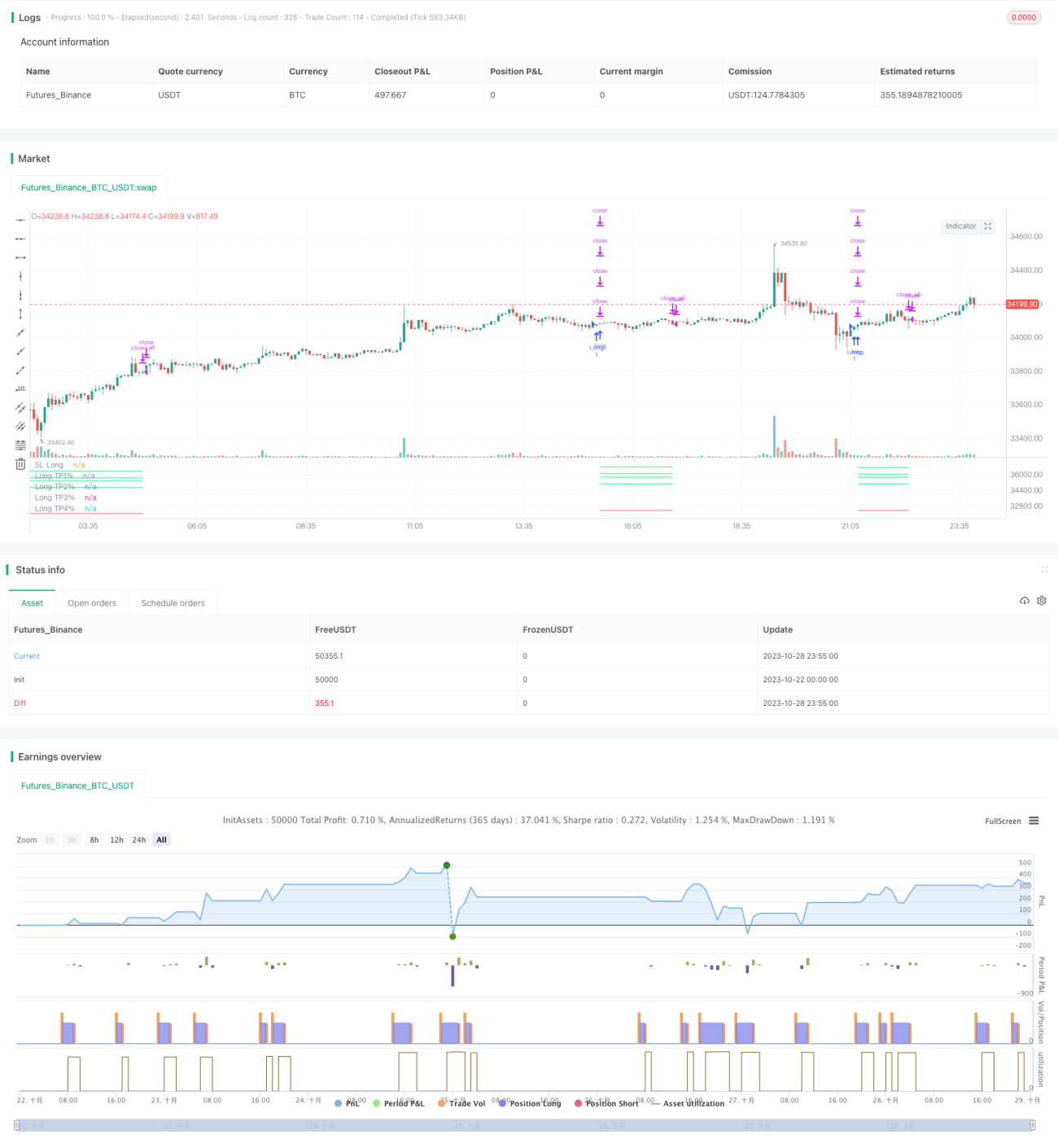
A estratégia visa realizar o gerenciamento de paradas em vários períodos de tempo. A estratégia utiliza simultaneamente paradas de porcentagem e paradas de áreas de preço-chave acima dos períodos de tempo principais, para gerenciamento de paradas mais preciso e eficaz.
A estratégia introduziu primeiro o indicador de tendência de ondas, com entrada de múltiplos sinais de acordo com o indicador Gold Forks.
No que diz respeito à gestão de bloqueios, a estratégia utiliza dois tipos de bloqueio:
Parâmetros de porcentagem: Configure vários parâmetros de porcentagem do preço de entrada.
Paradas de quadros de tempo múltiplos: trace uma linha média sobre a linha diária e a linha de 4 horas, e pegue o preço dessas linhas médias como o preço de parada.
Para a parada percentual, a estratégia define 4 preços de parada percentual diferentes. Quando o preço toca cada preço de parada, a posição é parcialmente liquidada de acordo com a porcentagem definida.
Para paradas de quadros de tempo múltiplos, a estratégia é traçar a média de 100 dias e a média de 200 dias, respectivamente, na linha diária e na linha de 4 horas. Pegue o preço dessas linhas médias como o preço de parada e feche a posição quando o preço atingir.
Além disso, a estratégia também estabelece um preço de stop loss. Quando o preço é inferior ao preço de stop loss, todos os posicionamentos são eliminados.
Toda a estratégia permite um gerenciamento mais abrangente e refinado do tempo de espera, através da combinação de um tempo de espera percentual e um tempo de espera de múltiplos quadros.
O uso de um percentual de esterilização, de acordo com uma proporção fixa de esterilização, para evitar esterilização prematura ou insuficiente.
Com a análise de multi-quadros de tempo, é possível definir preços de parada mais precisos e escolher pontos de parada melhores.
A redução do risco pode ser feita por meio da aplicação de vários níveis de estímulo, que podem ser divididos em grupos.
Estabelecer um preço de stop loss para controlar o risco de queda.
A combinação de estenose por percentual e estenose por multi-quadros de tempo permite uma estenose mais completa e mais refinada.
A porcentagem de parada depende da configuração dos parâmetros, e se os parâmetros forem mal definidos, isso pode causar parada prematura ou tardia.
A análise de multi-quadros de tempo depende do indicador de linha média, que tem um certo atraso e pode se desviar.
A configuração errada do ponto de parada pode causar uma parada desnecessária.
Os parâmetros precisam ser apropriadamente otimizados para obter a melhor correspondência entre a estenose porcentual e a estenose por múltiplos períodos de tempo.
Pode-se testar mais indicadores de média, escolhendo a média mais favorável como o preço de parada-chave.
Pode-se experimentar métodos de previsão de modelos, prevendo áreas críticas de preços como preços de parada.
Pode-se introduzir mais regras de bloqueio, como proporção de bloqueio esperado, bloqueio móvel, etc., para que o bloqueio seja mais abrangente.
Pode testar o parâmetro de paralisação da porcentagem ideal em diferentes períodos de posse.
Pode-se otimizar os parâmetros de suspensão por meio da retrospectiva, tornando o risco-benefício geral superior.
Esta estratégia permite um gerenciamento de parada flexível e preciso por meio da combinação de parada porcentual e parada por vários períodos de tempo. A estratégia possui vantagens como uma melhor escolha do ponto de parada e uma parada mais abrangente.
/*backtest
start: 2023-10-22 00:00:00
end: 2023-10-29 00:00:00
period: 5m
basePeriod: 1m
exchanges: [{"eid":"Futures_Binance","currency":"BTC_USDT"}]
*/
// This source code is subject to the terms of the Mozilla Public License 2.0 at https://mozilla.org/MPL/2.0/
// © TrendCrypto2022
//@version=5
// strategy("Take profit Multi timeframe", overlay=true, margin_long=100, margin_short=100)
takepercent = input.bool(title="Take profit %", defval=true ,group="Set up take profit")
takemtf = input.bool(title="Take profit Multi timeframe", defval=false ,group="Set up take profit")
//Paste your strategy at here. This is example strategy. I use WaveTrend indicator
//WaveTrend indicator
n1 = input(10, "Channel Length")
n2 = input(21, "Average Length")
oblv1 = input(60, "Over Bought Lv 1")
oblv2 = input(53, "Over Bought Lv 2")
oslv1 = input(-60, "Over Sold Lv 1")
oslv2 = input(-53, "Over Sold Lv 2")
ap = hlc3
esa = ta.ema(ap, n1)
d = ta.ema(math.abs(ap - esa), n1)
ci = (ap - esa) / (0.015 * d)
tci = ta.ema(ci, n2)
wt1 = tci
wt2 = ta.sma(wt1,4)
//Strategy
buy = ta.crossover(wt1, wt2) and wt1 < -40
if (buy)
strategy.entry("Long", strategy.long)
//Resistant in time D and 4H
ema_len1 = input.int(title='Ema1', defval=100, group='Take profit Mtf')
ema_len2 = input.int(title='Ema2', defval=200, group='Take profit Mtf')
src = input.source(title='Source', defval=close, group='Take profit Mtf')
tf1 = input.timeframe(title='Time frame 1', defval='240', group='Take profit Mtf')
tf2 = input.timeframe(title='Time frame 2', defval='D', group='Take profit Mtf')
htf_ma1 = ta.ema(src, ema_len1)
htf_ma2 = ta.ema(src, ema_len2)
ema1 = request.security(syminfo.tickerid, tf1, htf_ma1)
ema2 = request.security(syminfo.tickerid, tf1, htf_ma2)
ema3 = request.security(syminfo.tickerid, tf2, htf_ma1)
ema4 = request.security(syminfo.tickerid, tf2, htf_ma2)
//Plot
plotema1 = plot(ema1, color=color.new(color.silver, 0), style=plot.style_line, linewidth=1, offset=0, title='Ema100 4h', display=display.none)
plotema2 = plot(ema2, color=color.new(color.silver, 0), style=plot.style_line, linewidth=1, offset=0, title='Ema200 4h', display=display.none)
plotema3 = plot(ema3, color=color.new(color.orange, 20), style=plot.style_line, linewidth=1, offset=0, title='Ema100 D', display=display.none)
plotema4 = plot(ema4, color=color.new(color.orange, 20), style=plot.style_line, linewidth=1, offset=0, title='Ema200 D', display=display.none)
//Label take profit multitime frame
var label labelema1 = na
label.delete(labelema1)
labelema1 := label.new(x=time + 120, y=ema1, text='\n*****Ema100 4H: ' + str.tostring(math.round(ema1,4)) + '', color=color.new(#000000, 100), textcolor = color.yellow, size=size.small, style=label.style_label_left, xloc=xloc.bar_time, yloc=yloc.price)
var label labelema2 = na
label.delete(labelema2)
labelema2 := label.new(x=time + 120, y=ema2, text='\n*****Ema200 4H: ' + str.tostring(math.round(ema2,4)) + '', color=color.new(#000000, 100), textcolor = color.yellow, size=size.small, style=label.style_label_left, xloc=xloc.bar_time, yloc=yloc.price)
var label labelema3 = na
label.delete(labelema3)
labelema3 := label.new(x=time + 120, y=ema3, text='\n*****Ema100 1D: ' + str.tostring(math.round(ema3,4)) + '', color=color.new(#000000, 100), textcolor = color.yellow, size=size.small, style=label.style_label_left, xloc=xloc.bar_time, yloc=yloc.price)
var label labelema4 = na
label.delete(labelema4)
labelema4 := label.new(x=time + 120, y=ema4, text='\n*****Ema200 1D: ' + str.tostring(math.round(ema4,4)) + '', color=color.new(#000000, 100), textcolor = color.yellow, size=size.small, style=label.style_label_left, xloc=xloc.bar_time, yloc=yloc.price)
//Set up take profit %
percent(pcnt) =>
strategy.position_size != 0 ? math.round(pcnt / 100 * strategy.position_avg_price / syminfo.mintick) : float(na)
TP1=input.float(3, title="TP1 %", step=0.1, group="Take profit %")
TP2=input.float(5, title="TP2 %", step=1, group="Take profit %")
TP3=input.float(6, title="TP3 %", step=1, group="Take profit %")
TP4=input.float(8, title="TP4 %", step=1, group="Take profit %")
SL=input.float(5, title="Stop Loss %", step=1, group="Take profit %")
qty1=input.float(5, title="% Close At TP1", step=1, group="Take profit %")
qty2=input.float(5, title="% Close At TP2", step=1, group="Take profit %")
qty3=input.float(5, title="% Close At TP3", step=1, group="Take profit %")
qty4=input.float(5, title="% Close At TP4", step=1, group="Take profit %")
lossPnt_L = percent(SL)
//Set up take profit multi timeframe
a = array.from((ema1), (ema2), (ema3), (ema4))
tpmtf1 = array.min(a)
tpmtf2 = array.min(a, 2)
tpmtf3 = array.min(a, 3)
tpmtf4 = array.min(a, 4)
//Set up exit
long_sl_level = strategy.position_avg_price - lossPnt_L*syminfo.mintick
if takepercent == true
strategy.exit("TP1%", "Long", qty_percent = qty1, profit = percent(TP1), loss = lossPnt_L)
strategy.exit("TP2%", "Long", qty_percent = qty2, profit = percent(TP2), loss = lossPnt_L)
strategy.exit("TP3%", "Long", qty_percent = qty3, profit = percent(TP3), loss = lossPnt_L)
strategy.exit("TP4%", "Long", qty_percent = qty4, profit = percent(TP3), loss = lossPnt_L)
strategy.close_all(when= ta.crossunder(wt1, wt2) and wt1 > 0, comment="Close All")
if takemtf == true and array.max(a, 1) > strategy.position_avg_price
strategy.exit("TP1Mtf", "Long", qty_percent = qty1, limit = tpmtf1, stop = long_sl_level)
strategy.exit("TP2Mtf", "Long", qty_percent = qty2, limit = tpmtf2, stop = long_sl_level)
strategy.exit("TP3Mtf", "Long", qty_percent = qty3, limit = tpmtf3, stop = long_sl_level)
strategy.close_all(when= ta.crossunder(wt1, wt2) and wt1 > 0, comment="Close All")
// Plot TP & SL
long_tp1_level = strategy.position_avg_price + percent(TP1)*syminfo.mintick
long_tp2_level = strategy.position_avg_price + percent(TP2)*syminfo.mintick
long_tp3_level = strategy.position_avg_price + percent(TP3)*syminfo.mintick
long_tp4_level = strategy.position_avg_price + percent(TP4)*syminfo.mintick
plot(strategy.position_size > 0 ? long_sl_level : na, color=color.red, style=plot.style_linebr, title="SL Long")
plot(strategy.position_size > 0 ? long_tp1_level : na, color=color.lime, style=plot.style_linebr, title="Long TP1%")
plot(strategy.position_size > 0 ? long_tp2_level : na, color=color.lime, style=plot.style_linebr, title="Long TP2%")
plot(strategy.position_size > 0 ? long_tp3_level : na, color=color.lime, style=plot.style_linebr, title="Long TP3%")
plot(strategy.position_size > 0 ? long_tp4_level : na, color=color.lime, style=plot.style_linebr, title="Long TP4%")
plot(strategy.position_size > 0 ? tpmtf1 : na, color=color.orange, style=plot.style_linebr, title="Long TP1Mtf", display = display.none)
plot(strategy.position_size > 0 ? tpmtf2 : na, color=color.orange, style=plot.style_linebr, title="Long TP2Mtf", display = display.none)
plot(strategy.position_size > 0 ? tpmtf3 : na, color=color.orange, style=plot.style_linebr, title="Long TP3Mtf", display = display.none)
//Label TP
if strategy.position_size > 0
var label labellongtp1 = na
label.delete(labellongtp1)
labellongtp1 := label.new(x=time + 120, y=long_tp1_level, text='\nTP1: ' + str.tostring(math.round(long_tp1_level,2)) + '', color=color.new(#000000, 100), textcolor = color.lime, size=size.small, style=label.style_label_left, xloc=xloc.bar_time, yloc=yloc.price)
var label labellongtp2 = na
label.delete(labellongtp2)
labellongtp2 := label.new(x=time + 120, y=long_tp2_level, text='\nTP2: ' + str.tostring(math.round(long_tp2_level,2)) + '', color=color.new(#000000, 100), textcolor = color.lime, size=size.small, style=label.style_label_left, xloc=xloc.bar_time, yloc=yloc.price)
var label labellongtp3 = na
label.delete(labellongtp3)
labellongtp3 := label.new(x=time + 120, y=long_tp3_level, text='\nTP3: ' + str.tostring(math.round(long_tp3_level,2)) + '', color=color.new(#000000, 100), textcolor = color.lime, size=size.small, style=label.style_label_left, xloc=xloc.bar_time, yloc=yloc.price)
var label labellongtp4 = na
label.delete(labellongtp4)
labellongtp4 := label.new(x=time + 120, y=long_tp4_level, text='\nTP4: ' + str.tostring(math.round(long_tp4_level,2)) + '', color=color.new(#000000, 100), textcolor = color.lime, size=size.small, style=label.style_label_left, xloc=xloc.bar_time, yloc=yloc.price)